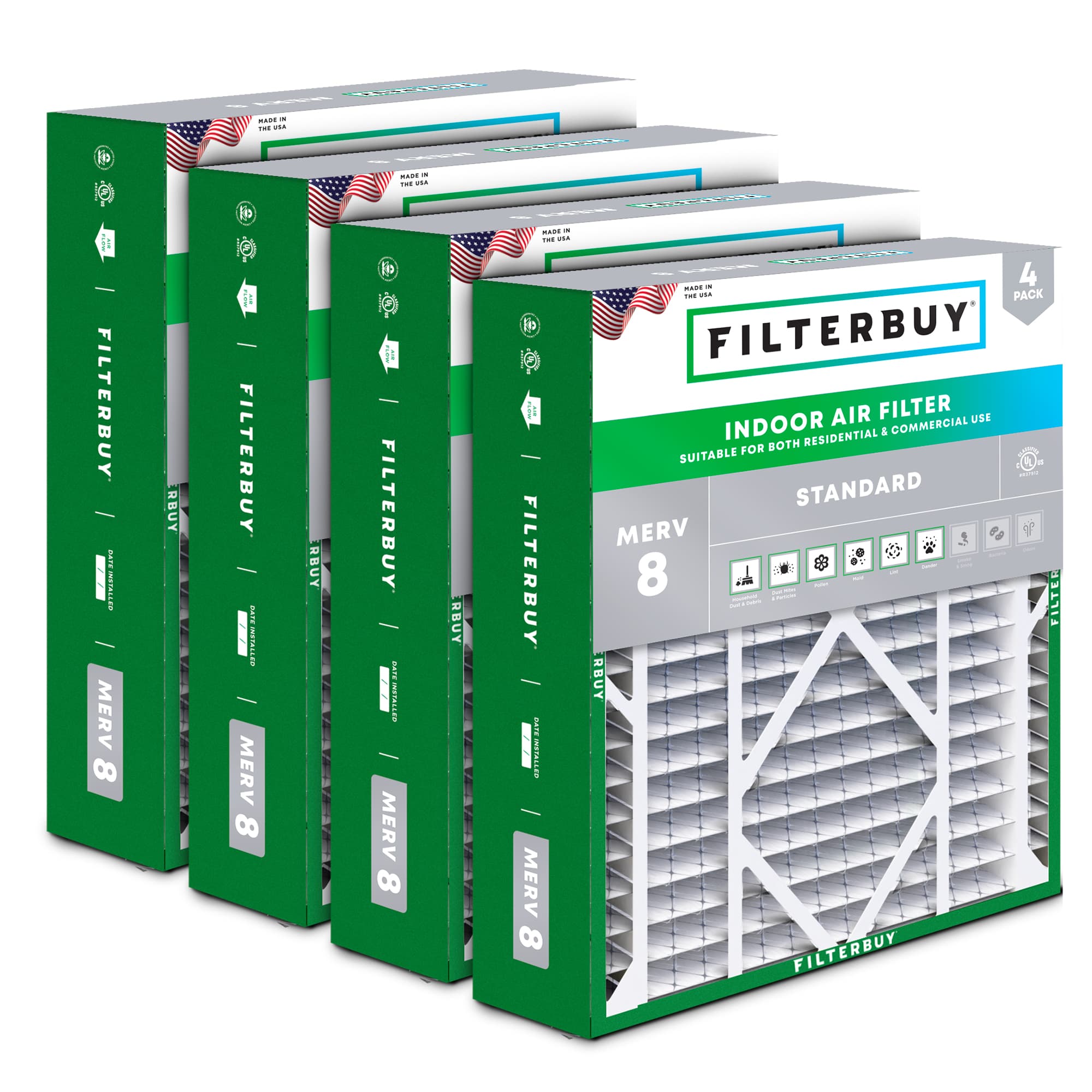
Tip: Ensure you buy the exact air filter size for your system. Certain brands have precise dimensions that only fit their specific models. See related filters
Actual Size: 23.63x24.69x4.25
 Free Delivery
  Factory-Direct Low Prices, Made in the USA
 Hassle-Free Returns & Free Exchanges
RESIDENTIAL AND/OR COMMERCIAL USE
Change Every 3 Months
Tip: Ensure you buy the exact air filter size for your system. Certain brands have precise dimensions that only fit their specific models. See related filters
Actual Size: 23.63x24.69x4.25
Free Delivery Factory-Direct Low Prices, Made in the USAHassle-Free Returns & Free ExchangesRESIDENTIAL AND/OR COMMERCIAL USE
Change Every 3 Months
Tip: Ensure you buy the exact air filter size for your system. Certain brands have precise dimensions that only fit their specific models. See related filters
Actual Size: 23.63x24.69x4.25
Free Delivery Factory-Direct Low Prices, Made in the USAHassle-Free Returns & Free ExchangesRESIDENTIAL AND/OR COMMERCIAL USE
Change Every 3 Months
At Filterbuy, we don't cut corners—we craft high-quality air filters right here in the USA and ship them to your doorstep for free. No delays, no gimmicks—just clean air, made easy. With thousands of five-star reviews and filters built for real life & every HVAC system, it's no wonder why over 4 million families trust Filterbuy.

Proudly Made In The USA

Fast, Free Shipping on Every Order

Premium Materials That Go The Distance

85,000+ 5-Star Reviews From Happy Customers

Save Up to 70% Per Filter with Packs


Measure length × width × depth with a tape measure to find the actual size.

Round up each dimension to the nearest whole number to get the nominal size. Example: 23.63x24.69x4.25 in → 24x25x5 nominal.

Search by nominal size on our site for the best fit.


5″ filters give you maximum filtration with minimal maintenance — lasting up to 12 months while handling higher MERV ratings without restricting airflow.
Sizing note:

If the filter you buy doesn't fit, we'll send you a better size.
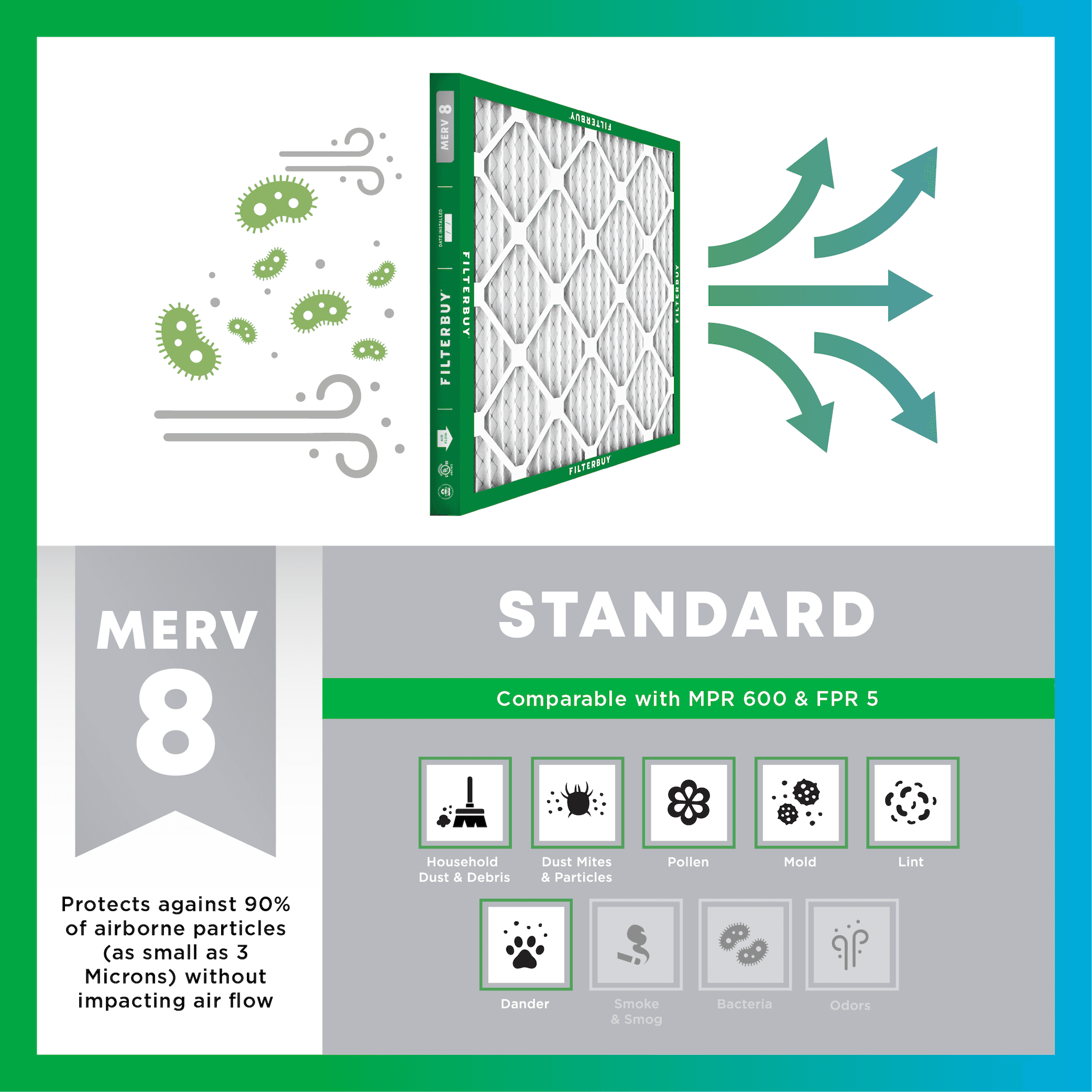
MERV stands for Minimum Efficiency Reporting Value—but don't let the technical name fool you. It's just a way to rate how well an air filter traps stuff like dust, pollen, pet dander, and smoke. The higher the MERV number, the more particles it catches—and the cleaner your air will be.

Comparable to:FPR: 4-7
MPR: 600-1000
 Dust & Debris
 Dust Mites & Particles
 Pollen
 Mold
Mold Lint
Lint Dander
Comparable to:FPR: 6-9
MPR: 1200-1550
Dust & DebrisDust Mites & ParticlesPollenMoldLintDander Smoke & Smog
Comparable to:FPR: 10
MPR: 1900-2800
Dust & DebrisDust Mites & ParticlesPollenMoldLintDanderSmoke & Smog Bacteria


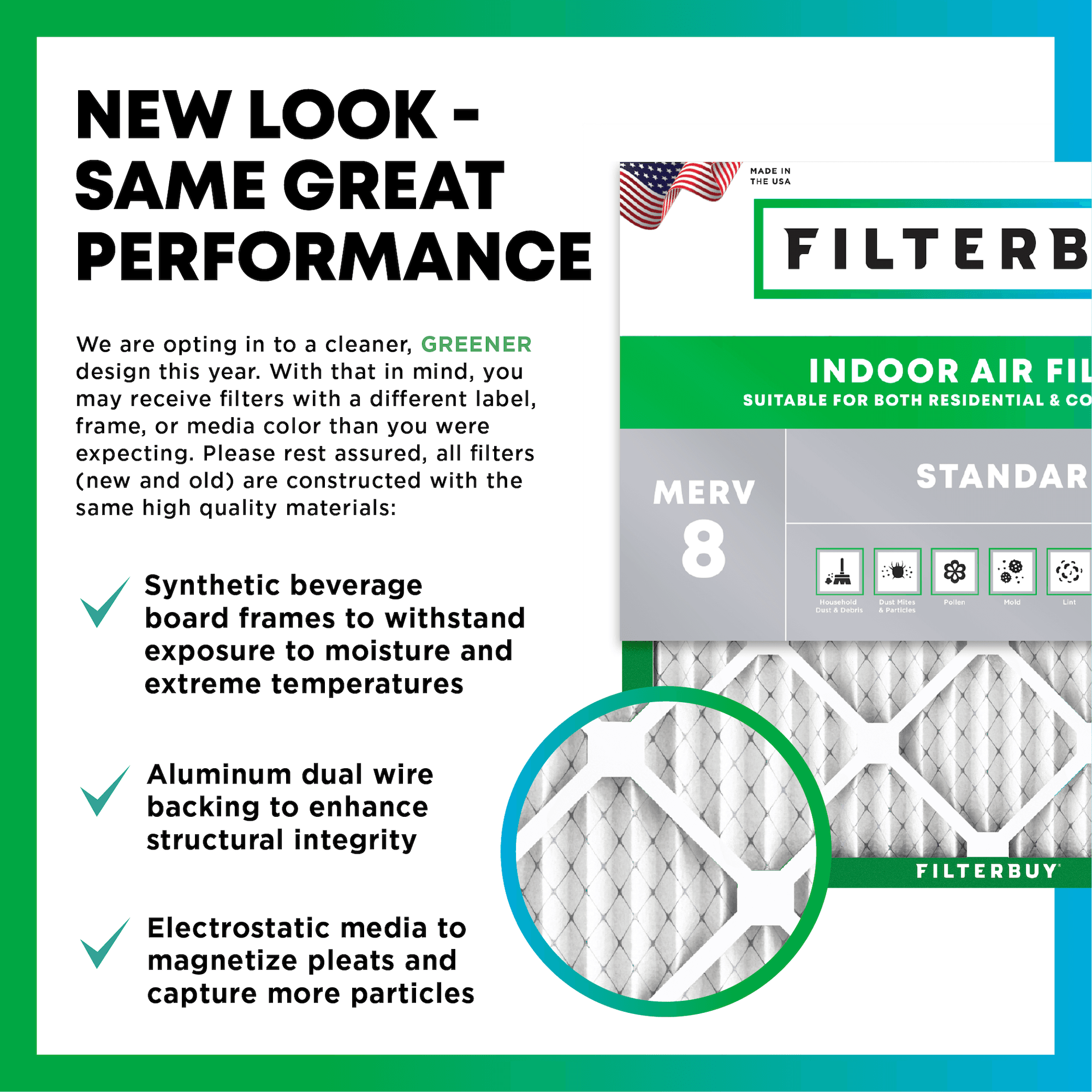
We build every Filterbuy filter to deliver reliable 90-day performance—thanks to smart design and premium materials that do the heavy lifting. Here's what makes the difference:
More pleats = more surface area to capture dust and debris, keeping your air cleaner longer.
Pleats are magnetized to attract and trap microscopic particles—like pet dander, pollen, and smoke.
Engineered to resist warping in extreme temperatures and high humidity.

A layer of metal reinforcement keeps pleats evenly spaced and structurally sound—no sagging, even at high airflow.
Assembled with care. Built to perform. Ships fast, free, and reliably from our U.S. facilities.

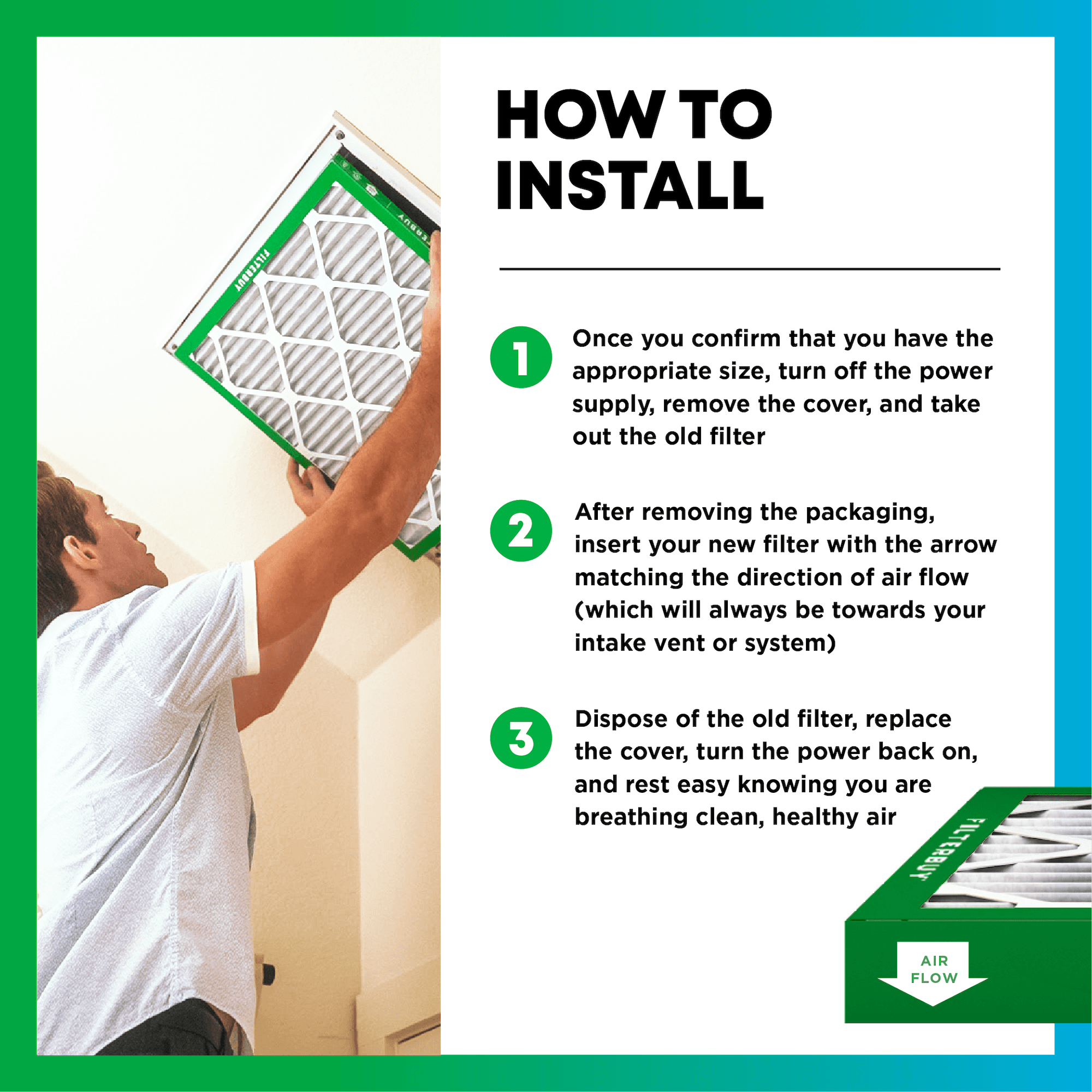
Turn Off Your HVAC SystemSafety first.

Remove The Old FilterLook for the airflow arrow and make note of the direction.

Slide In Your New FilterArrow should point toward the system (same direction as before).

Turn Your System Back OnAnd enjoy the fresh, clean air.

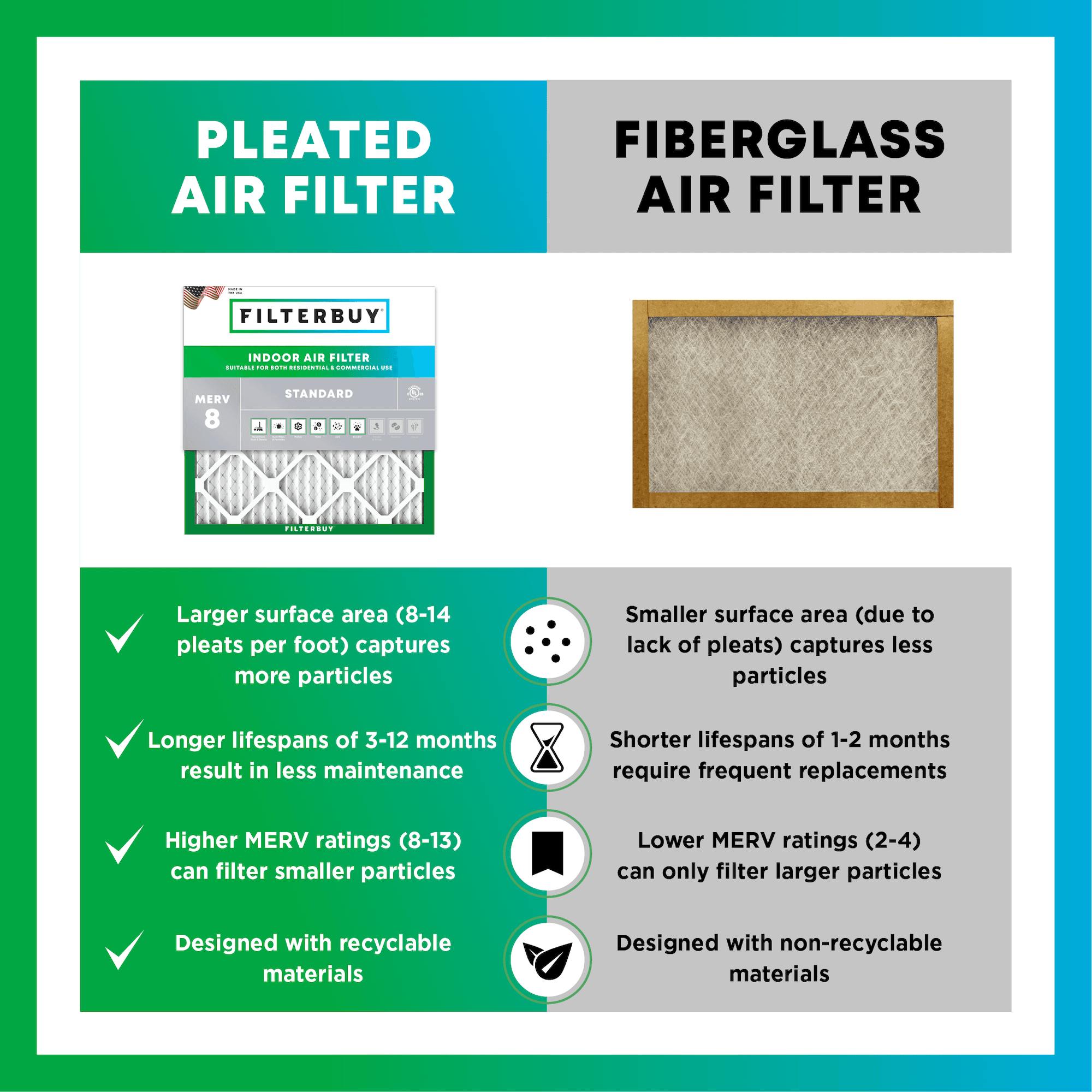
Not all air filters are created equal. Pleated filters don't just last longer—they actually clean your air better. Here's how they stack up:

Efficiency:
High (MERV 8–13) – Traps more particles
Lifespan:
90 days – Long-lasting performance
Air Quality:
Excellent – Cleaner, healthier air
Materials:
Recyclable and durable

Efficiency:
Low (MERV 4 or less) – Misses small stuff
Lifespan:
30 days or less – Replace often
Air Quality:
Minimal – Basic protection only
Materials:
Thin, flimsy, and not recyclable
Pleated filters are a no-brainer—more protection, less hassle, and better air for your home.
Changing your filter on time keeps your HVAC system running efficiently—and helps protect your lungs from dust, allergens, and airborne irritants. Here's how often to swap it out based on your needs:

For most homes without pets or special air quality concerns. Great for general upkeep and energy efficiency.

Shedding fur, dander, and allergy triggers can build up fast. Changing your filter every two months helps keep the air fresher and symptoms at bay.

For households affected by smoke, pollution, or respiratory conditions, monthly changes ensure maximum protection.

| Nominal Size | 24 x 25 x 5 inches |
| Actual Size | 23.63 x 24.69 x 4.25 inches |
| Filter Type | Pleated |
| Media | Electrostatically Charged |
| Frame | Beverage Board |
| MERV Ratings Available | 8, 11, 13 |
| Lifespan | Up to 12 Months |
| Origin | Made in USA |
We see it constantly: a homeowner with a BDP 24x25x5 system grabs MERV 13 filters because higher always feels like the safer call. What follows is a blower motor working against media it wasn’t rated for, energy costs that edge up for no real gain, and indoor air quality that doesn’t actually improve. After manufacturing filters for over a decade and serving more than two million households, we’ve confirmed something the product specs don’t say plainly enough: fit matters as much as filtration rating. For BDP whole-house systems, MERV 8 is the call we’d make every time. This page explains exactly why.
The MERV 8 24x25x5 BDP air filter (actual size: 23.75" x 24.75" x 4.38") is the filter we recommend for BDP whole-house media cabinet systems, including compatible Day & Night, Payne, and Carrier FILXXCAR-0024 housings. At MERV 8, it captures roughly 90% of airborne particles between 3 and 10 microns — dust, pollen, mold spores, and pet dander — without restricting the airflow BDP systems need to run efficiently. Replace every 90 days under normal conditions, every 60 days with pets, and every six weeks if anyone in the home has asthma or allergies.
The nominal size is 24x25x5 inches. The actual physical dimensions are 23.75” x 24.75” x 4.38”. Order by actual size, not the nominal label.
MERV 8 captures roughly 90% of airborne particles in the 3–10 micron range, including dust, pollen, mold spores, and pet dander.
For most BDP whole-house systems, MERV 8 gives you the filtration you need with the airflow your equipment requires.
Higher MERV ratings (11–13) increase media density and can restrict airflow in systems not rated for it — always check your owner’s manual before upgrading.
Standard replacement schedule: 90 days. With pets: 60 days. With asthma or allergy sufferers in the home: 6 weeks.
Compatible with BDP model MACPAK24, Day & Night, Payne, and Carrier housing FILXXCAR-0024.
Made in the USA, manufactured in Alabama, Pennsylvania, Texas, and Utah.
ASHRAE created the MERV scale (Minimum Efficiency Reporting Value) to give homeowners and HVAC professionals a consistent way to compare filter performance across brands and systems. The higher the rating, the smaller the particles a filter captures. MERV 8 lands in the middle of the residential range, and after more than a decade of manufacturing experience, we can say with confidence that’s where most BDP households need to be.
At MERV 8, your 24x25x5 BDP filter catches roughly 90% of airborne particles between 3 and 10 microns in size. That covers dust and lint, pollen, mold spores, pet dander, and dust mites — the pollutants most responsible for the respiratory symptoms your family notices on harder days. These particles are invisible to you. Your lungs register them anyway.
MERV 8 is comparable to MPR 600 and FPR 5. MERV 11 pushes capture to roughly 95% and adds smoke and smog filtration. MERV 13 reaches 98% and picks up bacteria and some virus-carrying particles. Each step up catches more and pushes harder against your blower. For BDP systems, that trade-off is what makes MERV 8 the right call.
BDP whole-house filtration systems (including sibling brands Day & Night and Payne) use a 5-inch media cabinet. That cabinet depth is deliberate: the extra surface area gives the filter room to work, extending filter life and reducing airflow restriction compared to a standard 1-inch filter in the same setup. BDP built these systems to move large air volumes continuously. Unrestricted airflow is how they stay efficient.
Static pressure is where MERV rating really matters. When filter media is too dense for the system (MERV 11 or MERV 13 in equipment that wasn’t rated for it), the blower motor pulls against resistance it wasn’t built to handle. Over time, that strain reduces efficiency, adds wear to mechanical components, and drives up your monthly energy costs. For BDP’s MACPAK24 and compatible systems, MERV 8 delivers the filtration that matters without creating the pressure drop that works against your equipment.
In our experience manufacturing filters for BDP-compatible systems over the past decade, MERV 8 is the most commonly ordered rating by a wide margin. Customers who run it report consistent system performance and solid indoor air quality. The data says the same thing.
If your home has multiple pets, significant allergy sufferers, or if your BDP system’s documentation confirms it handles higher-density media, MERV 11 is worth a look. Check your owner’s manual or talk to an HVAC technician before switching. The wrong media density doesn’t just reduce filtration efficiency. It shortens equipment lifespan and pushes energy costs higher over time.
What’s circulating through your ductwork right now isn’t just temperature-controlled air. Outdoor pollen carries in through gaps, mold spores release when humidity rises, your pets shed continuously, and dust mites live in every fabric surface in the house. A MERV 8 filter working properly stops these particles before they recirculate through your living areas — across the furniture, over the kitchen table, and into the bedrooms where your family sleeps.
For households with children, changing the filter on schedule is one of the most practical things a parent can do. Kids’ lungs are still developing, and sustained exposure to unfiltered particulates compounds over time. For families managing asthma, the stakes are higher still. Pollen, mold spores, and pet dander rank among the most common asthma triggers, and MERV 8 catches all of them.
If someone in your home manages asthma, we’ve put together a first-hand guide on conquering asthma triggers in your home that goes deeper on how indoor air quality connects to respiratory health and covers the steps beyond filter changes that actually move the needle.
Replacing a 24x25x5 BDP furnace filter takes under five minutes.
Turn off your HVAC system at the thermostat.
Find the media cabinet — typically mounted on your air handler or furnace where the return air duct connects.
Slide out the existing filter and note the airflow direction arrow on the frame.
Insert your new Filterbuy 24x25x5 MERV 8 filter with the arrow pointing toward the air handler.
Close the cabinet, restore power, and write down the installation date so you know when the next replacement is due.
Pro Tip: Our customer service team sees the same installation error more than any other: the filter goes in backward. The airflow arrow on the frame is not a suggestion. Follow it every time.
“The performance data from our BDP system customers tells the same story every time: pair MERV 8 with equipment that’s rated for it, and you get better long-term results and lower lifetime operating costs than going up a rating. The number isn’t everything. The fit is.”
— Filterbuy Team
These resources were curated by the Filterbuy team to help you dig into air filtration, indoor air quality, and what actually goes into choosing the right filter for your BDP system.
1. EPA — Indoor Air Quality
The EPA’s main hub for indoor air quality. It covers pollution sources, health effects, and practical guidance. If you want the most authoritative baseline on what’s in your home’s air and why it matters, start here.
Source: https://www.epa.gov/indoor-air-quality-iaq
2. EPA — The Inside Story: A Guide to Indoor Air Quality
An EPA deep-dive into the most common indoor pollutants — where they come from, what they do to your health, and what you can actually do about them. Especially useful if you have children, older adults, or respiratory conditions in your household.
Source: https://www.epa.gov/indoor-air-quality-iaq/inside-story-guide-indoor-air-quality
3. Wikipedia — Air Filter
A clear, neutral rundown of air filter types and the classification systems behind MERV, MPR, and FPR ratings. A solid starting point if you’re new to the rating scales or comparing options across manufacturers.
Source: https://en.wikipedia.org/wiki/Air_filter
4. ASHRAE — Standard 52.2
ASHRAE created the MERV rating standard and maintains it today. Standard 52.2 is the test methodology behind every MERV classification on the market, including ours. Understanding the source adds important context to any filter decision.
Source: https://www.ashrae.org
Publisher note: confirm the specific Standard 52.2 page URL on ashrae.org before publication.
5. CDC — Asthma Resources
The CDC’s asthma resource covers triggers, prevalence, and management strategies with solid data on how the condition affects American households. Essential reading for families where asthma shapes filtration decisions.
Source: https://www.cdc.gov/asthma/
6. Filterbuy — Conquer Asthma Triggers in Your Home
Our own guide to reducing the indoor air quality factors that drive asthma episodes at home, drawn from what we’ve learned manufacturing filters for households with respiratory concerns. Goes further than filter selection.
Source: https://filterbuy.com/resources/health-and-wellness/conquer-asthma-triggers-in-your-home/
7. U.S. Department of Energy — Heating and Cooling Efficiency
The Department of Energy’s practical guidance on heating and cooling efficiency, including how filter selection affects energy consumption, equipment lifespan, and long-term costs. Directly relevant to the MERV rating decision for media cabinet systems.
Source: https://www.energy.gov/energysaver/heat-and-cool
These numbers don’t need interpreting. They make the case for why consistent, quality filtration is a health decision, not just a maintenance one.
1. Americans spend approximately 90% of their time indoors, where concentrations of some pollutants are often 2 to 5 times higher than typical outdoor concentrations.
Source: U.S. EPA — https://www.epa.gov/report-environment/indoor-air-quality
2. EPA’s Total Exposure Assessment Methodology (TEAM) studies found levels of roughly a dozen common organic pollutants to be 2 to 5 times higher inside homes than outside — regardless of whether those homes were located in rural or highly industrialized areas.
Source: U.S. EPA — https://www.epa.gov/indoor-air-quality-iaq/inside-story-guide-indoor-air-quality
3. Under ASHRAE Standard 52.2 — the industry benchmark that defines the MERV classification system — a MERV 8 filter captures approximately 90% of particles in the 3–10 micron range under standardized test conditions.
Source: ASHRAE Standard 52.2 — https://www.ashrae.org
More filtration feels like the responsible call. We understand why. We build across the full MERV range, and we’ve watched homeowners choose MERV 13 when 8 was right and MERV 11 when 8 was what the system needed. The result is usually higher energy costs, more frequent replacements, and about the same indoor air quality as the correct filter would have delivered.
For most BDP whole-house systems, MERV 8 is the correct filter. It catches the everyday pollutants accumulating in your ductwork — pollen, mold spores, pet dander — without fighting the airflow engineering your equipment depends on. That’s not a positioning statement. That’s what a decade of manufacturing data and customer outcomes keeps confirming.
If your system is rated for higher-density media and your household has health needs that make MERV 11 or MERV 13 worth the trade-off, we manufacture those too. But for BDP systems under standard residential conditions, MERV 8 is where we’d put our money. And where we put our own filters.
Check the actual size printed on your current filter frame. The number to match is 23.75” x 24.75” x 4.38”.
Order by quantity. A multi-pack saves you up to 19% per filter and means you have a replacement ready when the 90 days are up.
Set a calendar reminder. 90 days from installation. 60 days with pets. 6 weeks if asthma or allergies are a factor.
If your BDP system supports it and your household warrants it, browse the MERV 11 and MERV 13 24x25x5 options to compare.
Visit the Filterbuy Resource Center for more on air quality, filter maintenance, and protecting the air your family breathes.
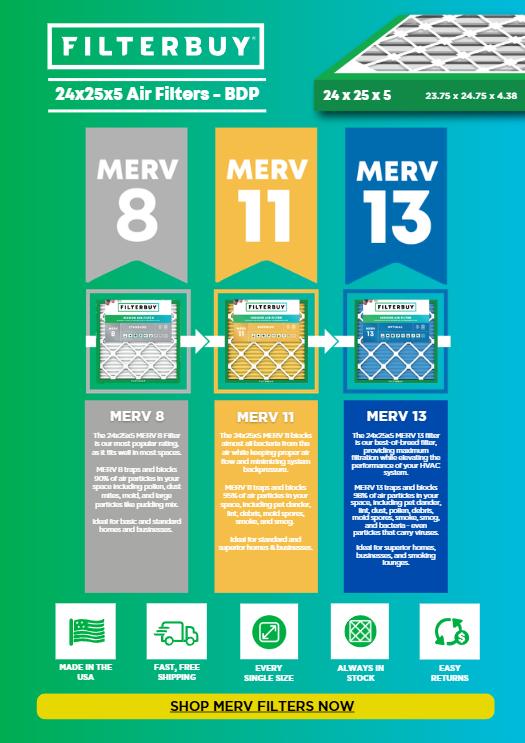
The nominal size is 24x25x5 inches — the rounded label printed on the filter frame. The actual dimensions are 23.75” x 24.75” x 4.38”. When ordering a replacement, match the actual size printed on your existing filter. The two numbers differ, and your media cabinet won’t accommodate the wrong fit.
Yes. MERV 8 captures roughly 90% of airborne particles in the 3–10 micron range: dust, pollen, mold spores, and pet dander. It maintains the airflow your BDP system was built to run on. For most BDP whole-house systems, it’s not a fallback rating. It’s the right one.
Particles in the 3–10 micron range: dust, lint, pollen, mold spores, pet dander, and dust mites. MERV 8 doesn’t catch smoke, bacteria, or ultrafine virus-carrying particles. If those are concerns for your household, MERV 11 or MERV 13 may be worth considering — check BDP compatibility before switching.
Every 90 days under normal conditions. Every 60 days if pets are in the home. Every six weeks if household members have asthma or allergies. By the time a filter looks dirty, it’s usually been underperforming for weeks.
Yes. It fits BDP model MACPAK24 and related Day & Night and Payne systems. It also fits Carrier housings FILXXCAR-0024, FILCCCAR0024, FILBBCAR0024, FILBBFTC0024, and FILCCFTC0024.
Order the Filterbuy 24x25x5 MERV 8 — American-made, precision-fit for your BDP system, and backed by more than 85,000 five-star reviews from homeowners who've made the same call. Buy a multi-pack and save up to 19% per filter, because protecting your family's air shouldn't take more than five minutes or more than one decision.

