Tip: Ensure you buy the exact air filter size for your system. Certain brands have precise dimensions that only fit their specific models. See related filters
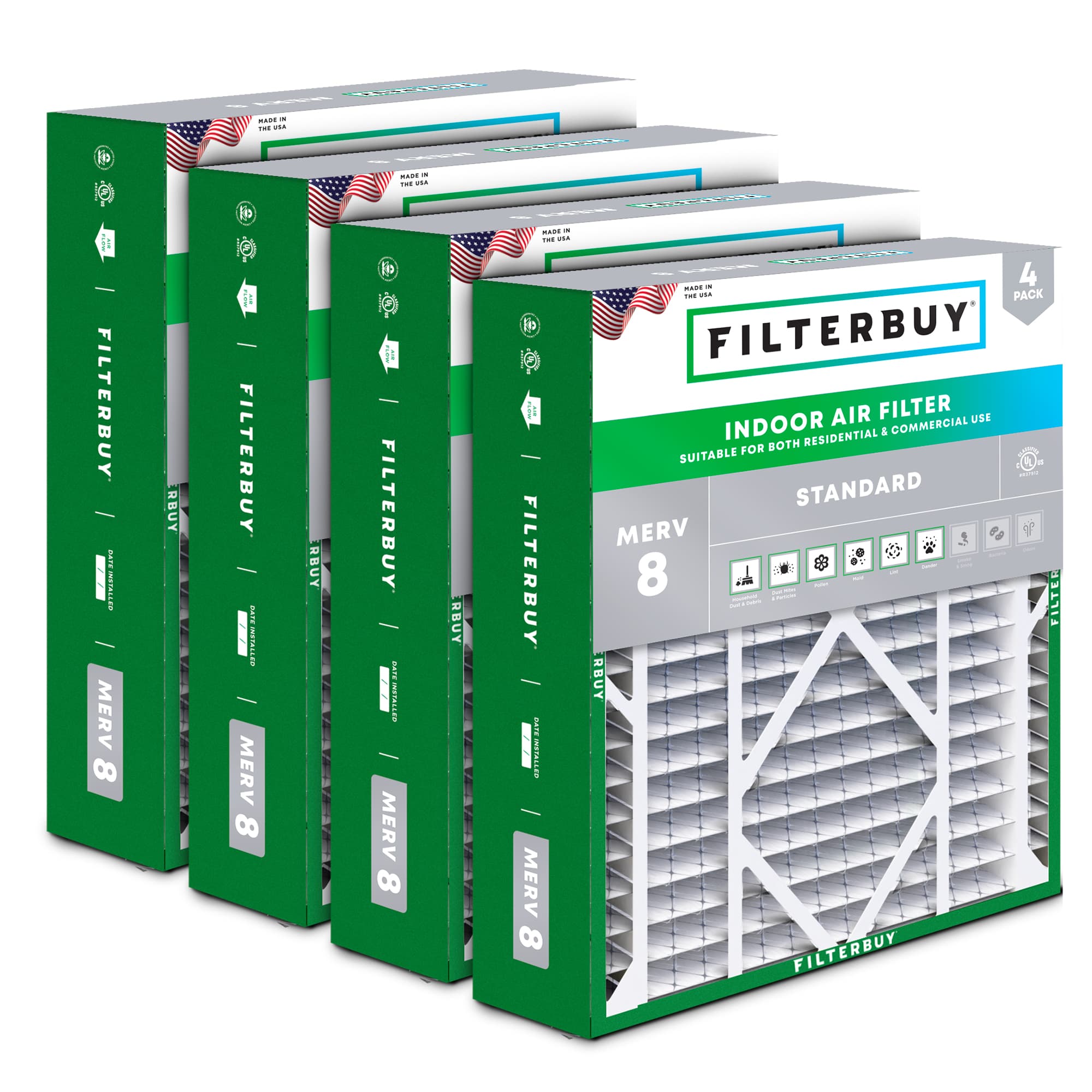
Actual Size: 23.75x24.75x4.38"
 Free Delivery
  Factory-Direct Low Prices, Made in the USA
 Hassle-Free Returns & Free Exchanges
RESIDENTIAL AND/OR COMMERCIAL USE
Change Every 3 Months
Tip: Ensure you buy the exact air filter size for your system. Certain brands have precise dimensions that only fit their specific models. See related filters
Actual Size: 23.75x24.75x4.38"
Free Delivery Factory-Direct Low Prices, Made in the USAHassle-Free Returns & Free ExchangesRESIDENTIAL AND/OR COMMERCIAL USE
Change Every 3 Months
Tip: Ensure you buy the exact air filter size for your system. Certain brands have precise dimensions that only fit their specific models. See related filters
Actual Size: 23.75x24.75x4.38"
Free Delivery Factory-Direct Low Prices, Made in the USAHassle-Free Returns & Free ExchangesRESIDENTIAL AND/OR COMMERCIAL USE
Change Every 3 Months
At Filterbuy, we don't cut corners—we craft high-quality air filters right here in the USA and ship them to your doorstep for free. No delays, no gimmicks—just clean air, made easy. With thousands of five-star reviews and filters built for real life & every HVAC system, it's no wonder why over 4 million families trust Filterbuy.

Proudly Made In The USA

Fast, Free Shipping on Every Order

Premium Materials That Go The Distance

85,000+ 5-Star Reviews From Happy Customers

Save Up to 70% Per Filter with Packs


Measure length × width × depth with a tape measure to find the actual size.

Round up each dimension to the nearest whole number to get the nominal size. Example: 23.75x24.75x4.38" in → 24X25X5 nominal.

Search by nominal size on our site for the best fit.


5″ filters give you maximum filtration with minimal maintenance — lasting up to 12 months while handling higher MERV ratings without restricting airflow.
Sizing note:

If the filter you buy doesn't fit, we'll send you a better size.
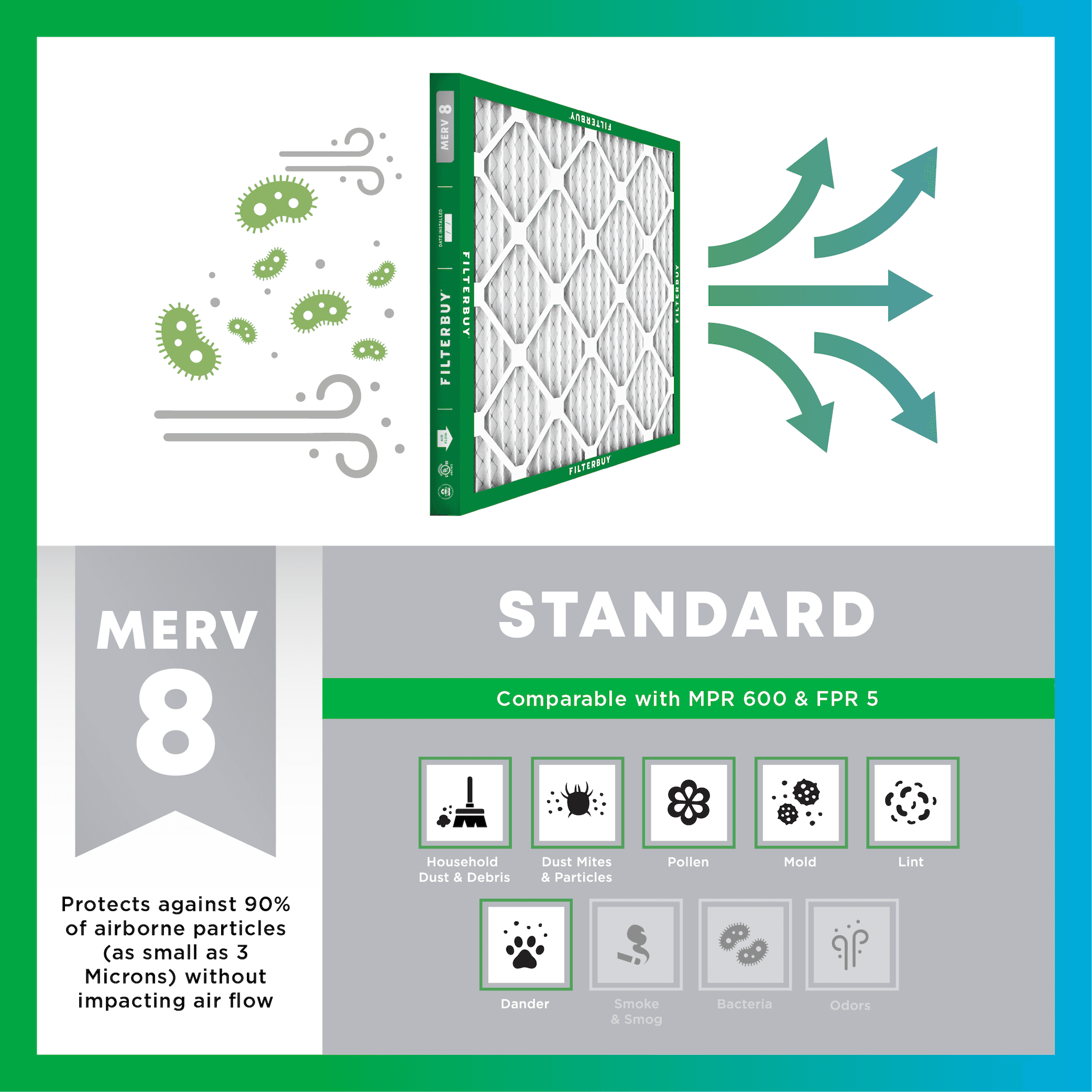
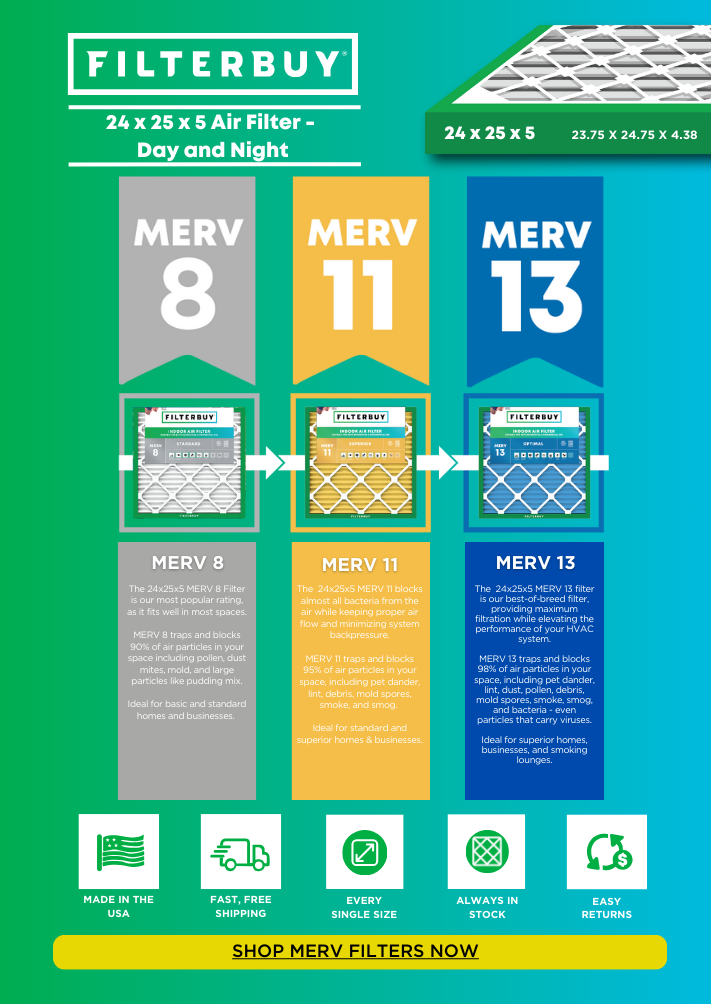
MERV stands for Minimum Efficiency Reporting Value—but don't let the technical name fool you. It's just a way to rate how well an air filter traps stuff like dust, pollen, pet dander, and smoke. The higher the MERV number, the more particles it catches—and the cleaner your air will be.

Comparable to:FPR: 4-7
MPR: 600-1000
 Dust & Debris
 Dust Mites & Particles
 Pollen
 Mold
Mold Lint
Lint Dander
Comparable to:FPR: 6-9
MPR: 1200-1550
Dust & DebrisDust Mites & ParticlesPollenMoldLintDander Smoke & Smog
Comparable to:FPR: 10
MPR: 1900-2800
Dust & DebrisDust Mites & ParticlesPollenMoldLintDanderSmoke & Smog Bacteria


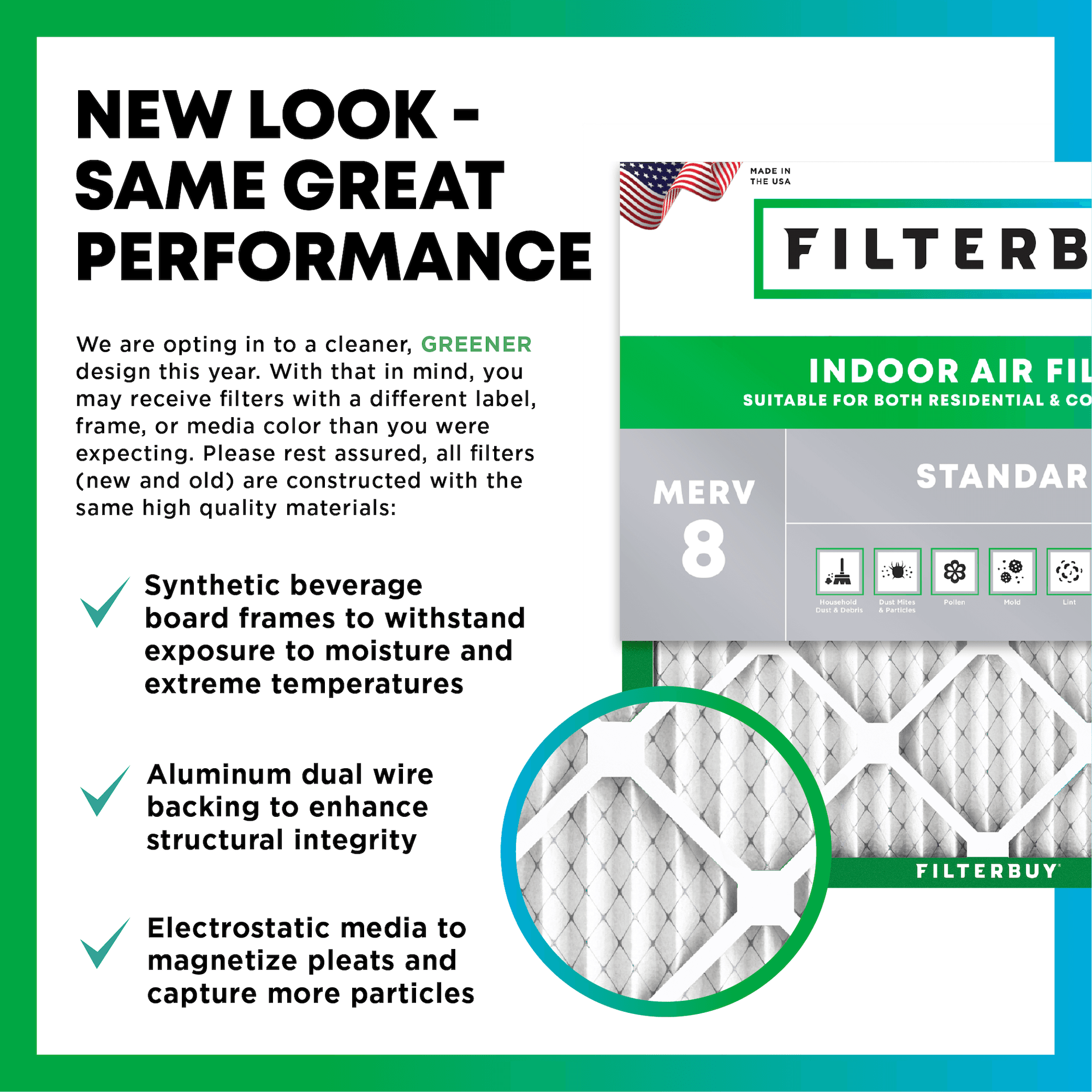
We build every Filterbuy filter to deliver reliable 90-day performance—thanks to smart design and premium materials that do the heavy lifting. Here's what makes the difference:
More pleats = more surface area to capture dust and debris, keeping your air cleaner longer.
Pleats are magnetized to attract and trap microscopic particles—like pet dander, pollen, and smoke.
Engineered to resist warping in extreme temperatures and high humidity.

A layer of metal reinforcement keeps pleats evenly spaced and structurally sound—no sagging, even at high airflow.
Assembled with care. Built to perform. Ships fast, free, and reliably from our U.S. facilities.

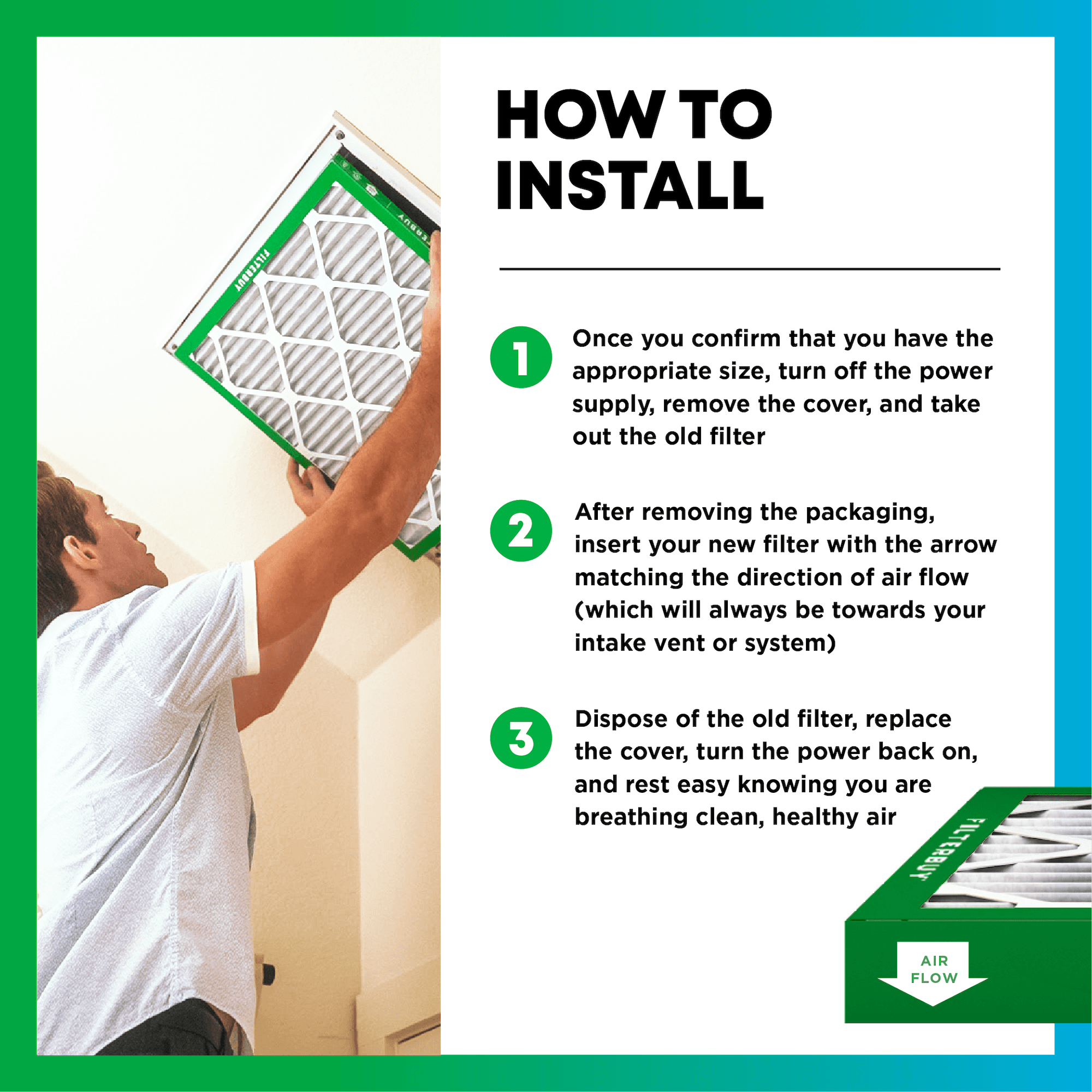
Turn Off Your HVAC SystemSafety first.

Remove The Old FilterLook for the airflow arrow and make note of the direction.

Slide In Your New FilterArrow should point toward the system (same direction as before).

Turn Your System Back OnAnd enjoy the fresh, clean air.

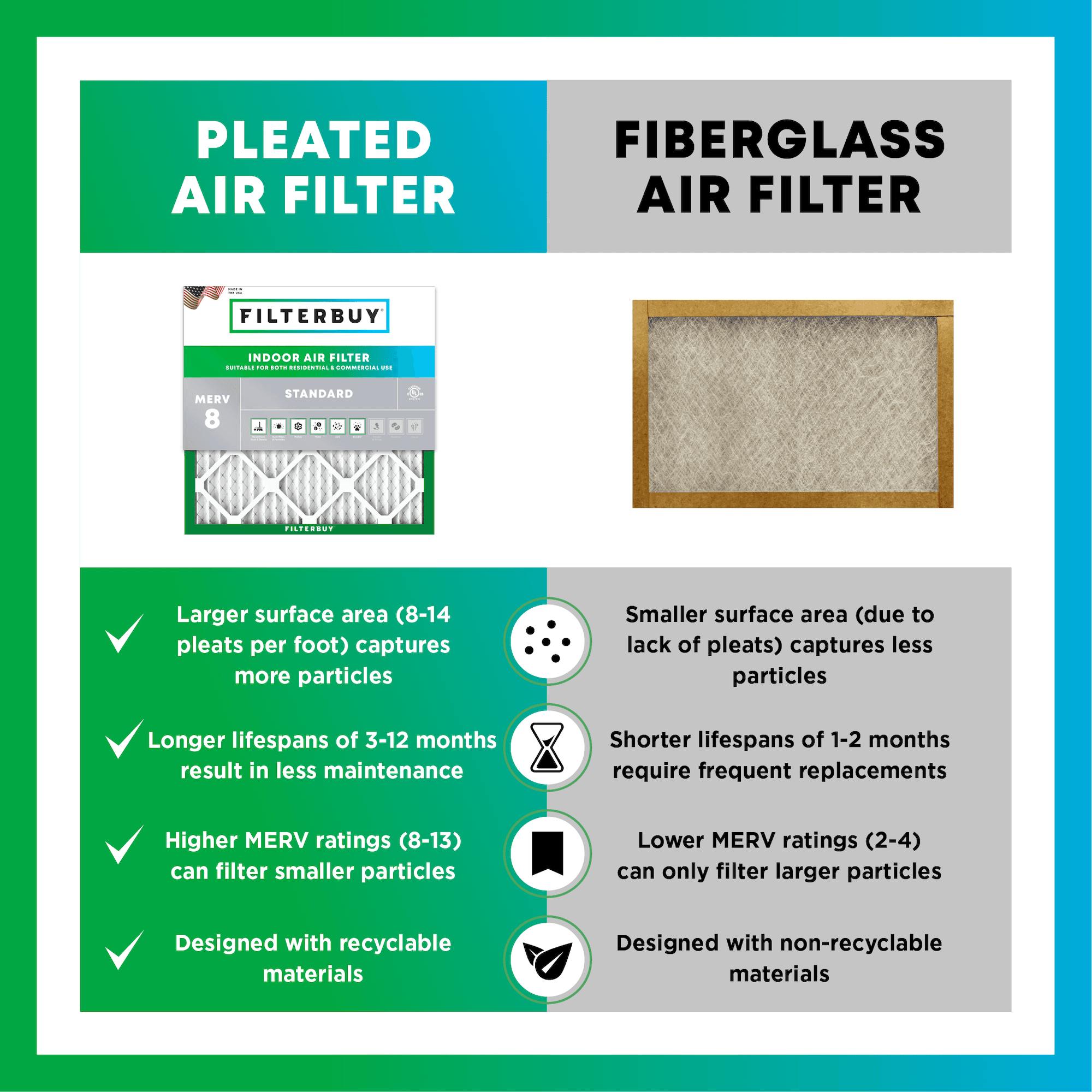
Not all air filters are created equal. Pleated filters don't just last longer—they actually clean your air better. Here's how they stack up:

Efficiency:
High (MERV 8–13) – Traps more particles
Lifespan:
90 days – Long-lasting performance
Air Quality:
Excellent – Cleaner, healthier air
Materials:
Recyclable and durable

Efficiency:
Low (MERV 4 or less) – Misses small stuff
Lifespan:
30 days or less – Replace often
Air Quality:
Minimal – Basic protection only
Materials:
Thin, flimsy, and not recyclable
Pleated filters are a no-brainer—more protection, less hassle, and better air for your home.
Changing your filter on time keeps your HVAC system running efficiently—and helps protect your lungs from dust, allergens, and airborne irritants. Here's how often to swap it out based on your needs:

For most homes without pets or special air quality concerns. Great for general upkeep and energy efficiency.

Shedding fur, dander, and allergy triggers can build up fast. Changing your filter every two months helps keep the air fresher and symptoms at bay.

For households affected by smoke, pollution, or respiratory conditions, monthly changes ensure maximum protection.

| Nominal Size | 24X25X5 |
| Actual Size | 23.75 x 24.75 x 4.38" inches |
| Filter Type | Pleated |
| Media | Electrostatically Charged |
| Frame | Beverage Board |
| MERV Ratings Available | 8, 11, 13 |
| Lifespan | Up to 12 Months |
| Origin | Made in USA |
Dust mite debris measures roughly 10 microns. Mold spores run 3 to 12. Both travel through your Day and Night system every time the blower kicks on, landing on surfaces, recirculating through vents, reaching the living space if the filter doesn’t stop them first.
After manufacturing air filters for over a decade and supplying more than two million households, we’ve learned to tell the difference between a filter that fills a slot and one that actually cleans what passes through it. The 5-inch thick media format gives this 24x25x5 MERV 8 filter enough surface area to capture biological debris at real-world airflow rates without adding the static pressure penalty that makes your Day and Night system work harder than it was designed to.
What follows covers what MERV 8 catches, what it won’t, and whether this is the right filter for your household.
The Filterbuy MERV 8 24x25x5 is a thick media air filter built for Day and Night HVAC systems and their OEM equivalents — BDP, Carrier, Goodman, and Amana — that use a dedicated 24x25x5 media filter cabinet.
At MERV 8, it captures particles in the 3–10 micron range at 70% minimum efficiency. That covers the household irritants that accumulate fastest: dust mite debris, mold spores, pollen, pet dander, and lint. Particles smaller than 1 micron — viruses, tobacco smoke, ultrafine combustion byproducts — pass through MERV 8 media.
The 5-inch thick media format gives this filter significantly more surface area than a standard 1-inch MERV 8, which extends its service life to 6–12 months per change cycle without adding the static pressure that strains your blower.
Key facts at a glance:
• Nominal size: 24x25x5
• Actual size: 23.5" x 24.5" x 4.375"
• MERV rating: MERV 8
• Captures: Dust mite debris, mold spores, pollen, pet dander, lint (3–10 microns)
• Does not capture: Viruses, smoke, ultrafine combustion particles (under 1 micron)
• Change interval: Every 6–12 months
• Compatible systems: Day and Night, BDP, Carrier, Goodman, Amana (24x25x5 media cabinet required)
This filter requires a dedicated media cabinet. It will not fit a standard 1-inch return air slot.
• MERV 8 captures dust mite debris, mold spores, pet dander, and pollen — particles in the 3–10 micron range.
• Viruses, tobacco smoke, and ultrafine combustion byproducts are all smaller than 1 micron and pass straight through MERV 8 media.
• The 5-inch thick media format typically lasts 6–12 months, versus 1–3 months for a standard 1-inch MERV 8.
• Actual dimensions are 23.5” x 24.5” x 4.375”. Confirm your media cabinet accepts those measurements before ordering.
• This filter fits Day and Night, BDP, Carrier, Goodman, and Amana systems with a 24x25x5 media cabinet.
• MERV 8 delivers real filtration without the airflow restriction that comes with higher-rated filters.
• Households with severe allergies, multiple pets, or a smoker may be better served by MERV 11 or MERV 13.
MERV stands for Minimum Efficiency Reporting Value, the testing standard ASHRAE developed to measure how well an air filter traps particles. Ratings run from 1 to 20. At MERV 8, the filter captures particles in the 3–10 micron range at 70% minimum efficiency — covering the dust mite, fecal matter, mold spores, pollen, lint, and pet dander that accumulate in most homes.
Particles smaller than 1 micron are a separate problem. Viruses, tobacco smoke, and ultrafine combustion byproducts move through MERV 8 media without restriction. If those are a primary concern in your home, MERV 11 or MERV 13 is the right recommendation. We’d rather tell you that directly than have you replace this filter in three months wondering why it didn’t address the problem.
A standard 1-inch MERV 8 and a 24x25x5 thick media MERV 8 carry the same efficiency rating. The similarity stops there. Inside the 5-inch format, significantly more pleated surface area captures more particulate per air pass and holds more dust before resistance climbs high enough to restrict airflow.
A well-maintained 24x25x5 MERV 8 in a Day and Night system typically runs 6 to 12 months between changes. The 1-inch version in that same system needs replacing every 1 to 3 months. Fewer change-outs means fewer gaps in filtration, and fewer moments when an overloaded filter is working against your blower motor instead of cleaning your air.
Thick media filters require a dedicated media cabinet — a 24x25x5 filter won’t fit a standard 1-inch return air slot. If your system has a media cabinet labeled 24x25x5, this filter is the correct size. If you’re unsure, the label inside your filter compartment will confirm it.
This 24x25x5 MERV 8 filter fits Day and Night HVAC systems and their OEM equivalents (BDP, Carrier, Goodman, and Amana) when those systems use a 24x25x5 media filter cabinet. The nominal size, 24x25x5, is what the cabinet is designed to accept. Actual filter dimensions are 23.5” x 24.5” x 4.375”.
Day and Night systems with a 24x25x5 media cabinet are built for an extended change schedule. For guidance on timing based on your specific home and system, see how often you really need to change your HVAC filter. Pets, occupancy level, regional air quality, and how hard the system runs all affect how quickly the filter loads.
• Nominal Size: 24x25x5
• Actual Size: 23.5” x 24.5” x 4.375”
• MERV Rating: MERV 8
• Filter Depth: 5 inches (thick media format)
• Capture Range: Particles 3–10 microns (dust mite debris, mold spores, pollen, pet dander, lint)
• Does Not Capture: Particles under 1 micron (viruses, smoke, ultrafine combustion byproducts)
• Recommended Change Interval: Every 6–12 months
• Compatible Systems: Day and Night, BDP, Carrier, Goodman, Amana (24x25x5 media cabinet required)
“The 24x25x5 format gives us more to work with during manufacturing — the additional pleat depth lets us optimize media density in a way a 1-inch filter simply can’t, and that directly translates to longer filter life and more consistent performance. What we’ve tracked in real homes confirms the thick media holds its rated efficiency well past what the nominal dimensions suggest.”
— Filterbuy Team
The EPA’s foundational overview explains the primary sources of indoor air pollution, from building materials and combustion byproducts to biological contaminants like mold and pet dander, and identifies air filtration as one of three recommended strategies for reducing indoor exposure. Worth reading before you make any filter decision.
Source: epa.gov — Introduction to Indoor Air Quality
ASHRAE Standard 52.2 is the testing methodology behind every MERV rating in use today. This FAQ, from the organization that wrote the standard, explains how filter efficiency is measured, what the scale represents, and why a filter’s rated efficiency matters to both air quality and system performance.
Source: ashrae.org — Filtration and Disinfection FAQ
NIEHS identifies the biological allergens most commonly found in household dust — dust mites, mold, pet dander, and cockroach debris — and explains how they accumulate in bedding, furniture, and carpeting. Knowing what your filter is working against gives the MERV 8 capture range real meaning.
Source: niehs.nih.gov — Dust Mites and Cockroaches
Particulate matter indoors doesn’t come from one source. Cooking, combustion appliances, candles, tobacco smoke, biological debris, and outdoor infiltration all contribute. This EPA resource explains each category and why upgrading your HVAC filter is one of the most direct actions a homeowner can take to lower PM exposure.
Source: epa.gov — Sources of Indoor Particulate Matter
The EPA’s consumer guide explains how HVAC filters work, what MERV ratings mean in real-world terms, and how to evaluate whether your system can handle a higher-efficiency filter. It covers medium-efficiency filters in the MERV 7–13 range — the category this 24x25x5 MERV 8 filter sits in.
Source: epa.gov — Guide to Air Cleaners in the Home
The Asthma and Allergy Foundation of America covers the biology and lifecycle of dust mites, the allergens they produce, and the environmental control strategies that reduce exposure, including air filtration. Dust mite debris falls in the 3–10 micron range this filter captures, making this a useful reference for allergy-affected households.
Source: aafa.org — Dust Mite Allergy
The EPA’s homeowner guide covers sources, health effects, and control strategies for the full range of indoor air pollutants. The sections on biological contaminants, particulate matter, and ventilation strategies help homeowners understand when MERV 8 fits the household’s needs and when a higher-rated filter is the better call.
Source: epa.gov — The Inside Story: A Guide to Indoor Air Quality
1. Americans spend approximately 90 percent of their time indoors, where concentrations of some pollutants are often 2 to 5 times higher than typical outdoor levels.
That number has shaped how we approach every filter we manufacture. The home isn’t a refuge from air quality problems — for most people, it’s where exposure is highest and lasts the longest. A filter running inside your Day and Night system isn’t a passive accessory. It’s the primary line of defense against the particulate load that builds up around your family every day.
Source: epa.gov — Indoor Air Quality: EPA’s Report on the Environment
2. Research from NIEHS found that more than 45 percent of U.S. homes have bedding with dust mite allergen concentrations at levels associated with the development of allergies.
The fecal particles and shed body parts that make dust mite allergens so potent sit squarely in the 3–10 micron range a MERV 8 captures. Homeowners switching from MERV 1–4 to MERV 8 consistently cite dust mite allergen reduction as the primary reason for the upgrade. The 45 percent figure confirms why that concern is well-founded.
Source: niehs.nih.gov — Bedroom Dust Contains Unexpectedly High Levels of Allergens
3. A national allergen survey found that more than 90 percent of participating homes had three or more detectable allergens, and 73 percent had at least one allergen present at elevated levels.
Most homes aren’t dealing with one allergen. Mold spores, pet dander, and pollen accumulate together in the air your system circulates, not one at a time. The MERV 8 24x25x5 filter addresses that combined load across the 3–10 micron range, which is why this format works well for households managing everyday allergen exposure rather than a single, identified trigger.
Source: niehs.nih.gov — Asthma, Allergy, and the Environment
MERV 8 in a 24x25x5 thick media format is one of the most practical filtration choices for most Day and Night households. But that word “most” matters.
For homes with one or two occupants, no known respiratory conditions, and minimal dust sources, MERV 8 delivers effective filtration and keeps the system running efficiently. The extended change interval is a practical advantage for anyone who wants consistent protection without frequent maintenance.
Households with moderate allergy sufferers, a pet or two, or known mold problems will find MERV 8 covers the bulk of the allergen load. It won’t address fine particles below 1 micron. A MERV 11 is worth considering in those situations — it captures particles down to 1 micron and often makes a measurable difference for allergy-sensitive occupants.
Where someone in the home has severe asthma, multiple pets, or a smoker is part of the household, MERV 13 is the rating we’d recommend. It reaches particles as small as 0.3 microns, including fine combustion byproducts. The trade-off is a higher static pressure drop. Confirm your Day and Night system can handle MERV 13 before switching.
The 24x25x5 MERV 8 Day and Night compatible filter is a sound, practical choice. Make sure what it solves matches what your household actually needs.
1. Confirm your system uses a media cabinet, not a 1-inch return air slot. The 24x25x5 filter won’t fit a standard 1-inch slot.
2. Open the filter compartment and check the label. Confirm it reads 24x25x5.
3. Note the actual dimensions before ordering: 23.5” x 24.5” x 4.375”. Nominal size and actual size are different.
4. Consider your household’s allergen load. Multiple pets, a smoker, or a severe respiratory condition may call for MERV 11 or MERV 13.
5. Set a change reminder for 6 months. If the filter looks heavily loaded at that point, shorten your cycle. If it’s moderately used, extend to 12 months.
A: A MERV 8 filter captures particles in the 3–10 micron size range at a minimum efficiency of 70%. That includes:
• Dust mite fecal matter and body fragments
• Mold spores (most common household varieties)
• Pollen from trees, grass, and weeds
• Pet dander from dogs, cats, and other furry animals
• Lint, dust, and coarse atmospheric particles
It does not capture tobacco smoke, viruses, or particles smaller than 1 micron. Those require a MERV 11 or MERV 13 filter.
A: The 24x25x5 MERV 8 filter is compatible with Day and Night systems and their OEM equivalents (BDP, Carrier, Goodman, Amana) that use a dedicated 24x25x5 media filter cabinet. It won’t fit a standard 1-inch filter slot. Check the label inside your filter compartment. If it reads 24x25x5, you have the right system for this filter.
A: In most homes, a 24x25x5 MERV 8 filter runs 6 to 12 months before it needs replacing. Homes with pets, heavy foot traffic, nearby construction, or high pollen regions may need changes closer to the 6-month mark. Low-occupancy homes with no pets and good outdoor air quality often reach 12 months. Check the filter at the 6-month point. Visual inspection is the most reliable guide.
A: The nominal size is 24x25x5, the size listed on the cabinet label and used for ordering. The actual physical dimensions are 23.5” x 24.5” x 4.375”. Filters are manufactured slightly undersized to fit snugly into their labeled slots. Ordering by nominal size (24x25x5) gives you the correct filter.
A: MERV 8 is a safe rating for most residential HVAC systems, including Day and Night equipment. The 5-inch thick media format produces a lower static pressure drop than a standard 1-inch MERV 8 of equivalent efficiency, because the greater surface area means air doesn’t have to push as hard through any single section of the media. Airflow restriction becomes a concern at MERV 13 and above. At that point, checking with your system manufacturer is advisable.
The MERV 8 24x25x5 Day and Night air filter that guards your home's air without overworking your system is the straightforward upgrade your family's air quality deserves. Order yours from Filterbuy today and get the exact size, manufactured to fit, shipped directly to your door.

