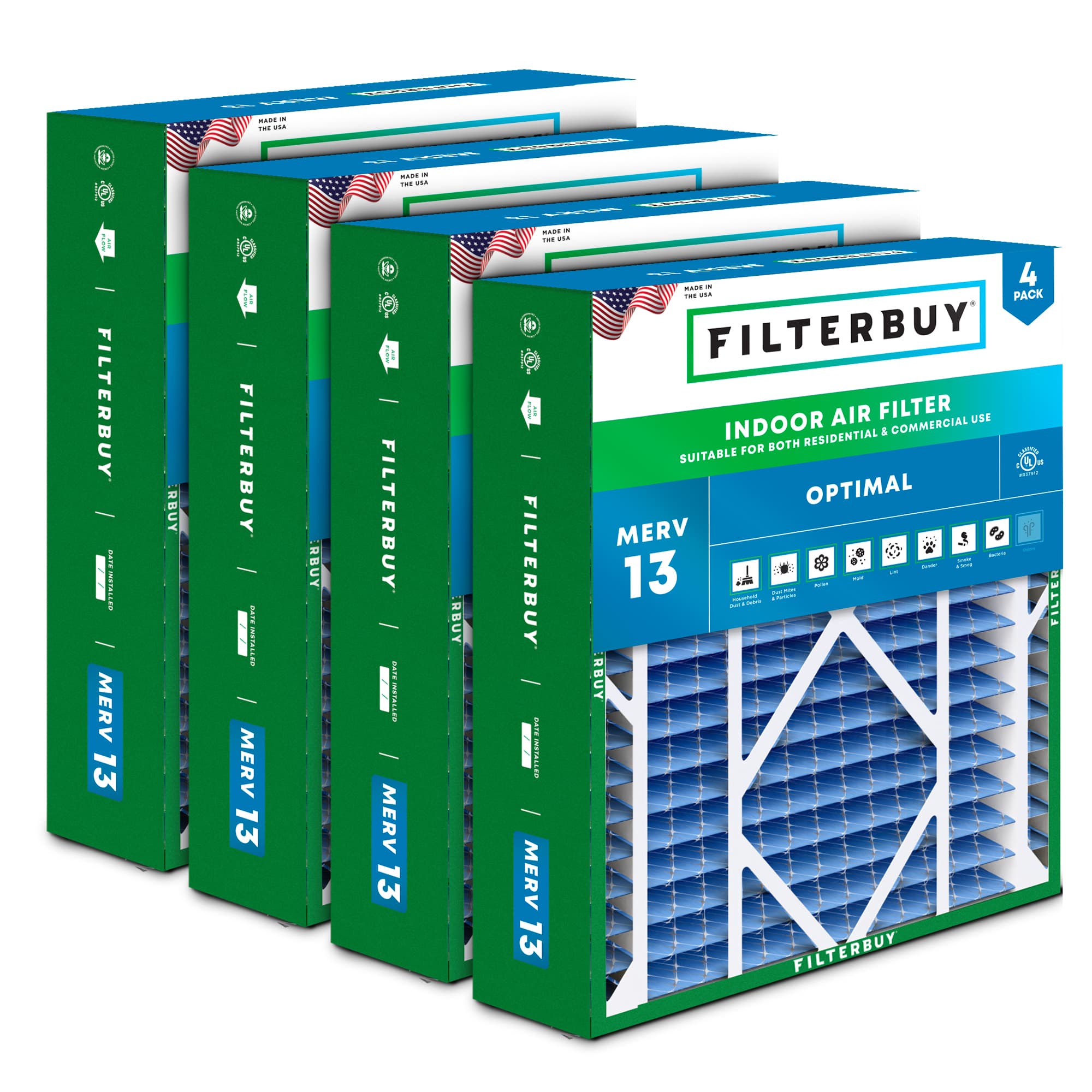
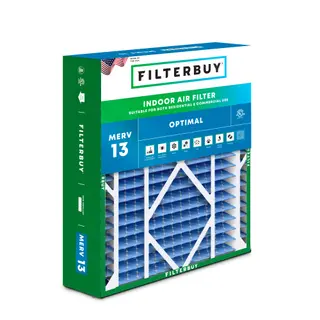
Tip: Ensure you buy the exact air filter size for your system. Certain brands have precise dimensions that only fit their specific models. See related filters
Actual Size: 23.75x24.75x4.38"
 Free Delivery
  Factory-Direct Low Prices, Made in the USA
 Hassle-Free Returns & Free Exchanges
RESIDENTIAL AND/OR COMMERCIAL USE
Change Every 3 Months
Tip: Ensure you buy the exact air filter size for your system. Certain brands have precise dimensions that only fit their specific models. See related filters
Actual Size: 23.75x24.75x4.38"
Free Delivery Factory-Direct Low Prices, Made in the USAHassle-Free Returns & Free ExchangesRESIDENTIAL AND/OR COMMERCIAL USE
Change Every 3 Months
Tip: Ensure you buy the exact air filter size for your system. Certain brands have precise dimensions that only fit their specific models. See related filters
Actual Size: 23.75x24.75x4.38"
Free Delivery Factory-Direct Low Prices, Made in the USAHassle-Free Returns & Free ExchangesRESIDENTIAL AND/OR COMMERCIAL USE
Change Every 3 Months
At Filterbuy, we don't cut corners—we craft high-quality air filters right here in the USA and ship them to your doorstep for free. No delays, no gimmicks—just clean air, made easy. With thousands of five-star reviews and filters built for real life & every HVAC system, it's no wonder why over 4 million families trust Filterbuy.

Proudly Made In The USA

Fast, Free Shipping on Every Order

Premium Materials That Go The Distance

85,000+ 5-Star Reviews From Happy Customers

Save Up to 70% Per Filter with Packs


Measure length × width × depth with a tape measure to find the actual size.

Round up each dimension to the nearest whole number to get the nominal size. Example: 23.75x24.75x4.38" in → 24x25x5 nominal.

Search by nominal size on our site for the best fit.


5″ filters give you maximum filtration with minimal maintenance — lasting up to 12 months while handling higher MERV ratings without restricting airflow.
Sizing note:

If the filter you buy doesn't fit, we'll send you a better size.
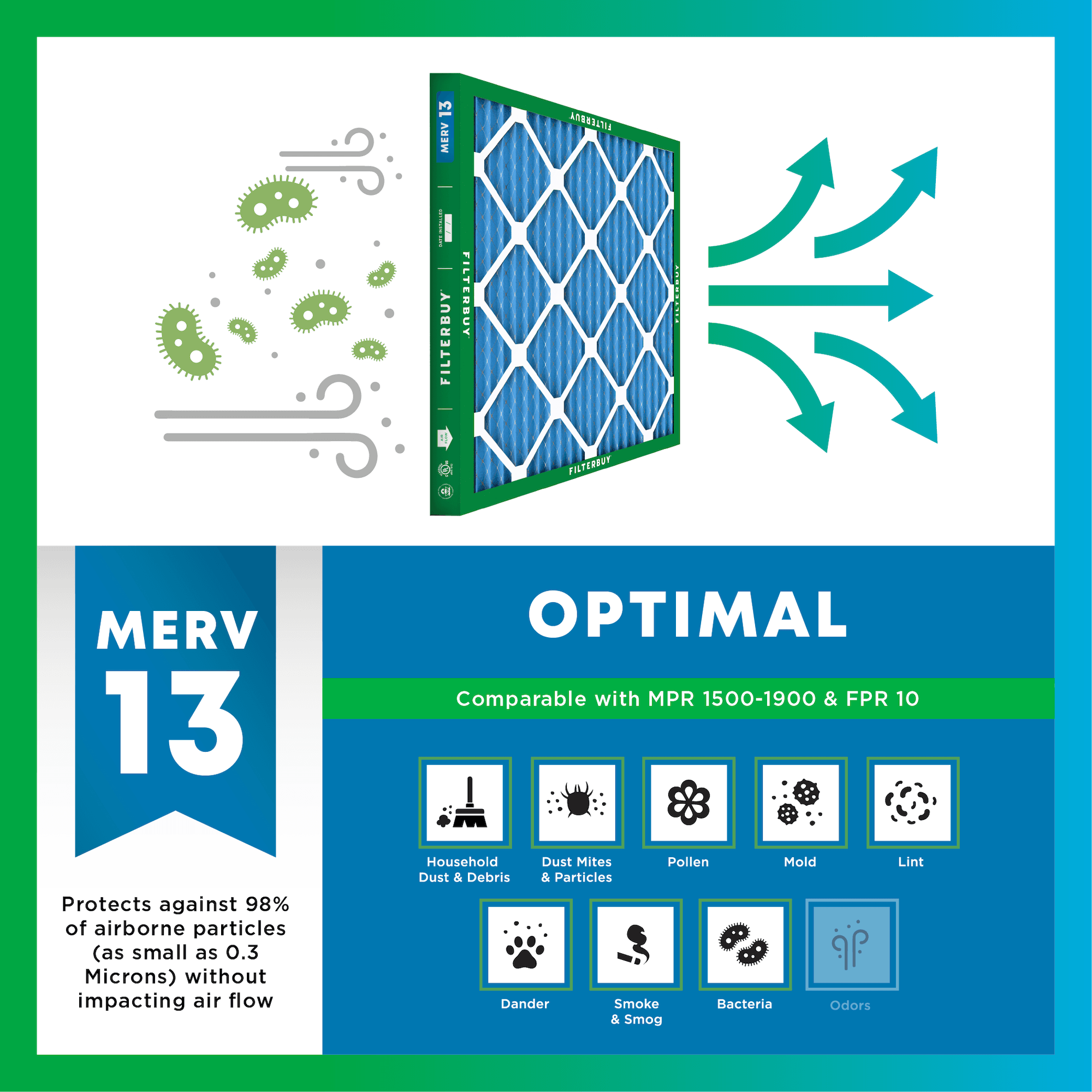
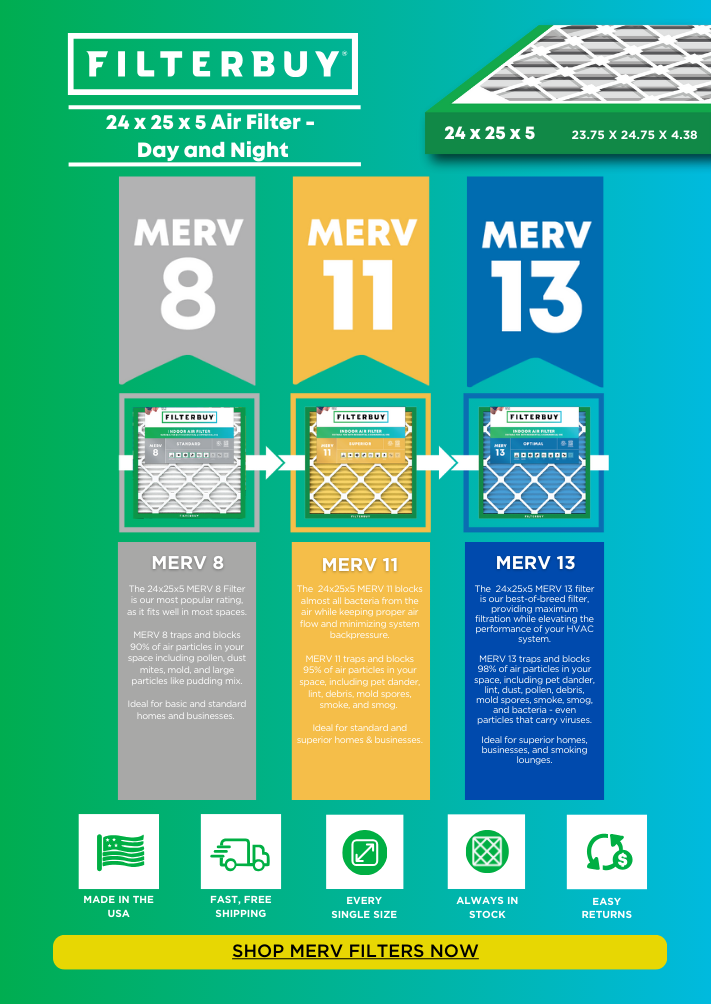
MERV stands for Minimum Efficiency Reporting Value—but don't let the technical name fool you. It's just a way to rate how well an air filter traps stuff like dust, pollen, pet dander, and smoke. The higher the MERV number, the more particles it catches—and the cleaner your air will be.

Comparable to:FPR: 4-7
MPR: 600-1000
 Dust & Debris
 Dust Mites & Particles
 Pollen
 Mold
Mold Lint
Lint Dander
Comparable to:FPR: 6-9
MPR: 1200-1550
Dust & DebrisDust Mites & ParticlesPollenMoldLintDander Smoke & Smog
Comparable to:FPR: 10
MPR: 1900-2800
Dust & DebrisDust Mites & ParticlesPollenMoldLintDanderSmoke & Smog Bacteria


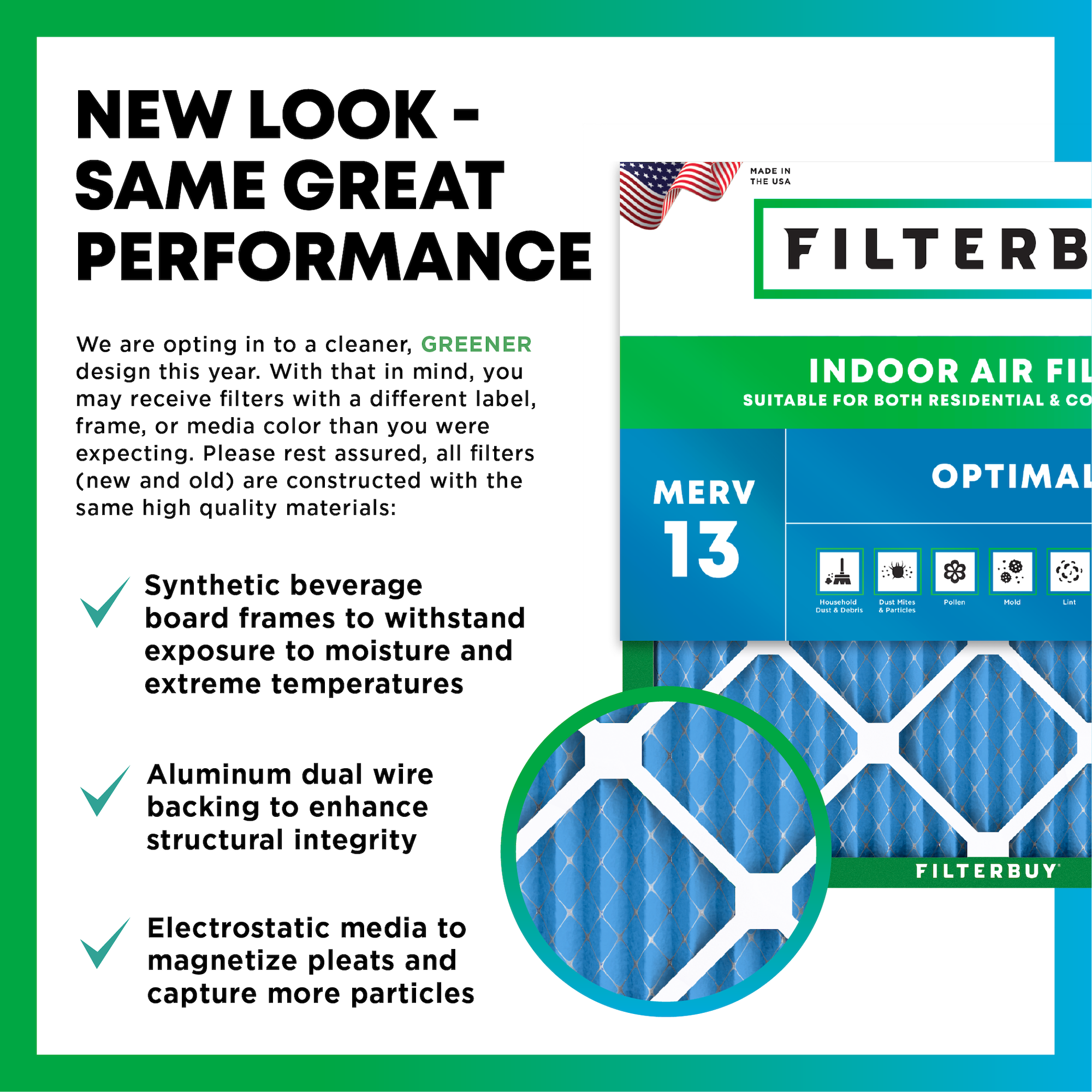
We build every Filterbuy filter to deliver reliable 90-day performance—thanks to smart design and premium materials that do the heavy lifting. Here's what makes the difference:
More pleats = more surface area to capture dust and debris, keeping your air cleaner longer.
Pleats are magnetized to attract and trap microscopic particles—like pet dander, pollen, and smoke.
Engineered to resist warping in extreme temperatures and high humidity.

A layer of metal reinforcement keeps pleats evenly spaced and structurally sound—no sagging, even at high airflow.
Assembled with care. Built to perform. Ships fast, free, and reliably from our U.S. facilities.

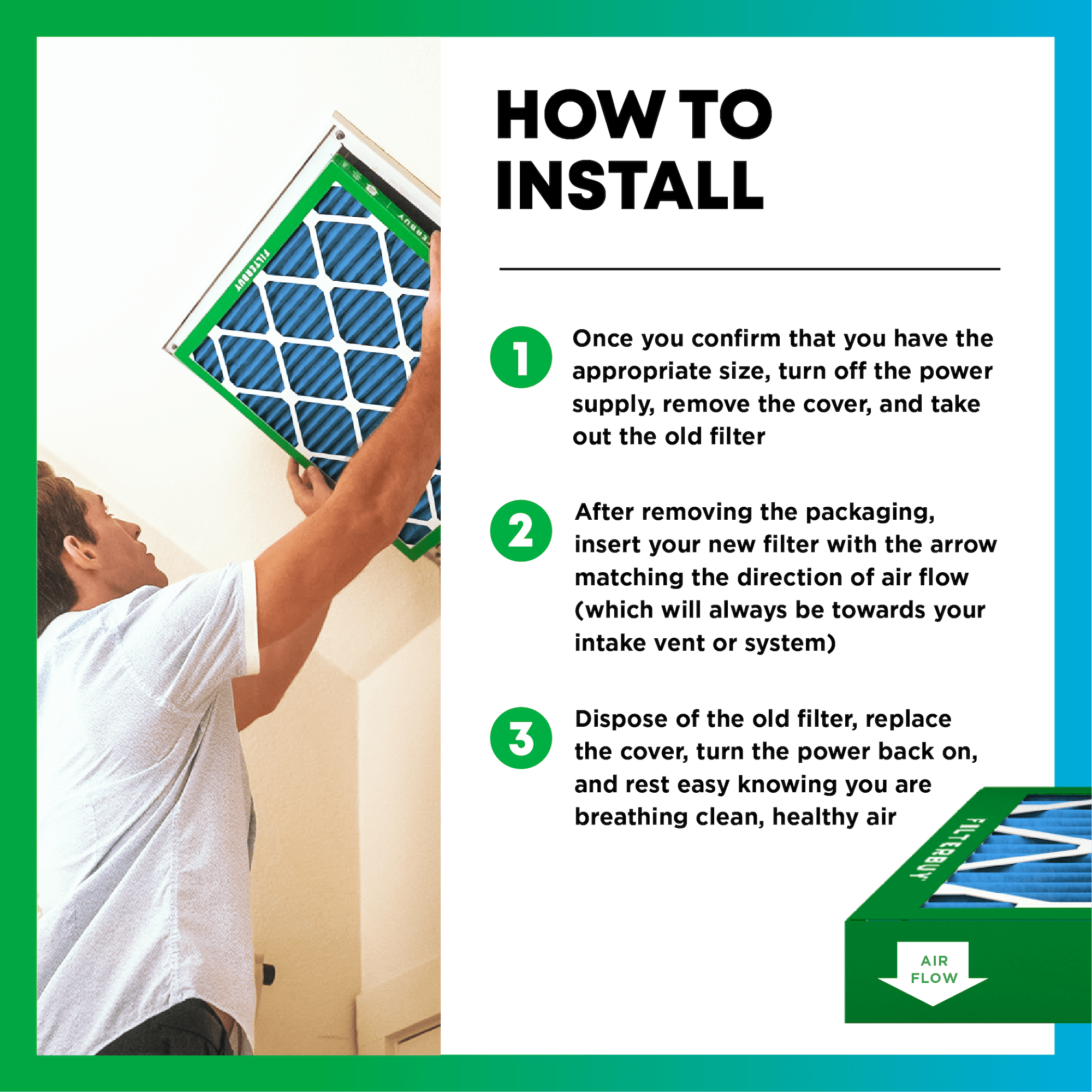
Turn Off Your HVAC SystemSafety first.

Remove The Old FilterLook for the airflow arrow and make note of the direction.

Slide In Your New FilterArrow should point toward the system (same direction as before).

Turn Your System Back OnAnd enjoy the fresh, clean air.

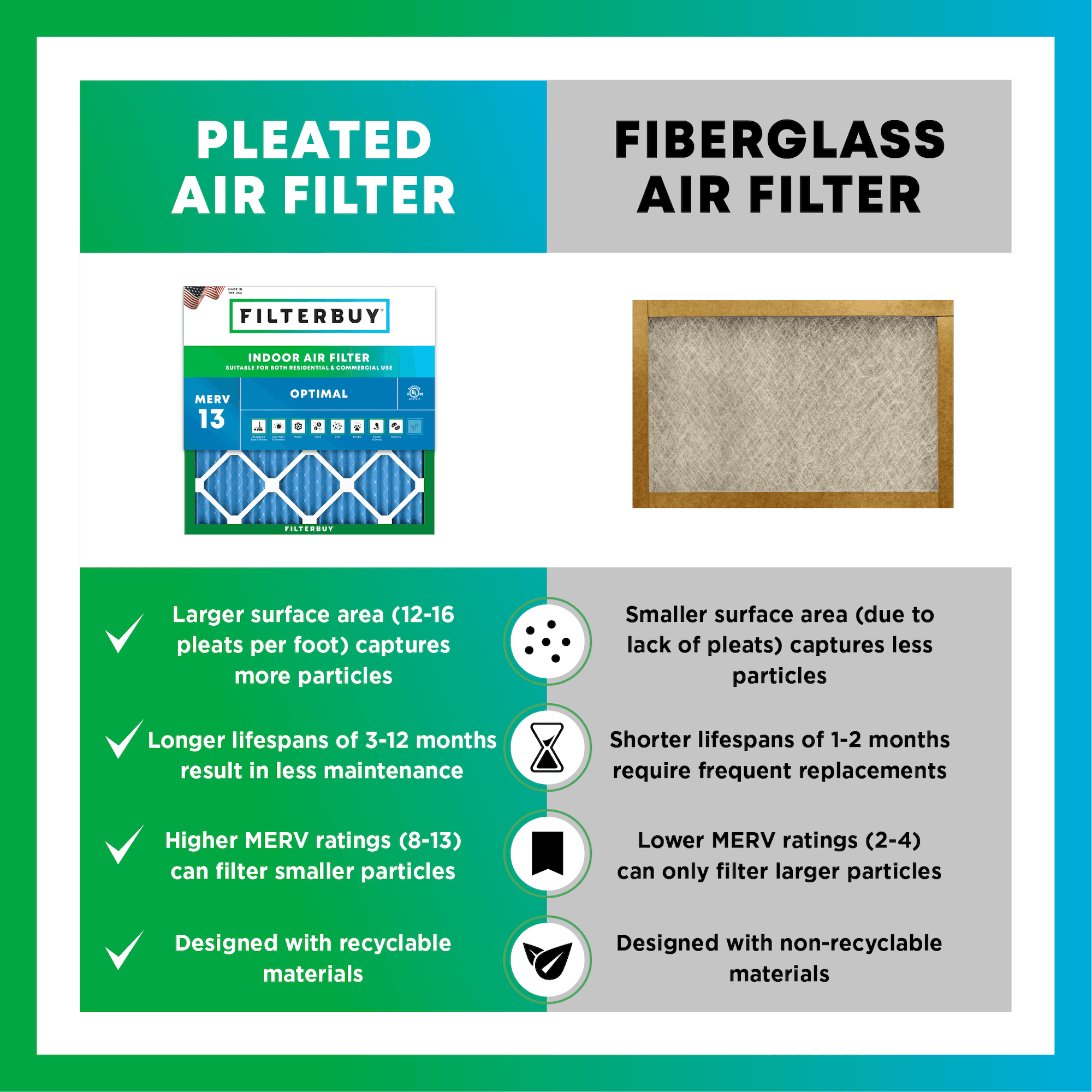
Not all air filters are created equal. Pleated filters don't just last longer—they actually clean your air better. Here's how they stack up:

Efficiency:
High (MERV 8–13) – Traps more particles
Lifespan:
90 days – Long-lasting performance
Air Quality:
Excellent – Cleaner, healthier air
Materials:
Recyclable and durable

Efficiency:
Low (MERV 4 or less) – Misses small stuff
Lifespan:
30 days or less – Replace often
Air Quality:
Minimal – Basic protection only
Materials:
Thin, flimsy, and not recyclable
Pleated filters are a no-brainer—more protection, less hassle, and better air for your home.
Changing your filter on time keeps your HVAC system running efficiently—and helps protect your lungs from dust, allergens, and airborne irritants. Here's how often to swap it out based on your needs:

For most homes without pets or special air quality concerns. Great for general upkeep and energy efficiency.

Shedding fur, dander, and allergy triggers can build up fast. Changing your filter every two months helps keep the air fresher and symptoms at bay.

For households affected by smoke, pollution, or respiratory conditions, monthly changes ensure maximum protection.

| Nominal Size | 24 x 25 x 5 inches |
| Actual Size | 23.75 x 24.75 x 4.38" inches |
| Filter Type | Pleated |
| Media | Electrostatically Charged |
| Frame | Beverage Board |
| MERV Ratings Available | 8, 11, 13 |
| Lifespan | Up to 12 Months |
| Origin | Made in USA |
Your 24x25x5 Day and Night furnace air filter is doing two jobs, and most homeowners only give it credit for one. After manufacturing filters for over a decade, we've watched this pattern repeat across thousands of households: the filter gets evaluated as an equipment component, changed when it turns gray, and given no further thought, even as its MERV 13 rated media works through every cycle to pull fine dust, mold spores, pollen, pet dander, smoke particles, and respiratory droplet nuclei out of the air your family actually breathes.
Five inches of pleated, electrostatically charged synthetic media gives MERV 13 a meaningfully different capability than a 1-inch filter at the same rating. More surface area slows particle loading, which extends the time between replacements. Each air molecule also stays in contact with the media longer, and that contact time is precisely what improves fine particle capture at this filtration level. The result isn't just cleaner equipment. It's cleaner air for the people who live there.
A 24x25x5 MERV 13 air filter is a 5-inch thick media replacement filter designed for Day and Night HVAC systems. It captures airborne particles between 1.0 and 3.0 microns — including fine dust, mold spores, pollen, pet dander, smoke particles, and respiratory droplet nuclei — across five inches of pleated, electrostatically charged synthetic media.
Key facts:
• MERV 13 is the EPA's recommended minimum rating for capturing fine particles of greatest health concern
• 24x25x5 refers to the filter's nominal dimensions in inches: 24 wide, 25 tall, 5 inches deep
• Day and Night compatibility means this filter fits the factory-designated thick media slot in Day and Night furnaces and air handlers
• 5-inch depth delivers more filtration surface area than a standard 1-inch filter, which extends service life and maintains efficiency longer between replacements
• Replacement interval is typically every 9 to 12 months under normal household conditions
This filter protects both the HVAC equipment and the people inside the home. Households with allergy sufferers, asthma, pets, young children, or older adults benefit most from the MERV 13 rating.
• MERV 13 is the EPA's recommended minimum for capturing fine particles of greatest health concern, including those in the 1.0 to 3.0 micron range.
• A 24x25x5 thick media filter carries significantly more filtration surface area than a 1-inch filter at the same MERV rating, which means longer filter life and lower airflow resistance.
• Day and Night designs its HVAC systems to accept 5-inch deep media filters, but verify static pressure compatibility before switching from a lower-rated replacement.
• The households that benefit most from MERV 13 filtration include those with allergy sufferers, asthma patients, young children, older adults, and pets.
• Replace your MERV 13 filter on schedule (typically every 6 to 12 months in a 5-inch format) to maintain efficiency and prevent pressure buildup.
• This filter works by capturing particles as air passes through the pleated media. It emits nothing back into your home, which makes it one of the most cost-effective air quality improvements a homeowner can make.
A 1-inch MERV 13 and a 24x25x5 MERV 13 share a rating but not a performance profile. Filter depth sets the available surface area, and surface area controls how long any particle stays in contact with the media. In a 5-inch format, that contact window is substantially longer. The filter also holds far more captured material before a replacement is needed, which keeps filtration efficiency strong across a much longer service interval than a thin filter can manage.
Day and Night designs the 24x25x5 slot specifically for thick media filters. The equipment can handle a higher-resistance replacement without straining the blower, but that tolerance has limits. Before switching from a lower MERV-rated filter, check your system documentation or ask a technician to confirm the unit's rated static pressure. Most modern Day and Night systems handle MERV 13 without modification, but no two installations are identical.
MERV 13 targets the particle sizes most closely linked to respiratory health, specifically the 1.0 to 3.0 micron range. Particles in this band are small enough to reach the lower airways but large enough for a properly rated air filter to capture mechanically. Anyone in your home managing asthma, seasonal allergies, or a chronic respiratory condition will feel the difference most during peak seasons, when outdoor particle concentrations spike and infiltration pushes more of them inside. If airborne pathogens are your primary concern, our resource on the best filter for viruses walks through the full specification picture.
"After manufacturing MERV 13 media through thousands of production runs, we've learned that pleat count and spacing in a 5-inch filter matter as much as the media rating itself — pack them too tightly and you sacrifice the surface area advantage that makes the thick format worth choosing. Getting that geometry right is what keeps the filter performing at its rated efficiency through the full service cycle, not just the first few weeks after installation."
The EPA explains how Minimum Efficiency Reporting Value ratings work across the full 1 to 20 scale, which particle sizes each range addresses, and why MERV 13 represents the threshold for capturing fine particles of greatest health concern. It's the right starting point for any homeowner comparing filter ratings before making a purchase decision.
Source: https://www.epa.gov/indoor-air-quality-iaq/what-merv-rating
The EPA's Guide to Air Cleaners in the Home covers MERV ratings in the context of real residential HVAC systems, including what to do when you're unsure whether your system fan can support a higher-efficiency filter. It confirms that most furnaces can accommodate MERV 13 when you replace the filter on schedule, and that MERV 13 filters must hit at least 50 percent removal efficiency for the smallest particles in their rated range.
Source: https://www.epa.gov/indoor-air-quality-iaq/guide-air-cleaners-home
This EPA resource directly addresses MERV 13 filtration in the context of protecting household members from airborne particles, including viruses. It recommends upgrading to at least MERV 13, or the highest-rated filter your system can accommodate, and notes that running the system fan for longer periods extends protection between cycles. It's one of the clearest federal-level endorsements of MERV 13 for residential use.
The National Institute of Environmental Health Sciences documents the full range of health effects linked to indoor air pollutants, from respiratory disease to cardiovascular risk. It notes that indoor concentrations of certain pollutants have increased in recent decades and that most Americans spend the overwhelming majority of their time inside. Knowing what's in household air is the first step toward addressing it with the right filtration.
Source: https://www.niehs.nih.gov/health/topics/agents/indoor-air
The EPA's Indoor Air Filtration Fact Sheet documents how MERV 13 to 16 rated filters can reduce indoor particulate concentrations by as much as 95 percent. During wildfire events, when outdoor PM2.5 concentrations spike and infiltrate homes, a thick media filter at MERV 13 is among the most practical household defenses available. The resource also covers when lower-rated filters fall short and how to assess whether your current setup is keeping pace.
Source: https://www.epa.gov/sites/default/files/2018-11/documents/indoor_air_filtration_factsheet-508.pdf
The American Lung Association catalogs the full range of indoor air pollutants, including combustion byproducts, mold, dust mites, pet dander, and volatile organic compounds, and explains the respiratory mechanisms through which each affects lung health. This resource helps homeowners connect filter specifications to the actual particle types circulating in their living space.
Source: https://www.lung.org/clean-air/indoor-air/indoor-air-pollutants
The EPA's indoor environment guide provides actionable steps homeowners can take to reduce pollutant concentrations, with HVAC filter selection and replacement at the center of the strategy. It confirms that filter upgrades are among the most accessible interventions for improving residential air quality, particularly for households with vulnerable members.
Source: https://www.epa.gov/indoor-air-quality-iaq/improving-your-indoor-environment
1. Americans spend approximately 90 percent of their time indoors, where concentrations of certain pollutants frequently measure 2 to 5 times higher than typical outdoor levels.
We've thought about that number a lot. When your family spends the equivalent of five full days every week inside your home, the system filtering that air isn't a background appliance. It's actively processing every breath taken in those rooms. A filter rated for genuine fine particle capture at that level of exposure isn't a premium option for households with sensitive family members. It's the right baseline.
Source: https://www.epa.gov/report-environment/indoor-air-quality
2. According to EPA Indoor airPLUS technical guidance, a MERV 13 filter typically demonstrates at least 50 percent removal efficiency for the smallest particles tested, those in the 0.3 to 1.0 micron range.
That 50 percent efficiency figure applies precisely where most residential filters stop working. Lower-rated options like MERV 8 address particles above 3.0 microns and leave the finer particle band largely uncaptured. In our experience, homeowners reach for MERV 13 most often after allergy season exposes what a MERV 8 was missing, or after a wildfire nearby makes indoor air quality feel urgent in a way it hadn't before.
Source: https://www.epa.gov/sites/default/files/2020-06/documents/2019.11_tech_bulletin_filtration.pdf
3. More than 22 million U.S. adults — 8.7 percent of the adult population — currently live with asthma, according to the CDC's 2022 National Health Interview Survey.
For every one of those households, indoor particle concentrations are a concrete daily concern. A 24x25x5 MERV 13 filter addresses that concern directly, working through every HVAC cycle to reduce the airborne triggers that provoke symptoms. It doesn't treat the condition. What it does is reliably reduce what makes the condition harder to manage, in every season, across the full service life of the filter.
Source: https://www.cdc.gov/asthma-data/about/most-recent-asthma-data.html
Most households have at least one reason to consider a MERV 13 upgrade. A family member managing asthma or seasonal allergies, a pet that sheds dander year-round, young children whose lungs are still developing, older adults with reduced respiratory resilience, or a home in a region with wildfire activity at certain times of year, any one of those situations makes MERV 13 filtration the more sensible choice. And most homes check at least one of those boxes.
The practical consideration that holds some homeowners back is the compatibility question. MERV 13 generates a higher pressure drop than MERV 8 or MERV 11. In a well-maintained Day and Night system with a properly sized 24x25x5 slot, that pressure drop is typically within operating range. But if the system has restricted ductwork, an older blower motor, or a history of airflow issues, it's worth getting a technician's confirmation before committing to the switch.
So who actually benefits most from a 24x25x5 MERV 13 Day and Night filter? The people inside. Your equipment benefits too, because cleaner air moving through the system means coils and blower components accumulate less debris over time. But the protection that shows up most meaningfully is in what your household members don't breathe in across thousands of HVAC cycles every year. That's what MERV 13 was built to deliver, and in the right system, that's what it consistently does.
1. Confirm your Day and Night system's filter slot dimensions. Measure the actual opening before ordering to verify the 24x25x5 size fits without bending or forcing the filter. A filter that doesn't seat flush allows unfiltered air to bypass the media entirely.
2. Check your system documentation or manufacturer specs for the maximum rated static pressure. This tells you whether your Day and Night unit can handle a MERV 13 filter without straining the blower. Most modern units can, but confirming protects both the system and your investment.
3. Compare MERV 13 to MERV 11 if you have any uncertainty about airflow. MERV 11 captures particles down to 1.0 micron with somewhat lower pressure drop and may be the right balance for older systems or those with longer duct runs.
4. Order your 24x25x5 MERV 13 Day and Night replacement filter and note the installation date. In a 5-inch thick media format, plan for replacement every 9 to 12 months under typical household conditions, or every 6 months in high-pet or high-occupancy homes.
5. Set a calendar reminder. Filtration only works when the filter is within its service life. A clogged MERV 13 filter creates more pressure drop and delivers less particle capture, two outcomes that defeat the point of choosing a high-efficiency filter in the first place.
A: MERV stands for Minimum Efficiency Reporting Value, a rating system ASHRAE developed to standardize air filter performance testing. A MERV 13 air filter captures particles between 1.0 and 3.0 microns with a minimum demonstrated efficiency of 50 percent for the smallest particles in that range. Key differences from common alternatives:
• MERV 8 filters address particles down to 3.0 microns and miss the fine particles that cause the most respiratory concern.
• MERV 11 filters reach down to 1.0 micron but at lower efficiency than MERV 13 in the finest size bands.
• The EPA recommends MERV 13 as the minimum for households prioritizing fine particle and respiratory droplet capture.
• MERV 16 and above begin to approach true HEPA performance but typically require system modification in residential settings.
A: Day and Night engineers these systems to work with 5-inch thick media replacements, including MERV 13. Compatibility still depends on the specific unit and installation, though:
• Physically measure your Day and Night system's filter slot before ordering. Nominal dimensions sometimes differ from actual, and a filter that doesn't seat properly defeats the purpose.
• Review your system's rated static pressure to confirm it handles MERV 13's pressure drop. Most modern Day and Night units do.
• If your system has restricted ductwork or an aging blower, consult a technician before upgrading from a lower MERV rating.
A: MERV 13 filtration delivers the clearest benefit to households where indoor air quality has a direct health impact. The people who typically gain the most:
• Family members with asthma or chronic respiratory conditions, for whom airborne particle reduction is a daily concern.
• Allergy sufferers, particularly during pollen season or in high-dust environments.
• Households with pets, where dander concentrations stay consistently elevated.
• Young children and older adults, whose respiratory systems are more sensitive to fine particle exposure.
• Households in wildfire-prone regions, where seasonal PM2.5 infiltration can spike quickly and dramatically.
A: The additional media depth in a 24x25x5 MERV 13 filter accommodates far more captured particulate before airflow restriction sets in, so it outlasts a standard 1-inch replacement by a significant margin. General replacement guidelines:
• Every 9 to 12 months for most households with standard occupancy and no pets.
• Every 6 months for households with one or more pets, high occupancy, or allergy sufferers.
• Every 3 to 6 months during wildfire season or in high-dust construction zones.
Always inspect the filter visually before the scheduled replacement. A filter that looks uniformly dark on the inlet face is near the end of its service life regardless of how much time has elapsed.
A: A higher MERV rating does increase static pressure across the filter, which can reduce airflow if the blower can't compensate. What that looks like in a real installation:
• Most modern Day and Night systems handle MERV 13 in a 5-inch media format without airflow restriction.
• The 5-inch depth offsets much of the resistance increase versus a 1-inch MERV 13, because the greater surface area distributes the same pressure drop across more media.
• Signs of inadequate airflow include reduced heating or cooling performance, longer system run times, or unusual blower noise after a filter change.
• If any of those symptoms appear after installing a MERV 13 filter, downgrading to MERV 11 reduces resistance while maintaining meaningful fine particle capture.
Your 24x25x5 Day and Night air filter slot was built for a filter that does more than protect equipment. Order your MERV 13 replacement from Filterbuy and start delivering cleaner air to everyone inside your home.

