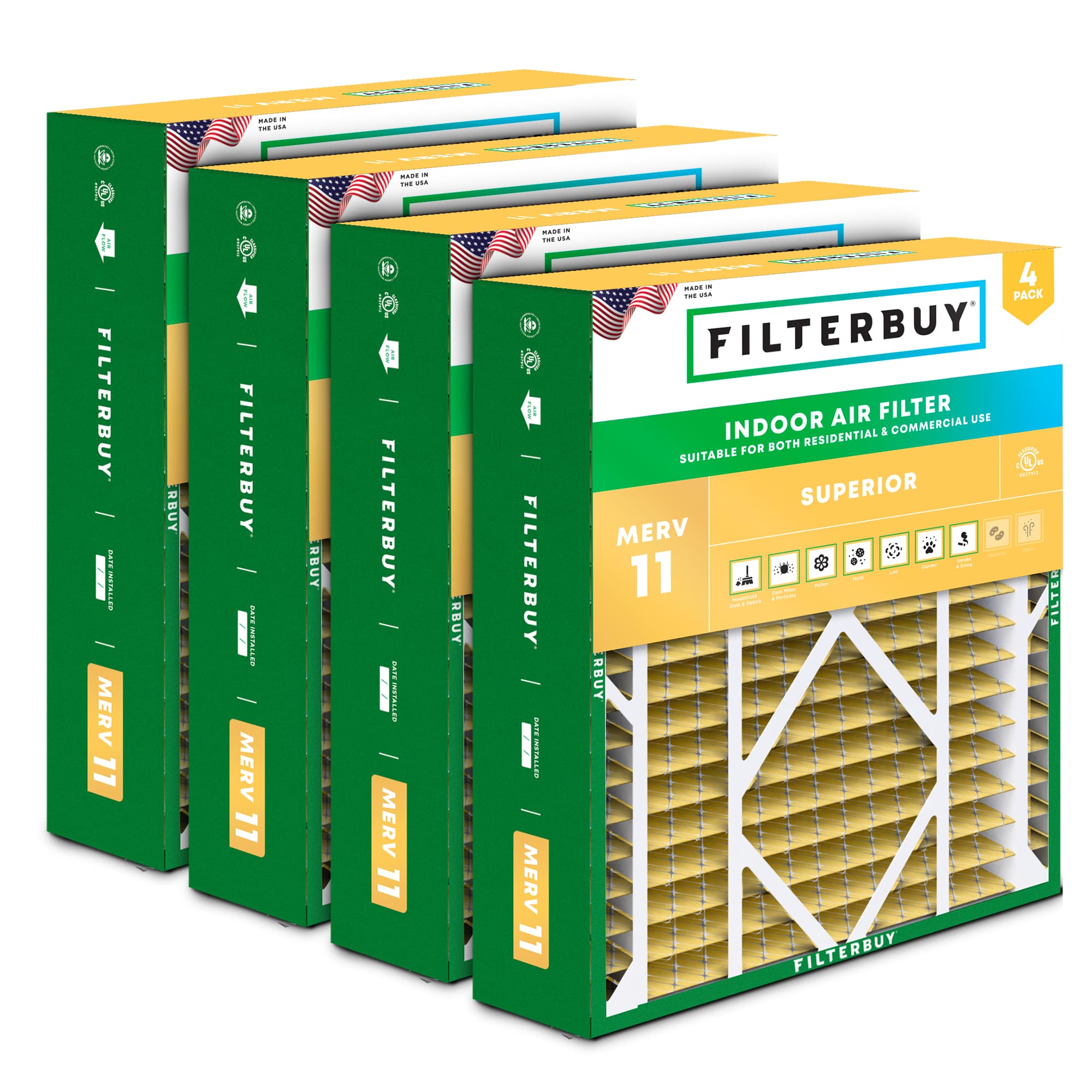
Tip: Ensure you buy the exact air filter size for your system. Certain brands have precise dimensions that only fit their specific models. See related filters
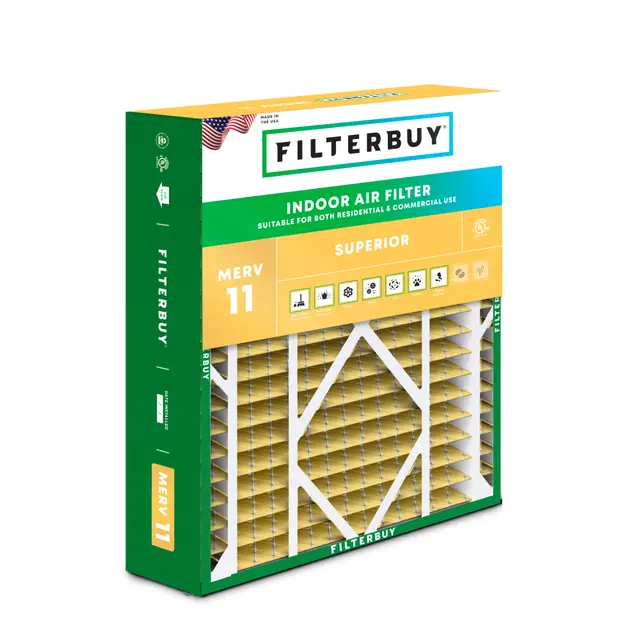
Actual Size: 23.75x24.75x4.38"
 Free Delivery
  Factory-Direct Low Prices, Made in the USA
 Hassle-Free Returns & Free Exchanges
RESIDENTIAL AND/OR COMMERCIAL USE
Change Every 3 Months
Tip: Ensure you buy the exact air filter size for your system. Certain brands have precise dimensions that only fit their specific models. See related filters
Actual Size: 23.75x24.75x4.38"
Free Delivery Factory-Direct Low Prices, Made in the USAHassle-Free Returns & Free ExchangesRESIDENTIAL AND/OR COMMERCIAL USE
Change Every 3 Months
Tip: Ensure you buy the exact air filter size for your system. Certain brands have precise dimensions that only fit their specific models. See related filters
Actual Size: 23.75x24.75x4.38"
Free Delivery Factory-Direct Low Prices, Made in the USAHassle-Free Returns & Free ExchangesRESIDENTIAL AND/OR COMMERCIAL USE
Change Every 3 Months
At Filterbuy, we don't cut corners—we craft high-quality air filters right here in the USA and ship them to your doorstep for free. No delays, no gimmicks—just clean air, made easy. With thousands of five-star reviews and filters built for real life & every HVAC system, it's no wonder why over 4 million families trust Filterbuy.

Proudly Made In The USA

Fast, Free Shipping on Every Order

Premium Materials That Go The Distance

85,000+ 5-Star Reviews From Happy Customers

Save Up to 70% Per Filter with Packs


Measure length × width × depth with a tape measure to find the actual size.

Round up each dimension to the nearest whole number to get the nominal size. Example: 23.75x24.75x4.38" in → 24X25X5 nominal.

Search by nominal size on our site for the best fit.


5″ filters give you maximum filtration with minimal maintenance — lasting up to 12 months while handling higher MERV ratings without restricting airflow.
Sizing note:

If the filter you buy doesn't fit, we'll send you a better size.
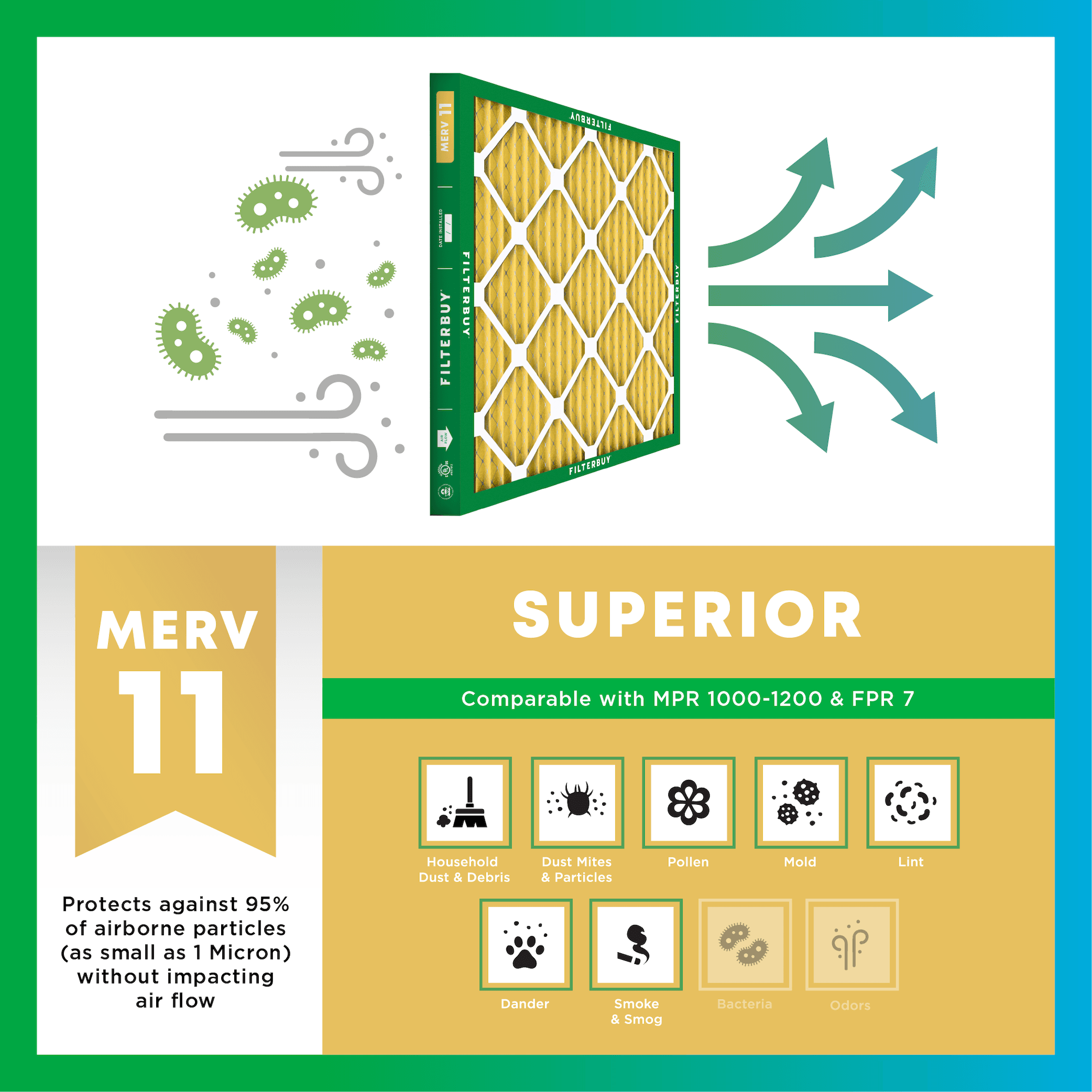
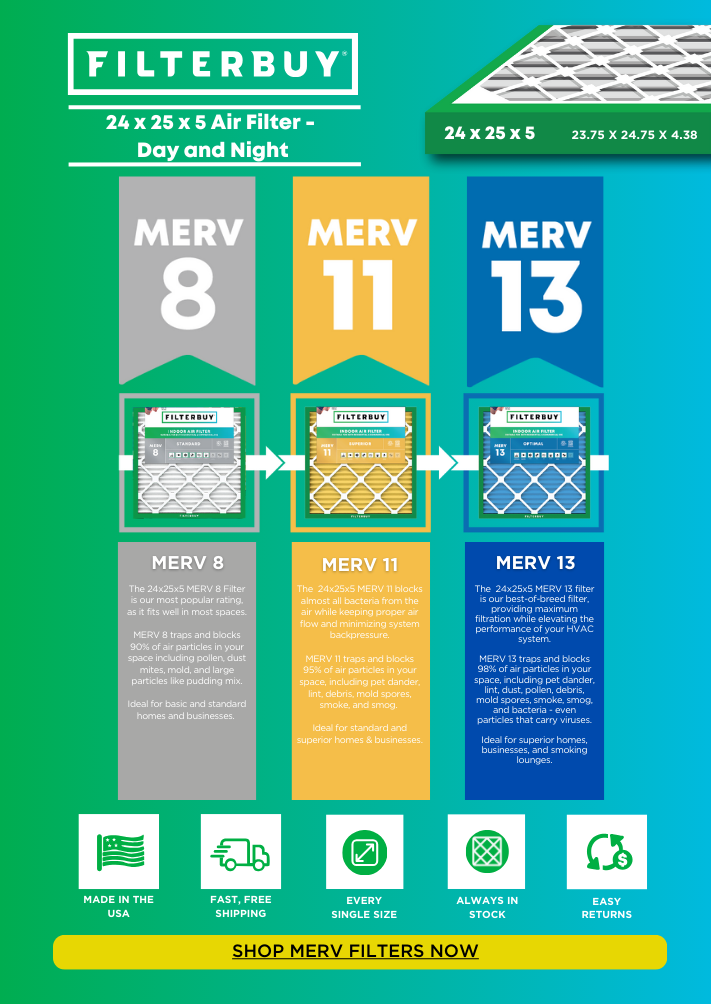
MERV stands for Minimum Efficiency Reporting Value—but don't let the technical name fool you. It's just a way to rate how well an air filter traps stuff like dust, pollen, pet dander, and smoke. The higher the MERV number, the more particles it catches—and the cleaner your air will be.

Comparable to:FPR: 4-7
MPR: 600-1000
 Dust & Debris
 Dust Mites & Particles
 Pollen
 Mold
Mold Lint
Lint Dander
Comparable to:FPR: 6-9
MPR: 1200-1550
Dust & DebrisDust Mites & ParticlesPollenMoldLintDander Smoke & Smog
Comparable to:FPR: 10
MPR: 1900-2800
Dust & DebrisDust Mites & ParticlesPollenMoldLintDanderSmoke & Smog Bacteria


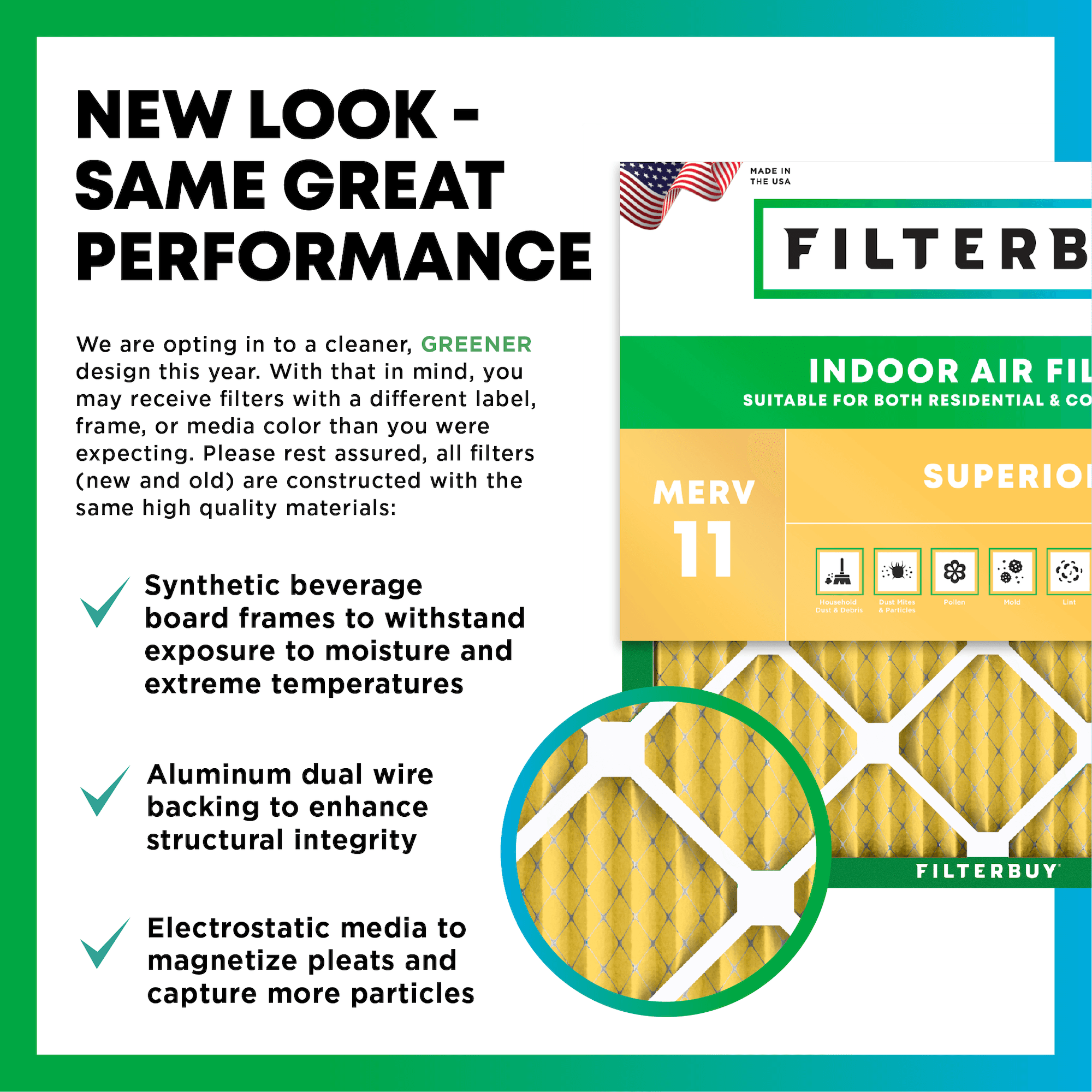
We build every Filterbuy filter to deliver reliable 90-day performance—thanks to smart design and premium materials that do the heavy lifting. Here's what makes the difference:
More pleats = more surface area to capture dust and debris, keeping your air cleaner longer.
Pleats are magnetized to attract and trap microscopic particles—like pet dander, pollen, and smoke.
Engineered to resist warping in extreme temperatures and high humidity.

A layer of metal reinforcement keeps pleats evenly spaced and structurally sound—no sagging, even at high airflow.
Assembled with care. Built to perform. Ships fast, free, and reliably from our U.S. facilities.

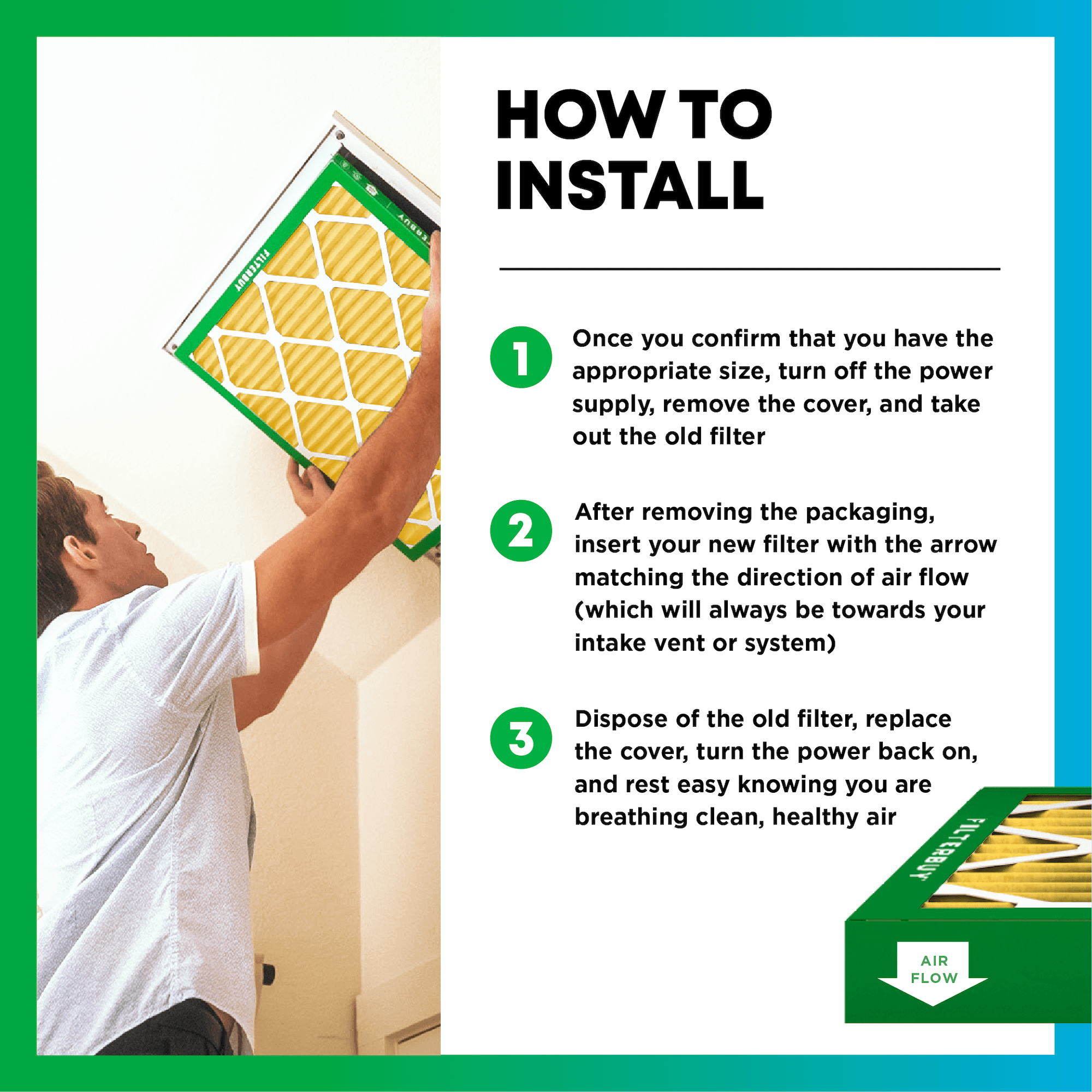
Turn Off Your HVAC SystemSafety first.

Remove The Old FilterLook for the airflow arrow and make note of the direction.

Slide In Your New FilterArrow should point toward the system (same direction as before).

Turn Your System Back OnAnd enjoy the fresh, clean air.

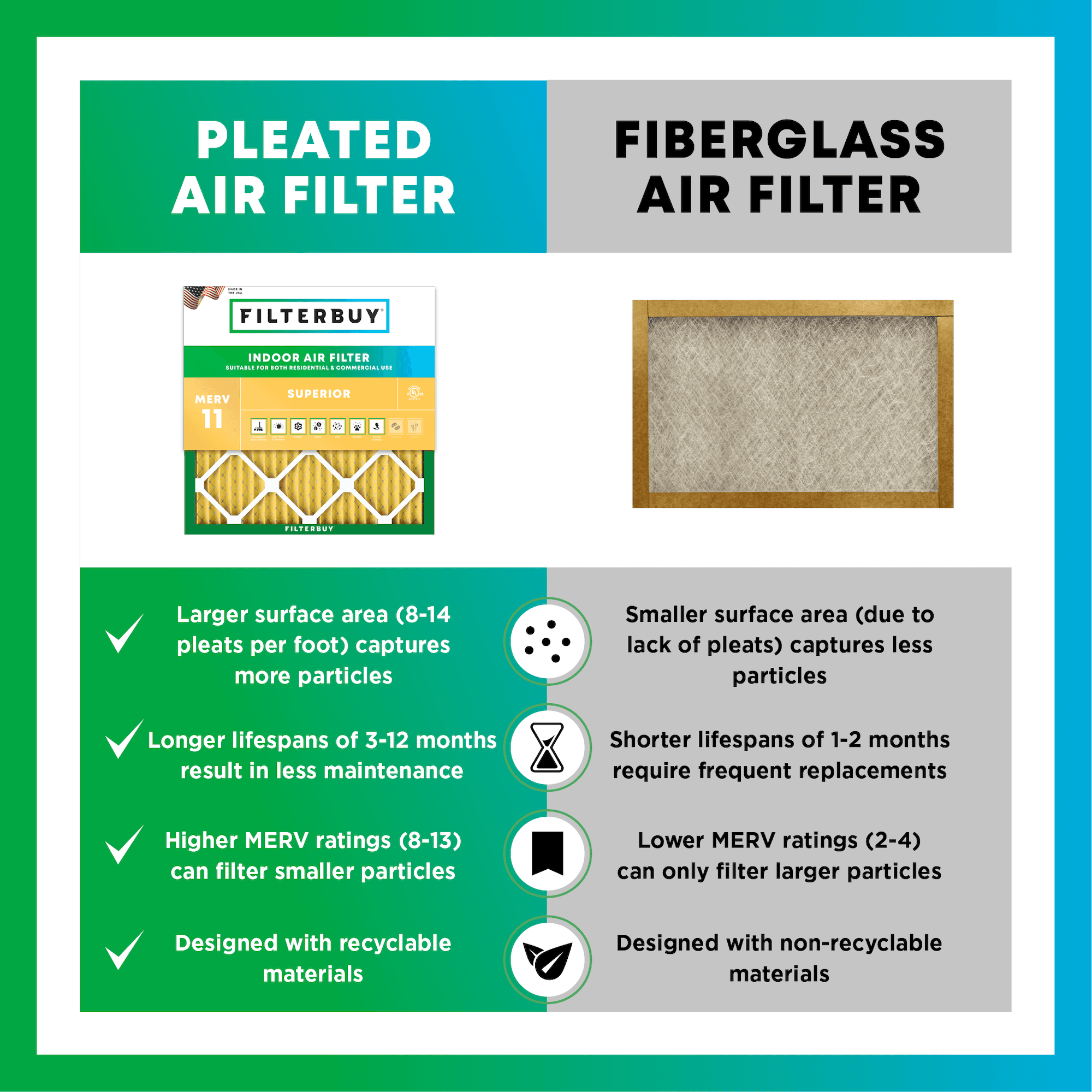
Not all air filters are created equal. Pleated filters don't just last longer—they actually clean your air better. Here's how they stack up:

Efficiency:
High (MERV 8–13) – Traps more particles
Lifespan:
90 days – Long-lasting performance
Air Quality:
Excellent – Cleaner, healthier air
Materials:
Recyclable and durable

Efficiency:
Low (MERV 4 or less) – Misses small stuff
Lifespan:
30 days or less – Replace often
Air Quality:
Minimal – Basic protection only
Materials:
Thin, flimsy, and not recyclable
Pleated filters are a no-brainer—more protection, less hassle, and better air for your home.
Changing your filter on time keeps your HVAC system running efficiently—and helps protect your lungs from dust, allergens, and airborne irritants. Here's how often to swap it out based on your needs:

For most homes without pets or special air quality concerns. Great for general upkeep and energy efficiency.

Shedding fur, dander, and allergy triggers can build up fast. Changing your filter every two months helps keep the air fresher and symptoms at bay.

For households affected by smoke, pollution, or respiratory conditions, monthly changes ensure maximum protection.

| Nominal Size | 24X25X5 |
| Actual Size | 23.75 x 24.75 x 4.38" inches |
| Filter Type | Pleated |
| Media | Electrostatically Charged |
| Frame | Beverage Board |
| MERV Ratings Available | 8, 11, 13 |
| Lifespan | Up to 12 Months |
| Origin | Made in USA |
Pull a 24x25x5 filter out of a Day and Night system at the six-month mark and hold it to the light. What you’re looking at on that gray-brown media face is dust mite fragments, mold spores, pet dander, and fine particles from cooking and cleaning — everything your family breathed past, caught by the filter instead. That is what MERV 11 filtration does that a MERV 8 rating cannot: it intercepts the smaller, finer particle load most household air carries every day, the load most homeowners never see.
A 24x25x5 air filter built for Day and Night furnace systems gives you the media depth to do that interception reliably for 6 to 12 months, without the rapid airflow decline that makes 1-inch formats a constant maintenance problem. If you want to understand how to choose the best home air filter for your loved ones and confirm whether MERV 11 is the right tier for your specific system, this page covers both.
A MERV 11 24x25x5 air filter is a thick media replacement filter built for Day and Night furnace systems that require a 24-by-25-by-5-inch housing. At MERV 11, it captures the particle types most households produce every day — dust, pollen, mold spores, and pet dander — at a meaningfully higher efficiency than a standard MERV 8.
• Size: 24 x 25 x 5 inches — direct fit for Day and Night deep media housings
• MERV 11 captures: dust, pollen, mold spores, pet dander, and fine particles in the 1–10 micron range
• Service life: 6–12 months for most households, due to the 5-inch thick media depth
• System safety: runs within the safe airflow range for most residential Day and Night systems — no static pressure issues associated with MERV 13 ratings
• Compatible systems: Day and Night, BDP, Carrier, Goodman, and Amana furnaces requiring a 24x25x5 housing
• The 24x25x5 format packs significantly more filtration media into a 5-inch deep frame than any 1-inch filter can match, and that depth is what makes 6–12-month service life achievable.
• At MERV 11, this filter captures particles in the 1–10 micron range: dust, pollen, mold spores, pet dander, and fine particles from cooking and cleaning products. MERV 8 misses most of that finer load.
• This filter installs directly into Day and Night furnace systems requiring a 24x25x5 housing, with no modification and no adapter required. BDP, Carrier, Goodman, and Amana systems using the same deep-media cabinet specification take it too.
• MERV 11 runs within the safe airflow range for most residential HVAC equipment. It doesn’t create the static pressure problems that push MERV 13 out of range for many standard systems.
• Filter age matters as much as filter rating. A MERV 11 past its service life performs worse than a fresh MERV 8, so the replacement schedule is part of the protection.
• The EPA has confirmed that indoor air carries 2 to 5 times more pollutant concentration than outdoor air in most homes. Choosing the right high efficiency air filter is one of the most direct daily health decisions a homeowner makes.
Most homeowners install a filter, push the housing closed, and don’t revisit it until the system makes noise or an allergy season flares. What the filter is stopping versus what’s getting through in the meantime is the part that matters most for your family’s air.
A 1-inch filter runs out of room quickly. Particles accumulate on the face, airflow resistance climbs, and efficiency drops before most households get around to a replacement. The 24x25x5 thick media format solves that problem at the design level. Five inches of depth means significantly more filtration media packed into the same frame, giving you larger surface area, a lower pressure drop at installation, and sustained performance across a 6 to 12-month window.
We’ve pulled 24x25x5 filters at the six-month mark. The accumulation on the media face is real, and visible. A 1-inch filter reaches that same saturation point in weeks.
MERV 11 targets the particle types most residential households actually produce. Here is what this filter stops on every system cycle:
• Dust and dust mite allergens
• Pollen from grass, trees, and weeds
• Mold spores entering from outside or growing in damp areas
• Pet dander from dogs and cats
• Fine particles from cooking, candles, and cleaning products
• Lint, carpet fibers, and airborne textile particles
MERV 11 doesn’t capture particles below 1 micron. That range includes most airborne viruses and the smallest bacteria, which require MERV 13 or higher. For households without a specific clinical reason to filter at that level, MERV 11 is where meaningful daily protection lives — and where most residential systems operate without airflow strain.
This filter drops directly into Day and Night furnace systems built around a 5-inch deep media housing. Measure your current housing, confirm the 24x25x5 dimensions, and it installs in under a minute. BDP, Carrier, Goodman, and Amana systems using the same deep-media cabinet specification take it too. If your current filter is a 24x25x5, this is the replacement.
“In our manufacturing experience, MERV 11 is the rating where we see the most meaningful real-world difference for residential households — particularly homes with pets or anyone managing seasonal allergies. The 24x25x5 format gives us the media depth to deliver consistent performance across a six-month service life, which a 1-inch filter at the same rating simply cannot match.”
— Filterbuy Team
The EPA’s indoor air quality guide covers the primary categories of household pollutants, including combustion byproducts, biological contaminants, and fine particles, and explains why filtration is one of the most direct control strategies available to homeowners. Read it if you want to understand the full scope of what’s in your air before it reaches your filter.
Source: https://www.epa.gov/indoor-air-quality-iaq/introduction-indoor-air-quality
This resource explains how indoor air contaminants, from dust and mold to pet dander and fine particulate matter, travel into the respiratory system and affect health. It also covers practical steps homeowners can take to reduce their family’s daily exposure.
Source: https://www.lung.org/clean-air/indoor-air
The National Institute for Occupational Safety and Health’s indoor environmental quality topic page covers how pollutants accumulate in occupied buildings, the role HVAC filtration plays in controlling exposure, and the health complaints most associated with poor indoor air. The underlying principles apply directly to residential settings.
Source: https://www.cdc.gov/niosh/topics/indoorenv/
The Department of Energy explains how a clogged or undersized filter forces HVAC equipment to compensate, burning more energy, reducing efficiency, and shortening system life. Proper filter selection and maintenance protects both your indoor air and your equipment investment.
Source: https://www.energy.gov/energysaver/air-conditioner-maintenance
The National Air Filtration Association’s publications explain the MERV test protocol, what particle size efficiency means in practical terms, and why a filter’s rated efficiency is only one factor in real-world performance. This is the trade association standard for air filtration professionals.
Source: https://www.nafahq.org/publications/
The National Institute of Environmental Health Sciences covers the biological allergen categories, dust mites, pet dander, and mold spores, that drive indoor air quality concerns for most households. This resource puts the MERV 11 capture range in direct context with the specific particles driving those concerns.
Source: https://www.niehs.nih.gov/health/topics/agents/allergens
The EPA’s Report on the Environment confirms that Americans spend approximately 90 percent of their time indoors, where concentrations of some pollutants run 2 to 5 times higher than typical outdoor levels. After manufacturing filters for over a decade, we’ve seen that reality on 24x25x5 media at the six-month mark. The accumulation on a filter that’s been working tells you more about your indoor air than any outdoor reading will.
Source: https://www.epa.gov/report-environment/indoor-air-quality
EPA studies of human exposure to air pollutants confirm that indoor pollutant levels run 2 to 5 times higher than outdoor levels — and occasionally more than 100 times higher. For most households, the air inside carries a heavier particle burden than the outdoor air they’re trying to keep out. A properly rated MERV 11 indoor air quality filter targets the specific particle size range that defines that burden.
Source: https://www.epa.gov/iaq-schools/why-indoor-air-quality-important-schools
Per ASHRAE filtration data, MERV 11 filters achieve approximately 65 percent efficiency for particles in the 1–3 micron range — the category that includes mold spores, fine dust, and pet dander that MERV 8 filters allow through consistently. MERV 13 reaches 85 percent efficiency in that same range but introduces static pressure levels that many standard Day and Night systems aren’t designed to handle without reduced airflow or added wear.
Source: https://www.ashrae.org/ — ASHRAE Filtration & Disinfection Guidance (COVID-19)
MERV 8 handles coarse dust and large pollen, and it protects HVAC equipment from debris accumulation. For a home with no pets, no allergy sufferers, and no one in a vulnerable age group, it’s an adequate filter.
Most households don’t fit that description.
If your home has a pet, anyone managing seasonal allergies or asthma, a child under five, or an adult over 65, MERV 11 is the tier your air actually needs. It captures what MERV 8 misses, at the particle sizes that affect those groups most. In a 24x25x5 thick media format, it does that without the airflow restriction that puts MERV 13 out of reach for most standard residential systems.
Choosing MERV 13 isn’t automatically the stronger call. It makes sense for systems built to handle its static pressure requirements and for households with a specific health reason to filter at that level. For the majority of Day and Night system owners, MERV 11 is the honest recommendation — the filter that matches the system and the household without overpromising what it delivers.
1. Confirm your filter size. Measure your current housing or check the label on your Day and Night unit before ordering. The 24x25x5 dimensions need to be exact — even a small gap prevents the filter from seating and sealing correctly.
2. Choose MERV 11 with confidence. If your household includes pets, allergy sufferers, children under five, or adults over 65, this is the appropriate filtration tier for your system and the people in it.
3. Set a replacement schedule on the day you install. A 24x25x5 MERV 11 filter serves most households for 6 to 12 months. Write the installation date on the filter frame and set a phone reminder before you put the housing back.
4. Inspect at month four. Gray or brown accumulation on the filter face means it’s loading normally. Replace immediately if the media looks collapsed or bowed, if airflow from vents has dropped noticeably, or if the system is running unusually long cycles.
5. Consider subscription delivery. A furnace running on an expired filter performs worse than one running on a lower-rated fresh one. Subscription delivery keeps the 24x25x5 furnace filter replacement on schedule, automatically.
A: Yes. It’s built and sized as a direct 24x25x5 furnace filter replacement for Day and Night HVAC systems. BDP, Carrier, Goodman, and Amana systems that specify the same housing dimensions are also compatible.
A: Particles in the 1–3 micron range: mold spores, fine dust, pet dander, and some smoke particles. MERV 8 handles large dust and pollen but consistently lets finer particles through — and those are the ones that affect allergy and pet households most.
A: Most households get 6 to 12 months of service. Higher pet counts, dusty conditions, or homes with allergy sufferers may need a change closer to six months. Check the filter face at month four to gauge how quickly it’s loading.
A: MERV 11 falls within the safe operating range for most residential HVAC equipment, including Day and Night systems. The 24x25x5 thick media format also distributes resistance across a larger filter surface than a 1-inch alternative, which lowers strain on the system.
A: MERV 13 captures smaller particles at higher efficiency but introduces static pressure that many residential systems can’t run efficiently under. For most standard Day and Night systems, MERV 11 is the appropriate ceiling.
Serving more than two million households, we manufacture every 24x25x5 Day and Night air filter to a standard we hold across every size we make — because the filter you install is the only thing standing between your family and what your HVAC system pulls out of the air every day. Order yours, set your replacement schedule, and know the job is done right.

