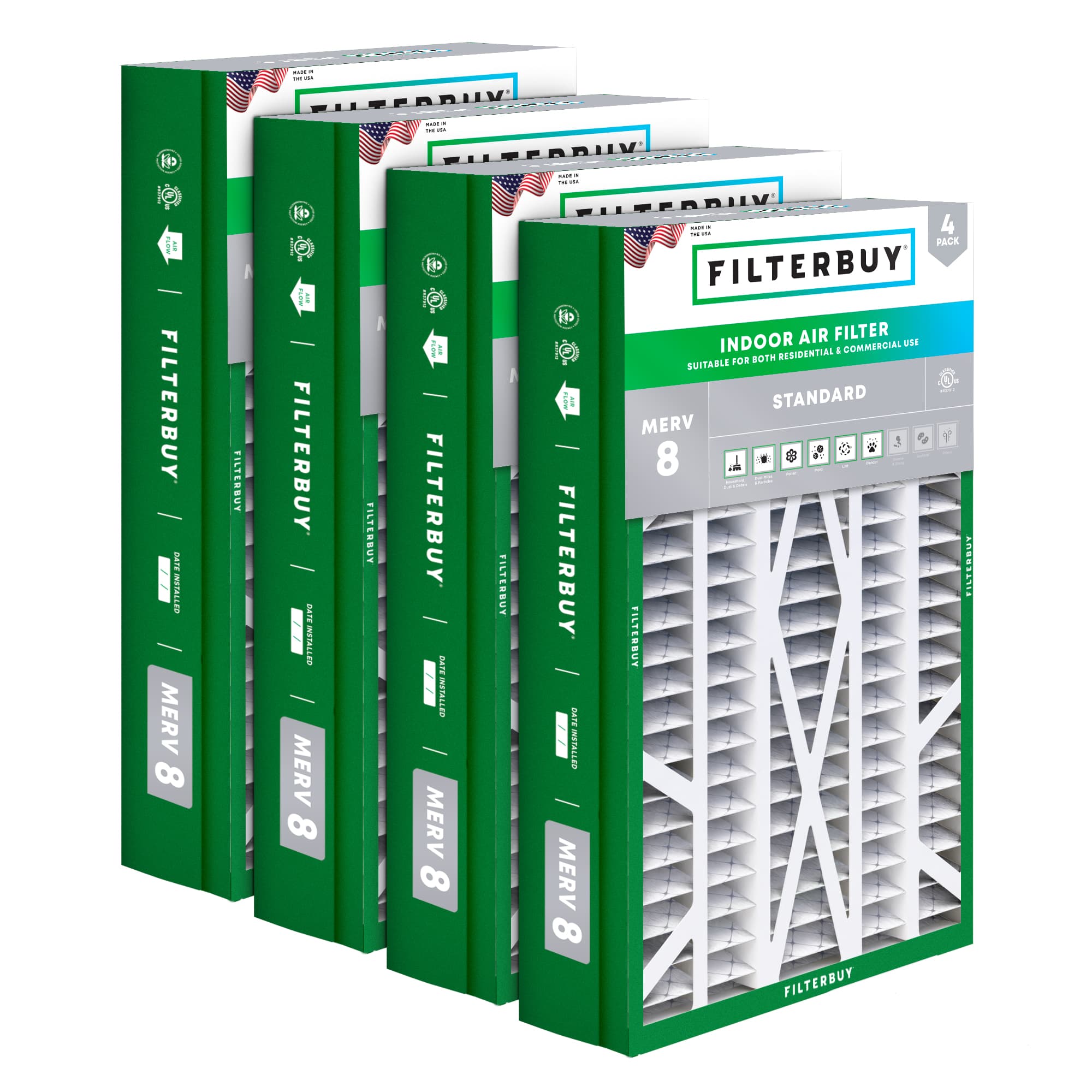
Tip: Ensure you buy the exact air filter size for your system. Certain brands have precise dimensions that only fit their specific models. See related filters
Actual Size: 20.56x26.13x4.97
 Free Delivery
  Factory-Direct Low Prices, Made in the USA
 Hassle-Free Returns & Free Exchanges
RESIDENTIAL AND/OR COMMERCIAL USE
Change Every 3 Months
Tip: Ensure you buy the exact air filter size for your system. Certain brands have precise dimensions that only fit their specific models. See related filters
Actual Size: 20.56x26.13x4.97
Free Delivery Factory-Direct Low Prices, Made in the USAHassle-Free Returns & Free ExchangesRESIDENTIAL AND/OR COMMERCIAL USE
Change Every 3 Months
Tip: Ensure you buy the exact air filter size for your system. Certain brands have precise dimensions that only fit their specific models. See related filters
Actual Size: 20.56x26.13x4.97
Free Delivery Factory-Direct Low Prices, Made in the USAHassle-Free Returns & Free ExchangesRESIDENTIAL AND/OR COMMERCIAL USE
Change Every 3 Months
At Filterbuy, we don't cut corners—we craft high-quality air filters right here in the USA and ship them to your doorstep for free. No delays, no gimmicks—just clean air, made easy. With thousands of five-star reviews and filters built for real life & every HVAC system, it's no wonder why over 4 million families trust Filterbuy.

Proudly Made In The USA

Fast, Free Shipping on Every Order

Premium Materials That Go The Distance

85,000+ 5-Star Reviews From Happy Customers

Save Up to 70% Per Filter with Packs


Measure length × width × depth with a tape measure to find the actual size.

Round up each dimension to the nearest whole number to get the nominal size. Example: 20.56x26.13x4.97 in → 21X27X5 nominal.

Search by nominal size on our site for the best fit.


5″ filters give you maximum filtration with minimal maintenance — lasting up to 12 months while handling higher MERV ratings without restricting airflow.
Sizing note:

If the filter you buy doesn't fit, we'll send you a better size.
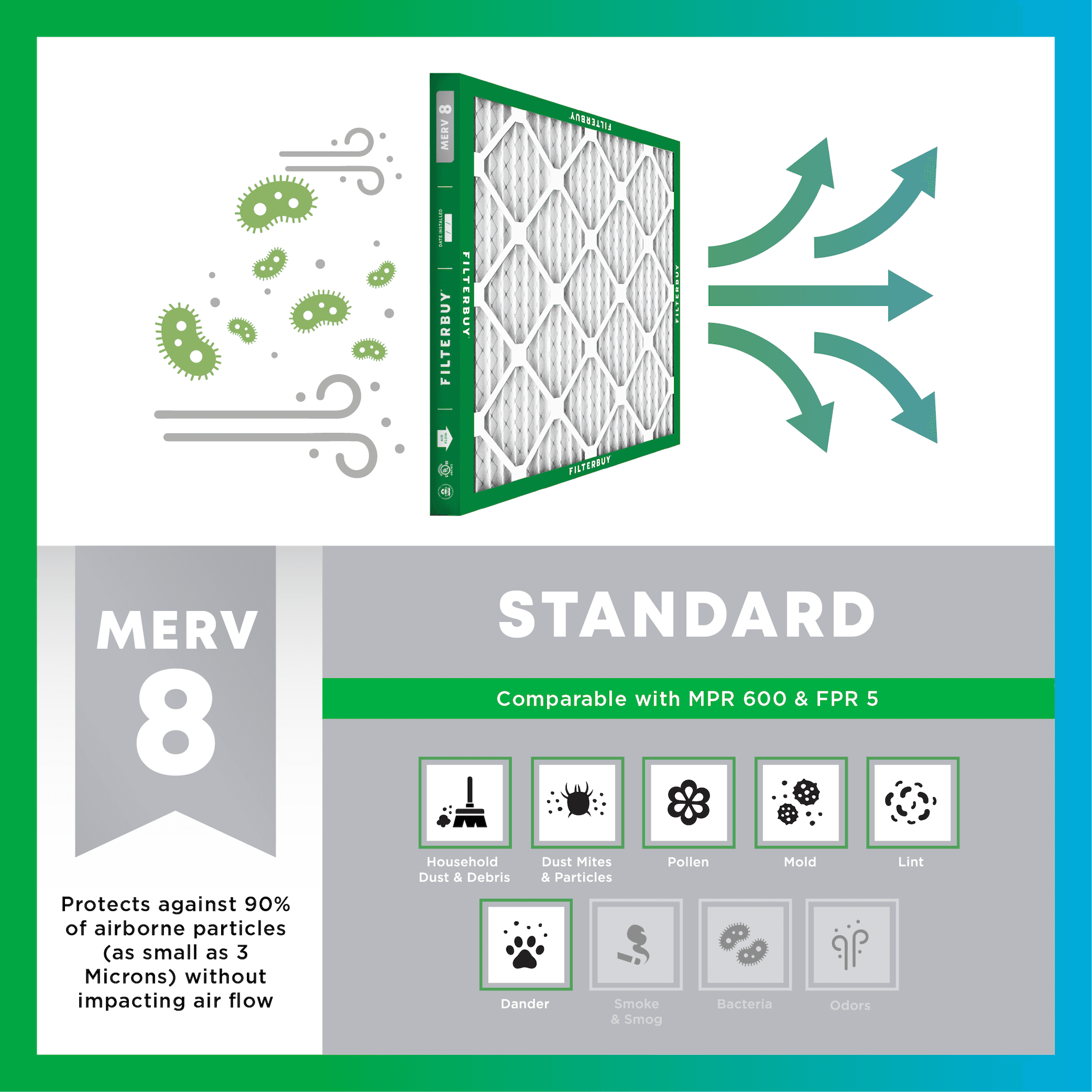
MERV stands for Minimum Efficiency Reporting Value—but don't let the technical name fool you. It's just a way to rate how well an air filter traps stuff like dust, pollen, pet dander, and smoke. The higher the MERV number, the more particles it catches—and the cleaner your air will be.

Comparable to:FPR: 4-7
MPR: 600-1000
 Dust & Debris
 Dust Mites & Particles
 Pollen
 Mold
Mold Lint
Lint Dander
Comparable to:FPR: 6-9
MPR: 1200-1550
Dust & DebrisDust Mites & ParticlesPollenMoldLintDander Smoke & Smog
Comparable to:FPR: 10
MPR: 1900-2800
Dust & DebrisDust Mites & ParticlesPollenMoldLintDanderSmoke & Smog Bacteria


We build every Filterbuy filter to deliver reliable 90-day performance—thanks to smart design and premium materials that do the heavy lifting. Here's what makes the difference:
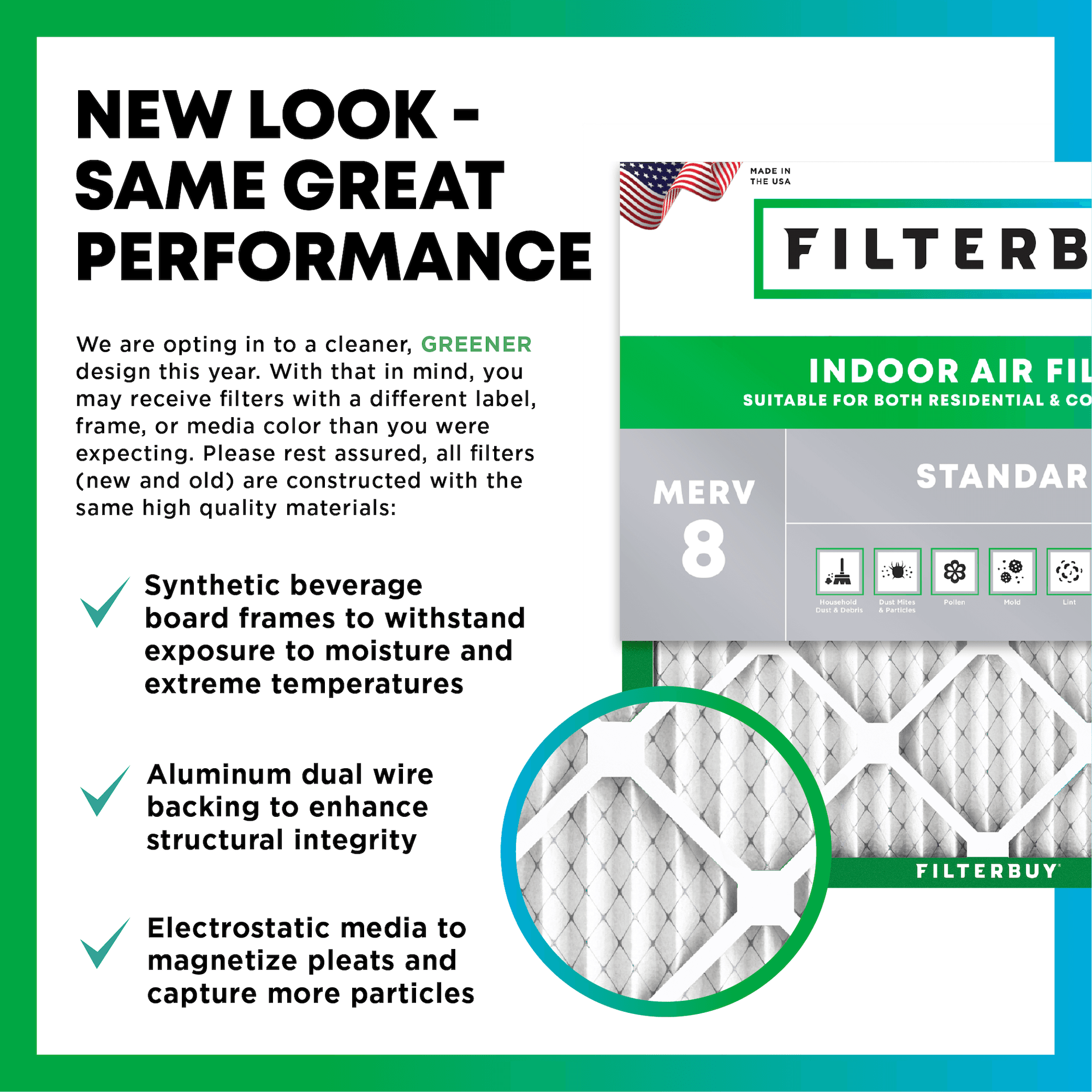
More pleats = more surface area to capture dust and debris, keeping your air cleaner longer.
Pleats are magnetized to attract and trap microscopic particles—like pet dander, pollen, and smoke.
Engineered to resist warping in extreme temperatures and high humidity.

A layer of metal reinforcement keeps pleats evenly spaced and structurally sound—no sagging, even at high airflow.
Assembled with care. Built to perform. Ships fast, free, and reliably from our U.S. facilities.

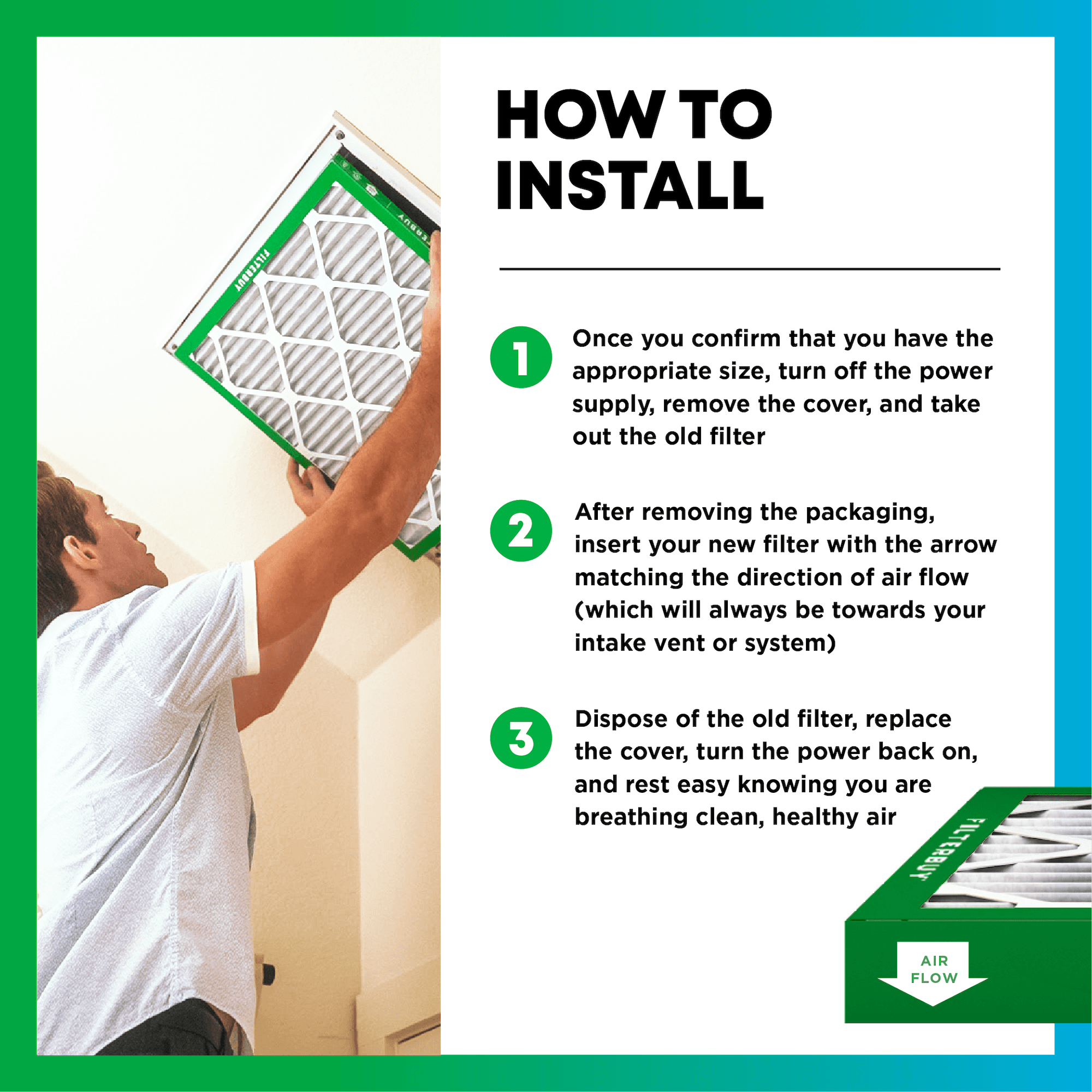
Turn Off Your HVAC SystemSafety first.

Remove The Old FilterLook for the airflow arrow and make note of the direction.

Slide In Your New FilterArrow should point toward the system (same direction as before).

Turn Your System Back OnAnd enjoy the fresh, clean air.

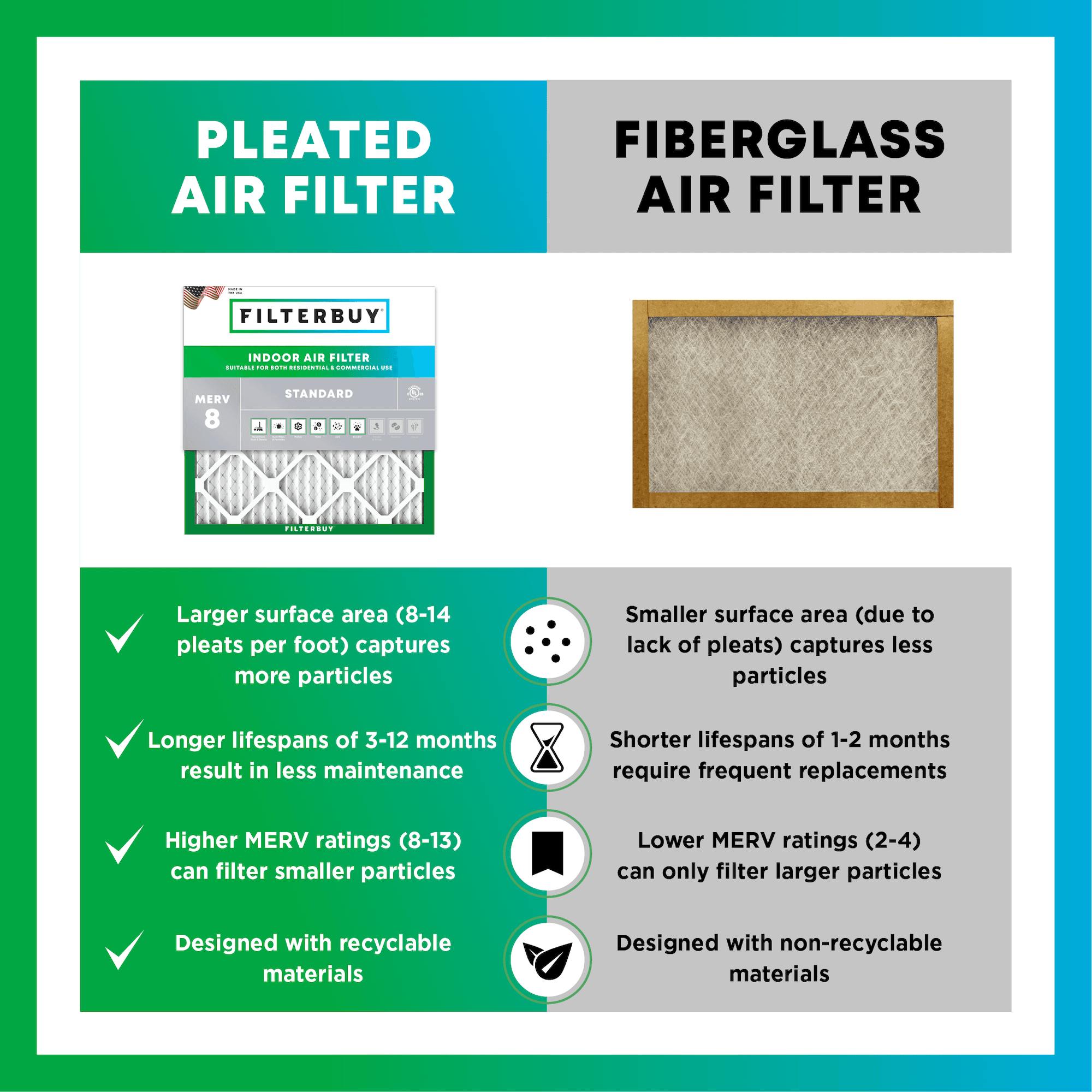
Not all air filters are created equal. Pleated filters don't just last longer—they actually clean your air better. Here's how they stack up:

Efficiency:
High (MERV 8–13) – Traps more particles
Lifespan:
90 days – Long-lasting performance
Air Quality:
Excellent – Cleaner, healthier air
Materials:
Recyclable and durable

Efficiency:
Low (MERV 4 or less) – Misses small stuff
Lifespan:
30 days or less – Replace often
Air Quality:
Minimal – Basic protection only
Materials:
Thin, flimsy, and not recyclable
Pleated filters are a no-brainer—more protection, less hassle, and better air for your home.
Changing your filter on time keeps your HVAC system running efficiently—and helps protect your lungs from dust, allergens, and airborne irritants. Here's how often to swap it out based on your needs:

For most homes without pets or special air quality concerns. Great for general upkeep and energy efficiency.

Shedding fur, dander, and allergy triggers can build up fast. Changing your filter every two months helps keep the air fresher and symptoms at bay.

For households affected by smoke, pollution, or respiratory conditions, monthly changes ensure maximum protection.

| Nominal Size | 21X27X5 |
| Actual Size | 20.56 x 26.13 x 4.97 inches |
| Filter Type | Pleated |
| Media | Electrostatically Charged |
| Frame | Beverage Board |
| MERV Ratings Available | 8, 11, 13 |
| Lifespan | Up to 12 Months |
| Origin | Made in USA |
After manufacturing filters for over a decade and working with millions of American Standard system owners, we've learned something most homeowners never hear: the wrong 5-inch filter doesn't just underperform—it quietly works against your system. The 21x27x5 MERV 8 isn't a generic swap. It's a precision fit that has to balance deep-media filtration with the specific airflow demands American Standard equipment was engineered around. Get that balance right, and you'll notice it—in cleaner air, quieter operation, and energy bills that stop creeping upward. Get it wrong, and no amount of filter changes fixes it.
That's the insight we bring to every filter we manufacture at Filterbuy.
The 21x27x5 MERV 8 is the precision-matched deep-media filter designed for American Standard systems that use a 5-inch media cabinet. Here's what you need to know:
What it fits: American Standard units compatible with the FLR06070 replacement filter designation
What it captures: Dust, pollen, mold spores, and pet dander — particles between 3 and 10 microns
Actual dimensions: 20.56" x 26.13" x 4.97"
Filter lifespan: 6 to 12 months depending on household conditions
Why MERV 8: It's the rating American Standard systems were engineered around — delivering maximum filtration without restricting the airflow your system depends on
Why 5-inch depth matters: Deep-media construction maintains consistent filtration efficiency far longer than 1-inch alternatives — protecting your air, your equipment, and your energy costs simultaneously
Who makes it: Filterbuy manufactures the 21x27x5 MERV 8 in the USA — precision-built to match American Standard system specs
Bottom line: The right fit, the right rating, replaced on schedule. That's what protects your American Standard system and your family's air.
Fit is everything. Even a small gap around the air filter frame sends unfiltered air directly into your system's most expensive components.
MERV 8 is the engineered sweet spot. It's what your American Standard system was designed around—not a compromise, not a limitation.
5-inch depth changes everything. Deep-media construction maintains consistent filtration for 6 to 12 months without the airflow penalties that make thinner filters a liability.
The wrong filter is costing you money right now. A mismatched or degraded filter can drive HVAC energy consumption up by 15%—quietly, every single month.
Consistency beats perfection. The right filter, in the right system, is replaced on schedule—that's the habit that protects your air, your equipment, and your family long term.
American Standard systems that use a 5-inch media filter aren't just filtering more air—they're filtering it more slowly and thoroughly than a standard 1-inch filter ever could. That extra depth is what gives the 21x27x5 filter its staying power, typically lasting 6 to 12 months versus the 30 to 90 days you get from thinner alternatives. But that performance only holds when the dimensions are exact. Even a quarter-inch variance creates bypass gaps where unfiltered air moves around the media instead of through it—defeating the entire purpose of upgrading in the first place.
MERV 8 is the sweet spot most American Standard systems were designed around. It captures the particles that matter most in the average household—dust mites, pollen, mold spores, lint, and pet dander—without creating the airflow restriction that higher MERV ratings can impose on systems not rated to handle them. We've seen homeowners install MERV 11 or MERV 13 filters thinking more filtration is always better, only to find their system short-cycling, their coils freezing, or their blower motor wearing out ahead of schedule. MERV 8 protects your air without punishing your equipment.
Not all 21x27x5 filters are built with American Standard's specific static pressure tolerances in mind. American Standard systems are engineered for precise airflow balance, and a filter that fits the slot doesn't automatically mean it performs within those parameters. At Filterbuy, we manufacture our 21x27x5 MERV 8 filters with the media density and frame integrity that keeps your system operating the way it was designed to—efficiently, consistently, and without the strain that comes from a poor-fit filter forcing your blower to work harder than it should.
A mismatched or low-quality 21x27x5 filter doesn't just affect your air quality—it affects your wallet. Restricted airflow forces your system to run longer cycles to reach your thermostat's set temperature, which drives up energy consumption. Dirty or degraded media allows fine particles to accumulate on your evaporator coil, reducing heat transfer efficiency and eventually requiring professional cleaning. And a filter that collapses or gaps under negative pressure sends debris directly into your system's most expensive components. The right filter at the right change interval is one of the lowest-cost, highest-return maintenance decisions a homeowner can make.
For most households, every 6 months is the reliable standard. Homes with pets, allergy sufferers, or above-average dust levels should lean toward the 6-month mark consistently rather than stretching toward 12. A quick visual check tells you a lot—if the media surface looks uniformly gray and loaded, it's time regardless of the calendar. One thing we consistently see in customer feedback: homeowners who set a recurring replacement reminder report noticeably better air quality and fewer HVAC service calls year over year. It's a small habit with a measurable impact.
"In over a decade of manufacturing 5-inch media filters, the most consistent thing we've seen is this: homeowners who match their filter precisely to their system's design specs don't just breathe cleaner air—they spend significantly less on HVAC repairs, and their systems simply last longer." — Filterbuy Manufacturing Team
We're obsessed with making sure you have everything you need to protect your home's air—and that starts with the right information before you ever order a filter. These seven resources cover the science, the specs, and the manufacturer guidance that turns a routine filter swap into a genuinely informed decision.
Don't take filter marketing claims at face value. The U.S. EPA's official MERV explainer cuts through the noise with a clear, science-backed breakdown of what each rating level actually captures—and what it misses. When you understand what MERV really measures, you stop guessing and start protecting.
Source: U.S. Environmental Protection Agency (EPA)
URL: https://www.epa.gov/indoor-air-quality-iaq/what-merv-rating
Here's something worth knowing straight from the manufacturer: American Standard confirms that the ideal MERV rating for most residential systems falls between 8 and 13—a range proven to trap pet dander, smoke, smog, and pollen for easier breathing, even for households dealing with respiratory conditions. This is the manufacturer telling you exactly what performs in their equipment—and MERV 8 sits right at that sweet spot.
Source: American Standard Heating & Air Conditioning
URL: https://www.americanstandardair.com/resources/filter-101/
A filter that almost fits is a filter that fails. American Standard's step-by-step guide walks you through identifying your correct filter dimensions, understanding the difference between nominal and actual sizes, and knowing when to replace based on your specific system type. Even a small gap around the filter frame lets unfiltered air bypass the media entirely—this resource closes that gap.
Source: American Standard Heating & Air Conditioning
URL: https://www.americanstandardair.com/resources/blog/hvac-air-filter-replacement-101/
We've seen it thousands of times: homeowners save a few dollars on a bargain filter and spend hundreds on a preventable HVAC repair. American Standard's own resource breaks down the three main filter types, explains how MERV ratings apply across real residential systems, and makes clear why low-cost filters consistently underperform when it comes to protecting both your air quality and your equipment. Protecting your greatest assets starts with not cutting corners on the filter that guards them.
Source: American Standard Heating & Air Conditioning
URL: https://www.americanstandardair.com/resources/glossary/filter/
You don't need a service contract to keep your system running like it should—you need the right filter changed on the right schedule. American Standard's maintenance guide walks you through the replacement process and makes it clear that using the correct filter isn't optional—the wrong filter can cause direct, measurable damage to your system over time. This is the low-effort, high-return habit every American Standard owner should build.
Source: American Standard Heating & Air Conditioning
URL: https://www.americanstandardair.com/resources/maintenance/air-quality/
After manufacturing filters for American Standard systems for over a decade and helping millions of homeowners get the right fit, we built this resource so you never have to wonder. Confirm exact compatibility, compare MERV ratings side by side, and verify actual versus nominal dimensions for the 21x27x5 size—all in one place, all backed by the manufacturing knowledge that comes from making these filters ourselves.
Source: Filterbuy.com
URL: https://Filterbuy.com/brand/american-standard-air-filters/
Every MERV number on every filter you've ever purchased traces back to one source. The MERV rating system was developed by ASHRAE—the American Society of Heating, Refrigerating, and Air Conditioning Engineers—as a standardized method for measuring a filter's ability to capture particles between 0.3 and 10 microns. Understanding the test behind the rating helps you cut through manufacturer claims and choose a filter whose performance you can actually verify.
Source: American Society of Heating, Refrigerating and Air-Conditioning Engineers (ASHRAE)
URL: https://www.ashrae.org/technical-resources/standards-and-guidelines
After a decade of manufacturing filters and working with millions of homeowners, we've learned that the most informed customers take their filter choice seriously. These three statistics from the U.S. government and national health organizations explain exactly why.
The U.S. EPA confirms Americans spend approximately 90% of their time indoors—where pollutant concentrations are often 2 to 5 times higher than outdoor air.
What that means for your home:
The air cycling through your American Standard system carries more contaminants than most homeowners ever realize
Indoor pollutants don't dissipate—they recirculate until something captures them
A properly fitted 21x27x5 filter gives that air maximum contact time with deep-media filtration before it reaches your family
We built every Filterbuy 21x27x5 around that reality. Five-inch deep-media construction isn't just about longevity—it's about actually cleaning the air, not just slowing it down.
Source: U.S. Environmental Protection Agency (EPA)
URL: https://www.epa.gov/report-environment/indoor-air-quality
According to the U.S. Department of Energy, a clogged or underperforming filter can drive HVAC energy consumption up by as much as 15%.
What we consistently hear from customers:
Energy bills creep upward and the equipment gets blamed
The actual culprit is usually a mismatched or degraded filter
The blower works against resistance it was never designed to handle
What we've learned from manufacturing: the 5-inch deep-media format maintains airflow efficiency far longer than thinner alternatives. That means the 15% energy penalty is far less likely to quietly accumulate on your monthly bill when the filter is properly matched to your system.
Source: U.S. Department of Energy — Energy Efficiency & Renewable Energy
URL: https://www.energy.gov/energysaver/maintaining-your-air-conditioner
The Asthma and Allergy Foundation of America reports that over 28 million people in the U.S. currently have asthma—with pollen, mold spores, dust, and pet dander among the most common triggers.
Why this hits close to home for us:
Every one of those trigger particles falls within the MERV 8 capture range
Customers regularly tell us they didn't connect worsening symptoms to a degraded or ill-fitting filter—until they made the switch
Many noticed a measurable difference in their household's comfort within weeks of upgrading to the correct filter
For households managing asthma or allergies, the 21x27x5 MERV 8 isn't a maintenance checkbox. It's one of the most direct interventions available between your family and the triggers affecting their health every day.
Source: Asthma and Allergy Foundation of America (AAFA)
URL: https://aafa.org/asthma/asthma-facts/
After manufacturing hundreds of millions of air filters and working with millions of homeowners, we keep coming back to the same conclusion:
The biggest air quality mistake most American Standard owners make isn't choosing the wrong MERV rating. It's underestimating how much the right filter—precisely fitted and consistently replaced—actually changes daily life inside their home.
Homeowners who shift from treating filter replacement as a chore to treating it as their most accessible air quality lever are the ones who stop dealing with:
Rising energy bills with no clear cause
Unexplained allergy flare-ups inside the home
HVAC service calls that seemed to come out of nowhere
This filter sits at a specific intersection that most homeowners overlook:
It's the rating the system was engineered around. Not a compromise. Not an upgrade that pushes airflow tolerance. The designed sweet spot.
It's the depth that changes filtration from reactive to proactive. A 5-inch media bed holds capacity for months without the pressure drop penalties that make thinner filters a liability.
It's the fit that closes every gap. Gaps are where the real damage happens—quietly, invisibly, and expensively.
The homeowners who get the most out of their American Standard systems aren't the ones chasing expensive equipment upgrades. They're the ones who respect the fundamentals:
Correct filter match for their specific system
Consistent replacement on a reliable schedule
An understanding that clean filtration protects far more than just air quality
The data we see from customer outcomes points to one conclusion consistently. Lower energy costs. Fewer service calls. Better air. Longer system life.
The right filter, in the right system, changed on the right schedule, is one of the highest-return home maintenance decisions available to any homeowner. The 21x27x5 MERV 8 for your American Standard system is exactly that.
We're obsessed with better air for all. And it starts here—not with the most advanced filtration technology on the market, but with making sure the right filter is doing its job inside the right system, every single day.
You know why the 21x27x5 MERV 8 matters. Here's how to move from informed to protected—in four simple steps.
Take two minutes to verify fit before ordering.
Locate your existing filter in your air handler or return vent
Check the nominal size printed on the filter frame — look for 21x27x5
Confirm your system uses a 5-inch media cabinet format
Unsure? Check your owner's manual or look up your model at americanstandardair.com
MERV 8 is the right choice for most American Standard homes. Use this quick guide:
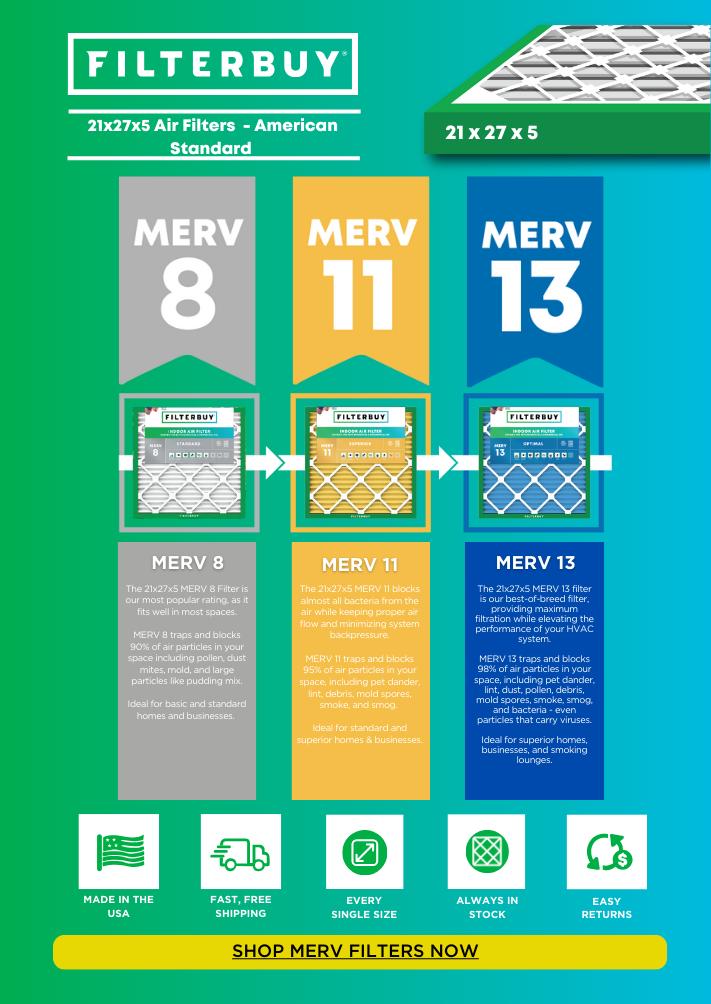
MERV 8 — Dust, pollen, mold spores, and pet dander. Ideal for average households
MERV 11 — Multiple pets, moderate allergies, or higher-than-average dust levels
MERV 13 — Asthma, serious allergies, or compromised immune systems
Not sure which rating your system can handle? Contact Filterbuy before upgrading beyond MERV 8.
Don't just order one filter. Set yourself up for consistent protection.
Order a multi-pack to have a replacement ready before you need it
Set a recurring reminder every 6 months as a reliable baseline
Pets, allergy sufferers, or heavy dust? Replace every 3 to 4 months
Do a visual check at 3 months — gray and loaded media means replace it now regardless of the calendar
A filter that isn't installed correctly isn't working. Follow these steps every time:
Turn off your HVAC system before removing the old filter
Note the airflow direction arrow on the new filter frame
Insert with the arrow pointing toward the blower motor
Check all four edges for a snug, gap-free fit
Write the installation date on the frame with a marker
A: No — not all American Standard units use a 5-inch media cabinet. Here's what to confirm before ordering:
Check your existing filter frame for the printed nominal size
Look for compatibility with the FLR06070 replacement designation
Confirm your system uses a 5-inch deep-media cabinet format
When in doubt, check your owner's manual or contact your American Standard dealer
What we've learned after a decade of manufacturing: A filter can occupy the right slot and still perform like the wrong filter if it isn't matched to the system's specific airflow design. Getting the compatibility check right is the single most important step in the entire process.
A: Because higher isn't always better — and we've seen the damage firsthand. Installing a MERV 11 or MERV 13 in a system engineered around MERV 8 tolerances can cause:
Restricted airflow throughout the system
Frozen evaporator coils
Premature blower motor failure
Avoidable and expensive repairs
What MERV 8 actually captures:
Dust and dust mites
Pollen and mold spores
Pet dander and lint
Particles between 3 and 10 microns
MERV 8 keeps your system operating exactly the way American Standard designed it to. For households managing serious allergies or asthma, consult an HVAC professional before upgrading. For most homes, MERV 8 isn't settling — it's the right call.
A: Every 6 months is the reliable baseline for most households. Adjust based on your specific conditions:
Every 3 to 4 months — Homes with pets, allergy sufferers, or high dust levels
Every 6 months — Average households with no significant air quality challenges
Visual check at 3 months — If the media looks uniformly gray and loaded, replace it immediately regardless of the schedule
The single most effective habit we've seen customers adopt:
Write the installation date on the filter frame with a permanent marker
Set a recurring 6-month calendar reminder at the same time
Do a visual check at the 3-month mark every time
This eliminates the guesswork that leads to stretched replacement intervals and the preventable system strain that follows.
A: The 21x27x5 is the nominal size — the rounded number used for ordering. The actual manufactured dimensions are:
Length: 26.13 inches
Width: 20.56 inches
Depth: 4.97 inches
Key sizing rules to follow:
Never order by the exact measured dimensions of your old filter
Always round your measurements up to the nearest inch to find the correct nominal size
If a filter requires force to insert — it's the wrong size
Forced installation creates frame distortion that opens bypass gaps around the edges
Filters are intentionally manufactured slightly smaller than the nominal size so they slide cleanly into the cabinet without bending or distorting the frame.
A: Yes — and it's one of the most common sources of preventable HVAC damage we've seen across more than a decade of manufacturing. Two failure modes account for most of the damage:
Failure Mode 1 — Filter Too Loose (bypass gaps):
Unfiltered air moves around the media instead of through it
Debris deposits directly onto the evaporator coil and blower assembly
Heat transfer efficiency drops
Energy consumption rises
Component wear accelerates
Failure Mode 2 — Filter Too Restrictive (wrong MERV rating):
Airflow to the blower is starved
Evaporator coils freeze
System short cycles repeatedly
Blower motor strain compounds until failure
The solution to both: The right filter, precisely fitted, replaced on a consistent schedule — every time. That's not a marketing claim. It's what we've observed across millions of systems over more than a decade of doing this work.
After more than a decade of manufacturing precision-matched filters for American Standard systems, we've made it simple to get the right filter, at the right rating, delivered straight to your door — so protecting your family's air never has to be complicated.

