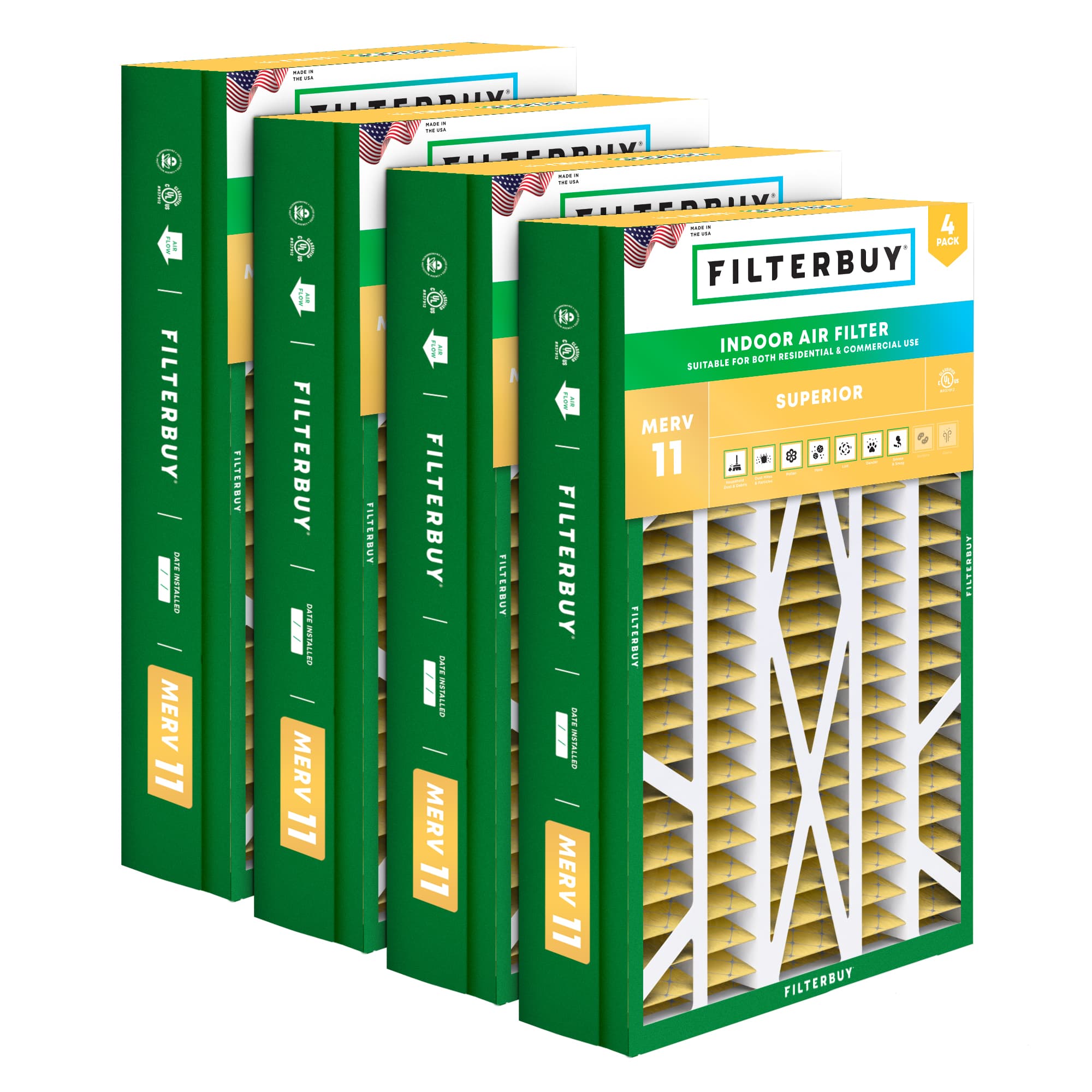
Tip: Ensure you buy the exact air filter size for your system. Certain brands have precise dimensions that only fit their specific models. See related filters
Actual Size: 20.56x26.13x4.97
 Free Delivery
  Factory-Direct Low Prices, Made in the USA
 Hassle-Free Returns & Free Exchanges
RESIDENTIAL AND/OR COMMERCIAL USE
Change Every 3 Months
Tip: Ensure you buy the exact air filter size for your system. Certain brands have precise dimensions that only fit their specific models. See related filters
Actual Size: 20.56x26.13x4.97
Free Delivery Factory-Direct Low Prices, Made in the USAHassle-Free Returns & Free ExchangesRESIDENTIAL AND/OR COMMERCIAL USE
Change Every 3 Months
Tip: Ensure you buy the exact air filter size for your system. Certain brands have precise dimensions that only fit their specific models. See related filters
Actual Size: 20.56x26.13x4.97
Free Delivery Factory-Direct Low Prices, Made in the USAHassle-Free Returns & Free ExchangesRESIDENTIAL AND/OR COMMERCIAL USE
Change Every 3 Months
At Filterbuy, we don't cut corners—we craft high-quality air filters right here in the USA and ship them to your doorstep for free. No delays, no gimmicks—just clean air, made easy. With thousands of five-star reviews and filters built for real life & every HVAC system, it's no wonder why over 4 million families trust Filterbuy.

Proudly Made In The USA

Fast, Free Shipping on Every Order

Premium Materials That Go The Distance

85,000+ 5-Star Reviews From Happy Customers

Save Up to 70% Per Filter with Packs


Measure length × width × depth with a tape measure to find the actual size.

Round up each dimension to the nearest whole number to get the nominal size. Example: 20.56x26.13x4.97 in → 21X27X5 nominal.

Search by nominal size on our site for the best fit.


5″ filters give you maximum filtration with minimal maintenance — lasting up to 12 months while handling higher MERV ratings without restricting airflow.
Sizing note:

If the filter you buy doesn't fit, we'll send you a better size.
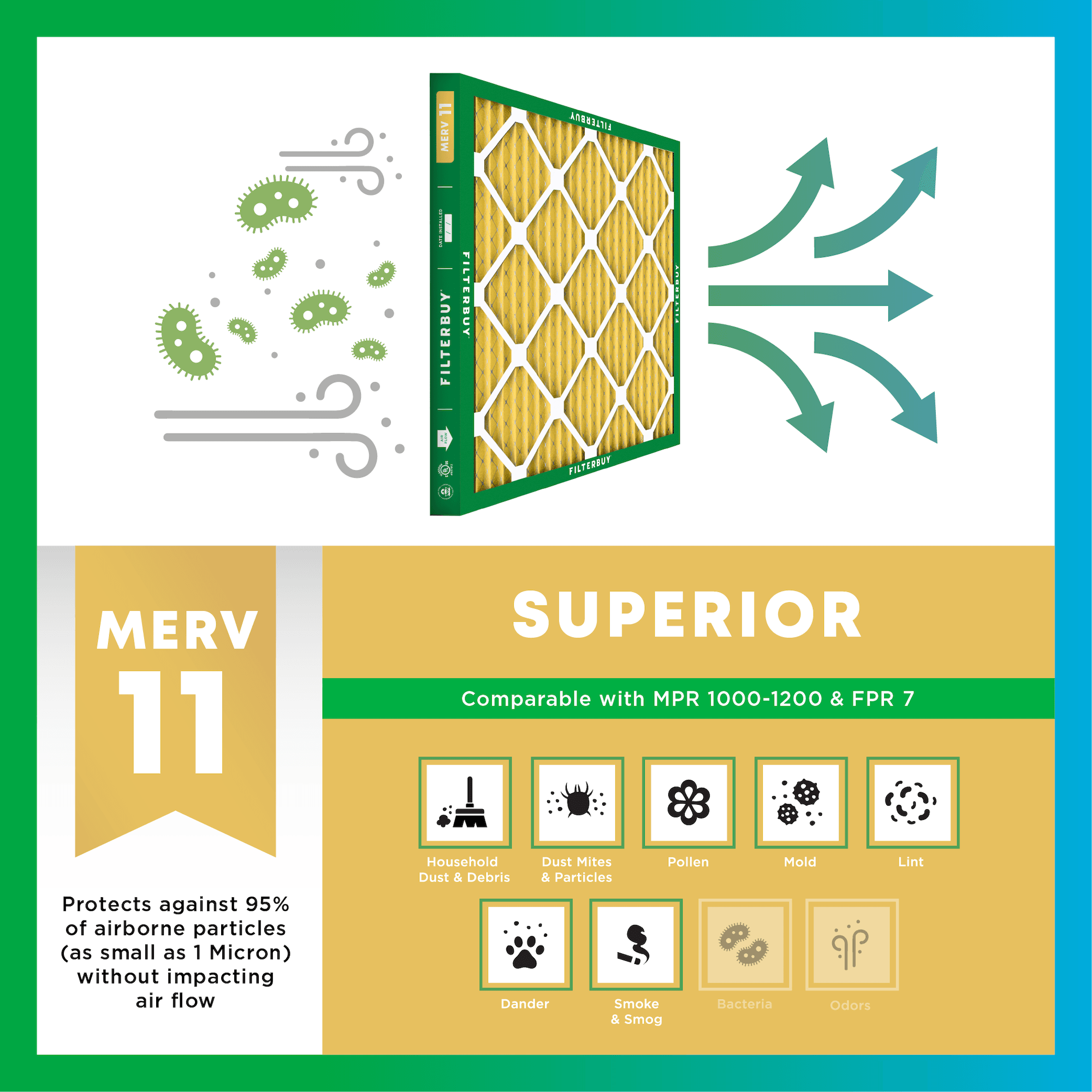
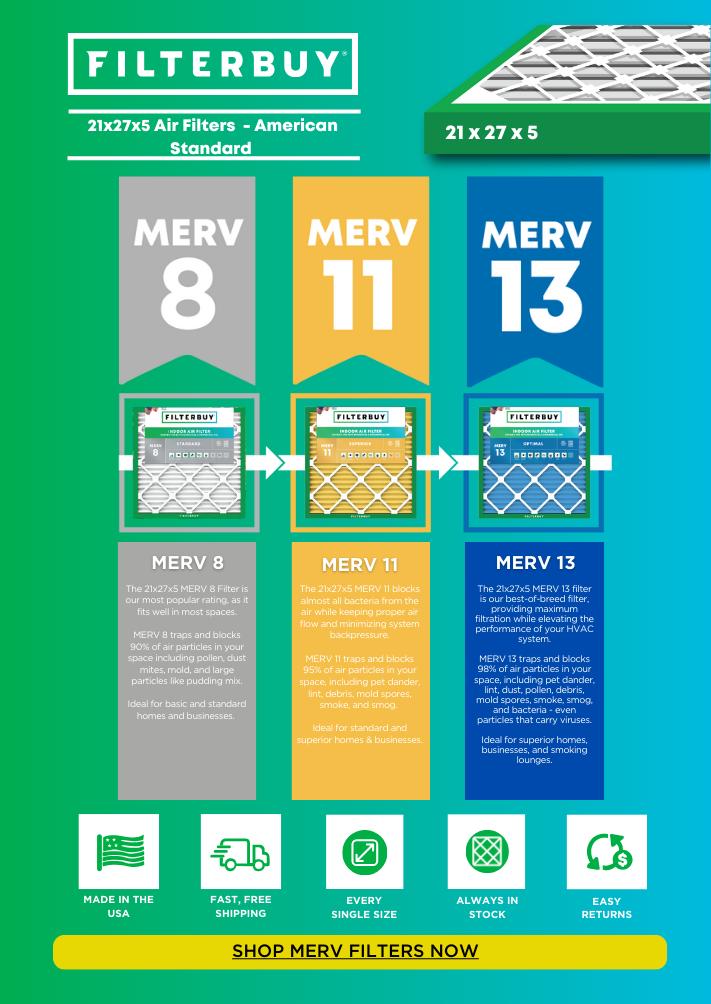
MERV stands for Minimum Efficiency Reporting Value—but don't let the technical name fool you. It's just a way to rate how well an air filter traps stuff like dust, pollen, pet dander, and smoke. The higher the MERV number, the more particles it catches—and the cleaner your air will be.

Comparable to:FPR: 4-7
MPR: 600-1000
 Dust & Debris
 Dust Mites & Particles
 Pollen
 Mold
Mold Lint
Lint Dander
Comparable to:FPR: 6-9
MPR: 1200-1550
Dust & DebrisDust Mites & ParticlesPollenMoldLintDander Smoke & Smog
Comparable to:FPR: 10
MPR: 1900-2800
Dust & DebrisDust Mites & ParticlesPollenMoldLintDanderSmoke & Smog Bacteria


We build every Filterbuy filter to deliver reliable 90-day performance—thanks to smart design and premium materials that do the heavy lifting. Here's what makes the difference:
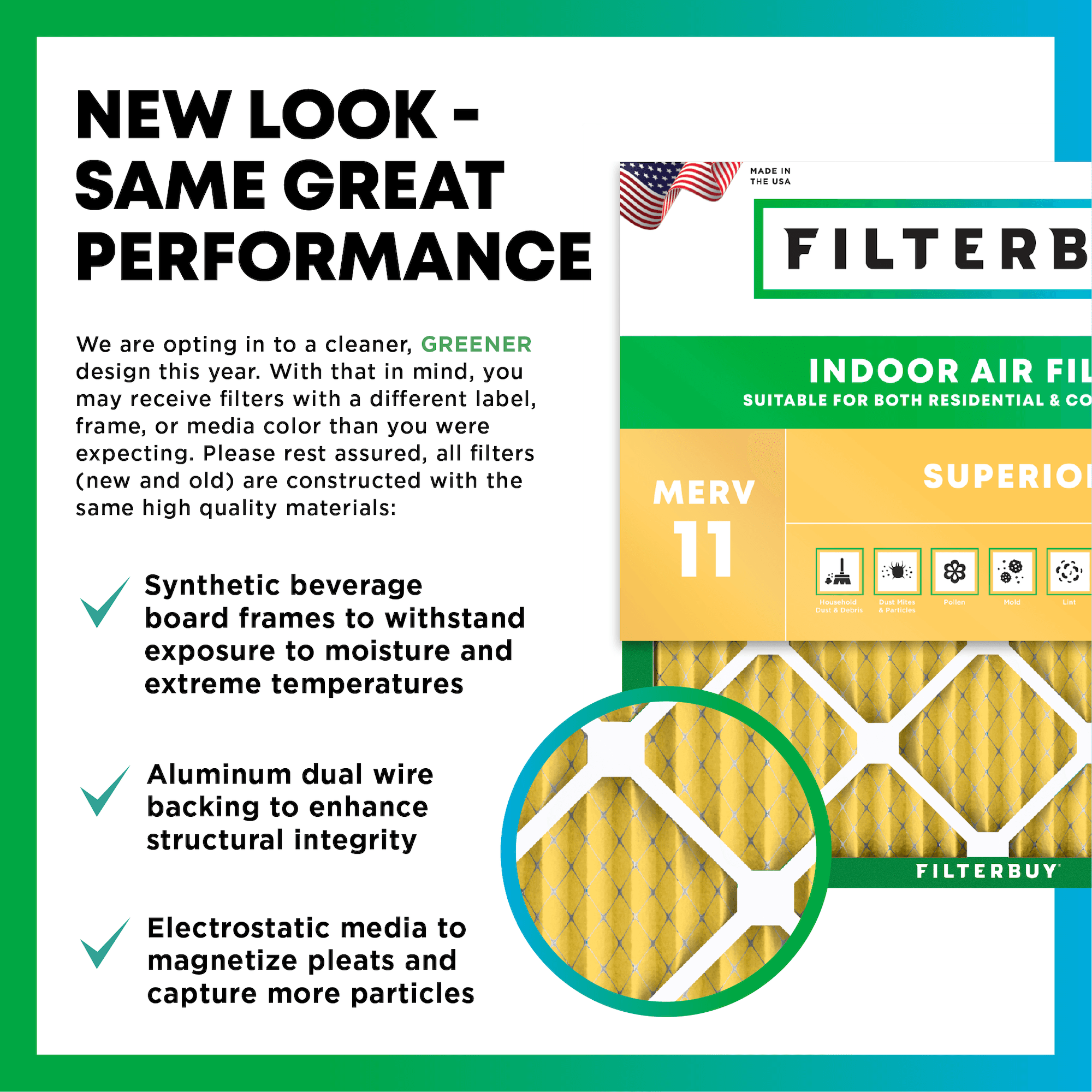
More pleats = more surface area to capture dust and debris, keeping your air cleaner longer.
Pleats are magnetized to attract and trap microscopic particles—like pet dander, pollen, and smoke.
Engineered to resist warping in extreme temperatures and high humidity.

A layer of metal reinforcement keeps pleats evenly spaced and structurally sound—no sagging, even at high airflow.
Assembled with care. Built to perform. Ships fast, free, and reliably from our U.S. facilities.

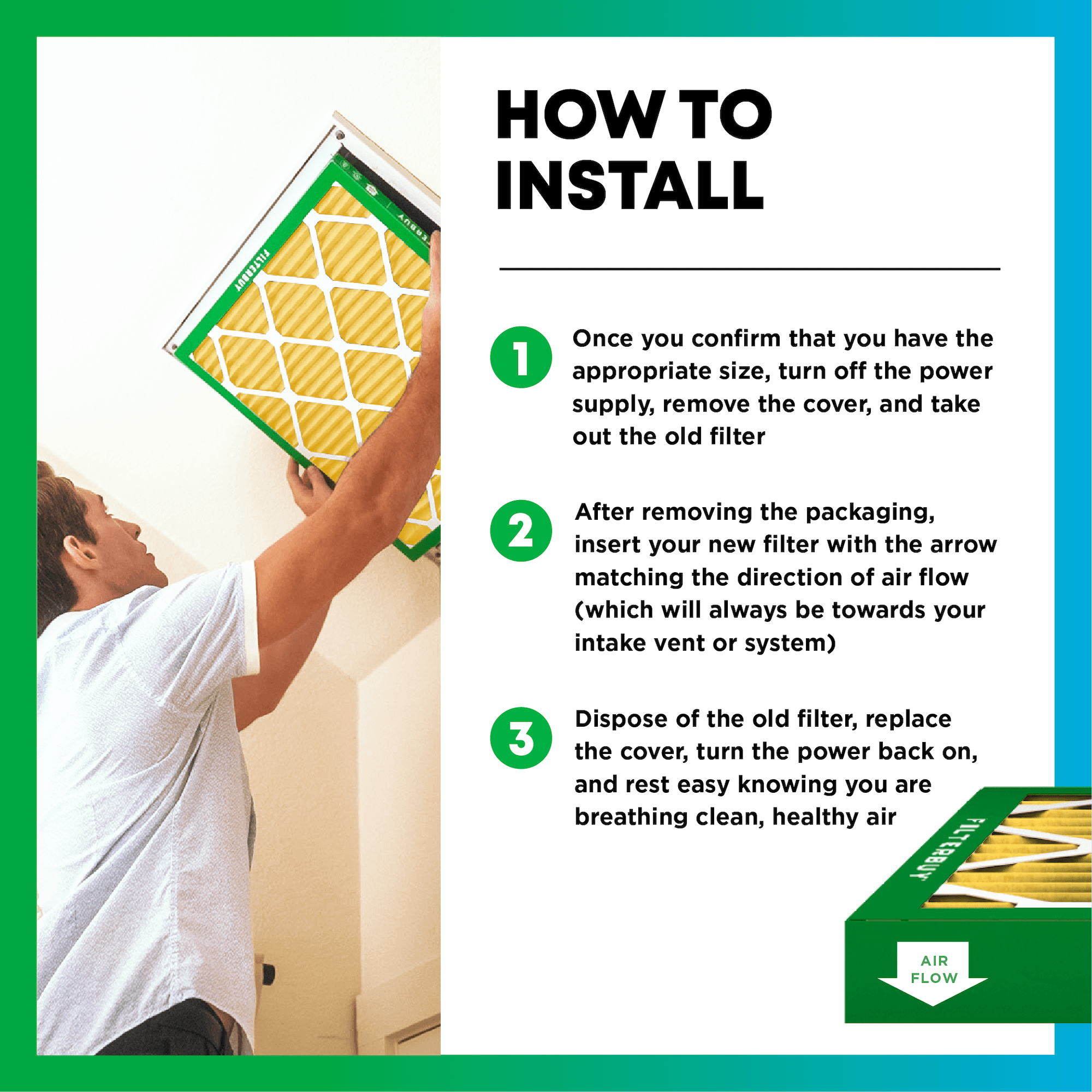
Turn Off Your HVAC SystemSafety first.

Remove The Old FilterLook for the airflow arrow and make note of the direction.

Slide In Your New FilterArrow should point toward the system (same direction as before).

Turn Your System Back OnAnd enjoy the fresh, clean air.

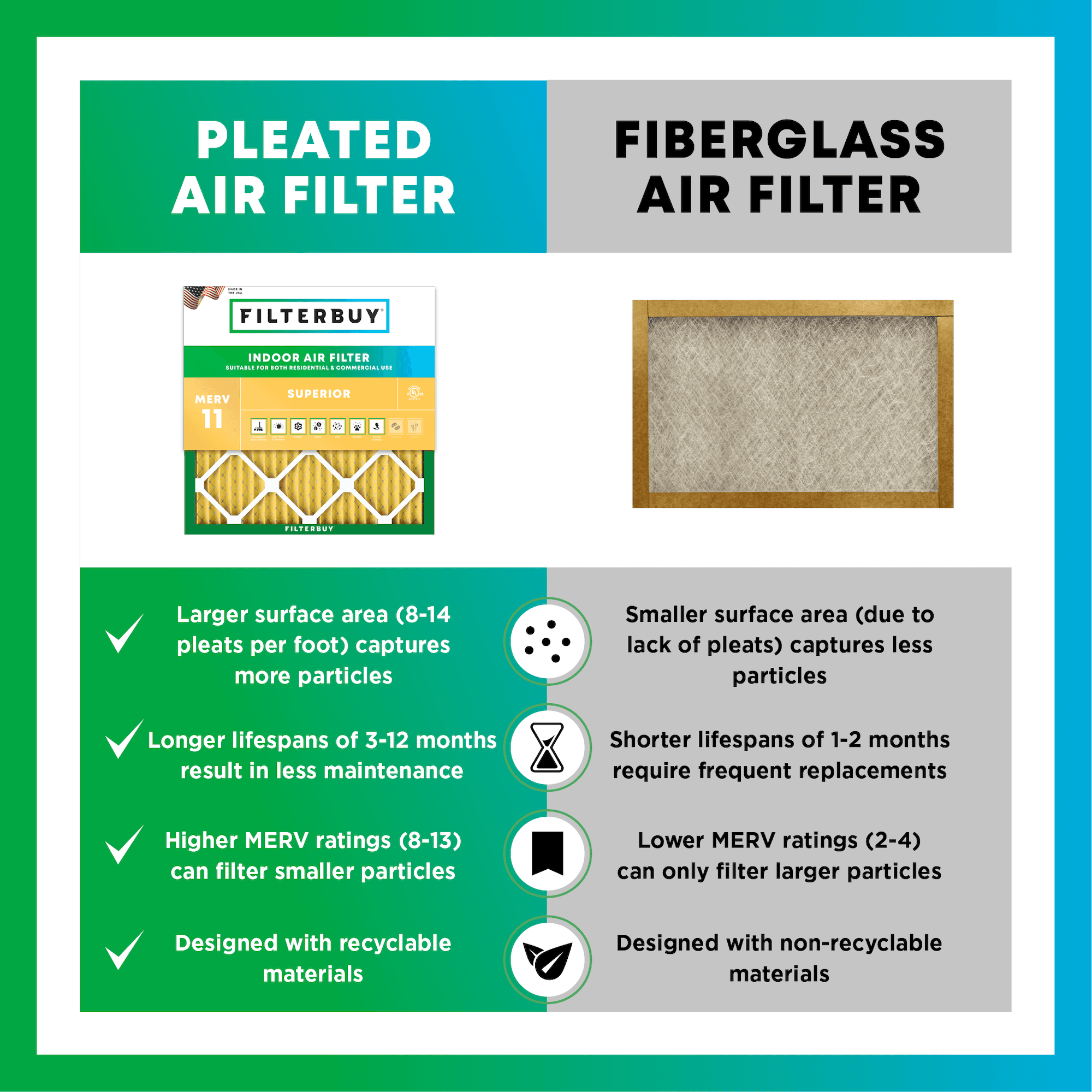
Not all air filters are created equal. Pleated filters don't just last longer—they actually clean your air better. Here's how they stack up:

Efficiency:
High (MERV 8–13) – Traps more particles
Lifespan:
90 days – Long-lasting performance
Air Quality:
Excellent – Cleaner, healthier air
Materials:
Recyclable and durable

Efficiency:
Low (MERV 4 or less) – Misses small stuff
Lifespan:
30 days or less – Replace often
Air Quality:
Minimal – Basic protection only
Materials:
Thin, flimsy, and not recyclable
Pleated filters are a no-brainer—more protection, less hassle, and better air for your home.
Changing your filter on time keeps your HVAC system running efficiently—and helps protect your lungs from dust, allergens, and airborne irritants. Here's how often to swap it out based on your needs:

For most homes without pets or special air quality concerns. Great for general upkeep and energy efficiency.

Shedding fur, dander, and allergy triggers can build up fast. Changing your filter every two months helps keep the air fresher and symptoms at bay.

For households affected by smoke, pollution, or respiratory conditions, monthly changes ensure maximum protection.

| Nominal Size | 21X27X5 |
| Actual Size | 20.56 x 26.13 x 4.97 inches |
| Filter Type | Pleated |
| Media | Electrostatically Charged |
| Frame | Beverage Board |
| MERV Ratings Available | 8, 11, 13 |
| Lifespan | Up to 12 Months |
| Origin | Made in USA |
Most homeowners pick a replacement filter based on size alone — and never question the rating. After manufacturing filters for over a decade and working directly with HVAC engineers and millions of households, we've learned that MERV rating selection is where real air quality is won or lost.
Here's what that hands-on experience taught us: MERV 11 hits a performance threshold that lower ratings simply can't reach — capturing the fine particle categories that actually drive allergy symptoms, aggravate asthma, and quietly degrade your HVAC system over time. For a 21x27x5 American Standard air filter, that distinction matters even more. The 5-inch media depth we build into these filters gives MERV 11 room to perform at full efficiency without the airflow restriction that chokes thinner designs at the same rating.
This guide gives you the real-world breakdown — not just what the number means on paper, but what it means inside your specific system, your home, and for the people breathing that air every day.
A MERV 11 21x27x5 filter is a high-capacity 5-inch media air filter designed for American Standard HVAC systems. Here's what you need to know:
What it does: Captures at least 85% of airborne particles in the 1–3 micron range — including pet dander, mold spores, and dust mite debris
Why the size matters: The 5-inch media depth delivers more surface area, lower static pressure, and longer service life than standard 1-inch filters
Who it's best for: Households with pets, allergy sufferers, or anyone with respiratory sensitivities
How long it lasts: Up to 12 months under normal residential conditions
Why MERV 11: Delivers meaningful filtration improvement over MERV 8 without the airflow restriction risk of MERV 13
Bottom line: For American Standard systems running a 21x27x5 filter slot, MERV 11 is the rating that protects your family, your air, and your equipment — every day.
MERV 11 is the threshold that matters. Captures pet dander, mold spores, and dust mite debris — the particle categories lower-rated filters miss entirely.
5-inch media depth changes the performance equation. More surface area, lower static pressure, full MERV 11 efficiency without straining your system.
Your filter choice affects your energy bill. A mismatched or clogged filter forces your blower to work harder — and you pay for it monthly.
Indoor air is your family's primary air supply. Americans spend 90% of their time indoors. Indoor air runs up to 5x more polluted than outdoor air.
Expect up to 12 months of service life. The 5-inch media format outlasts standard 1-inch filters by months — better air quality, less maintenance, stronger value.
Size gets you the right fit. MERV rating determines whether your filter actually works. The Minimum Efficiency Reporting Value scale runs from 1 to 16 in residential applications, measuring how effectively a filter captures particles across three size ranges. A MERV 11 filter captures at least 85% of particles in the 1–3 micron range — the size category that includes pet dander, mold spores, dust mite debris, and fine household dust. Filters rated MERV 8 and below miss a significant portion of that range entirely.
For most households — especially those with pets, allergy sufferers, or anyone with respiratory sensitivities — MERV 11 is the point where filtration stops being cosmetic and starts being functional.
Most residential filters are 1-inch deep. The 21x27x5 is a high-capacity media filter, and that 5-inch depth changes the performance equation in two important ways.
First, surface area. A 5-inch media filter contains significantly more pleated filter material than a 1-inch equivalent — giving particles more opportunity to be captured rather than passing through. Second, airflow efficiency. More media depth means less resistance per square inch of filtration surface, which allows MERV 11 to perform at full efficiency without creating the static pressure buildup that can strain your blower motor over time.
The result: cleaner air, longer filter life, and less wear on your system between changes.
American Standard designs its equipment to accommodate high-capacity media filters, and MERV 11 falls well within the compatible range for most of their residential units. Based on our manufacturing experience and direct feedback from HVAC technicians, MERV 11 strikes the right balance for American Standard systems — providing meaningfully better filtration than MERV 8 without the airflow restriction risk that comes with MERV 13 and above in systems not specifically rated for it.
If your household includes pets, allergy sufferers, or anyone with asthma, MERV 11 in a 21x27x5 format is the configuration we consistently recommend. It protects your family without working against your equipment.
One of the most practical advantages of the 5-inch media format is extended filter life. Where a standard 1-inch MERV 11 filter typically needs replacement every 60–90 days, a 21x27x5 filter in normal residential conditions can last up to 6–12 months before performance begins to decline.
That said, households with multiple pets, heavy dust, or anyone with respiratory conditions should inspect filters closer to the 6-month mark. A filter that's doing its job collecting contaminants will show it — and a clogged filter that hasn't been changed is no longer protecting anyone.
When you pull a 21x27x5 American Standard filter from the packaging, the label tells you three things: nominal size, actual size, and MERV rating. Nominal size is the rounded measurement used for identification — 21x27x5. Actual size is slightly smaller to allow proper fit within the filter housing. MERV rating confirms filtration efficiency tier.
One thing the label won't tell you: whether the filter was built to hold its rated efficiency across its full service life. At Filterbuy, we manufacture to maintain MERV 11 performance from the first day of installation to the last — not just under controlled lab conditions.
"After manufacturing millions of filters and working alongside HVAC engineers across the country, we've seen firsthand that the homeowners who switch to MERV 11 in a 5-inch media format consistently report fewer filter changes, lower service calls, and noticeably better air — because the format finally gives the rating room to do its job." — Filterbuy Manufacturing & Air Quality Team
At Filterbuy, we believe an informed homeowner is an empowered one. After over a decade of manufacturing filters and working alongside millions of families, we know that the right filter decision starts with the right information. These seven authoritative resources cover everything from the science behind MERV ratings to your specific American Standard system's requirements — so you can stop guessing and start protecting.
Source: U.S. Environmental Protection Agency (EPA)
Don't take your indoor air for granted. The EPA's official indoor air quality guidance pulls back the curtain on the household pollutants most families never see — the fine dust, mold spores, pet dander, and airborne debris that MERV 11 filtration is specifically engineered to stop. This is the essential first read for any homeowner who wants to understand what they're actually protecting their family from.
URL: https://www.epa.gov/indoor-air-quality-iaq
Source: ASHRAE Standard 52.2
We test every filter we manufacture against real performance standards — and ASHRAE's Standard 52.2 is the industry benchmark that makes that possible. This is the definitive technical reference that determines how MERV ratings are tested, assigned, and verified. Understanding it means you'll never have to take a performance claim on faith again.
URL: https://www.ashrae.org/technical-resources/standards-and-guidelines
Source: U.S. Department of Energy (DOE)
Here's something that surprises most homeowners: the filter you choose doesn't just affect your air — it affects your energy bill. The DOE's heating and cooling efficiency resources explain exactly how media depth and MERV rating influence your system's airflow resistance and long-term operating costs. For 5-inch media filter owners, this one is worth reading closely.
URL: https://www.energy.gov/energysaver/heating-cooling
Source: American Standard Heating & Air Conditioning
Protecting your family starts with knowing your system. American Standard's official product resources let you verify your unit's exact filter sizing, confirm MERV compatibility, and review manufacturer-recommended maintenance schedules — straight from the source. Before you buy, make sure your filter and your system are built to work together.
URL: https://www.americanstandardair.com
Source: Centers for Disease Control and Prevention (CDC)
The air inside your home is working on your family's health every single day — for better or worse. The CDC's indoor air quality guidance connects airborne particulate exposure directly to respiratory health outcomes, allergy triggers, and asthma aggravation in household environments. This is the research that makes MERV 11 more than just a number on a label.
URL: https://www.cdc.gov/air/default.htm
Source: National Institute of Allergy and Infectious Diseases (NIAID)
We've worked with enough allergy and asthma sufferers to know that the worst offenders are usually invisible. NIAID research documents exactly how pet dander, dust mite debris, and mold spores accumulate in residential air — and how high-efficiency filtration like MERV 11 meaningfully reduces household allergen load for the people who need cleaner air most.
URL: https://www.niaid.nih.gov/diseases-conditions/allergic-diseases
Source: Filterbuy Learning Center
We built this guide because we kept hearing the same questions from homeowners who just wanted a straight answer. Our expert buying resource translates over a decade of manufacturing experience into plain-language guidance on MERV ratings, media types, filter sizing, and replacement schedules — everything you need to make a confident, informed decision without wading through technical specs on your own.
URL: https://Filterbuy.com/resources/air-filter-buying-guide
After a decade of manufacturing filters and working with homeowners and HVAC technicians across the country, these numbers don't surprise us — but they should give every homeowner pause.
Source: U.S. Environmental Protection Agency
URL: https://www.epa.gov/indoor-air-quality-iaq/introduction-indoor-air-quality
The EPA reports indoor air pollutant levels can run 2–5x higher than outdoor concentrations — and up to 100x higher in some cases. We see the proof every time a customer shares a photo of a 90-day-old filter pull. What's on that media tells the whole story:
Mold fragments
Pet dander
Fine airborne debris
Particulates cycling through your home 24 hours a day
The bottom line: Americans spend roughly 90% of their time indoors. MERV 11 isn't an upgrade — it's the responsible baseline.
Source: Centers for Disease Control and Prevention
URL: https://www.cdc.gov/asthma/data.html
The CDC identifies these as the most common household asthma and allergy triggers:
Dust mite debris
Pet dander
Mold spores
Those are also the exact particle categories MERV 11 is engineered to capture. That's not a coincidence — it's why MERV 11 is our most recommended rating for sensitive households. The feedback we consistently hear after customers switch to MERV 11 in a 5-inch format:
Fewer allergy and asthma symptoms
Fewer HVAC service calls
Air that finally feels like it's actually being cleaned
Source: U.S. Department of Energy
URL: https://www.energy.gov/energysaver/heating-cooling
The DOE puts heating and cooling at nearly 50% of total household energy consumption. In our experience, a mismatched filter is one of the most overlooked drivers of that number. The most common scenario we see:
Homeowner runs a 1-inch filter in a system designed for 5-inch media
Static pressure builds
Blower works harder
Energy bills climb
Service calls follow
A properly fitted 21x27x5 MERV 11 filter maintains lower static pressure across a longer service life. Your American Standard system was built to run efficiently with the right media — and when it does, you feel it in your air and your monthly bills.
Most homeowners treat filter replacement as a chore. After a decade of manufacturing and working with millions of households, we've come to see that mindset as one of the most quietly costly mistakes a homeowner can make.
The 21x27x5 American Standard format is one of the most capable residential filtration configurations available. But we've seen that potential consistently undermined by three things:
The wrong MERV rating
Low-quality filter media
A filter left in service too long
MERV 11 isn't the highest number on the scale — it's the point where filtration becomes genuinely meaningful for real households. It captures the particle categories that:
Drive allergy and asthma symptoms
Degrade indoor air quality silently over time
Accelerate HVAC wear when left unfiltered
And in a 5-inch media format, it does all of that without straining your system.
Better air quality — immediately noticeable in sensitive households
Fewer HVAC service calls between maintenance visits
Lower energy bills from a system running as designed
Reduced allergy and asthma symptoms for family members
A MERV 11 21x27x5 filter isn't a premium splurge. It's the version of home maintenance that actually works — quietly, consistently, every single day. After everything we've seen inside this industry, that's not a sales pitch. It's just what the evidence keeps showing us.
You have the information. Here's exactly what to do next — in order.
Locate your existing filter in the return air duct or air handler
Check the printed dimensions on the filter's cardboard frame
Confirm the nominal size reads 21x27x5
No label? Measure the slot opening and round up to the nearest inch
Check your American Standard owner's manual for recommended MERV range
Find your model number on the air handler or furnace cabinet
Cross-reference at americanstandardair.com if manual is unavailable
Still unsure? Contact a local HVAC technician for confirmation
Visit Filterbuy and enter your filter size
Select MERV 11 from the rating options
Choose single filter or subscribe-and-save for automatic delivery
Ships fast from U.S. manufacturing facilities
Power down your HVAC system before removing the old filter
Note the airflow direction arrow on the old filter frame
Insert new air filter with airflow arrow pointing toward the blower motor
Confirm filter seats flush with no gaps around the frame
Power system back on and listen for normal airflow
Set a calendar reminder for a 6-month inspection
Check filter face for visible gray or brown discoloration
Replace immediately if airflow feels reduced at vents
Pets or allergy sufferers in the home? Inspect at the 6-month mark
After installation, expect to notice:
Less dust accumulation near vents
More consistent airflow throughout your home
Fewer allergy and asthma symptoms in sensitive family members
Reduced energy consumption on your next utility bill
A: Yes — for the vast majority of American Standard residential units. Here's what we recommend before installing:
Check your owner's manual for the recommended MERV range
Locate your model number on the air handler or furnace cabinet
Cross-reference compatibility at americanstandardair.com
When in doubt, confirm with a local HVAC technician
Bottom line: If your system was designed with a 21x27x5 filter slot, it was engineered to handle MERV 11 without airflow restriction issues.
A: It's not just thicker — it's a fundamentally different filtration format. Here's what the 5-inch media depth delivers that a 1-inch filter can't:
More pleated filter media = more particle capture opportunity
Lower static pressure across the full service life
Longer replacement cycle — up to 12 months vs. 60–90 days
Full MERV 11 efficiency without straining your system
Bottom line: Homeowners who switch from 1-inch to 5-inch media consistently notice better air quality and longer time between filter changes.
A: MERV 11 captures at least 85% of airborne particles in the 1–3 micron range. In real household terms, that includes:
Pet dander
Mold spores
Dust mite debris
Fine household dust
Smoke particles
Legionella bacteria
Bottom line: These are the exact particle categories that drive allergy symptoms and aggravate asthma. MERV 8 misses a significant portion of them. MERV 11 doesn't.
A: Inspect at 6 months. Replace within 6–12 months under normal conditions. Shorten that timeline if your household includes:
Multiple pets — inspect at 6 months
Allergy or asthma sufferers — inspect at 6 months
Heavy dust or recent renovation — inspect at 3–4 months
High daily HVAC runtime — inspect at 6 months
Watch for these replacement indicators:
Visible gray or brown discoloration across the filter face
Noticeable drop in airflow at vents
Increase in dust accumulation on nearby surfaces
Bottom line: A visibly loaded filter has stopped protecting your family and started restricting your system. When you see it — change it.
A: Because higher isn't always better — and we've seen what happens when it isn't. Here's the MERV 13 problem we see repeatedly:
Higher static pressure restricts airflow in systems not rated for it
Blower motor works harder to compensate
Energy consumption increases
System wear accelerates
Service calls follow
What MERV 11 delivers instead:
Meaningful filtration improvement over MERV 8
Full particle capture in the categories that matter most
No unnecessary strain on your American Standard system
Lower energy consumption over the filter's service life
Bottom line: After a decade of working with homeowners and HVAC technicians across the country, MERV 11 in a 21x27x5 format isn't the compromise option — it's the right option for most households.
Stop guessing and start protecting — find your exact 21x27x5 MERV 11 replacement filter at Filterbuy and get it shipped fast, direct from our U.S. manufacturing facility. Your family's air quality is worth getting right.

