
Tip: Ensure you buy the exact air filter size for your system. Certain brands have precise dimensions that only fit their specific models. See related filters
Actual Size: 20.25x20.75x5.25"
 Free Delivery
  Factory-Direct Low Prices, Made in the USA
 Hassle-Free Returns & Free Exchanges
RESIDENTIAL AND/OR COMMERCIAL USE
Change Every 3 Months
Tip: Ensure you buy the exact air filter size for your system. Certain brands have precise dimensions that only fit their specific models. See related filters
Actual Size: 20.25x20.75x5.25"
Free Delivery Factory-Direct Low Prices, Made in the USAHassle-Free Returns & Free ExchangesRESIDENTIAL AND/OR COMMERCIAL USE
Change Every 3 Months
Tip: Ensure you buy the exact air filter size for your system. Certain brands have precise dimensions that only fit their specific models. See related filters
Actual Size: 20.25x20.75x5.25"
Free Delivery Factory-Direct Low Prices, Made in the USAHassle-Free Returns & Free ExchangesRESIDENTIAL AND/OR COMMERCIAL USE
Change Every 3 Months
At Filterbuy, we don't cut corners—we craft high-quality air filters right here in the USA and ship them to your doorstep for free. No delays, no gimmicks—just clean air, made easy. With thousands of five-star reviews and filters built for real life & every HVAC system, it's no wonder why over 4 million families trust Filterbuy.

Proudly Made In The USA

Fast, Free Shipping on Every Order

Premium Materials That Go The Distance

85,000+ 5-Star Reviews From Happy Customers

Save Up to 70% Per Filter with Packs


Measure length × width × depth with a tape measure to find the actual size.

Round up each dimension to the nearest whole number to get the nominal size. Example: 20.25x20.75x5.25" in → 20X20X5 nominal.

Search by nominal size on our site for the best fit.


5″ filters give you maximum filtration with minimal maintenance — lasting up to 12 months while handling higher MERV ratings without restricting airflow.
Sizing note:

If the filter you buy doesn't fit, we'll send you a better size.
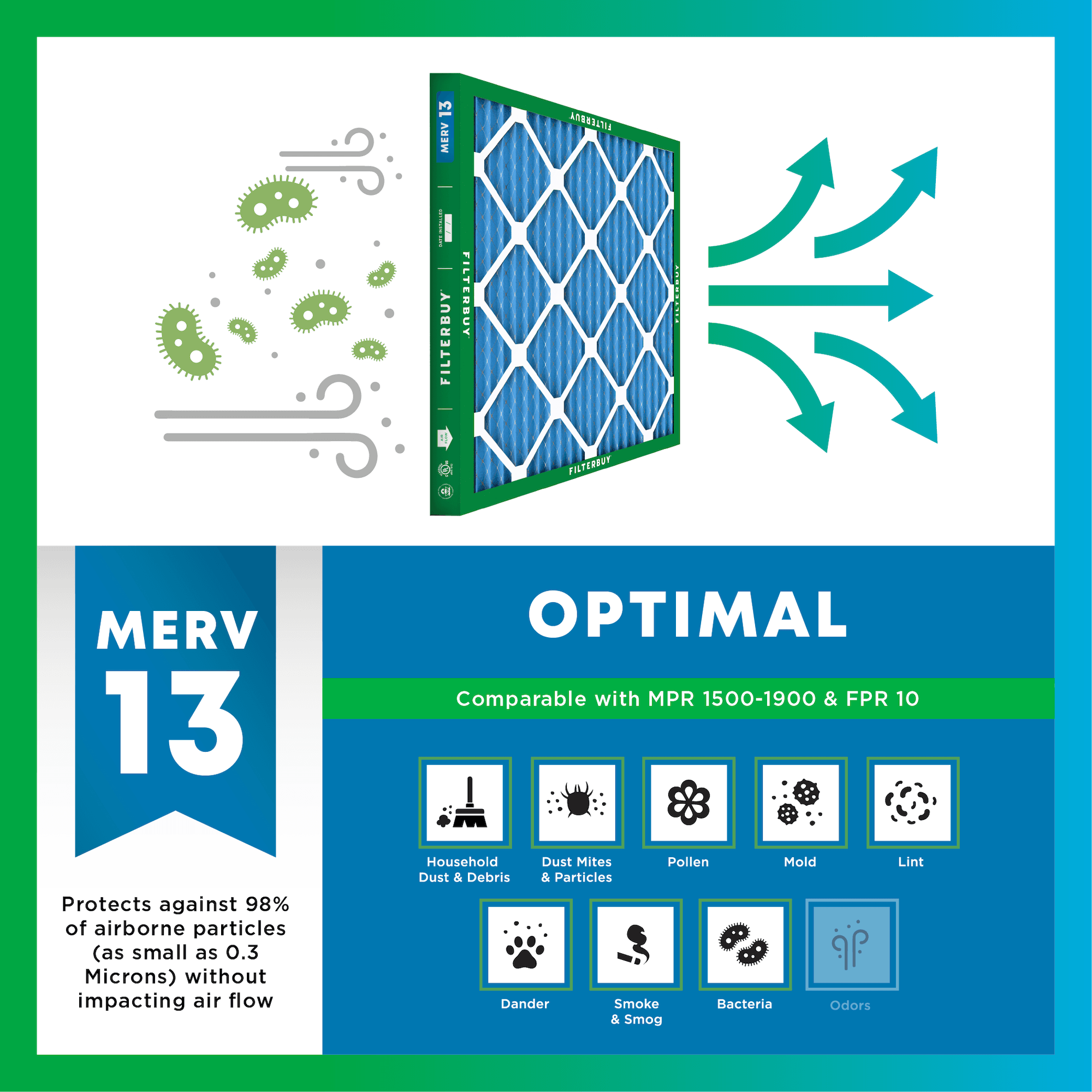
MERV stands for Minimum Efficiency Reporting Value—but don't let the technical name fool you. It's just a way to rate how well an air filter traps stuff like dust, pollen, pet dander, and smoke. The higher the MERV number, the more particles it catches—and the cleaner your air will be.

Comparable to:FPR: 4-7
MPR: 600-1000
 Dust & Debris
 Dust Mites & Particles
 Pollen
 Mold
Mold Lint
Lint Dander
Comparable to:FPR: 6-9
MPR: 1200-1550
Dust & DebrisDust Mites & ParticlesPollenMoldLintDander Smoke & Smog
Comparable to:FPR: 10
MPR: 1900-2800
Dust & DebrisDust Mites & ParticlesPollenMoldLintDanderSmoke & Smog Bacteria


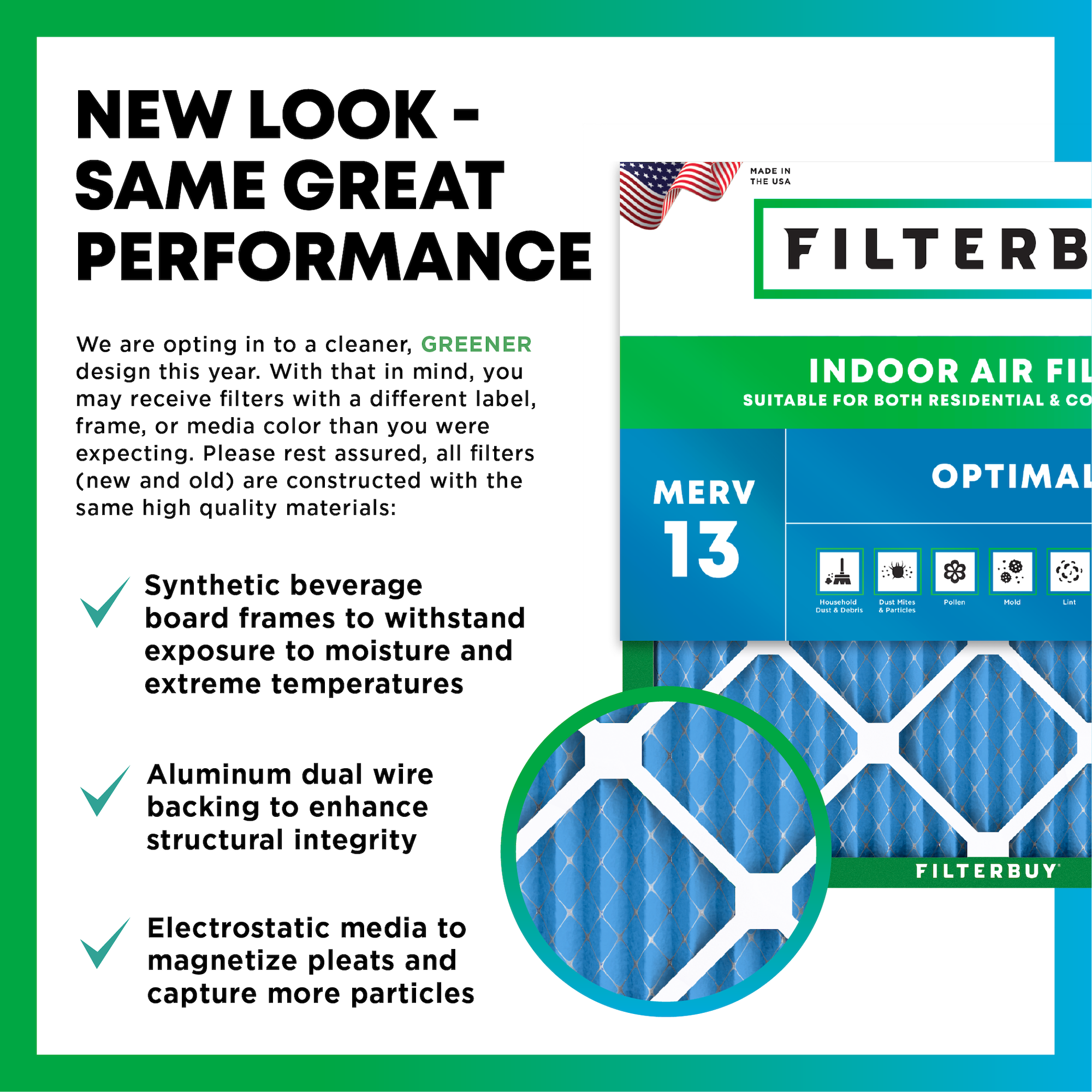
We build every Filterbuy filter to deliver reliable 90-day performance—thanks to smart design and premium materials that do the heavy lifting. Here's what makes the difference:
More pleats = more surface area to capture dust and debris, keeping your air cleaner longer.
Pleats are magnetized to attract and trap microscopic particles—like pet dander, pollen, and smoke.
Engineered to resist warping in extreme temperatures and high humidity.

A layer of metal reinforcement keeps pleats evenly spaced and structurally sound—no sagging, even at high airflow.
Assembled with care. Built to perform. Ships fast, free, and reliably from our U.S. facilities.

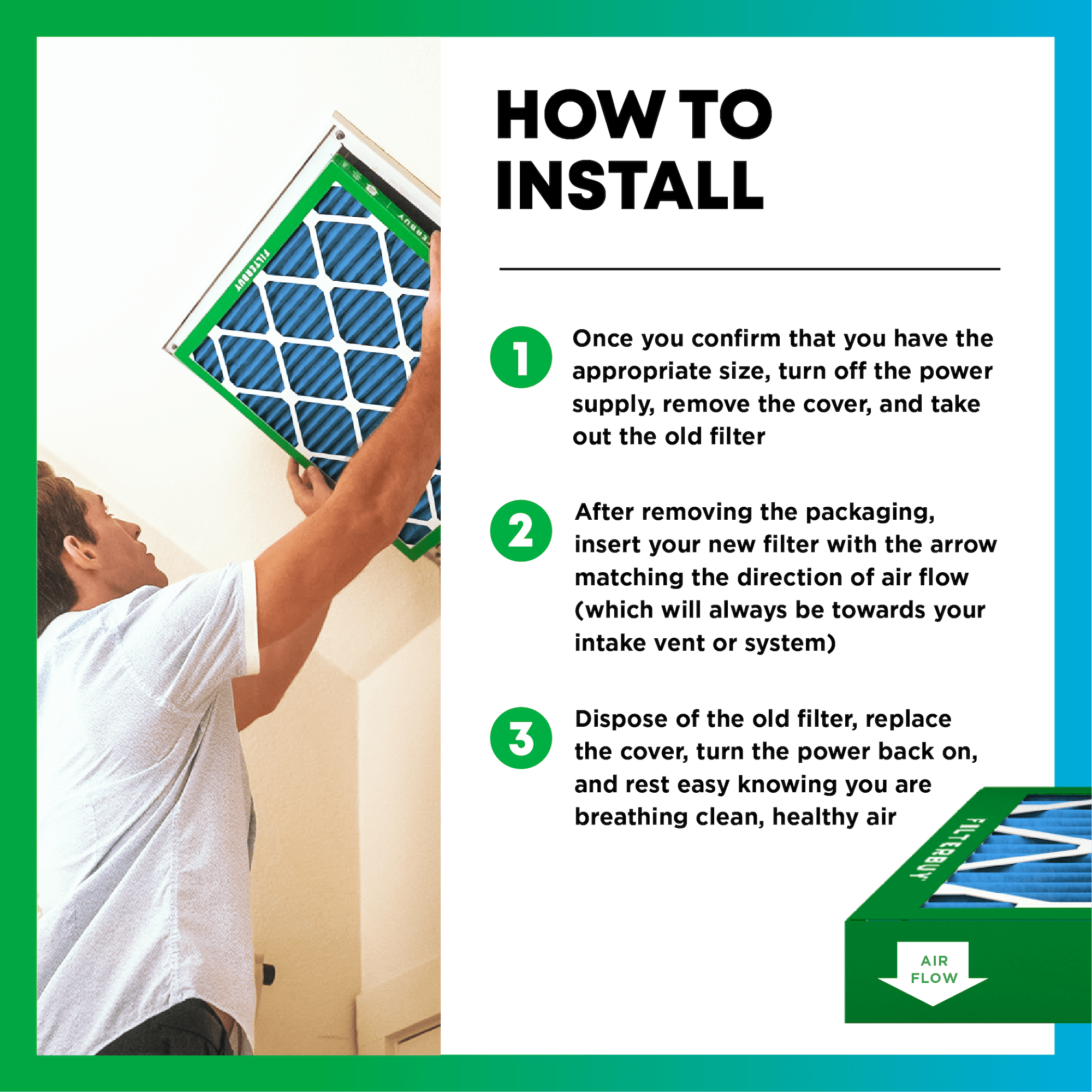
Turn Off Your HVAC SystemSafety first.

Remove The Old FilterLook for the airflow arrow and make note of the direction.

Slide In Your New FilterArrow should point toward the system (same direction as before).

Turn Your System Back OnAnd enjoy the fresh, clean air.

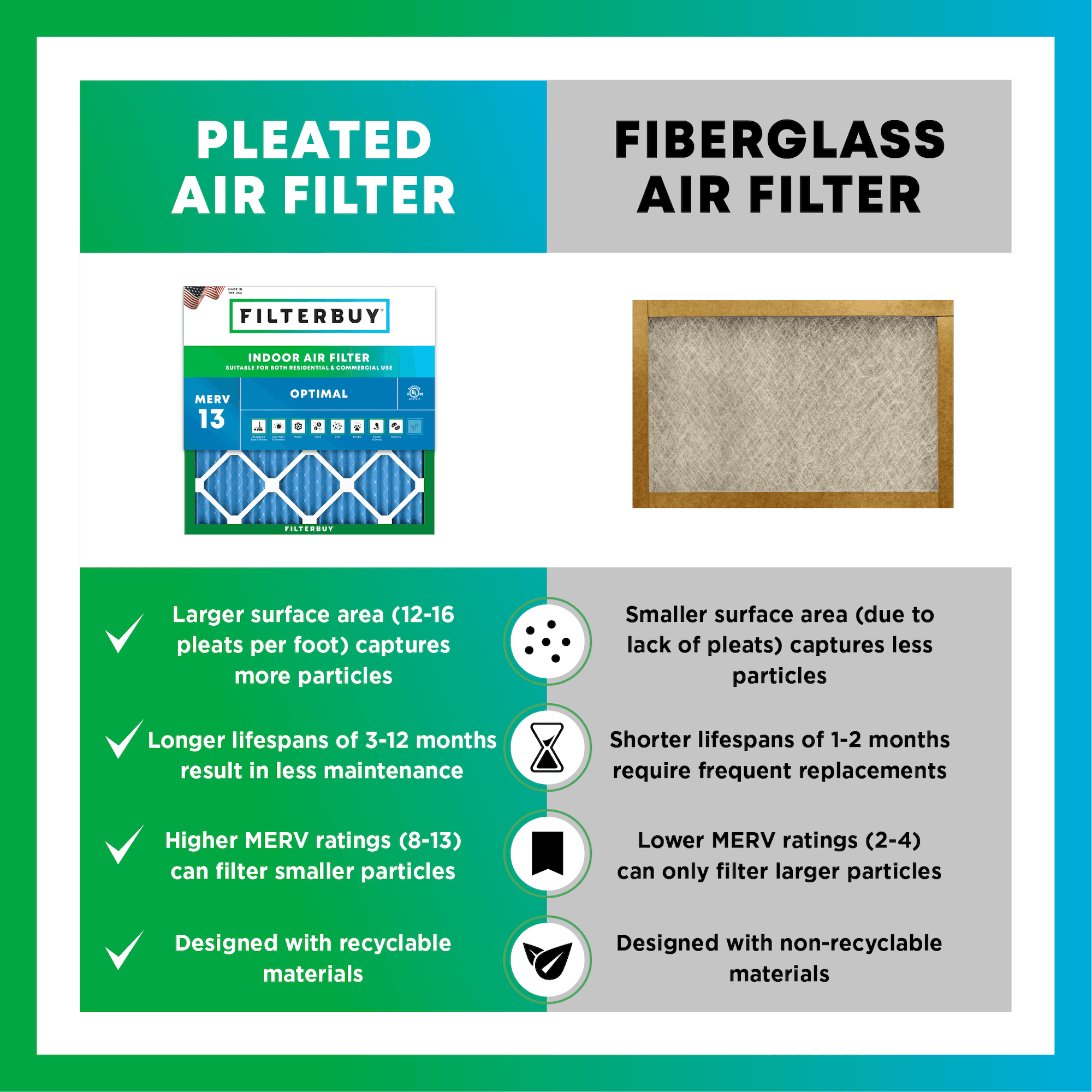
Not all air filters are created equal. Pleated filters don't just last longer—they actually clean your air better. Here's how they stack up:

Efficiency:
High (MERV 8–13) – Traps more particles
Lifespan:
90 days – Long-lasting performance
Air Quality:
Excellent – Cleaner, healthier air
Materials:
Recyclable and durable

Efficiency:
Low (MERV 4 or less) – Misses small stuff
Lifespan:
30 days or less – Replace often
Air Quality:
Minimal – Basic protection only
Materials:
Thin, flimsy, and not recyclable
Pleated filters are a no-brainer—more protection, less hassle, and better air for your home.
Changing your filter on time keeps your HVAC system running efficiently—and helps protect your lungs from dust, allergens, and airborne irritants. Here's how often to swap it out based on your needs:

For most homes without pets or special air quality concerns. Great for general upkeep and energy efficiency.

Shedding fur, dander, and allergy triggers can build up fast. Changing your filter every two months helps keep the air fresher and symptoms at bay.

For households affected by smoke, pollution, or respiratory conditions, monthly changes ensure maximum protection.

| Nominal Size | 20X20X5 |
| Actual Size | 20.25 x 20.75 x 5.25" inches |
| Filter Type | Pleated |
| Media | Electrostatically Charged |
| Frame | Beverage Board |
| MERV Ratings Available | 8, 11, 13 |
| Lifespan | Up to 12 Months |
| Origin | Made in USA |
Is your Amana system working harder but delivering less? Weak airflow, uneven temperatures, and rising energy bills often point to one culprit: your MERV 13 20x20x5 filter may be restricting airflow beyond what your system can handle.
Customers tell us this is one of the most common issues they face after upgrading to higher-efficiency filters. After manufacturing millions of MERV 13 filters, we've seen firsthand how the denser media that captures more pollutants also demands more from your blower motor. The result? Your system strains to pull air through, and your comfort suffers.
The signs are consistent—and fixable. We'll show you exactly what to look for and how to restore proper airflow without sacrificing the air quality your family deserves.
A MERV 13 20x20x5 filter delivers hospital-grade particle capture for Amana HVAC systems—trapping bacteria, smoke, and allergens down to 0.3 microns.
What we've learned after manufacturing millions of these filters:
5-inch depth reduces resistance — More surface area than 1-inch filters at the same MERV rating
Actual dimensions matter — Our 20x20x5 measures 20.25" x 20.75" x 5.25" actual
Compatible with most Amana systems — Also fits Goodman, Coleman, York, and Maytag units
Replace every 6-9 months — Check monthly during peak seasons
Best for households with:
Allergy or asthma sufferers
Pets
Smokers
Respiratory health concerns
Consider MERV 11 if:
Your system shows airflow restriction symptoms
Energy bills have increased since upgrading
You want strong filtration with less resistance
After working with thousands of Amana system owners, we've found the 20x20x5 format handles MERV 13 filtration better than any thinner alternative—giving you cleaner air without straining your equipment.
MERV 13 captures more but demands more. Dense media traps bacteria, smoke, and fine dust—but not every Amana system generates enough static pressure to push air through it.
Airflow symptoms are predictable. Weak vents, uneven temperatures, longer run times, higher bills, and whistling sounds all signal excessive filter resistance.
5-inch depth works in your favor. Deeper pleats mean more surface area, less resistance per square inch, and easier breathing for your system compared to 1-inch filters.
Dirty filters compound the problem. Check monthly during peak seasons—manageable resistance becomes a severe restriction as particles accumulate.
MERV 11 often solves the problem. If your system struggles with MERV 13, stepping down delivers 90% of the air quality benefit with significantly less airflow penalty.
One of the first signs of a filter-related airflow restriction is reduced output from your supply vents. Walk through your home and hold your hand near each register. If the air feels noticeably weaker than usual — or if some rooms get strong airflow while others barely get a breeze — your MERV 13 filter may be the culprit.
This happens because a clogged or overly restrictive filter forces your blower motor to work harder to push air through the dense media. The system can't distribute conditioned air evenly, leaving certain rooms stuffy or uncomfortable. If you've ruled out closed dampers and blocked registers, check the filter first.
Pay attention to how long your system runs before reaching your thermostat's set temperature. When a MERV 13 filter becomes loaded with captured particles, your system has to run significantly longer to heat or cool your home. You may notice the unit cycling on and off more frequently or simply running nonstop during moderate weather.
Extended run times put unnecessary strain on your blower motor, compressor, and other critical components. They also drive up your energy bills. If your utility costs have crept up without an obvious explanation, a restricted MERV 13 filter could be silently forcing your system to overwork.
A healthy HVAC system produces a steady, low hum during operation. When your MERV 13 20x20x5 Amana filter is creating too much resistance, you may start hearing whistling, rattling, or a strained motor sound near the air handler or return vent.
Common noises that point to filter-related airflow restriction include:
Whistling or hissing near the return vent — air is being forced through a small gap in the loaded filter media
Rattling or vibration — the filter may be getting sucked inward due to high negative pressure
Loud blower motor strain — the fan is working overtime to compensate for restricted airflow
Any of these sounds should prompt an immediate filter inspection. A severely restricted filter can even collapse under pressure, sending debris into your ductwork.
Pull your 20x20x5 Amana filter out and inspect it. A new MERV 13 filter should appear uniformly white or light gray. If the intake side is coated in a dark layer of dust, pet hair, or debris — or if you can't see light passing through the media — it's well past time for a replacement.
MERV 13 filters in a 20x20x5 format typically offer 6 to 12 months of service life, depending on household conditions. Homes with pets, smokers, high dust levels, or recent construction may need replacements closer to every 3 to 6 months. Don't rely solely on a calendar schedule — visual inspection is the most reliable way to assess your filter's remaining capacity.
When airflow is restricted, your HVAC system can't deliver conditioned air where it's needed most. The result is hot and cold spots that make your home feel uncomfortable regardless of what the thermostat reads. You might find upstairs rooms significantly warmer in summer or far-end bedrooms that never quite reach the set temperature.
These temperature swings are especially common with MERV 13 filters in older systems or units with lower-powered blower motors. The higher filtration rating demands more static pressure, and systems that weren't designed for that level of resistance will struggle to maintain balanced airflow across all zones.
This is one of the more serious consequences of prolonged airflow restriction. When a loaded MERV 13 filter starves your system of air, the evaporator coil doesn't receive enough warm air to maintain proper operating temperature. The coil drops below freezing and moisture in the air condenses and freezes on its surface.
If you notice ice or frost on your indoor coil, or if water is pooling around your air handler, shut the system off immediately and check the filter. Running a system with a frozen coil can damage the compressor — one of the most expensive HVAC components to replace. A simple filter swap can prevent a repair bill that runs into the thousands.
If you're experiencing any of these warning signs, start by replacing the filter with a fresh MERV 13 20x20x5 that's specifically engineered for your Amana system. A properly sized replacement ensures a snug fit with no air bypass, which is critical for both filtration performance and unrestricted airflow.
After installing a new filter, keep these best practices in mind:
Check the filter every 60 to 90 days — don't wait for symptoms to appear
Confirm MERV 13 compatibility with your specific Amana unit — consult your owner's manual or an HVAC professional
Subscribe to a filter delivery schedule so you always have a replacement on hand when it's time
Schedule annual HVAC maintenance to verify your system handles MERV 13 static pressure requirements without issue
The right MERV 13 filter protects your indoor air quality without compromising system performance. The key is staying ahead of replacement schedules and matching the filter to your system's capabilities.
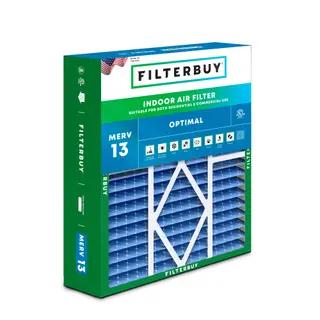
"After manufacturing millions of MERV 13 filters, we've seen that the same dense media delivering superior air quality can overwhelm systems not designed to handle the added resistance—knowing your equipment's limits is just as important as choosing the right filtration level."
The American Society of Heating, Refrigerating and Air-Conditioning Engineers establishes the MERV testing standards (ASHRAE 52.2) that determine how effectively filters capture particles from 0.3 to 10 microns. This resource explains why ASHRAE recommends MERV 13 as a minimum for capturing airborne bacteria, smoke particles, and virus-carrying aerosols in residential environments.
Source: https://www.ashrae.org/technical-resources/filtration-and-disinfection-faq
The U.S. Environmental Protection Agency provides authoritative guidance on selecting furnace filters that balance particle capture efficiency with system airflow requirements. This resource confirms that filters rated MERV 7-13 perform nearly as effectively as HEPA filtration for most residential indoor air contaminants while maintaining adequate airflow.
Source: https://www.epa.gov/indoor-air-quality-iaq/guide-air-cleaners-home
The American Lung Association documents how poor indoor air quality contributes to asthma, respiratory infections, and chronic lung disease—with indoor air measuring 2-5 times more polluted than outdoor air in many homes. This resource recommends MERV 13 filtration for households seeking meaningful protection against airborne health threats.
Source: https://www.lung.org/clean-air/indoor-air
U.S. Department of Energy guidance explains that clogged or overly restrictive filters can increase HVAC energy consumption by up to 15% while reducing system lifespan. This resource provides maintenance schedules and filter selection criteria that balance air quality with operational efficiency.
Source: https://www.energystar.gov/saveathome/heating-cooling
Amana's official product documentation details which MERV ratings their residential furnaces and air conditioners are engineered to accommodate. Consulting this resource before upgrading to MERV 13 filtration helps prevent airflow restriction issues caused by filter-system incompatibility.
Source: https://www.amana-hac.com/resources/hvac-learning-center/operation/air-filters-and-merv-ratings
Pacific Northwest National Laboratory research demonstrates that 5-inch filters create significantly less airflow resistance than 1-inch filters at equivalent MERV ratings due to increased surface area. This technical guide explains why deeper media filters often deliver superior MERV 13 performance without straining residential HVAC systems.
Source: https://basc.pnnl.gov/resource-guides/high-merv-filters
Industry-standard guidance for HVAC professionals and informed homeowners explains how to measure filter pressure drop and interpret the results. This resource establishes the 20% rule: filter resistance should not exceed 20% of your equipment's maximum rated static pressure—typically 0.10 inches of water column for most residential systems rated at 0.50 inches.
Americans spend approximately 90% of their time indoors, where pollutant concentrations measure 2-5 times higher than outdoor levels.
After helping customers select filters for millions of HVAC systems, we've seen how this plays out:
Families assume their air is clean simply because a filter is installed
A restricted MERV 13 filter circulating less air can reduce overall air quality
Superior particle capture means nothing if your system can't move enough air through the filter
Source: U.S. Environmental Protection Agency https://www.epa.gov/indoor-air-quality-iaq
Clogged or overly restrictive filters increase HVAC energy consumption by up to 15%.
Customers frequently tell us they upgraded to MERV 13 expecting better performance—then watched utility bills climb. The pattern is predictable:
System strains against resistance it wasn't designed to handle
Blower motor runs longer to compensate
Energy costs rise while comfort declines
Source: U.S. Department of Energy https://www.energystar.gov/saveathome/heating-cooling
Poor indoor air quality contributes to headaches, respiratory irritation, chronic lung disease, cardiovascular problems, and cancer.
We hear from customers with allergy and asthma sufferers who switched to MERV 13 specifically for health protection. Our key insight:
A properly matched filter your system can breathe through protects better than a high-efficiency filter that chokes airflow
Adequate circulation matters as much as particle capture
The right balance keeps vulnerable family members safer
Source: American Lung Association https://www.lung.org/clean-air/indoor-air/building-type-air-resources/at-home
Recognizing the signs that your Filterbuy MERV 13 20x20x5 Amana filter is causing airflow issues comes down to paying attention to what your system is telling you. Weak airflow, rooms that won't reach temperature, rising energy bills, and unusual sounds near the return grille all point to the same problem: your filter's dense media is creating more resistance than your equipment can overcome.
The conversation around MERV 13 often frames it as a simple choice—higher rating equals better air quality. That's only half the story.
We've watched customers chase the highest MERV number without considering system compatibility. The result is often worse overall air quality, not better, because a system that can't circulate air properly isn't protecting anyone.
The 5-inch air filter depth provides a significant advantage over 1-inch filters at the same MERV rating
Deeper pleats mean more surface area and less resistance per square inch of media
Many Amana systems handle MERV 13 beautifully in a 20x20x5 format when they'd struggle with a 1-inch MERV 13
If you're experiencing airflow symptoms:
Check your filter's condition first—dirt compounds resistance exponentially
Verify your system's specifications against manufacturer documentation
Consider MERV 11 if your equipment can't handle MERV 13—it delivers 90% of the air quality benefit with none of the airflow penalty
The families who get this balance right enjoy clean air and efficient system performance. Those who don't end up with higher bills, inconsistent comfort, and avoidable repairs.
After seeing both outcomes countless times, we believe informed filter selection—not just chasing the highest number—is what truly protects your home.
Taking action now prevents minor airflow symptoms from becoming expensive HVAC repairs.
Remove your 20x20x5 filter and check its condition:
Light gray with visible pleats — Remaining capacity
Dark gray or matted surface — Replace immediately
Bowing inward — Excessive resistance; replace and investigate
Confirm your Amana system can handle MERV 13:
Check indoor unit nameplate for maximum static pressure rating
Review manufacturer specs for recommended MERV range
Note your blower motor type—ECM handles higher resistance better than PSC
Track what you're experiencing:
Weak airflow from vents
Uneven room temperatures
Extended system run times
Whistling at return grille
Ice on evaporator coils
Dirty filter? Replace with fresh MERV 13 and monitor for 48 hours.
Symptoms persist with a clean filter? Step down to MERV 11 for less resistance.
Unsure about compatibility? Schedule HVAC inspection to measure static pressure.
Check filter monthly during peak seasons
Replace 5-inch filters every 6-9 months
Replace more often with pets, allergies, or dusty conditions
Browse our 20x20x5 Amana-compatible filters in MERV 8, MERV 11, and MERV 13. Free shipping on every order—restore proper airflow and protect your family's comfort without delay.
A: After manufacturing filters for Amana systems for over a decade, we've found most units built in the last 20 years handle MERV 13 well in the 5-inch format.
Why the 5-inch depth matters:
Deeper pleats provide more surface area than 1-inch filters
More surface area means less resistance per square inch
Customers tell us their systems run smoothly with 20x20x5 MERV 13 when thinner versions caused problems
Check your indoor unit nameplate for maximum static pressure rating to confirm compatibility.
A: Check monthly. Replace every 6-9 months under normal conditions.
What customers tell us about replacement timing:
Multiple pets or allergies — Closer to 6 months
Dusty environments — 6 months or sooner
Cleaner households — Up to 9-12 months possible
We don't recommend exceeding 12 months. A filter that looks clean can still have reduced airflow capacity.
A: This is one of the most common questions we hear. MERV 13 media is denser by design—that's how it captures smaller particles.
When customers describe weak airflow or longer run times, we walk them through three checkpoints:
Verify proper seating — No air gaps around the frame
Confirm filter condition — Not dirty from storage or previous use
Check system specs — Static pressure rating must support MERV 13
In our experience, the issue is often a dirty filter or improper fit—not MERV incompatibility.
A: We manufacture both ratings in high volumes. Here's what customer feedback has taught us:
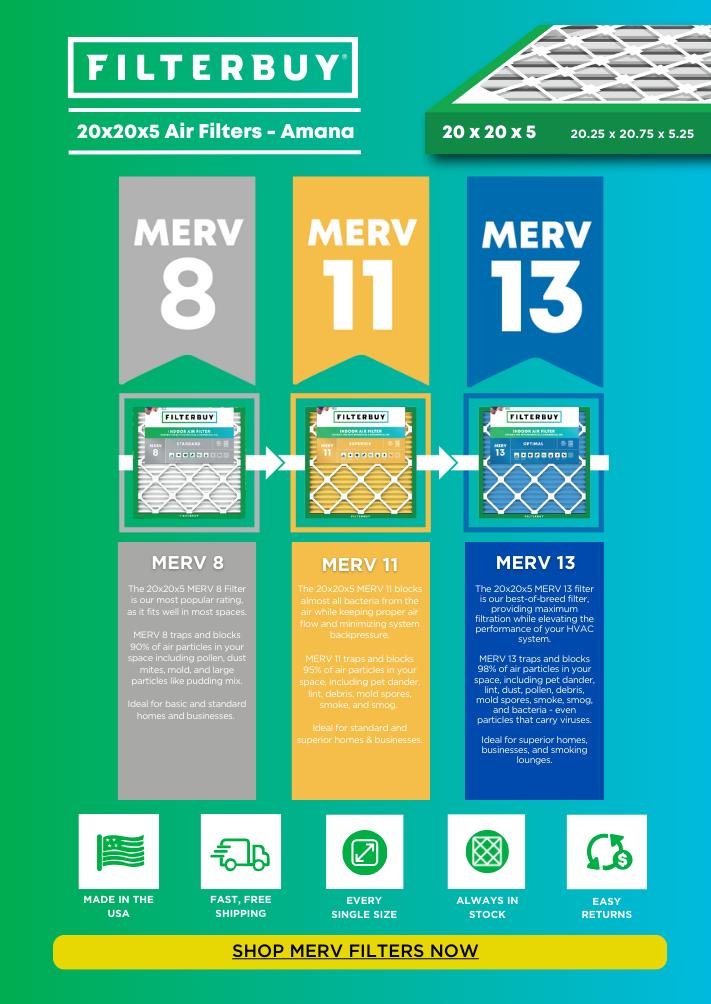
MERV 11:
Captures particles down to 1.0 micron
Filters pollen, dust mites, mold spores
Less airflow resistance
Handles most household air quality needs
MERV 13:
Captures particles down to 0.3 microns
Adds bacteria, smoke, virus-carrying aerosols
Higher airflow resistance
Noticeable difference for severe allergies or respiratory conditions
For households without specific health concerns, many customers find MERV 11 delivers excellent protection with less system strain.
A: Nominal size differs from actual size. This trips up many first-time buyers.
Our 20x20x5 Amana-compatible filters measure:
20.25" x 20.75" x 5.25" actual dimensions
How to verify your size:
Remove your current filter
Measure the filter slot directly
Or check dimensions printed on your existing filter's frame
We include actual dimensions prominently on every product listing because customers who skip this step occasionally order the wrong size.
Don't let a restricted filter compromise your comfort or your HVAC investment. Shop Filterbuy's MERV 13 20x20x5 Amana replacement filters and get the exact fit your system needs — delivered right to your door on a schedule that keeps airflow problems from ever starting.

