

Tip: Ensure you buy the exact air filter size for your system. Certain brands have precise dimensions that only fit their specific models. See related filters
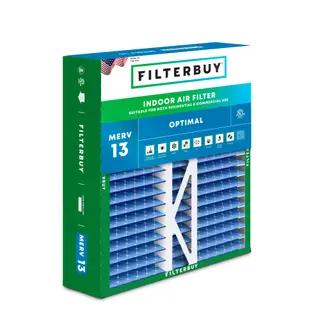
Air Demon 20x20x5 MERV 13 Aftermarket Replacement Filter
Actual Size: 19.63x19.88x4.38
 Free Delivery
  Factory-Direct Low Prices, Made in the USA
 Hassle-Free Returns & Free Exchanges
RESIDENTIAL AND/OR COMMERCIAL USE
Change Every 3 Months
Tip: Ensure you buy the exact air filter size for your system. Certain brands have precise dimensions that only fit their specific models. See related filters
Air Demon 20x20x5 MERV 13 Aftermarket Replacement Filter
Actual Size: 19.63x19.88x4.38
Free Delivery Factory-Direct Low Prices, Made in the USAHassle-Free Returns & Free ExchangesRESIDENTIAL AND/OR COMMERCIAL USE
Change Every 3 Months
Tip: Ensure you buy the exact air filter size for your system. Certain brands have precise dimensions that only fit their specific models. See related filters
Air Demon 20x20x5 MERV 13 Aftermarket Replacement Filter
Actual Size: 19.63x19.88x4.38
Free Delivery Factory-Direct Low Prices, Made in the USAHassle-Free Returns & Free ExchangesRESIDENTIAL AND/OR COMMERCIAL USE
Change Every 3 Months
About
- This is a list 20x20x5 MERV 13 air filter replacement for your furnace, air conditioner, heat pump, or HVAC system
- Actual air filter size: 19.63x19.88x4.38
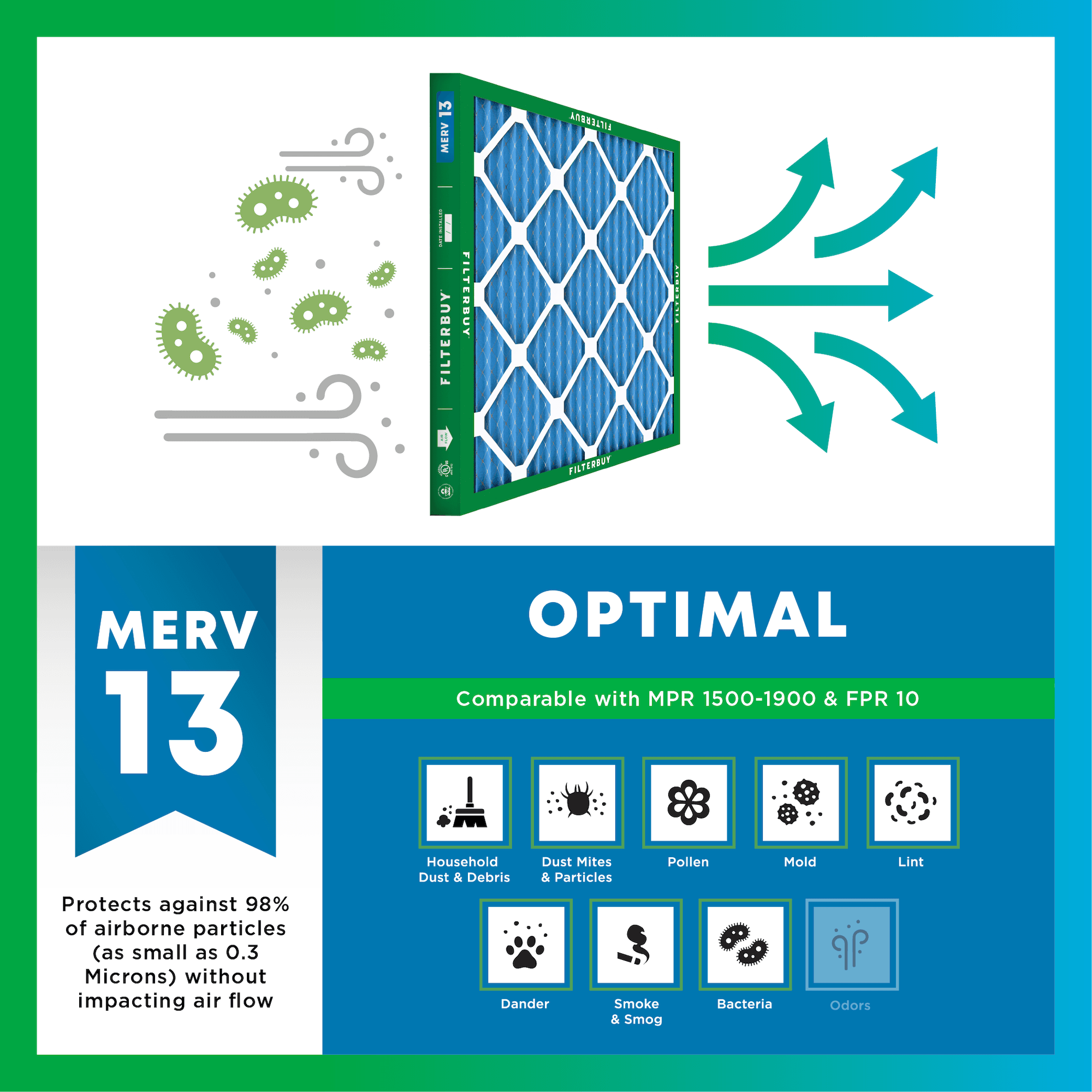
- MERV 13 synthetic media (comparable with MPR 1500/1900 and FPR 10) offers the best protection from dust, pollen, pet dander, mold, smog, bacteria, and virus carrying particles by trapping 98% of airborne particles without impacting air flow.
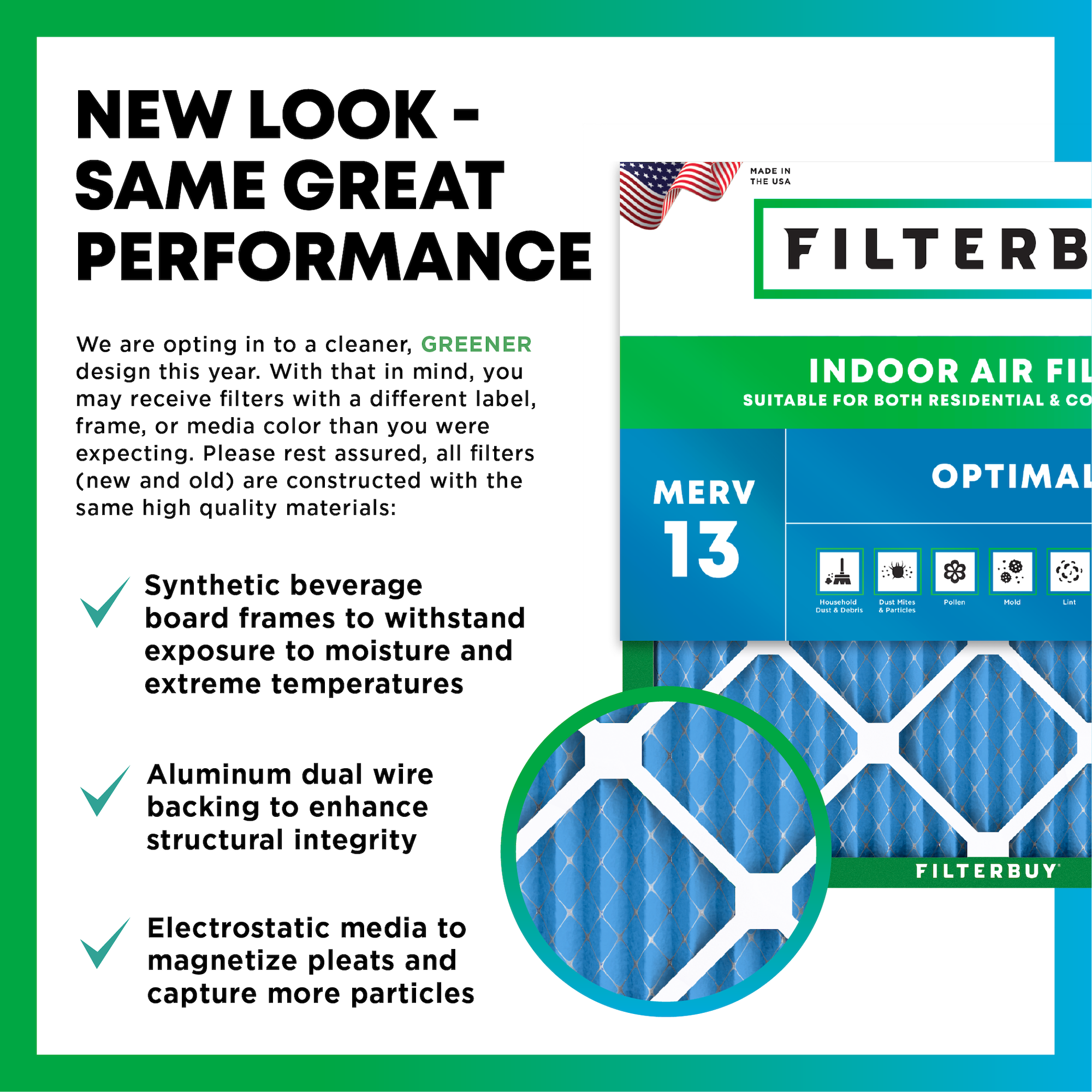
- High-quality construction means electrostatically charged pleated filter media, reinforced wire backing for structural integrity, and a durable frame to resist heat and humidity
- Built to last 3 months. 300% longer than fiberglass models
- 100% manufactured in the United States and designed with recyclable materials
- Learn more about 20x20x5 Air Filters
Top-Rated Filters. American Made. Delivered Free.
At Filterbuy, we don't cut corners—we craft high-quality air filters right here in the USA and ship them to your doorstep for free. No delays, no gimmicks—just clean air, made easy. With thousands of five-star reviews and filters built for real life & every HVAC system, it's no wonder why over 4 million families trust Filterbuy.

Proudly Made In The USA

Fast, Free Shipping on Every Order

Premium Materials That Go The Distance

85,000+ 5-Star Reviews From Happy Customers

Save Up to 70% Per Filter with Packs
Things to Know About Filter Sizes

Nominal Size
- The rounded size printed on your filter or HVAC unit (e.g., 20x20x5).
- Usually whole numbers to make identifying and ordering easier.
- A label for compatibility—not the exact measurement.

Actual Size
- The true, trimmed dimensions of the filter (e.g., 19.63x19.88x4.38 inches).
- Filters are manufactured slightly smaller so they slide into the filter slot without forcing.
- If you don't know your nominal size, measure your filter to get the actual size, then round up to find the nominal size to search on our site.

Why the difference?
- Nominal sizes simplify shopping and standardize categories.
- Actual sizes ensure the filter fits properly inside your HVAC's filter rack.
How To Find Your Nominal Size When You Don't Know It


Measure length × width × depth with a tape measure to find the actual size.

Round up each dimension to the nearest whole number to get the nominal size. Example: 19.63x19.88x4.38 in → 20x20x5 nominal.

Search by nominal size on our site for the best fit.

Why Getting the Right Size Matters
- Too small? Air can bypass the filter, reducing air quality and efficiency.
- Too big? It won't fit—risking bent frames and airflow issues.
- Just right? You get maximum performance, better filtration, and cleaner air.

Why Choose a 5″ filter

5″ filters give you maximum filtration with minimal maintenance — lasting up to 12 months while handling higher MERV ratings without restricting airflow.
Sizing note:
- Requires a 5″ cabinet or system.
- Actual thickness varies by brand (~4¾″–5¼″), so check your model for the best fit.

Free Exchange Policy
If the filter you buy doesn't fit, we'll send you a better size.

What's a MERV Rating?
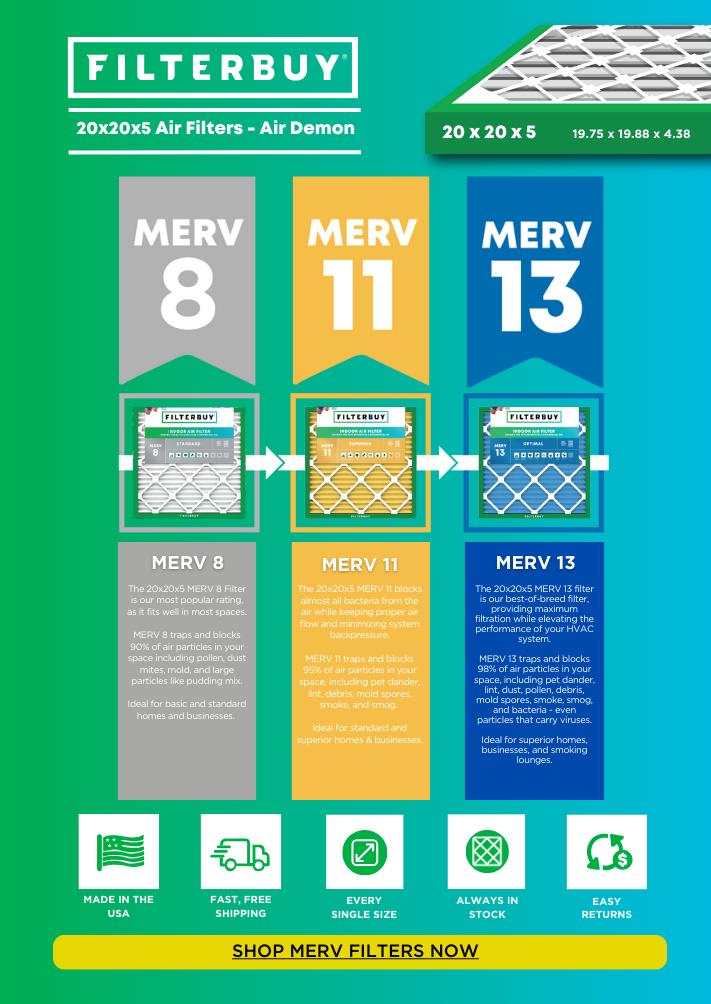
MERV stands for Minimum Efficiency Reporting Value—but don't let the technical name fool you. It's just a way to rate how well an air filter traps stuff like dust, pollen, pet dander, and smoke. The higher the MERV number, the more particles it catches—and the cleaner your air will be.

Merv 8
Comparable to:FPR: 4-7
MPR: 600-1000
 Dust & Debris
 Dust Mites & Particles
 Pollen
 Mold
Mold Lint
Lint Dander
Merv 11
Comparable to:FPR: 6-9
MPR: 1200-1550
Dust & DebrisDust Mites & ParticlesPollenMoldLintDander Smoke & Smog
Merv 13
Comparable to:FPR: 10
MPR: 1900-2800
Dust & DebrisDust Mites & ParticlesPollenMoldLintDanderSmoke & Smog Bacteria
MERV 8
Comparable to:FPR: 4-7MPR: 600-1000


MERV 11
Comparable to:FPR: 6-9MPR: 1200-1550

MERV 13
Comparable to:FPR: 10MPR: 1900-2800
What Makes Our Filters Last 90 Days? Quality, From the Inside Out
We build every Filterbuy filter to deliver reliable 90-day performance—thanks to smart design and premium materials that do the heavy lifting. Here's what makes the difference:
Pleated Design
More pleats = more surface area to capture dust and debris, keeping your air cleaner longer.
Electrostatically Charged Media
Pleats are magnetized to attract and trap microscopic particles—like pet dander, pollen, and smoke.
Synthetic Beverage Board Frame
Engineered to resist warping in extreme temperatures and high humidity.

Aluminum Dual Wire Backing
A layer of metal reinforcement keeps pleats evenly spaced and structurally sound—no sagging, even at high airflow.
Made in the USA
Assembled with care. Built to perform. Ships fast, free, and reliably from our U.S. facilities.
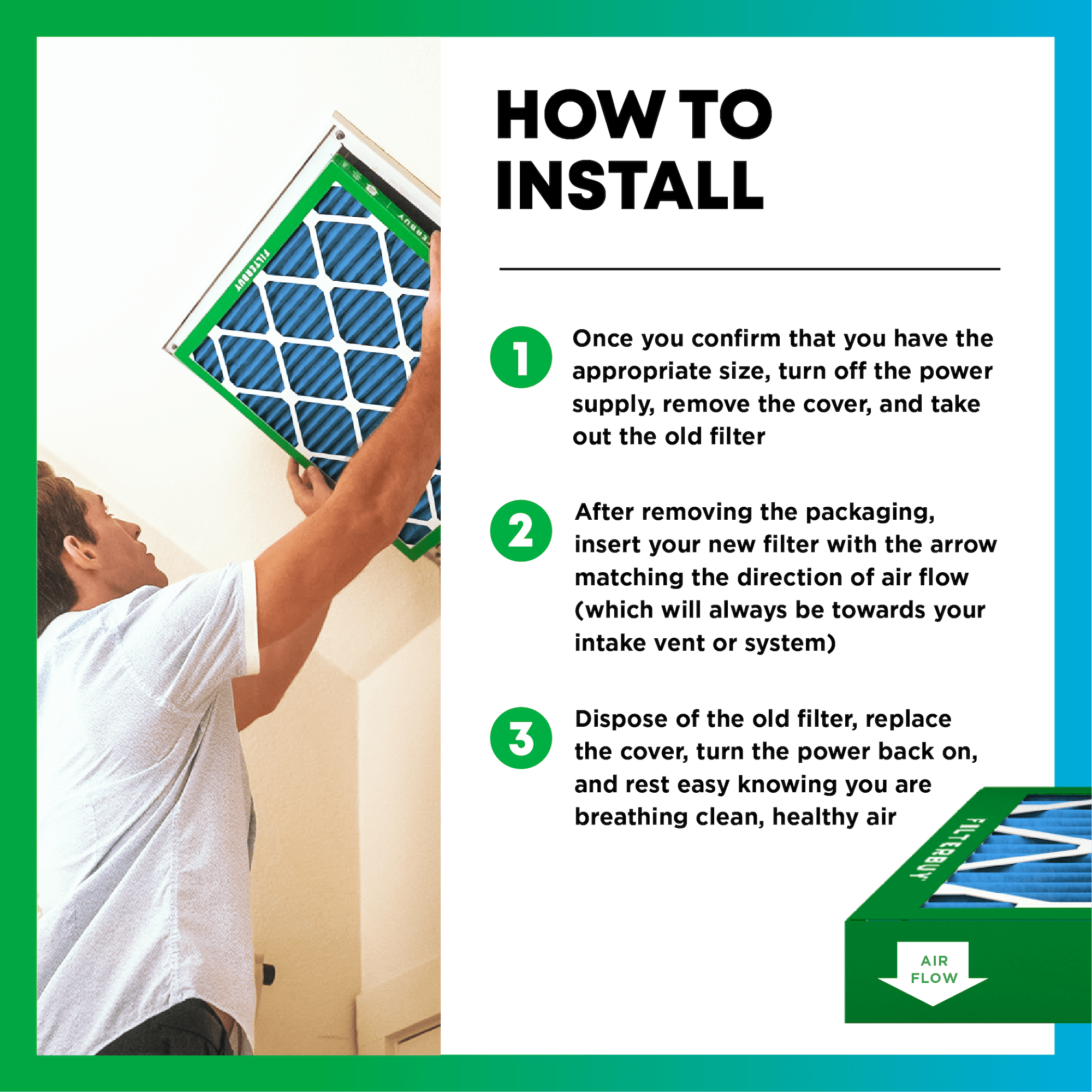
How to Install Your Filter in 4 Simple Steps

Turn Off Your HVAC SystemSafety first.

Remove The Old FilterLook for the airflow arrow and make note of the direction.

Slide In Your New FilterArrow should point toward the system (same direction as before).

Turn Your System Back OnAnd enjoy the fresh, clean air.

Never forget to replace your air filter again.
- Save 5% on every order
- Choose Your Delivery Schedule
- Edit, Skip, or Cancel Anytime.
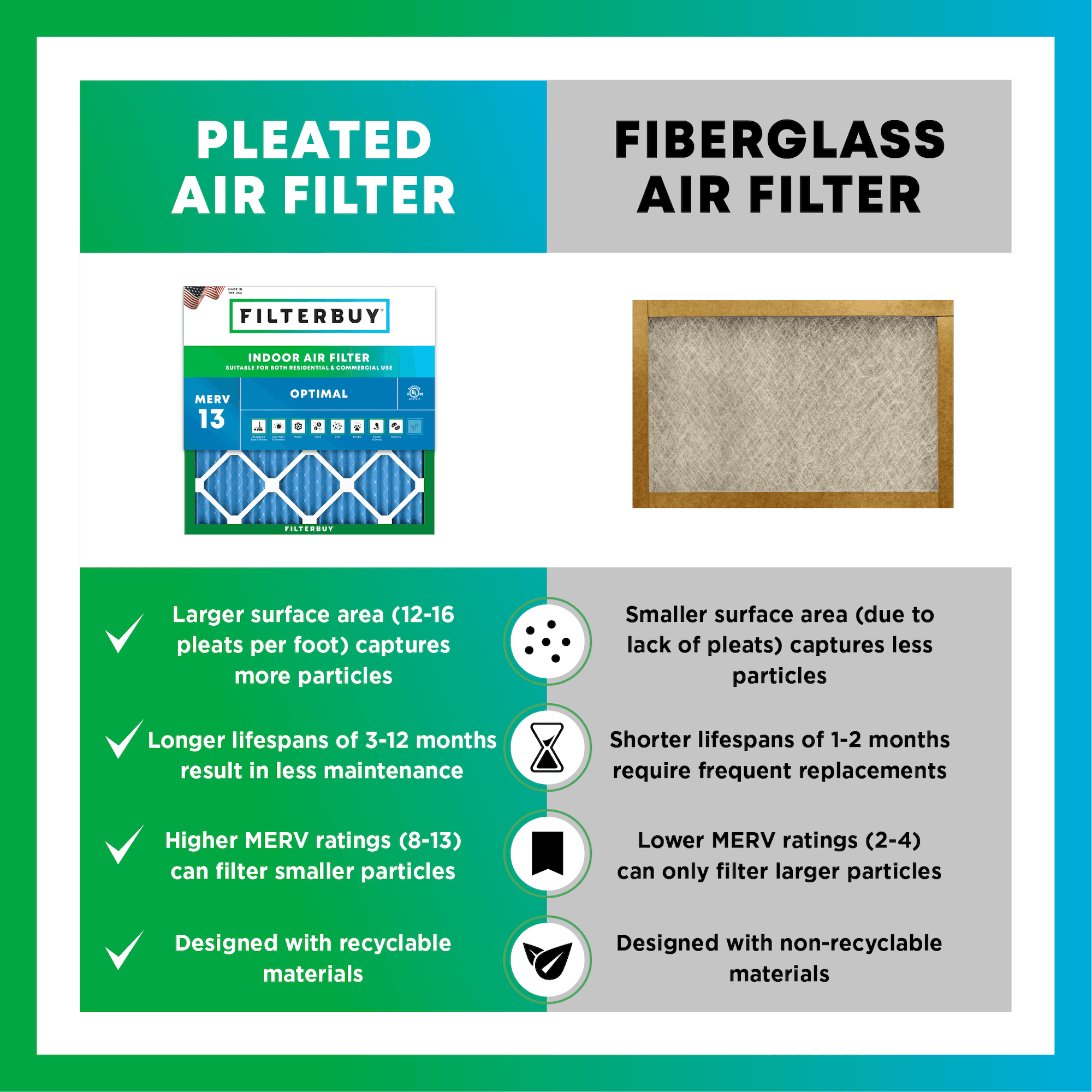
Pleated Filters vs. Fiberglass—What's the Difference?
Not all air filters are created equal. Pleated filters don't just last longer—they actually clean your air better. Here's how they stack up:

Pleated Filters
Efficiency:
High (MERV 8–13) – Traps more particles
Lifespan:
90 days – Long-lasting performance
Air Quality:
Excellent – Cleaner, healthier air
Materials:
Recyclable and durable

Fiberglass Filters
Efficiency:
Low (MERV 4 or less) – Misses small stuff
Lifespan:
30 days or less – Replace often
Air Quality:
Minimal – Basic protection only
Materials:
Thin, flimsy, and not recyclable
Pleated filters are a no-brainer—more protection, less hassle, and better air for your home.
How Often Should You Change Your Filter?
Changing your filter on time keeps your HVAC system running efficiently—and helps protect your lungs from dust, allergens, and airborne irritants. Here's how often to swap it out based on your needs:

Every 90 Days
Standard ScheduleFor most homes without pets or special air quality concerns. Great for general upkeep and energy efficiency.

Every 60 Days
If You Have Pets or AllergiesShedding fur, dander, and allergy triggers can build up fast. Changing your filter every two months helps keep the air fresher and symptoms at bay.

Every 30 Days
If You Have Respiratory Concerns or Live in Smog/Wildfire ZonesFor households affected by smoke, pollution, or respiratory conditions, monthly changes ensure maximum protection.

Want to stay on track? Set a reminder—or skip the stress with auto-delivery so fresh filters show up right when you need them.
Don't Just Take Our Word For It...
Got More Questions? We've Got Answers.
Product Specifications
| Nominal Size | 20 x 20 x 5 inches |
| Actual Size | 19.63 x 19.88 x 4.38 inches |
| Filter Type | Pleated |
| Media | Electrostatically Charged |
| Frame | Beverage Board |
| MERV Ratings Available | 8, 11, 13 |
| Lifespan | Up to 12 Months |
| Origin | Made in USA |
Energy Efficiency Tips Using a MERV 13 20x20x5 Air Demon Filter
We've seen it countless times: homeowners invest in a quality 20x20x5 Air Demon filter expecting automatic savings, then wonder why their utility costs haven't budged. After manufacturing millions of filters and hearing directly from customers about what actually moves the needle, we've identified the specific habits that separate energy-efficient households from the rest.
Your five-inch MERV 13 filter already gives you an advantage—its extended depth captures airborne particles without choking airflow the way standard one-inch filters can. But based on what we've learned from real-world feedback, the filter is only half the equation. The installation timing, thermostat coordination, and maintenance rhythm you pair with it determine whether you see genuine savings or just cleaner air at the same cost.
Below, we share the energy efficiency strategies that consistently work for households running MERV 13 filtration—practical adjustments drawn from our manufacturing expertise and the patterns we've observed across millions of filter shipments.
TL;DR Quick Answers
MERV 13 20x20x5 Air Demon Filter
What it is: A five-inch deep pleated air filter rated MERV 13 for residential HVAC systems requiring 20x20x5 dimensions.
Key benefits:
Captures 50%+ of particles down to 0.3 microns (dust mites, mold, pollen, pet dander)
Five-inch depth provides 5x the surface area of standard one-inch filters
Maintains airflow better than thinner high-MERV alternatives
Extended service life of 6–12 months under typical conditions
What we've learned after manufacturing millions of filters: The filter delivers excellent particle capture—but energy savings depend on proper installation, sealed housing, and regular visual inspection rather than calendar-based replacement.
Quick maintenance checklist:
✓ Check monthly by holding filter to light
✓ Seal gaps around filter frame
✓ Set thermostat fan to "auto"
✓ Replace when media appears gray or airflow feels restricted
Bottom line: Your MERV 13 20x20x5 Air Demon filter provides the foundation for cleaner air and lower energy bills. The habits you build around it determine whether you capture the full benefit.
Top Takeaways
Your filter is only half the equation. Monthly inspections, proper sealing, and thermostat settings determine whether you see real energy savings.
Air bypass kills efficiency. Even a quarter-inch gap around the filter frame forces your system to work harder while delivering less conditioned air.
Visual inspection beats calendar replacement. Check monthly. Replace based on what you see—not generic timelines.
Duct leaks undermine premium filtration. Typical homes lose 20-30% of conditioned air through leaky ducts. Seal accessible ductwork so your MERV 13 filter can perform as intended.
Small habits deliver measurable results. Switching to "auto," clearing return vents, and sealing housing gaps cost nothing—yet customers report noticeable bill drops within one billing cycle.
Choose the Right MERV 13 Rating for Your System's Capacity
Not every HVAC system is built to handle the same level of filtration resistance. Before installing a MERV 13 20x20x5 filter, confirm your system's blower motor can accommodate the slight increase in static pressure that a MERV 13 rating introduces compared to lower-rated filters. Most modern residential systems with variable-speed or ECM blower motors handle MERV 13 filters with no measurable increase in energy consumption. If your system uses an older single-speed PSC motor, consult your HVAC technician to ensure compatibility — forcing air through an incompatible filter creates strain that drives up utility costs rather than reducing them.
Leverage the 5-Inch Depth for Extended Filter Life
One of the biggest energy efficiency advantages of a 20x20x5 Air Demon filter is its extended service life compared to standard 1-inch filters. The 5-inch pleat depth holds significantly more particulate before reaching capacity, which means the filter maintains low airflow resistance for longer periods — typically 6 to 12 months depending on household conditions. A clogged filter is one of the single greatest causes of HVAC energy waste, forcing your blower motor to consume more electricity to maintain airflow. By upgrading to this 5-inch format, you reduce the frequency of filter changes while keeping static pressure low and energy consumption optimized throughout the filter's lifespan.
Seal the Filter Housing to Prevent Air Bypass
Even the highest-rated filter can't improve efficiency if conditioned air leaks around it instead of passing through it. When installing your 20x20x5 MERV 13 filter, inspect the filter housing or cabinet for gaps around the frame. Air bypass — unfiltered air that sneaks past a poorly seated filter — forces your system to work harder to maintain temperature while also allowing contaminants to circulate through the ductwork. Ensure the filter fits snugly with no visible gaps. If your filter cabinet allows slight movement, use foam gasket tape around the edges to create an airtight seal.
Pair Your MERV 13 Filter With a Programmable Thermostat
A MERV 13 filter handles the air quality side of the efficiency equation, but pairing it with a programmable or smart thermostat addresses the runtime side. Reducing unnecessary HVAC cycles during unoccupied hours means less air volume passing through the filter, which preserves filter life and reduces total energy draw. Program setback temperatures of 7–10°F during sleep and away periods. The Department of Energy estimates this practice alone can save homeowners up to 10% annually on heating and cooling costs — and a clean, properly rated MERV 13 filter ensures your system reaches set temperatures quickly and efficiently when it cycles back on.
Monitor Static Pressure and Replace on Schedule
The most energy-efficient approach to MERV 13 filtration is proactive maintenance rather than reactive replacement. Track your filter's installation date and monitor your HVAC system's performance for signs of increased static pressure — longer run cycles, uneven temperatures between rooms, or a noticeable increase in energy bills. While a 20x20x5 filter lasts considerably longer than thinner alternatives, local factors like pet dander, construction dust, high-pollen seasons, or wildfire smoke events can accelerate loading. Replace the filter before it reaches full capacity to maintain the lowest possible energy consumption and protect your HVAC equipment from unnecessary strain.
"After manufacturing millions of filters and hearing from homeowners across the country, we've found that the biggest energy savings don't come from the filter alone—they come from eliminating air bypass and replacing based on what you see, not what the calendar says."
Essential Resources for MERV 13 20x20x5 Air Filter Research
EPA Guide to Air Cleaners: Understanding Your Home Filtration Options
The Environmental Protection Agency's consumer guide explains how MERV-rated filters compare to HEPA filtration and helps homeowners select the right filter for their HVAC system. This resource confirms that filters rated MERV 7 to 13 can be nearly as effective as HEPA filters at controlling most airborne indoor particles while maintaining better airflow.
Source: U.S. Environmental Protection Agency
URL: https://www.epa.gov/indoor-air-quality-iaq/guide-air-cleaners-home
EPA MERV Rating Explainer: What the Numbers Actually Mean
This EPA resource breaks down the Minimum Efficiency Reporting Value system and explains how filters are tested for particle capture efficiency. Homeowners researching MERV 13 filters will understand exactly what particle sizes their filter captures and why this rating is recommended for improved air quality.
Source: U.S. Environmental Protection Agency
URL: https://www.epa.gov/indoor-air-quality-iaq/what-merv-rating
ASHRAE Filtration Standards: The Industry Benchmark for Air Quality
The American Society of Heating, Refrigerating and Air-Conditioning Engineers establishes the technical standards that define MERV ratings and filter testing protocols. ASHRAE recommends MERV 13 as the minimum rating for effectively reducing airborne contaminants in residential and commercial buildings.
Source: American Society of Heating, Refrigerating and Air-Conditioning Engineers
URL: https://www.ashrae.org/technical-resources/filtration-and-disinfection-faq
Department of Energy Duct Efficiency Guide: Maximizing Filter Performance
The DOE explains how duct leaks undermine HVAC efficiency and why sealed ductwork is essential for optimal filter performance. This resource helps homeowners understand that even a high-quality MERV 13 filter cannot compensate for conditioned air escaping through leaky ducts.
Source: U.S. Department of Energy
URL: https://www.energy.gov/energysaver/minimizing-energy-losses-ducts
ENERGY STAR Heating and Cooling Tips: Filter Maintenance for Lower Bills
ENERGY STAR provides practical guidance on how clean filters reduce energy consumption and extend HVAC system life. This resource establishes the direct connection between regular filter maintenance and measurable savings on utility costs.
Source: U.S. Environmental Protection Agency – ENERGY STAR Program
URL: https://www.energystar.gov/saveathome/heating-cooling
ENERGY STAR Duct Sealing Guide: Preventing Hidden Energy Waste
This resource details how leaky ductwork can reduce heating and cooling efficiency by up to 20 percent, even when using premium filtration. Homeowners learn proper sealing techniques that ensure all conditioned air passes through the MERV 13 filter before reaching living spaces.
Source: U.S. Environmental Protection Agency – ENERGY STAR Program
URL: https://www.energystar.gov/saveathome/heating-cooling/duct-sealing
Filterbuy Filter Replacement Guide: Timing Changes for Five-Inch Filters
This guide explains how five-inch filters like the 20x20x5 differ from standard one-inch filters in replacement frequency and performance characteristics. Homeowners discover how extended-depth filters can provide longer service intervals while maintaining air quality when properly monitored.
Source: Filterbuy
URL: https://filterbuy.com/resources/air-filter-maintenance/how-often-to-change-your-furnace-filter/
Supporting Statistics
Government research confirms what we observe daily after manufacturing millions of filters and hearing directly from homeowners nationwide.
90% of Your Time is Spent Indoors
The EPA reports Americans spend approximately 90 percent of their time indoors—where pollutant concentrations often run two to five times higher than outdoor levels.
What customers tell us:
Allergy symptoms improve after upgrading to MERV 13 filtration
Visible dust accumulation decreases within weeks of filter installation
Indoor air quality becomes noticeably fresher, especially in homes with pets
When nine out of ten hours are spent breathing indoor air, the filter protecting your family matters more than most people realize.
Source: U.S. Environmental Protection Agency
URL: https://www.epa.gov/report-environment/indoor-air-quality
20-30% of Conditioned Air Lost Through Duct Leaks
ENERGY STAR data shows typical homes lose 20 to 30 percent of conditioned air through leaks, holes, and poor duct connections.
Patterns we've observed from customer feedback:
Quality MERV 13 filters paired with leaky ducts still produce uneven temperatures
Energy bills remain high despite premium filtration
Sealing ducts alongside filter upgrades delivers the efficiency gains homeowners expect
Filter performance and duct integrity work together. Addressing one without the other leaves savings on the table.
Source: U.S. Environmental Protection Agency – ENERGY STAR Program
URL: https://www.energystar.gov/saveathome/heating-cooling/duct-sealing
5-15% Energy Reduction with Clean Filters
The Department of Energy reports that replacing a clogged filter with a clean one can reduce air conditioner energy consumption by 5 to 15 percent.
What we've learned from real-world results:
Households switching from calendar-based to visual inspection often see utility bill drops within one billing cycle
Heating and cooling account for nearly half of typical home energy costs—small efficiency gains add up fast
The five-inch depth of your 20x20x5 filter extends service life, but monitoring condition remains key to capturing savings
Source: U.S. Department of Energy
URL: https://www.energy.gov/energysaver/maintaining-your-air-conditioner
Final Thoughts
After manufacturing millions of air filters and working directly with homeowners nationwide, we've reached a conclusion that might surprise you: the filter itself is only part of the energy efficiency equation.
Your MERV 13 20x20x5 Air Demon filter already does the heavy lifting. Its five-inch depth captures fine particles without strangling airflow. That engineering advantage is built in from the start.
What actually separates energy-efficient households from the rest:
They treat filtration as a system, not a product.
The homeowners reporting the biggest savings aren't necessarily buying premium filters—they're paying attention:
Checking filters monthly instead of guessing
Sealing gaps around the filter housing
Setting thermostats to "auto" instead of "on"
Addressing duct leaks before blaming equipment
We've seen customers cut energy costs meaningfully with these adjustments alone.
Our perspective after years in this industry:
Most energy waste happens in the margins:
A quarter-inch gap around the filter frame
A disconnected duct joint in the attic
A filter that loaded up faster than expected due to renovation dust
None of these issues are dramatic. They compound quietly—showing up as higher bills and inconsistent comfort rather than obvious failures.
The good news? These are fixable problems.
Your 20x20x5 MERV 13 filter provides a strong foundation. The habits you build around it determine whether you capture the full efficiency benefit.
Start here:
Monthly visual inspections
Seal the filter housing completely
Check accessible ducts for obvious gaps
These steps cost nothing and consistently deliver results—not because we say so, but because customers tell us the same thing over and over again.
Next Steps
Ready to maximize energy efficiency with your MERV 13 20x20x5 Air Demon filter? Follow these steps to get started.
Immediate Actions (This Week)
Inspect your current filter – Hold it up to light. Can't see through it? Replacement is overdue.
Check the housing seal – Run your hand around filter edges after installation. Air movement means gaps exist.
Verify thermostat setting – Switch fan from "on" to "auto." This single change extends filter life and cuts energy draw.
Short-Term Actions (This Month)
Clear return vents—keep furniture and curtains at least two feet away
Vacuum return grilles to remove dust buildup
Seal identified gaps with foam weatherstripping
Document your current energy bill for future comparison
Ongoing Maintenance Schedule
Monthly: Visual filter inspection
Quarterly: Check accessible duct connections
Every 6-12 months: Replace filter based on visual condition
Annually: Professional duct inspection for hidden leaks
Shop With Confidence
Filterbuy carries the full range of 20x20x5 MERV 13 filters compatible with Air Demon systems.
What you get:
Direct shipment from our American manufacturing facility
Free delivery on subscription orders
Customer support from a team that has helped millions of homeowners
FAQ on "MERV 13 20x20x5 Air Demon Filter"
Q: How often should I replace my MERV 13 20x20x5 Air Demon filter?
A: The standard six-to-twelve month recommendation misses the mark for many households.
Factors that accelerate filter loading:
Multiple pets
Allergy sufferers in the home
Dusty climates or recent renovations
Our recommendation after working with homeowners for over a decade: Check monthly by holding the air filter up to light. Can't see through it? Airflow is already restricted. Customers who switch from calendar-based replacement to visual inspection consistently report lower energy bills.
Q: Will a MERV 13 filter restrict airflow and increase my energy bills?
A: The five-inch depth of your 20x20x5 filter is designed to address this concern.
Why it works:
Provides roughly five times the surface area of standard one-inch filters
Captures fine particles while maintaining airflow
Avoids the energy penalty common with thinner high-MERV options
What customers tell us: Improved air quality without increased energy costs—as long as filters are replaced before saturation and air bypass is eliminated around the housing.
Q: What particles does a MERV 13 rating capture?
A: MERV 13 filtration captures a wide range of airborne contaminants.
Capture efficiency:
50%+ of particles between 0.3–1.0 microns
85%+ of particles between 1.0–3.0 microns
Particles captured include:
Dust mites
Mold spores
Pet dander
Pollen
Many bacteria
What we've observed from customer feedback: Households upgrading from lower MERV ratings notice reduced dust accumulation and allergy symptom improvement within weeks. The EPA confirms MERV 7–13 filters perform nearly as effectively as HEPA for most residential applications.
Q: How do I know if my Air Demon filter is installed correctly?
A: Use this simple test we recommend to every customer.
Installation check:
Run your hand around all four edges of the filter frame
If you feel air movement, gaps exist allowing air bypass
Seal gaps with foam weatherstripping
Confirm filter sits flush within the housing
Verify the airflow arrow points toward the blower motor
Why this matters: We've seen air bypass undermine filtration effectiveness in otherwise well-maintained systems. Customers regularly contact us after realizing filters were installed backward or poorly sealed.
Q: Can I improve energy efficiency without replacing my current MERV 13 filter?
A: Yes. The biggest efficiency gains often come from adjustments around the filter.
No-cost steps customers report make a noticeable difference:
Switch thermostat fan from "on" to "auto"
Maintain at least two feet of clearance around return vents
Seal gaps around filter housing
Inspect accessible ductwork for disconnected joints or visible holes
Why duct inspection matters: The Department of Energy reports typical homes lose 20–30% of conditioned air through leaks. Addressing ductwork alongside proper filtration is where we've seen customers achieve the most dramatic results.
Start Saving Energy With the Right MERV 13 20x20x5 Air Demon Filter
Upgrading to a properly sized MERV 13 20x20x5 Air Demon filter is one of the simplest steps you can take to improve both your indoor air quality and your HVAC system's energy efficiency. Browse our selection of 20x20x5 MERV 13 filters to find the exact fit for your system and start lowering your energy costs today.