
Kent Real-Time AQI Tracker


Get Alerts For Unhealthy AQI In Your Area
When air quality in your area reaches unhealthy levels, we'll send you a quick alert, along with expert tips on how to reduce your exposure.
What's Actually In Kent Air Today?
What High AQI Means for Your Lungs in Kent
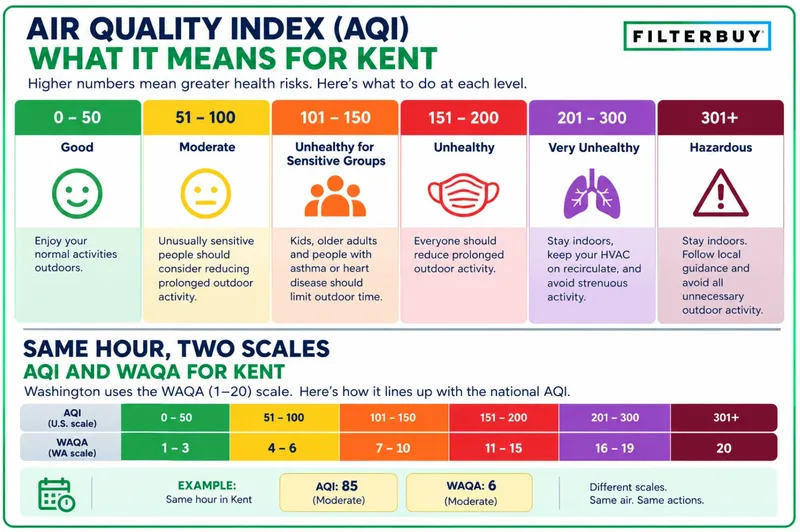
How to Read AQI
The Air Quality Index (AQI) measures how polluted the air is and how it may affect your health.
0–50 (Good): Air quality is satisfactory.
51–100 (Moderate): Acceptable, but some pollutants may pose minor concerns.
101–150 (Unhealthy for Sensitive Groups)
151–200 (Unhealthy)
201–300 (Very Unhealthy)
301+ (Hazardous)
Moderate
Still okay for most, but if you have asthma or allergies, take it easy and avoid long outdoor workouts.
Shop MERV 11 filters→What's the Right Filter for Your AQI Level?


Check Today's Live Real Time Air Quality Index AQI Map in Kent, WA Now
Author: Michelle Wan | Reviewer: David Clark, Licensed HVAC Technician | Publish Date: September 7, 2026 | Updated Date: September 7, 2026
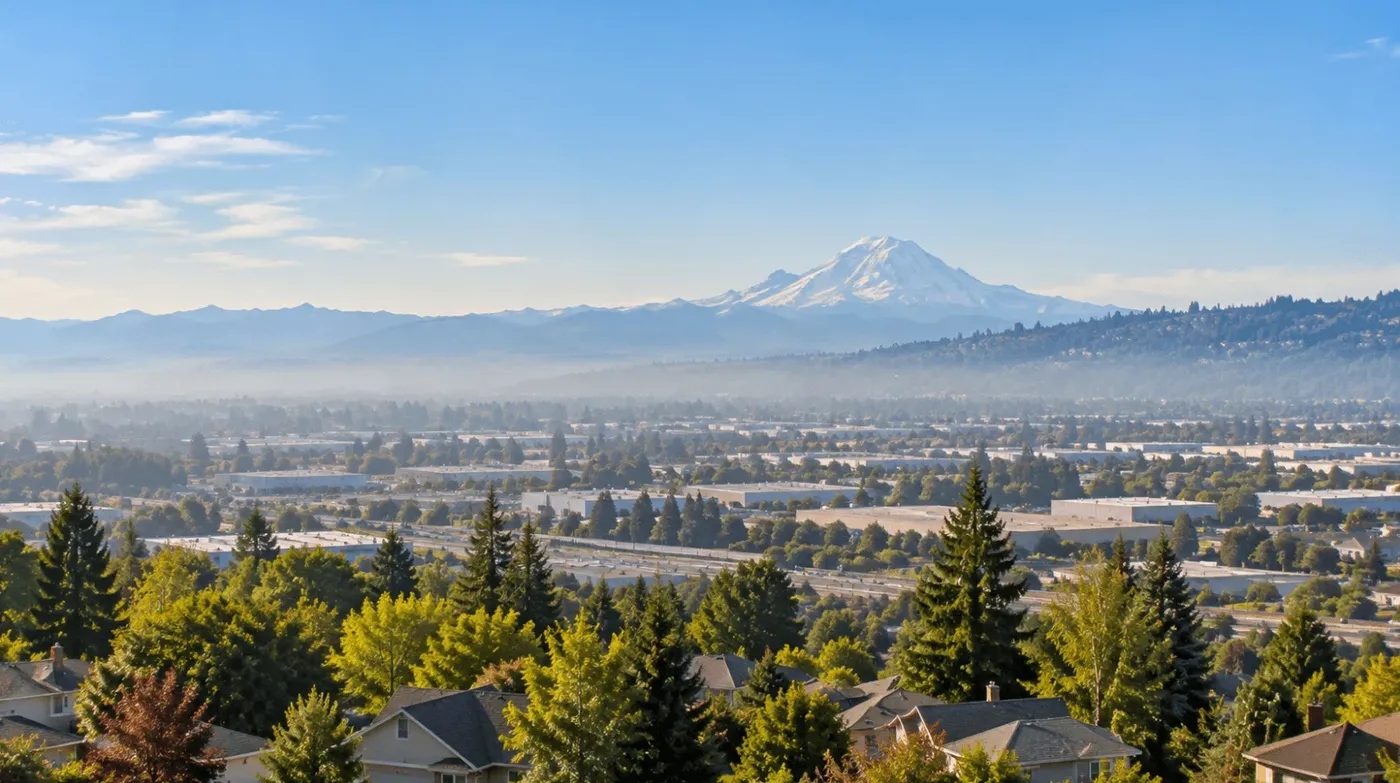
Kent, WA air quality is measured at Kent-S 236th St, a regulatory station the Puget Sound Clean Air Agency opened in November 2025, and its readings feed the state and federal maps. Because Kent sits on the Green River Valley floor, fine particle pollution settles lower here in calm weather than it does on East Hill or West Hill.
Key Takeaways
Kent has its own regulatory air monitor. Kent-S 236th St, AQS site 530330095, began operating on November 12, 2025 and reports continuously.
Kent's monitor is too new for a published design value, which takes three full years of data, so the long term numbers shown for Kent today come from nearby stations.
Valley floor stations read higher than hilltop stations. Tukwila Allentown logged a 2025 24-hour design value of 20 micrograms per cubic meter against 14 at Seattle-Beacon Hill.
Washington publishes two indexes off the same monitors, the federal AQI and the state Washington Air Quality Advisory. The state version is more protective.
Wildfires and residential wood burning drive most fine particle pollution in Washington, according to the Washington State Department of Ecology, ahead of ports and freight corridors.
Compare the Washington statewide AQI snapshot.
What Is The Air Quality In Kent, WA Today?
Kent air quality today is reported as an Air Quality Index value from 0 to 500, calculated mainly from fine particulate matter measured at Kent-S 236th St. Anything at or below 50 counts as Good and anything from 51 to 100 as Moderate. Once the number passes 100, the air has turned Unhealthy for Sensitive Groups or worse. Conditions shift within hours here, so a morning reading rarely holds through the evening.
Where Kent's Live Air Quality Numbers Actually Come From
Every Kent AQI map draws from the same regulatory network, then presents it differently. The Puget Sound Clean Air Agency operates the Kent station under Ecology quality assurance, and the data flows to EPA AirNow and the Washington Air Quality Map. Because the station opened in late 2025, it does not yet appear in Ecology's design value tables, which is why several consumer apps still estimate Kent from Auburn or Tukwila.
To see what that gap means in practice, Filterbuy, which manufactures pleated HVAC filters, pulled the PM2.5 monitors, which measure fine particle pollution, in Kent's King County network out of Ecology's 2026 plan and ranked them by elevation rather than distance. No published source arranges the data this way.
Compiled from the Washington State Department of Ecology 2026 Ambient Air Monitoring Network Plan, Publication 26-02-010, June 2026. Non-regulatory values are estimated from nephelometers.
A design value is a three year statistic used to judge federal compliance, and no station near Kent came close to the 35 microgram limit. The ordering matters more than the totals. Both valley floor sites landed at the top and the hilltop and foothill sites at the bottom, which means elevation predicted the reading better than distance from Kent did.
One caveat is worth knowing before you trust a single number for your address. Kent-S 236th St is sited at neighborhood scale, which under federal siting rules covers just 0.5 to 4 kilometers, while Kent spans roughly 34 square miles across three elevations. The Kent reading is therefore precise for the valley floor and only directional for the hills.
Why The Valley Floor And The Hills Read Differently In Kent
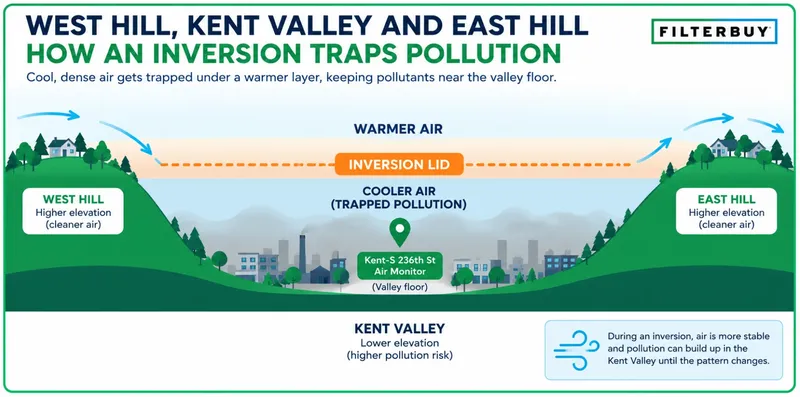
Kent divides into three areas: West Hill, the Kent Valley and East Hill. The valley floor carries the distribution district along State Route 167 and sits hundreds of feet below the hills on either side. When weather turns cold and calm, an inversion settles over the valley and traps colder air underneath.
A Kent household on East Hill and one near the warehouses can breathe different air on the same afternoon. The gradient separates neighboring cities too, so air quality in Federal Way and Seattle air quality readings can diverge from Kent.
Why Kent Shows Two Different Air Quality Numbers
Washington runs two indexes off the same monitors. The federal Air Quality Index is the national scale that AirNow uses, while the Washington Air Quality Advisory, or WAQA, is the state version. Ecology describes WAQA as more protective of human health, which is why a WAQA map often shows a higher warning level than the AQI map for the same hour at the same station. Ecology publishes the full Air Quality Index category guidance behind both.
If you are checking for someone with asthma or a heart condition, use the more protective number.
What Drives Fine Particle Pollution In Kent Through The Year
Ecology names wildfires and residential wood combustion as the dominant sources of fine particle pollution in Washington, which cuts against the obvious guess in Kent, where freight traffic is the pollution residents actually see.
The Washington State Department of Ecology identifies wildfires and residential wood combustion as the dominant sources of fine particle pollution statewide.
Winter wood smoke is regulated through Stage 1 air quality burn ban thresholds, which trigger on forecast conditions, not current readings.
What To Do At Each Air Quality Level In Kent
Filterbuy treats AQI 100 as the point to act in Kent. That is our own threshold rather than an EPA category change, since 100 still sits at the top of Moderate. Check AirNow and Puget Sound Clean Air Agency guidance first, then take four steps.
1. Put MERV 13 in the HVAC. Smoke maps to MERV 13 on our ladder.
2. Set the thermostat fan to On. Auto filters only while the system heats or cools.
3. Run a portable HEPA air cleaner in each occupied room, bedrooms first.
4. Close the house up, and skip candles, frying and vacuuming while smoke is in.
Washington treats a wide group as sensitive: anyone with heart or lung disease, respiratory illness or diabetes, anyone who has had a stroke, people under 18 or over 65, people who are pregnant and people who work outdoors. Outdoor workers make up much of Kent's warehouse workforce.
Category guidance follows Washington State Department of Ecology.
How To Keep Indoor Air Cleaner In Kent When The AQI Climbs
Indoor air is where Kent households have the most control, and the filter in the return is the layer doing the work. Switch the HVAC to recirculate rather than pulling air in from outside.
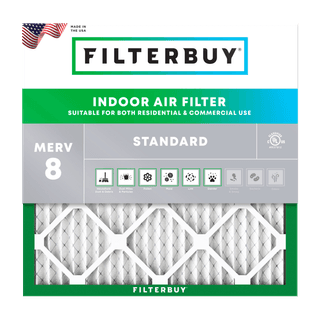
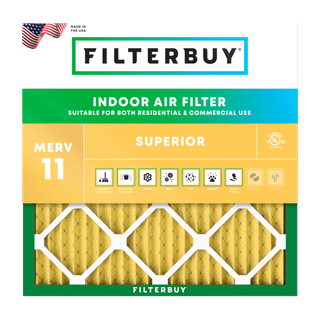
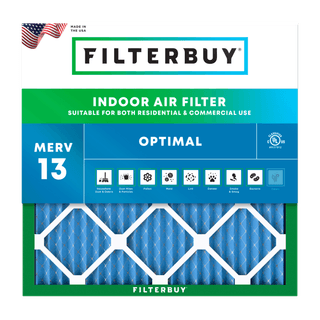
A Filterbuy MERV 13 pleated filter captures 98 percent of airborne particles, against 95 percent at MERV 11 and 90 percent at MERV 8. MERV 13 is the tier we recommend for smoke. The EPA recommends a filter rated MERV 13 or higher in a central system during smoke events and notes that most furnaces and HVAC systems accommodate it without equipment problems when the filter is replaced often. Check the fit the same way you would confirm which MERV rating suits your system.
During a smoke event, check the filter and replace it once it looks dirty, dark brown or black, which can come well before the normal interval. Keep spares on hand. Apartments and older Kent homes without ductwork have no whole-home layer at all, so for those readers a portable HEPA cleaner is the primary defense rather than a supplement.
Expert Perspective
After manufacturing filters for over a decade and serving more than two million households, we have watched Puget Sound orders climb within hours of a regional smoke alert. Kent families rarely need a fancier filter once smoke arrives. They need the right MERV rating already seated in the return and a spare on the shelf.
Filterbuy Team
Supporting Statistics
1. Kent gained a regulatory monitor on November 12, 2025.
Site: Kent-S 236th St, AQS 530330095, run by the Puget Sound Clean Air Agency
2025 24-hour design values at the five nearest stations: 20, 18, 17, 14 and 12 µg/m³
Federal 24-hour standard: 35 µg/m³
2. A thicker MERV 13 filter raised clean air delivery 123 percent in EPA testing.
Box fan with a 1-inch MERV 13 filter: Clean Air Delivery Rate of 111
Box fan with a 4-inch MERV 13 filter and shroud: 248
Dirty filters: almost completely ineffective
3. Wildfire smoke now reaches far more Americans than it once did.
People affected: an estimated 82 million
Increase in smoke frequency: 57 percent
Source: NIEHS Science for Disaster Reduction Interagency Working Group.
Frequently Asked Questions About Air Quality In Kent, WA
Glossary Of Kent Air Quality Terms
AQI, Air Quality Index: The EPA's national 0 to 500 scale, converting pollutant concentrations into a color coded category.
WAQA, Washington Air Quality Advisory: Ecology's state scale, built from the same monitor data as the AQI but with more protective breakpoints.
PM2.5: Fine inhalable particles 2.5 micrometers and smaller, small enough to reach deep into the lungs.
Temperature inversion: Warm air sitting above cooler surface air, holding pollution near the ground.
MERV: Minimum Efficiency Reporting Value, the scale describing how much airborne particulate a filter captures.