
Air Quality in Iowa
Air quality index (AQI⁺) and PM2.5 air pollution in Iowa •


Get Alerts For Unhealthy AQI In Your Area
When air quality in your area reaches unhealthy levels, we'll send you a quick alert, along with expert tips on how to reduce your exposure.
Live Air Quality Ratings in Iowa
Live Most Polluted City Ranking
Real-time most polluted cities in Iowa
Live Cleanest City Ranking
Real-time cleanest cities in Iowa
The Right Air Filter For High AQI Days
When outdoor air quality drops, the EPA recommends upgrading to a MERV 13 filter — or the highest-rated filter your HVAC system can handle — to help capture more of the fine particulate (PM2.5) that comes with poor air quality. MERV 13 is the highest rating most residential systems can run without restricting airflow.
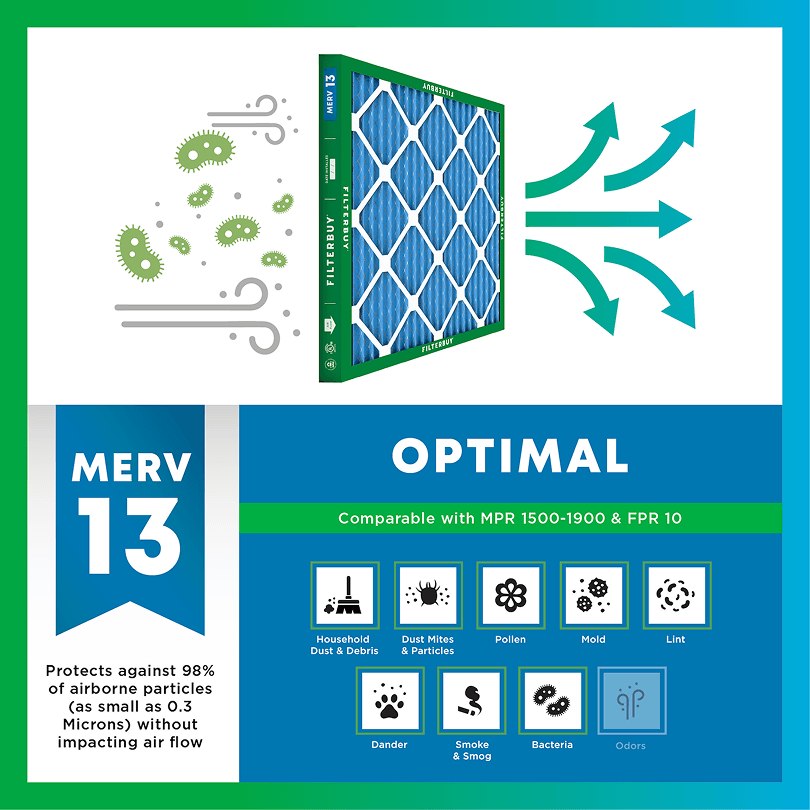
- Captures PM2.5 and other fine particulates
- Filters ash, soot, and smoke particles
- Rated to capture particles as small as 0.3 microns
- Matches the filter rating the EPA suggests during high-AQI and smoke events

AQI FAQs
What is AQI?
AQI stands for Air Quality Index, the EPA's scale for reporting daily air quality. It runs from 0 to 500. The higher the number, the greater the level of air pollution. Values at or below 100 are generally considered satisfactory; values above 100 mean air quality is unhealthy, first for sensitive groups, then for everyone as numbers climb.
What does AQI measure?
The AQI tracks five major pollutants regulated by the Clean Air Act: ground-level ozone, particle pollution (PM2.5 and PM10), carbon monoxide, sulfur dioxide, and nitrogen dioxide. The reported AQI value reflects whichever pollutant is highest at that time — most often ozone or fine particles (PM2.5).
How is AQI calculated?
Monitoring stations measure pollutant concentrations, and the EPA converts each into a standardized 0–500 score using set breakpoints. Each pollutant gets its own sub-index, and the highest sub-index becomes the reported AQI. That's why a single number can represent different pollutants on different days.
What is a good AQI?
An AQI of 0–50 is rated "Good" — air quality poses little or no risk. 51–100 is "Moderate," acceptable for most people though unusually sensitive individuals may want to limit prolonged outdoor exertion. Anything at or below 100 is generally considered satisfactory air quality.
What does an AQI of 100 (or 150) mean?
100 is the dividing line: at or below it, air quality is satisfactory for the general public. From 101–150, air is "Unhealthy for Sensitive Groups" — people with respiratory conditions, older adults, and children. From 151–200, it's "Unhealthy" and everyone may begin to feel effects.
Why is the AQI bad today?
Short-term AQI spikes usually come from wildfire smoke, temperature inversions that trap pollutants near the ground, high-ozone weather (hot, sunny, stagnant days), or heavy traffic and industrial activity. Check a real-time source like the map on this page to see which pollutant is driving today's reading in your area.
What AQI is bad for running or exercise?
Many runners follow the EPA category lines: below 50, no adjustment needed; 51–100, unusually sensitive people may shorten intense workouts; above 100, sensitive groups are advised to reduce prolonged or heavy outdoor exertion; above 150, that advice extends to everyone. Exercise increases how much air you breathe in, which is why thresholds matter more during workouts.
What AQI is safe to open windows?
A common rule of thumb is to keep windows open when the AQI is under 100 and close them when it climbs above, especially during wildfire smoke events when fine particles are elevated. When windows are closed, running your HVAC system with a fresh filter helps capture particles circulating indoors.
Should I wear a mask based on AQI?
Public health agencies generally suggest considering a well-fitted N95-style respirator outdoors when the AQI exceeds 150, particularly during smoke events. Cloth and surgical masks don't filter fine particles effectively. Follow guidance from your local health department, which may adjust recommendations during severe episodes.
Check Today's Live Real Time Air Quality Index AQI Map in Iowa, USA Now
By Michelle Wan, Brand Manager and Air Quality Writer at Filterbuy · Updated August 31, 2026
TL;DR:
Iowa's air is good most days and bad on a handful of predictable ones. The live AQI map below shows current conditions across the state, and once the index passes 100, sensitive groups feel it before anyone else does. Almost all of Iowa's bad air traces back to three sources: late-spring ozone, Fourth of July fireworks, and Canadian wildfire smoke.
What Is Iowa's Air Quality Right Now?
The map above pulls live Air Quality Index readings from monitors across Iowa, updated hour by hour. Find your city or county and read the number. Anything at or below 100 is generally fine for most people, but once it climbs higher, children, older adults, and anyone with asthma or heart disease should ease up on outdoor exertion.
Readings vary widely across the state on the same afternoon, so check your own area rather than a statewide average.
Key Takeaways
Iowa's air is episodic rather than chronically polluted. Iowa DNR monitoring reports recorded 168 exceedances of federal standards in 2023 and zero in 2024.
AQI 100 is Filterbuy's action line: MERV 13 in the HVAC, fan on, a HEPA cleaner in each occupied room, house closed up.
Three patterns drive nearly every bad-air day in Iowa: spring ozone, Fourth of July fireworks, and mid-summer Canadian smoke.
As of December 18, 2025, Iowa has no nonattainment areas for any federal pollutant.
Bad-air days come in runs. Ozone lasts several days, smoke one to three, fireworks overnight.
What Does the AQI Number Mean?
The Air Quality Index is the EPA's 0-to-500 scale for how clean or polluted outdoor air is. Lower is better. The number tracks whichever single pollutant is worst at that moment rather than averaging all of them. That's why Iowa's AQI can read 130 on an afternoon that looks perfectly clear.
| AQI | Category | What it means in Iowa |
|---|---|---|
| 0–50 | Good | Little or no risk. Most Iowa days land here. |
| 51–100 | Moderate | Fine for most. A good window to get the filter in and keep a spare. |
| 101–150 | Unhealthy for Sensitive Groups | Children, older adults, and people with asthma or heart disease should limit exertion. |
| 151–200 | Unhealthy | Everyone may feel effects. Iowa hits this in heavy smoke. |
| 201–300 | Very Unhealthy | Rare in Iowa. Follow AirNow and local guidance; filtration is one layer, not the answer. |
| 301+ | Hazardous | Not in Iowa's recent record. Local authorities lead at this level. |
The index tracks five pollutants regulated under the Clean Air Act: ozone, particle pollution, carbon monoxide, sulfur dioxide, and nitrogen dioxide. In Iowa the culprit is almost always one of two: fine particles, called PM2.5, which is the microscopic soot that smoke is largely made of, or ozone. The EPA explains what PM2.5 is and why it matters most. Work out which one is driving today's reading and you'll understand what's actually happening outside, which is worth more than the number by itself.
Why Does Iowa's Air Go Bad? Three Patterns to Know
Iowa doesn't have a chronic pollution problem so much as three recurring events. Most air quality pages give you the day's number and stop there, which tells you nothing about whether today is unusual, so Filterbuy sorted every exceedance date in the Iowa DNR's 2023 through 2026 reports by cause. Nearly all of them fall into one of three patterns, each tied to a different season and pollutant, and each lasting a different length of time. That last part is what most pages leave out.
| Pattern | When | Pollutant | Typically lasts | Hits hardest |
|---|---|---|---|---|
| Late-spring ozone | Mid-May to mid-June | Ground-level ozone | Several days running | Statewide, rural sites included |
| Fourth of July smoke | July 4–5, overnight | PM2.5 | Clears by next morning | Near population centers |
| Imported wildfire smoke | Late June through August | PM2.5 | One to three days | Eastern Iowa, along the Mississippi |
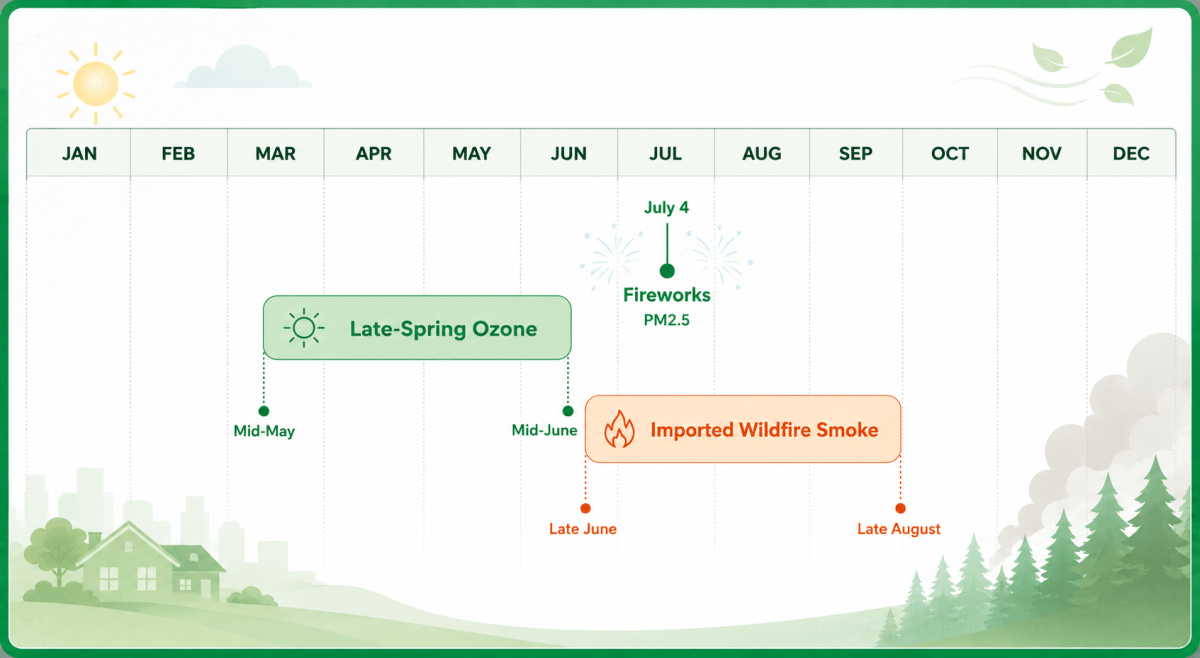
Late-spring ozone. Ozone forms when nitrogen oxides and volatile organic compounds react in sunlight and heat. Iowa's exceedances cluster from mid-May into mid-June, and 2023, 2025, and 2026 all followed that same window. Rural monitors trip as often as urban ones, with Pisgah and Emmetsburg turning up again and again. Because ozone is invisible, a high reading under a clear blue sky usually means ozone rather than smoke. The CDC's guidance on ozone and other air pollutants covers who feels it first and what to change about outdoor activity.
Fourth of July fireworks. Both the Iowa DNR and the Polk County Air Quality Division document Independence Day particle spikes. On July 4, 2026, a Council Bluffs monitor hit 90.3 µg/m³, an AQI of 175. Calm, humid air traps the smoke overnight, but it's gone by the next afternoon.
Canadian wildfire smoke. Smoke is Iowa's single biggest driver. In late June 2023, smoke from Canadian fires pushed a Clinton monitor to 133.1 µg/m³, an AQI of 191, and readings stayed above the federal limit for three straight days. The same eastern cities turn up in every episode: Clinton, Davenport, Muscatine, Iowa City, and Cedar Rapids. In July 2026, eleven monitors exceeded it in one day. While an event is underway, the AirNow Fire and Smoke Map is the fastest way to see where the plume is sitting.
How Often Does Iowa Exceed Federal Limits, and Where Does It Stand?
Iowa's monitoring network recorded 168 exceedances of federal air quality standards in 2023, then zero in 2024. That swing is what makes the state unusual, because its air quality runs on discrete events rather than a constant background level. Filterbuy compiled the table below by reading each of the Iowa DNR's annual exceedance reports and tallying every date by pollutant, so these figures count monitor readings rather than statewide days.
| Year | PM2.5 | PM10 | Ozone | Total |
|---|---|---|---|---|
| 2023 | 45 | 1 | 122 | 168 |
| 2024 | 0 | 0 | 0 | 0 |
| 2025 | 15 | 0 | 9 | 24 |
| 2026 (through July 30) | 14 | 0 | 14 | 28 |
Source: Iowa DNR, Iowa Exceedances of the National Ambient Air Quality Standards, 2023–2026.
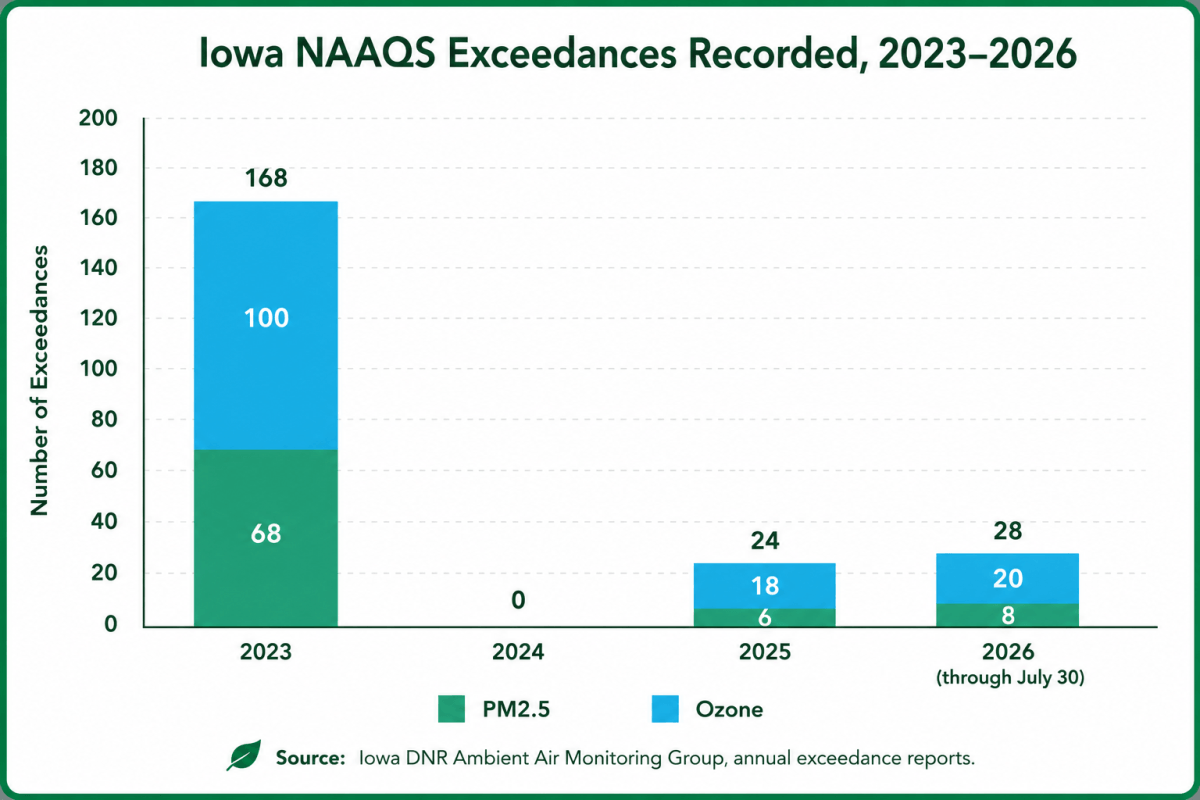
2023 combined a severe Canadian wildfire season with an unusually active ozone spring, while 2024 produced nothing at all. The 2026 figure runs only through July 30, so that year is still open.
As of December 18, 2025, Iowa has no designated nonattainment areas for any criteria pollutant. The last one, a portion of Muscatine County designated for sulfur dioxide, was redesignated to attainment that day. The exceedance record fills in what a designation can't tell you, since meeting a standard on a three-year average and having a bad Tuesday in July are two different things.
What Should You Do Indoors When Iowa's AQI Hits 100?
At an AQI of 100, put a MERV 13 filter in your HVAC system, set the thermostat fan to On, run a portable HEPA air cleaner in each occupied room starting with bedrooms, and close the house up. Check AirNow and your local air agency first. Official guidance comes ahead of anything Filterbuy recommends.
The EPA recommends a high-efficiency filter rated MERV 13 or higher in a central system during smoke events. Acting at 100, and running a cleaner in every occupied room rather than one, are Filterbuy's calls rather than the EPA's. Note that 100 is the top of the Moderate range, not an EPA category change. It's simply where we tell customers to move.
Put MERV 13 in the HVAC. This is the whole-home layer, since the central system moves far more air than any portable unit.
Set the thermostat fan to On, not Auto. Auto filters only while the system is heating or cooling. On filters continuously.
Run a portable HEPA air cleaner in each occupied room, bedrooms first. Choose a unit whose smoke CADR is at least two-thirds of the room's square footage, so a 300-square-foot bedroom wants roughly 200. The EPA advises against air cleaners that produce ozone, which rules out ionizers and ozone generators.
Close windows and doors, and don't add indoor pollution while smoke is around: no candles, frying, smoking, or vacuuming without a sealed unit.
The two layers do different jobs, so run both rather than choosing between them. If you don't have central HVAC, whether that's an apartment, window units, or an older house without ducts, there's no whole-home layer available and portable HEPA cleaners become your primary defense instead of a supplement.
| Conditions | Filter |
|---|---|
| Everyday Iowa days | MERV 8 air filters |
| Allergy season and pets | MERV 11 air filters |
| Smoke events | MERV 13 air filters |
Filterbuy's MERV 13 captures 98% of airborne particles. MERV 13 is the tier we recommend for smoke. It goes in the HVAC, while HEPA belongs in a portable air cleaner rather than a furnace slot, since they're separate products doing separate jobs.
Most furnaces and HVAC systems accommodate MERV 13 without equipment problems as long as the filter is replaced often, according to the EPA. Confirm the fit the same way you'd confirm a size.
Check the filter during a smoke event rather than after it. Smoke loads a filter far faster than ordinary dust, so replace it once it looks dark brown or black, which can come well before the usual interval. Keep spares on hand.
Filterbuy makes and sells the filters named above.
Where Does Iowa's Air Quality Data Come From?
Iowa's air quality data comes from a regulatory network run by the Iowa DNR Air Quality Bureau. The DNR contracts the State Hygienic Laboratory at the University of Iowa to collect and quality-assure readings, while Polk County and Linn County Public Health run monitors in the largest metros.
Those readings feed AirNow, where most live maps get their numbers. Real-time data is unvalidated when it's published and can be revised later, so treat a single hourly spike as a signal rather than a verdict.
The figures in the table above come from those DNR reports, which Filterbuy counted by hand. Where we couldn't verify something ourselves, we left it out rather than repeat it secondhand.
Supporting Statistics
Three federal findings back up the patterns above.
1. 8.9% of Iowa adults currently have asthma.
That's 221,751 people, with another 12.9% diagnosed at some point.
Rates run higher among women and Iowans with disabilities.
This is the group that feels a bad-air day before anyone else does.
Source: Iowa Department of Health and Human Services, 2023 Iowa BRFSS findings.
2. Fourth of July fireworks raise 24-hour PM2.5 by 42% nationwide.
NOAA analyzed 315 U.S. monitoring sites between 1999 and 2013.
The 24 hours from 8 p.m. on July 4 ran 5 µg/m³ above control days.
Readings peak between 9 and 10 p.m., then fall to zero by noon on July 5.
Iowa monitors trace the same curve.
Source: Seidel and Birnbaum, NOAA Air Resources Laboratory.
3. Asthma ER visits ran 17% above expected during the 2023 smoke episodes.
CDC tracked roughly 6,000 emergency departments nationwide.
Visits climbed on the 19 days Canadian smoke pushed the AQI past 101.
The Midwest ranked among the hardest-hit regions.
CDC's threshold was 101, one point above the line where Filterbuy tells you to act.
Source: CDC, Morbidity and Mortality Weekly Report, August 2023.
Frequently Asked Questions
Filterbuy tracks air quality nationwide. Check the live air quality index AQI map for the USA, or narrow down to Des Moines air quality today.
Essential Iowa Air Quality Resources
AirNow Iowa air quality: the federal real-time AQI page.
Iowa DNR ambient air monitoring: the exceedance reports behind our table.
EPA particulate matter basics: what PM2.5 is and who it affects.
American Lung Association Iowa report card: county grades.
Polk County air quality: Des Moines metro data.
Linn County air monitoring: Cedar Rapids data.
State Hygienic Laboratory: the network outside Polk and Linn.
Glossary
Air Quality Index (AQI): The EPA's 0-to-500 scale for daily outdoor air quality. Higher numbers mean more pollution.
PM2.5: Fine inhalable particles 2.5 micrometers and smaller, small enough to slip past the body's defenses.
PM10: Coarse inhalable particles up to 10 micrometers.
Ground-level ozone: A summertime pollutant formed when nitrogen oxides and volatile organic compounds react in sunlight rather than being emitted directly.
NAAQS: National Ambient Air Quality Standards, the health-based limits the EPA sets under the Clean Air Act.
Exceedance: A monitor reading above a federal standard, counted site by site.
Nonattainment: An EPA designation for an area that fails a federal air standard.
MERV: Minimum Efficiency Reporting Value, the 1-to-16 scale rating how much a filter captures.