
Sunnyvale Real-Time AQI Tracker


Get Alerts For Unhealthy AQI In Your Area
When air quality in your area reaches unhealthy levels, we'll send you a quick alert, along with expert tips on how to reduce your exposure.
What's Actually In Sunnyvale Air Today?
What High AQI Means for Your Lungs in Sunnyvale
How to Read AQI
The Air Quality Index (AQI) measures how polluted the air is and how it may affect your health.
0–50 (Good): Air quality is satisfactory.
51–100 (Moderate): Acceptable, but some pollutants may pose minor concerns.
101–150 (Unhealthy for Sensitive Groups)
151–200 (Unhealthy)
201–300 (Very Unhealthy)
301+ (Hazardous)
Moderate
Still okay for most, but if you have asthma or allergies, take it easy and avoid long outdoor workouts.
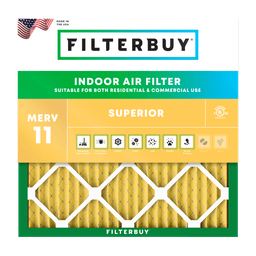
Shop MERV 11 filters→What's the Right Filter for Your AQI Level?
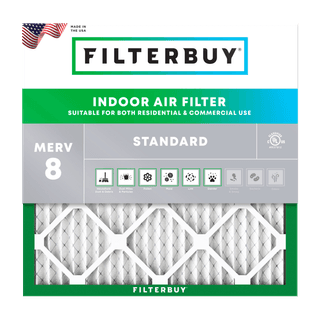
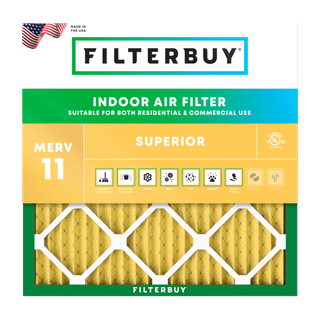
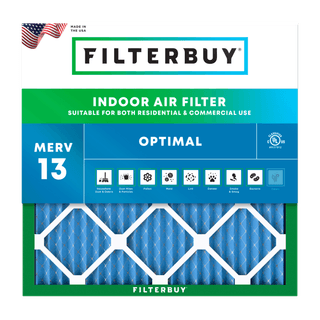


Check Today's Live Real Time Air Quality Index AQI Map in Sunnyvale, CA Now
By Michelle Wan, Brand Manager and Air Quality Writer at Filterbuy, based in the San Francisco Bay Area. Technically reviewed by David Clark, Licensed HVAC Technician. Published and updated August 18, 2026.
TL;DR
Sunnyvale’s air quality is usually Good, but it swings twice a year: ozone on hot summer afternoons, PM2.5 on cold, still winter nights. Check the live map above, then decide two things: how much time to spend outside, and whether your HVAC filter is keeping up. One detail most maps omit: Sunnyvale has no regulatory air monitor in city limits, so your reading is an estimate from nearby stations.
Key Takeaways
Sunnyvale’s official data comes from the Bay Area Air District, the nine-county agency branded BAAQMD until January 2025.
Ozone is a summer problem in Santa Clara County; PM2.5 a winter one. The Air District states this in its own county profile.
Hills east and west block winter air circulation, trapping wood smoke and freeway exhaust near the ground.
On October 1, 2025, the Air District Board amended its wood-burning rule, lowering the Spare the Air trigger from 35 to 25 micrograms per cubic meter of forecast PM2.5. Alerts now come earlier and more often.
An AQI of 50 for PM2.5 now equals 9.0 micrograms per cubic meter, not 12.0. The EPA tightened that breakpoint on May 6, 2024, so identical air reads worse than it did three years ago.
What Is the Air Quality in Sunnyvale Today?
Sunnyvale’s air quality today is whatever the live AQI map above reports for your ZIP code, most often Good (0 to 50) or Moderate (51 to 100). The Air Quality Index is the 0 to 500 scale the U.S. EPA uses for outdoor air pollution. In Sunnyvale one of two pollutants drives it: ozone in summer, PM2.5 in winter and during wildfire smoke.
Two things matter. The value tells you severity; the dominant pollutant tells you the shape of the day, which is covered in the timing table below. For the arithmetic, see how the AQI is calculated. Recheck if the wind shifts or you smell smoke. Sunnyvale air can move a full category in hours.
Where Does Sunnyvale’s AQI Number Actually Come From?
Sunnyvale has no Bay Area Air District regulatory monitor inside city limits. Its AQI is interpolated from the four nearest stations (San Jose–Jackson Street, San Jose–Knox Avenue, Redwood City, Los Gatos) and on some maps blended with PurpleAir sensors installed by residents, including one at Seven Seas Park.
Regulatory monitors are federal reference instruments. Their validated data is what AirNow.gov and the Air District network report officially. Accurate but sparse, and miles from most Sunnyvale addresses.
PurpleAir sensors update every two minutes and show block-by-block differences. Not validated, and they read high in humid or smoky conditions, but in a fast-moving smoke event they often register a change before the official number does.
Our rule: treat the regulatory AQI as the official call, and read the real-time air quality map alongside PurpleAir when smoke is nearby and you need a block-level view.
What Drives Sunnyvale’s Air Quality, Season by Season?
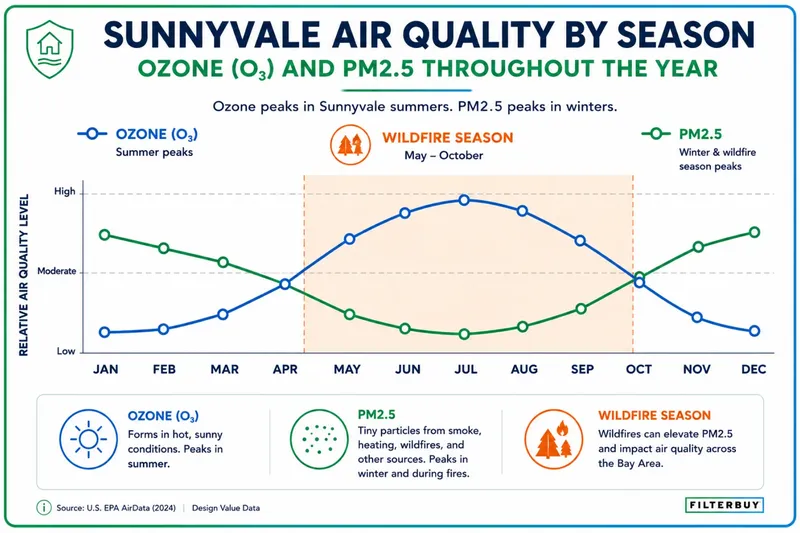
Source: Bay Area Air District, Santa Clara County climatology.
Sunnyvale sits between two of the county’s biggest particle sources: Highway 101 and Central Expressway, and the neighborhoods that light fireplaces in December. Neither shows up on a regional forecast.
What Most Sunnyvale Air Quality Advice Gets Wrong
The standard advice is to check the AQI, close the windows, run your system. In our view it quietly fails here, for a structural reason: a daily AQI is one number, and Sunnyvale does not have one kind of day. It runs two, and which half is bad flips with the season. Plan around a daily average and you will pick the wrong hour to be outside much of the year. Conditions also differ from the live AQI map for San Jose a few miles east and the live AQI map for San Francisco, which gets more marine influence.
The same mismatch shows up in filters. Replacement gets sold in 90-day increments, but Sunnyvale’s particle load is not spread evenly across 90 days. It concentrates into a handful of smoke days and cold, still winter nights. Filterbuy is a family-owned American manufacturer that has built air filters at its own U.S. factories since 2013. After more than a decade of shipping them into Bay Area homes through the region’s smoke seasons, the pattern we keep seeing is this: the filter that matters is whichever one is in the system when the air turns, and it is usually older than the owner thinks.
What Should You Do at Each AQI Level in Sunnyvale?
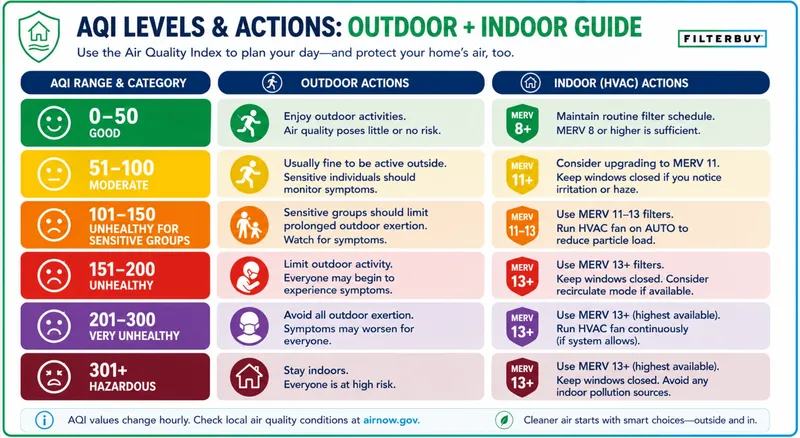
Source: U.S. EPA Air Quality Index categories. Always confirm the highest MERV rating your HVAC system is rated to handle.
From the orange row up, a fitted mask matters outdoors. See the best masks for air pollution.
How Much Does Your Filter Change What You Breathe Indoors?
Your HVAC filter is the one variable on this page you control. Outdoor AQI is weather and geography. Indoor air is a purchasing decision, and that is the part we can help with.
I don’t want anyone to feel like they need an HVAC license just to pick the right filter.
Michelle Wan, Brand Manager and Air Quality Writer, Filterbuy
The EPA recommends MERV 13 or higher during smoky periods, and notes most systems handle it provided the filter is replaced frequently. Ask an HVAC technician what your system can take. See the EPA on preparing for smoke and heat and creating a clean room.
Two numbers we come back to:
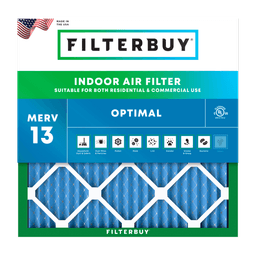
MERV 13 captures 98% of airborne particles as small as 0.3 microns at Filterbuy’s tested rating, including smoke and smog, against 90% for MERV 8. Compare MERV 11 and MERV 13 before a smoke event, not during one.
Every 30 days is what we recommend in smog or wildfire zones, against 90 for a standard home. Wood smoke is the leading source of wintertime air pollution in the Bay Area, so a Sunnyvale winter filter works harder than the calendar suggests.
Central or portable? See MERV 13 vs HEPA for wildfire smoke. Check the label for what your blower can take, find your filter size before you need it, and let auto-delivery handle the reminder.
Spare the Air Alerts and Sunnyvale’s Wood-Burning Rule
A Spare the Air Alert is a public health notice the Bay Area Air District issues when pollution is forecast to reach unhealthy levels. When one is called for fine particles, burning wood, fire logs, pellets, or any solid fuel is illegal in Sunnyvale, indoors and outdoors, year-round.
The threshold changed recently. At an October 1, 2025 hearing, the Board amended Regulation 6, Rule 3, lowering the wood-burning trigger from a forecast 35 micrograms per cubic meter of PM2.5 to 25. Alerts now come before pollution builds, so expect more, on days that only reach high-Moderate. The Spare the Air wood-burning rule page covers exemptions. For status, call 1-877-4NO-BURN or text START to 81757.
When Is It Actually Safe to Go Outside in Sunnyvale?
The AQI describes today. It does not describe this hour, which here is the question that decides your afternoon. Ozone and PM2.5 peak at opposite ends of the day, so an identical AQI reading means different things in July and January.
Filterbuy analysis of Bay Area Air District seasonal patterns. A default to check against the live map, not a measured schedule.
This table is Filterbuy’s reading of the Air District’s seasonal pattern, not a measured schedule. Treat it as a default to check against the live map, and let the hourly view overrule it whenever the two disagree.
What the AQI Does Not Measure
Three gaps worth knowing, because none of them show up in the number.
Pollen. Graded on a separate scale. A Good AQI morning can still be a rough allergy morning in a Sunnyvale spring.
Indoor sources. Cooking, candles, a gas range, and vacuuming all raise indoor PM2.5 no matter what the outdoor reading says.
Your block. The value is an area estimate. With no monitor in the city, a Sunnyvale reading smooths over real differences between a home near Highway 101 and one against the foothills.
Supporting Statistics
The San Jose–San Francisco–Oakland metro ranks 14th worst in the nation for ozone.
20.2 unhealthy ozone days a year, on average.
82% of Californians live in a county with unhealthy air.
Why it matters: the pattern behind Sunnyvale’s summer afternoons.
Source: American Lung Association, State of the Air 2026, April 2026.
Indoor air carries most of your exposure.
Americans spend about 90% of their time indoors.
Some pollutants run 2 to 5 times higher indoors than outdoors.
Why it matters: the AQI describes a fraction of what you breathe.
Source: U.S. EPA, Report on the Environment: Indoor Air Quality.
Filter depth and freshness measurably change performance.
A 4-inch MERV 13 raised clean air delivery rate 123% over a 1-inch.
Units running dirty filters removed almost nothing.
Both from EPA chamber tests with simulated wildfire smoke.
Why it matters: replace early after smoke, not on schedule.
Source: U.S. EPA Air Research, DIY air cleaner study; Holder et al., Indoor Air, 2022.
Frequently Asked Questions
Glossary
Air Quality Index (AQI): the 0 to 500 EPA scale for daily outdoor air pollution, in six color-coded categories from Good to Hazardous.
PM2.5: fine particulate matter 2.5 micrometers or smaller, small enough to reach deep lung tissue and the bloodstream.
Ground-level ozone: a gas formed when sunlight reacts with vehicle and industrial emissions. The county’s dominant summer pollutant.
Bay Area Air District: the air quality agency for the nine Bay Area counties. Known as BAAQMD until January 2025.
Spare the Air Alert: an Air District notice issued when pollution is forecast to reach unhealthy levels. For fine particles, it makes wood burning illegal region-wide.
MERV: Minimum Efficiency Reporting Value, the 1 to 16 scale rating how much particulate an HVAC filter captures.
Breakpoint: the pollutant concentration where the AQI crosses into the next category. The EPA reset the PM2.5 breakpoints in May 2024.
Regulatory monitor: a federally validated station used for compliance reporting. The nearest are in San Jose, Redwood City, and Los Gatos.
PurpleAir sensor: a low-cost consumer sensor reporting PM2.5 every two minutes. Not validated for regulatory use.