
How to Change the Cabin Air Filter in a Honda Accord
By Michelle Wan · Technically reviewed by David Clark, Licensed HVAC Technician
Published July 23, 2026 · Updated July 23, 2026
Michelle Wan writes about indoor and in-vehicle air quality for Filterbuy, which has manufactured air filters in the USA since 2013.
Two Honda part numbers cover every Accord on the road. Accords from 2003 to 2022 use 80292-SDA-407, and 2023 to 2026 models use 80291-TF3-E01. Both sit behind the glove box, and swapping either one takes about 10 minutes with no tools.
- 2003–2022 Accord: part 80292-SDA-407
- 2023–2026 Accord: part 80291-TF3-E01
Answer a few quick questions below and we will match you to the exact filter for your Accord.

Answer 3 quick questions and we'll match you to your perfect filter.
TL;DR
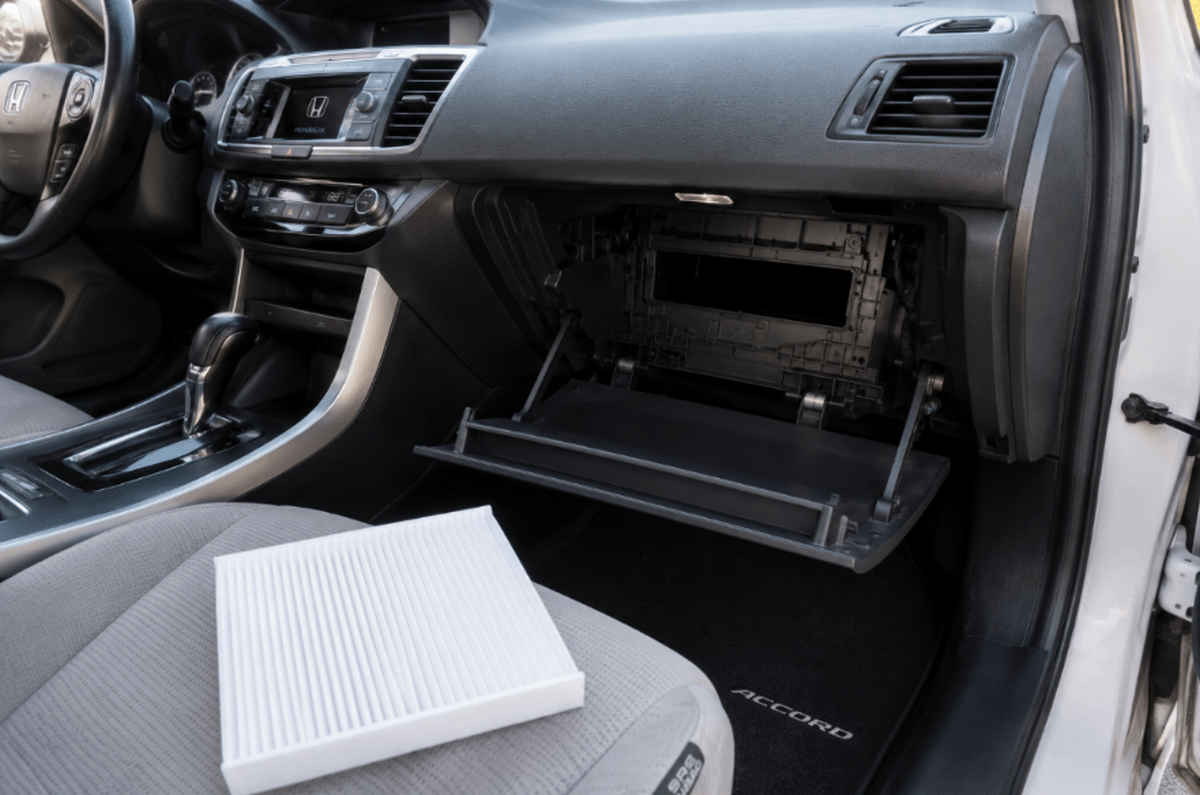
Changing the cabin air filter in a Honda Accord takes about 10 minutes and requires no tools. The filter sits in a housing behind the glove box on the passenger side, and the procedure is the same for every Accord from 2003 through 2026: empty the glove box, release the side stops and the damper arm so the door drops below its normal stop, unclip the filter cover, and slide the new filter in facing the same way as the one that came out.
Key Takeaways
The Honda Accord cabin air filter sits behind the glove box on every model year from 2003 through 2026.
Replacing a Honda Accord cabin air filter takes about 10 minutes and requires no tools.
Honda’s owner’s manual does not call it a cabin air filter. It is listed as the dust and pollen filter, under Maintenance Minder sub-item code 2.
Accord model years 2003–2022 use Honda part 80292-SDA-407. Model years 2023–2026 use Honda part 80291-TF3-E01.
Install the new filter with its airflow arrow facing the same way as the one you removed.
How Do You Change the Cabin Air Filter in a Honda Accord?
Open and empty the glove box, squeeze both side walls inward to clear the stops, unhook the damper arm on the right, and let the door hang. The filter housing is directly behind it. Release the cover clips, slide the old filter out, slide the new one in facing the same way, and reassemble. Ten minutes, no tools.
Empty the glove box completely. Anything left inside will land in the footwell when the door drops.
Release the damper arm. On the right side of the glove box, a small piston or strap limits how far the door opens. Unhook it from its post. It pops off by hand.
Squeeze the side walls inward. Press both sides toward the center until the stops clear their channels. The door will swing well below its normal open position.
Find the filter housing. It is a flat rectangular door in the dash directly behind the glove box, above the blower motor.
Release the cover. On 2013 and newer Accords, press the hinge tabs on the left and right of the cover and lift it away. On 2003–2012 models, the cover slides out of its track.
Note the arrow, then pull the old filter out. Check which way it faces before you touch anything. Pull it out slowly and level, straight into a bag. Tilting it dumps a season of pollen into the footwell.
Vacuum the housing. Leaves and grit collect in the tray; thirty seconds with a hand vacuum keeps them out of the new filter.
Slide the new filter in facing the same way as the old one. On 2003–2022 cars the arrow points down; on 2023–2026 Accords the filter seats in a carrier tray that slides back into the blower housing as a unit.
Reassemble. Clip the cover, lift the glove box until the side stops re-seat, and reattach the damper arm.
Which Cabin Air Filter Fits Your Honda Accord?
Two Honda part numbers cover the entire modern Accord run. No single guide we found says so, which is why we cross-referenced Honda’s parts catalog across all five generations: 2003 through 2022 share 80292-SDA-407, and 2023 through 2026 use 80291-TF3-E01. Both are single-element filters. The Accord does not take the two-piece set some Civics and CR-Vs do.
Part numbers supersede over time. Confirm fitment against your VIN before ordering. Common aftermarket cross-references: CF10134 for 2003–2022, CF11182 for 2023–2026.
Open the housing and find it empty? Not necessarily a fault. AAA notes manufacturers often run identical ductwork across trims, so the housing can exist on a car that never had one fitted.
The supersession quirk worth knowing: 2018–2022 Accords shipped with Honda filter 80292-TZ3-A41, superseded to 80292-SDA-407. The TZ3 drops straight in; the SDA is firmer and needs a gentle squeeze to seat. If your new filter feels a hair too big, that is expected. It is the correct part. Filterbuy builds every cabin filter to exact OEM tolerances, which is why we flag this: a loose filter lets unfiltered air slip past the frame, and a snug one gets returned as wrong when it was right.
How Often Should You Replace a Honda Accord Cabin Air Filter?
Honda schedules the dust and pollen filter under Maintenance Minder sub-item 2, which typically appears between 25,000 and 30,000 miles alongside the engine air cleaner. But the Accord owner’s manual maintenance schedule adds a footnote most owners never read: if you drive primarily in urban areas with high concentrations of soot from industry and diesel vehicles, replace the dust and pollen filter every 15,000 miles.
That range is consistent with the wider industry. AAA puts factory-recommended cabin filter intervals at 15,000 to 30,000 miles across makes. But notice: Honda’s schedule and Honda’s own footnote disagree. The Maintenance Minder stays quiet until roughly 30,000 miles, while the footnote on the same page halves that for city drivers. Filterbuy’s published guidance is 12 months or 12,000 miles. Better to pull the filter early and find it clean than wait on a prompt built for a commute you may not have. More in our guide to how often to change a cabin air filter and the Filterbuy cabin air filter buyer’s guide.
Signs Your Accord’s Cabin Filter Is Overdue
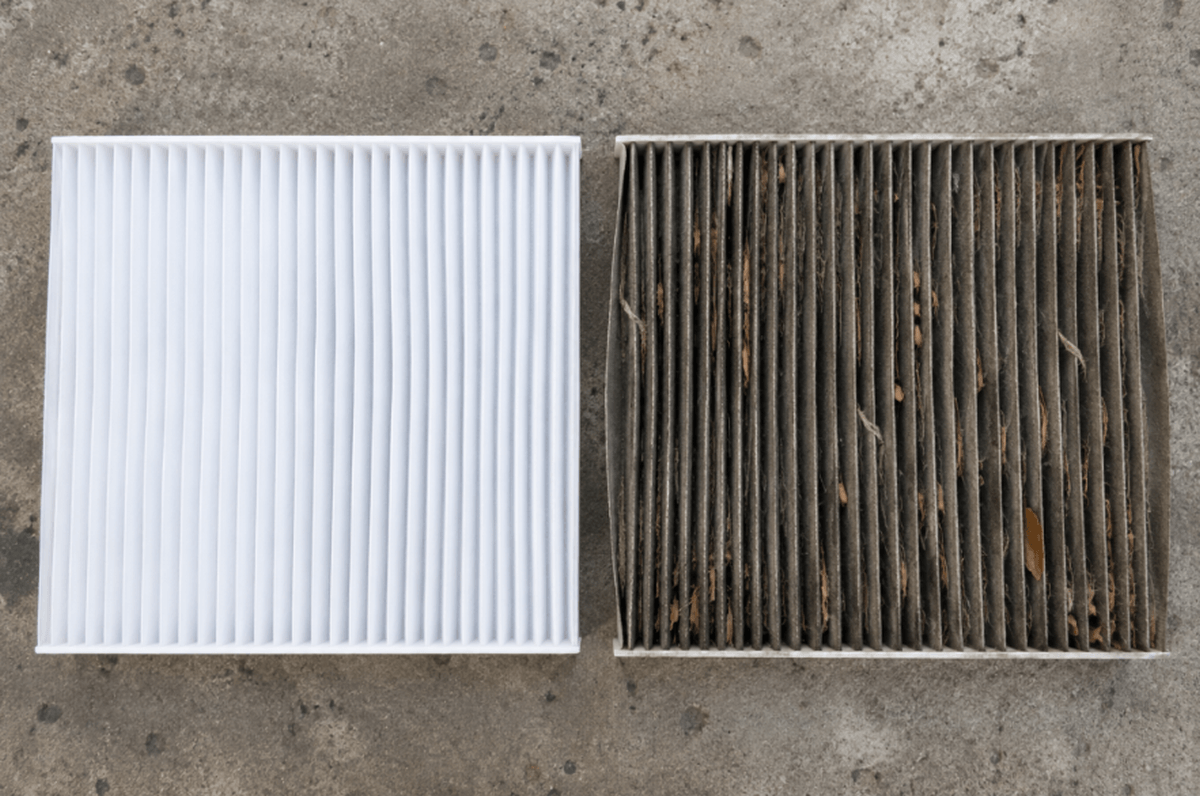
A filter that is grey, matted, or packed with debris tells you everything. Here is what each symptom points to; our guide to the signs your cabin air filter needs replacing goes deeper.
Two or more of these at once means the filter is overdue. Pull it and look at it before spending money on anything else.
Three Mistakes That Turn a 10-Minute Job Into an Afternoon
1. Forcing the glove box before releasing the damper. The damper arm on the right side is the part people break. It unhooks by hand; if you are pulling hard, something is still attached.
“The damper arm is the part I see broken most. People treat the glove box like it is stuck and pull. It is not stuck. There is a stop on each side and a strap on the right, and all three release by hand.”
— David Clark, Licensed HVAC Technician
2. Installing the filter backwards. The arrow shows which way air travels through the media. Reversed, it loads up faster and drops debris into the housing when you pull it.
3. Yanking the old filter out flat and fast. A year of pollen, ash, and leaf litter sits on top of it. Tilt it, support it underneath, and walk it into a trash bag.
Get More From the Filter You Just Installed
A cabin filter only cleans the air your Accord pulls in, so the vent setting matters too.
Recirculate in stop-and-go traffic. With a clean filter fitted, recirculating pulls in less exhaust when you are stuck behind a truck or bus.
Switch back to fresh air once you are moving. Long stretches on recirculate let cabin CO2 climb from the passengers themselves, a trade-off the same Health Canada team flagged.
Should You Upgrade From the Standard Filter?
A standard particulate filter catches dust, pollen, and leaf debris. It does not do much for smoke, exhaust, or the fine particulate matter you breathe sitting in traffic. EPA research on mobile-source pollution links vehicle exhaust to real health consequences.
The filter itself measurably helps. In a randomized cross-over study of 48 commuters in Environmental Science & Technology, Health Canada researchers found cabin filtration cut in-vehicle ultrafine particles 28%, PM2.5 30%, and black carbon 32%, close to a third, without restricting airflow. If you commute through a city, drive in wildfire country, or carry someone with asthma, the upgrade earns its cost.
Full disclosure: Filterbuy makes them. Our auto cabin air filters use HEPA-certified media that traps 99.97% of particles down to 0.3 microns, including smoke, mold spores and pet dander. They are built to exact OEM tolerances so unfiltered air cannot slip past the frame. Made in the USA, tool-free to fit, available on auto-delivery.
Supporting Statistics
Three U.S. findings explain why this job matters.
Most Americans drive to work alone. 69.2% drove alone in 2024, on a mean one-way commute of 27.2 minutes (U.S. Census Bureau). That is about 4.5 hours a week breathing cabin air.
Nearly half breathe failing-grade air. 44% of Americans (152.3 million people) live in counties graded F for ozone or particle pollution (American Lung Association, State of the Air 2026).
One in four adults has seasonal allergies. 25.2% were diagnosed in 2024 (CDC, NCHS Data Brief 545). They gain the most from HEPA-grade media.
Sources: Census Bureau ACS 1-year estimates (2024); American Lung Association State of the Air 2026; CDC/NCHS Data Brief No. 545 (January 2026).
Frequently Asked Questions
Source List
Full sources: Census Bureau commuting estimates · American Lung Association State of the Air 2026 · CDC/NCHS Data Brief 545 · Honda Accord Maintenance Minder schedule · Mallach et al., Environmental Science & Technology (2023) · AAA Automotive · U.S. EPA mobile source pollution research.
Glossary
Cabin air filter: A pleated filter that cleans outside air before it enters a vehicle’s passenger compartment through the HVAC system.
Dust and pollen filter: Honda’s own term for the cabin air filter, used throughout Accord owner’s manuals.
Maintenance Minder: Honda’s onboard maintenance system. It displays a letter (main item) and numbers (sub-items); sub-item 2 covers the dust and pollen filter.
Airflow arrow: The directional marking on a cabin filter frame showing which way air passes through the media.
HEPA-certified media: Media verified to capture 99.97% of airborne particles at 0.3 microns, the range that includes smoke and fine particulates.
Bypass air: Unfiltered air that slips around the edges of a filter that does not fit tightly.