May 5, 2026

Every winter, our customer support team hears the same thing: "Why is my house so dusty all of a sudden?" After manufacturing millions of air filters and helping homeowners troubleshoot their worst air quality seasons, we can tell you — winter dust isn't random. It's predictable, and it's fixable.
When you seal up your home and run the heat nonstop, you're recirculating the same trapped air through a system that's working harder than any other time of year. Dust, pet dander, and allergens build up fast with nowhere to escape. We've seen customers go from changing filters every 90 days to needing replacements in half that time once heating season hits — and most don't realize it until the dust is already out of control.
This guide shares what we've learned from over a decade of manufacturing filters and obsessing over indoor air quality: why winter makes your air worse, what's actually causing the dust and dryness, and the targeted fixes that deliver the biggest improvement for your home.
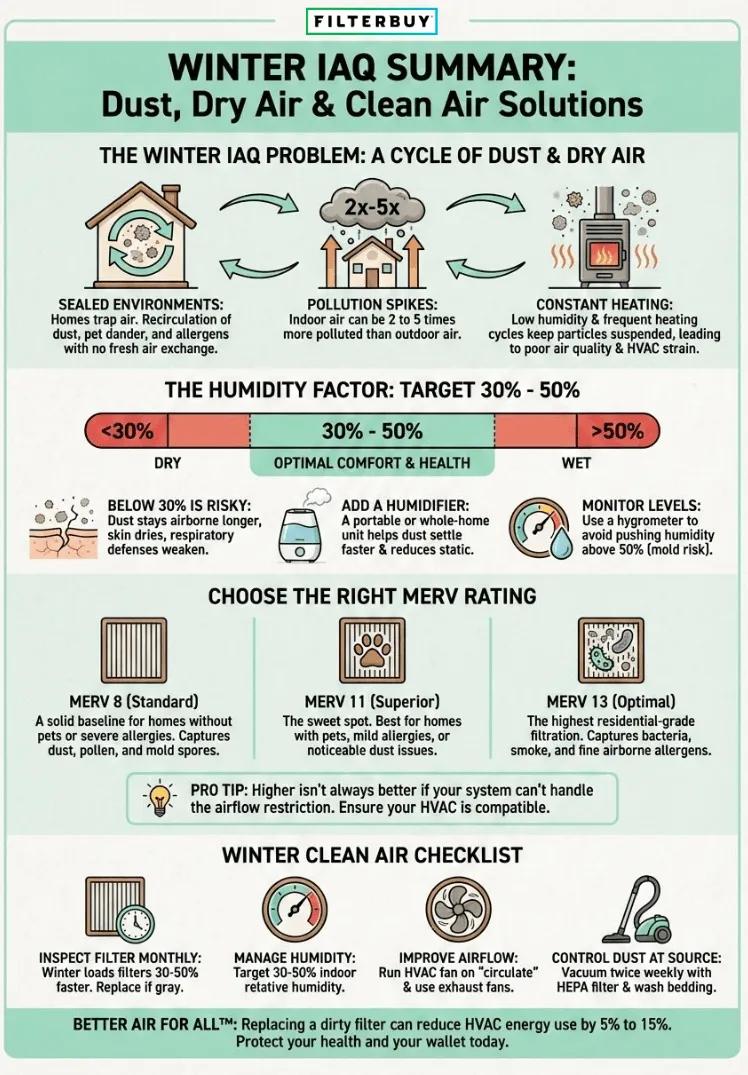
Winter dust increases because sealed homes and constant heating recirculate trapped air with no fresh air exchange. Your air filter is the single most effective tool for controlling it, but most homes are running a filter that's either underrated or overdue for replacement during heating season.
What you need to know:
Why it happens: Low humidity, sealed environments, and longer HVAC run cycles keep dust airborne and circulating through every room
Best filter for winter dust: MERV 11 is the sweet spot for most homes — MERV 8 minimum, MERV 13 for pets, allergies, or persistent dust
How often to replace: Check monthly during heating season. Filters rated for 90 days typically saturate in 45 to 60 days under winter demand
Biggest mistake homeowners make: Waiting for the printed replacement date instead of inspecting the filter monthly. A saturated filter lets dust through and increases energy costs by up to 15%
After manufacturing millions of filters and helping homeowners through every winter season, our advice is simple: upgrade to the right MERV rating, check it monthly, and replace it the moment it looks loaded. It's a two-minute fix that improves your air quality, lowers your energy bill, and reduces dust throughout your home.
Your air filter is the single most impactful winter upgrade.
Everything else works better when your system runs a clean, properly rated filter
Upgrade to at least MERV 8 — consider MERV 11 or 13 for homes with pets, allergies, or persistent dust
Winter loads filters 30% to 50% faster than other seasons.
A 90-day filter can become saturated in 45 to 60 days during peak heating
Check monthly and replace based on what you see — not what the packaging says
Indoor air can be 2 to 5 times more polluted than outdoor air.
Sealed homes, constant heating, and low humidity trap dust, dander, and allergens with no escape
Winter makes this worse — most families don't notice until symptoms appear
Humidity between 30% and 50% is the sweet spot.
Below 30%: dust stays airborne longer, and respiratory defenses weaken
A hygrometer and humidifier are low-cost tools that make a measurable difference
A clogged filter costs you twice — in air quality and energy.
The DOE estimates that replacing a dirty filter reduces HVAC energy use by 5% to 15%
A $15 filter swap protects your family's health and your utility bill simultaneously
Your home is designed to keep cold air out during winter — but that same seal traps everything else inside. Heating systems run longer cycles, pulling air through ductwork that may already carry dust, dander, and debris. Without fresh-air exchange through open windows or natural ventilation, pollutants accumulate faster than most homeowners realize.
From what we've seen working with customers across the country, homes with pets, older HVAC systems, or heavy heating use tend to see the sharpest drop in air quality once temperatures fall. The combination of sealed environments, constant forced-air heating, and low humidity creates a cycle in which dust and allergens remain airborne longer and circulate through every room in the house.
Dust isn't just a nuisance — it's a signal that your indoor air is carrying more particulates than your filtration system can handle. Winter makes this worse in several ways.
Dry air keeps dust airborne. When humidity drops, dust particles lose the moisture that normally helps them settle onto surfaces. Instead, they stay suspended and get pulled into your HVAC system over and over again.
Filters work harder and clog faster. Higher heating demand means more air cycles per day passing through your filter. A filter rated for 90 days under normal conditions can become saturated in 45 to 60 days during peak winter use — something we consistently see in our customer replacement data.
Indoor activity spikes. More time indoors means more cooking, more foot traffic, more pet dander, and more fabric fibers from blankets, holiday décor, and heavier clothing. All of it feeds the dust cycle.
Signs your home has a dust problem: If you're wiping down surfaces more often than usual, noticing dust buildup on vent covers, or seeing visible particles in sunlight, your filtration isn't keeping up with winter demand.

Low humidity doesn't just make your skin dry — it compounds every other winter air quality issue. When indoor relative humidity drops below 30%, you'll start noticing dry, cracked skin, irritated sinuses, increased static electricity, and sore throats that linger. These aren't just comfort problems. Dry nasal passages are less effective at filtering out airborne irritants, which means more allergens reach your respiratory system.
Dry conditions also accelerate dust circulation. Without adequate moisture in the air, particles stay lighter and travel farther through your home before settling. The EPA recommends maintaining indoor humidity between 30% and 50% for both comfort and air quality — a range that most homes fall below during winter without some form of humidification.
Not all fixes carry equal weight. Based on what we've learned from manufacturing filters and analyzing customer feedback across millions of orders, these are the changes that deliver the most noticeable improvement in winter indoor air quality — ranked by impact.
Your air filter is the single most impactful tool you have for winter air quality, and most homes are running a filter that's either too low-rated or long overdue for replacement.
MERV ratings determine how effectively your filter captures airborne particles. A basic fiberglass filter (MERV 1–4) catches large debris but lets dust, pollen, and dander pass right through. For winter dust and allergen control, we recommend a MERV 8 as the minimum and a MERV 11 or MERV 13 for homes with pets, allergies, or respiratory sensitivities. These higher-rated filters trap finer particles without restricting airflow to most standard HVAC systems.
Pro Tip: During winter, check your filter monthly instead of waiting for the recommended replacement date. If it looks gray or visibly loaded with dust, swap it out early. A clogged filter doesn't just let particles through — it forces your HVAC system to work harder, increasing energy costs and wear on your equipment.
Bringing humidity back into the 30–50% range does more than relieve dry skin. Adequate moisture helps dust particles settle faster, reduces static that attracts dust to surfaces and electronics, and keeps your respiratory system's natural defenses working effectively.
A whole-home humidifier connected to your HVAC system provides the most consistent coverage. Portable units work well for targeted rooms like bedrooms or living areas. Either way, use a hygrometer to monitor levels and avoid pushing humidity above 50%, which can encourage mold growth — trading one air quality problem for another.
Sealed homes need intentional air movement to prevent stagnant, pollutant-heavy zones. Running your HVAC fan on "circulate" or "on" mode — even when heating cycles aren't active — keeps air flowing through your filter and reduces dead spots where dust accumulates.
Use exhaust fans in kitchens and bathrooms during cooking and showering to remove moisture and particulates at the source. If the weather allows, crack a window for even 10–15 minutes a day to introduce fresh air exchange without significantly impacting your heating bill.
Filtration catches what's already airborne, but reducing dust at the source lightens the load on your entire system. During winter, focus on the biggest contributors.
Pets: Brush dogs and cats regularly to reduce dander before it goes airborne. Keep pet bedding clean and washed weekly.
Vacuuming: Use a vacuum with HEPA filtration at least twice a week, focusing on carpets, upholstered furniture, and along baseboards where dust collects.
Bedding: Wash sheets and pillowcases weekly in hot water. Heavier blankets and comforters used during winter shed fibers that add to indoor dust.
Surfaces: Damp-dust instead of dry-dusting. A dry cloth just redistributes particles back into the air.
Drafty windows, gaps around doors, and poorly sealed attic access points don't just let cold air in — they pull outdoor dust, pollen, and pollutants into your home. Weatherstripping, door sweeps, and caulking around window frames are inexpensive fixes that improve both energy efficiency and indoor air quality.
Pay special attention to areas around your HVAC system and ductwork. Leaky ducts can pull in unfiltered air from attics, crawl spaces, or wall cavities, bypassing your filter entirely and introducing dust and contaminants directly into your living spaces.
Use this quick checklist at the start of winter — and revisit it monthly — to stay ahead of air quality issues before they become noticeable problems.
Replace or upgrade your HVAC filter to MERV 8 or higher
Check indoor humidity levels with a hygrometer (target 30–50%)
Inspect visible ductwork and vents for dust buildup
Vacuum carpets and upholstery with HEPA filtration twice weekly
Clean supply vents and return air grilles
Test weatherstripping around windows and exterior doors
Run exhaust fans during cooking and bathing
Most winter IAQ issues respond well to the solutions above. But some situations call for professional attention. If you're consistently replacing filters ahead of schedule and still seeing heavy dust, your ductwork may have significant buildup or leaks that need professional inspection and cleaning.
Other signs it's time for professional help include persistent musty or stale odors that don't improve with filter changes, uneven heating or airflow across rooms, visible mold near vents or in ductwork, and allergy or respiratory symptoms that worsen indoors despite your best efforts. An HVAC technician can assess your system's performance, check for duct leaks, and recommend solutions tailored to your home's specific needs.
Winter air quality isn't something you fix once and forget. The homes that maintain the cleanest air through heating season share three habits: they run the right filter and check it monthly, they keep humidity in the 30–50% sweet spot, and they stay consistent with cleaning routines that reduce dust at the source.
Small, consistent actions outperform one-time deep cleans every time. Set a monthly reminder to inspect your filter, keep a hygrometer in your main living area, and stick to your vacuuming schedule even when things look clean — because the particles that affect your health and comfort the most are the ones you can't see.
At Filterbuy, we've spent over a decade helping homeowners protect their families, their homes, and their HVAC systems through better filtration. If you're ready to upgrade your winter air quality, start with the air filter that fits your home and your needs — it's the single easiest change with the biggest impact.
"After manufacturing millions of air filters and tracking replacement patterns across every season, we can say with confidence that winter is when most homes fall behind on air quality — not because homeowners aren't trying, but because their filters are working twice as hard as they were designed to under normal conditions." — Filterbuy Team
We're obsessed with helping you breathe better air — and that means pointing you toward the best information available, not just our own. Whether you're trying to figure out why your home is dustier than usual, choosing the right MERV-rated filter, or looking for ways to winterize your home without sacrificing air quality, these trusted resources will help you take control of your indoor environment with confidence.
Most homeowners don't realize that indoor air can be significantly more polluted than outdoor air — especially during winter. The EPA's indoor air quality hub breaks down the pollutants you can't see, the health risks they carry, and the three proven strategies experts recommend: source control, better ventilation, and upgraded filtration. If you're just starting to think about your home's air quality, this is the place to begin.
Source: U.S. Environmental Protection Agency
https://www.epa.gov/indoor-air-quality-iaq
With so many air-cleaning products on the market, it's easy to feel overwhelmed. This EPA guide simplifies the decision by explaining how HVAC filters and portable air cleaners actually work, what performance metrics matter most, and why the agency recommends MERV 13 or the highest rating your system can handle. We recommend reading this before making any filtration purchase — knowledge is your best filter.
Source: U.S. Environmental Protection Agency
https://www.epa.gov/indoor-air-quality-iaq/guide-air-cleaners-home
MERV ratings aren't just numbers on a box — they determine exactly which particles your filter traps and which ones pass right through into the air your family breathes. The EPA's explainer covers how the ASHRAE-developed rating scale works, what each MERV level captures from dust and pollen to bacteria and smoke particles, and how to match the right rating to your home's specific needs. After manufacturing millions of filters across MERV 8, 11, and 13, we can tell you — understanding this scale is one of the smartest things you can do for your home's air quality.
Source: U.S. Environmental Protection Agency
https://www.epa.gov/indoor-air-quality-iaq/what-merv-rating
Winter creates a perfect storm for poor indoor air quality, and most families don't realize it until the symptoms show up. This EPA resource covers how sealed homes, constant heating cycles, and reduced ventilation trap pollutants indoors — along with practical steps for maintaining healthier air when opening windows isn't an option. If you've noticed more dust, drier air, or unexplained congestion since the cold weather started, this guide explains exactly why.
Source: U.S. Environmental Protection Agency
https://www.epa.gov/emergencies-iaq/winter-weather-and-indoor-air-quality
Clean air isn't just about comfort — it's about protecting the people who matter most. The American Lung Association's winter guide connects indoor air quality directly to respiratory health, explaining how dust, mold, VOCs, and dry conditions impact your lungs and what you can do about it. For families managing allergies, asthma, or simply wanting to breathe easier during heating season, this resource makes the invisible health risks visible.
Source: American Lung Association
https://www.lung.org/blog/indoor-air-quality-winter
Here's something many homeowners don't connect: the same steps that lower your energy bill also improve your indoor air quality. The DOE's seasonal guide covers heating system efficiency, filter replacement schedules, weatherstripping, and insulation — all of which directly impact how clean your air stays when the house is sealed up tight. We love this resource because it shows that protecting your air and protecting your wallet don't have to be separate goals.
Source: U.S. Department of Energy
https://www.energy.gov/energysaver/fall-and-winter-energy-saving-tips
After over a decade of manufacturing air filters and helping millions of customers find the right fit, we built this guide to answer the questions our team hears most: Which MERV rating do I actually need? Will a higher-rated filter work with my HVAC system? How often should I replace it during winter? Our breakdown covers MERV 8, 11, and 13 performance for residential dust, allergens, and pet dander — with honest guidance on balancing filtration power with airflow, so you can make the right call for your home.
Source: Filterbuy.com
https://Filterbuy.com/resources/air-filter-basics/all-about-merv-ratings/
We don't just manufacture air filters — we study how they perform across millions of homes, every season, year after year. These three federal statistics explain why winter is the most critical season for your indoor air, and they align with patterns we see consistently in our own customer data.
Every heating season, our support team fields a surge in calls from homeowners who can't figure out why their house suddenly feels dustier and harder to breathe in. The EPA's research explains exactly why: indoor pollutant concentrations are typically two to five times higher than outdoor levels — and can spike to 100 times higher during certain activities.
What we see in our own data during winter:
Customers who normally reorder filters on a 90-day cycle start reordering in 45 to 60 days once temperatures drop
Homes running basic fiberglass filters (MERV 1–4) report the worst dust problems because those filters miss the finer particles that trigger allergy and respiratory symptoms
Upgrading to a pleated MERV 8, 11, or 13 is the single most immediate improvement — and the first recommendation our team gives when someone calls about winter dust
Most families have no idea they're sealing themselves inside with air that's getting progressively worse. A better filter changes that equation overnight.
Source: U.S. Environmental Protection Agency — Indoor Air Quality Report on the Environment
https://www.epa.gov/report-environment/indoor-air-quality
One connection we wish more homeowners understood earlier: your air filter directly impacts your energy bill — not just your air quality. According to the U.S. Energy Information Administration's 2020 Residential Energy Consumption Survey, space heating and cooling account for roughly 52% of household energy use. That makes your HVAC system the single largest energy consumer in your home.
Here's the part most sources miss — and what we've learned from a manufacturing perspective:
Every cubic foot of heated air passes through your filter first
A clean, properly rated filter keeps airflow efficient and your system running as designed
A clogged filter forces longer run cycles, higher energy consumption, and worse air quality simultaneously
Winter accelerates this problem because increased system runtime and higher dust loads saturate filters faster than any other season
Customers who switch to a consistent winter replacement schedule routinely report cleaner air and noticeably lower heating bills. Protecting your family's health and reducing energy costs come from the same action.
Source: U.S. Energy Information Administration — Use of Energy in Homes
https://www.eia.gov/energyexplained/use-of-energy/homes.php
This statistic from the U.S. Department of Energy gets the strongest reaction from our customers: simply replacing a clogged filter with a clean one can cut HVAC energy consumption by 5% to 15%. For a household spending over $2,000 annually on energy, that's real savings from a fix that takes under two minutes.
But here's what the DOE statistic doesn't capture — and what over a decade on the manufacturing side has taught us:
Most homeowners aren't replacing filters when they're slightly dirty — they're replacing them when they're completely saturated, weeks or months past the point where airflow restriction started driving up costs
During winter, a filter that performs well for 90 days in mild weather can hit capacity in half that time when heating runs 12 to 16 hours daily in a sealed home
Energy savings start the moment clean air flows freely again, and most families notice improved dust levels and air quality within the first day
Our recommendation for every homeowner during heating season:
Don't wait for the calendar — check your filter monthly
If it looks gray or you can't see light through the media, replace it immediately
A fresh, properly rated filter is the simplest and most cost-effective winter upgrade you can make
Source: U.S. Department of Energy — Energy Saver: Maintaining Your Air Conditioner
https://www.energy.gov/energysaver/maintaining-your-air-conditioner
After manufacturing millions of air filters and talking with homeowners across every climate and season, we've concluded most of the industry won't say directly: winter air quality isn't a comfort issue. It's a maintenance failure that compounds quietly until it becomes a health and cost problem.
Most families don't think about their indoor air until something forces them to:
The dust gets noticeable on surfaces that were just cleaned
Someone develops a persistent cough or wakes up congested every morning
The heating bill spikes without explanation
By the time these signals appear, air quality has already been deteriorating for weeks — sometimes months — while a saturated filter silently lets particulates recirculate through every room.
Here's what over a decade of manufacturing experience has taught us:
The filter is the foundation. Everything else is secondary.
Humidifiers help. Vacuuming routines matter. Sealing drafts makes a difference. But none of those solutions work at full potential if the air cycling through your HVAC system is passing through a clogged or underrated filter.
Your filter touches every cubic foot of air in your home, multiple times a day, all winter long
When it's clean and properly rated, every other improvement you make works better
When it's neglected, everything else you do is fighting an uphill battle against air that's already compromised
The 90-day replacement myth costs homeowners more than they realize.
We print recommended replacement timelines on our packaging because the industry expects it. But candidly, those timelines are based on average conditions — and winter is not average.
What our customer data actually shows:
Homes in heating season load filters 30% to 50% faster than the same homes in spring or fall
A 90-day filter running in a sealed home with heat on 12+ hours daily often functions by day 45 to 60
Every additional day a saturated filter stays in place means more dust in your air, more strain on your system, and more money on your energy bill
Checking monthly during winter isn't overcautious — it's what the conditions actually demand.
The real cost of poor winter air quality isn't visible on any single bill.
It shows up in the accumulation of small things most people don't connect:
Allergy medication that becomes a daily habit from November through March
Slightly higher heating bills are attributed to cold weather rather than restricted airflow
The HVAC service call in February that a $15 filter swap in December could have prevented
We've talked to thousands of homeowners who didn't realize how much winter air quality was costing them until they made one targeted change — upgrading their filter and committing to a monthly check during heating season. The difference isn't subtle. It's the kind of improvement that makes people wonder why they waited so long.
At Filterbuy, we're obsessed with indoor air quality because we've seen — in our manufacturing data, our customer conversations, and the federal research that backs it all up — that clean air isn't a luxury. It's a baseline for a healthy, comfortable, and efficient home. Winter makes that harder to maintain. The right filter, checked at the right time, makes it simple again.
You don't need to overhaul your entire home to breathe better air this winter. The biggest improvements come from a few targeted actions done in the right order.
Step 1: Check Your Current Filter Right Now
Pull it out and inspect it. If it looks gray or you can't see light through the media, it's already restricting airflow.
Note the size printed on the filter frame
Check the MERV rating — anything below MERV 8 is missing the particles that matter most
Step 2: Upgrade to the Right MERV Rating
Not every home needs the same filter:
MERV 8 — Solid baseline for homes without pets or allergy concerns
MERV 11 — Best fit for homes with pets, mild allergies, or moderate dust
MERV 13 — Maximum residential filtration for respiratory sensitivities or persistent dust problems
Not sure which rating your system can handle? Start with MERV 11. It delivers a meaningful upgrade without restricting airflow in most standard HVAC systems.
Step 3: Set a Monthly Filter Check
Winter loads filters faster than any other season. Don't rely on the replacement date printed on the packaging.
Set a recurring monthly reminder on your phone
Check on the same day each month, so it becomes routine
Replace the moment it looks loaded — not when the calendar says to
Step 4: Check Your Humidity Levels
Place an inexpensive hygrometer in your main living area and target 30% to 50% relative humidity.
Below 30%: Dust stays airborne longer, skin dries out, and respiratory defenses weaken
Above 50%: Mold and mildew risk increases
Consistently low? Add a portable or whole-home humidifier
Step 5: Tighten Up Your Cleaning Routine
A better filter catches what's airborne. Consistent cleaning reduces what gets there in the first place.
Vacuum carpets and upholstery twice weekly with HEPA filtration
Damp-dust hard surfaces — dry cloths just redistribute particles
Wash bedding weekly in hot water
Brush pets regularly to reduce dander before it becomes airborne
Step 6: Inspect Your Home's Weak Points
Spend 15 minutes checking where outdoor dust and cold air sneak in:
Test weatherstripping around doors and windows
Look for gaps around ductwork and attic access panels
Clean supply vents and return air grilles
Run exhaust fans during cooking and bathing
Step 7: Know When to Call a Professional
If you've followed these steps and still see persistent issues, schedule an HVAC inspection. Warning signs include:
Heavy dust that returns quickly despite regular filter changes
Uneven heating or weak airflow from certain vents
Musty or stale odors that don't improve with a fresh filter
Allergy or respiratory symptoms that worsen indoors
These often point to duct leaks or system issues beyond what a filter change can solve.
Ready to Start With the Fix That Makes the Biggest Difference?
Find the right filter at Filterbuy.com:
Enter your filter size
Choose the MERV rating that fits your needs
Set up a delivery schedule so you never run a saturated filter through another winter
It takes less than two minutes. It's the single easiest change with the single biggest impact.
A: This is the number one question our support team hears from November through March. After helping millions of homeowners troubleshoot this exact problem, the answer is almost always the same combination of factors:
Sealed homes recirculate the same trapped air with no fresh air exchange
Heating systems run longer cycles, stirring up particles that would normally settle
Low humidity keeps dust airborne longer than it would in warmer months
Increased indoor activity — cooking, heavier clothing, extra blankets, pet time, holiday décor — feeds the dust cycle
The homeowners who call us most about winter dust are typically running the same basic fiberglass filter they've used all year. Winter demands a higher-performing filter checked on a shorter schedule.
A: We print replacement timelines on every filter we manufacture — but we're also the first to tell customers those timelines don't account for peak winter conditions.
Our recommendation: check your filter monthly, no exceptions.
What our data shows across millions of orders:
Filters rated for 90 days under normal conditions routinely hit capacity in 45 to 60 days during heating season
Every day a saturated filter stays in place means more dust, more system strain, and higher energy costs
Customers who switch to monthly winter checks are consistently the ones who tell us the dust problem disappeared
How to test your filter:
Pull it out and hold it up to the light
If it looks gray, feels heavy, or you can't see through the media, replace it immediately
Don't wait for the calendar — trust what you see
A: After over a decade of manufacturing filters in MERV 8, 11, and 13 — and tracking which ratings customers reorder most during heating season — here's the framework we recommend:
MERV 8 — Minimum for meaningful winter dust control. Captures dust, pollen, and mold spores that basic fiberglass filters miss entirely
MERV 11 — Best fit for homes with pets, mild allergies, or noticeable dust issues. This is the rating where we see the most dramatic customer feedback — homeowners regularly report less dust on surfaces within the first week
MERV 13 — Highest residential-grade filtration. Captures bacteria, smoke particles, and the finest allergens
One important note: higher isn't automatically better if your system can't handle the airflow restriction. Choose the highest MERV rating your HVAC system can accommodate. When in doubt, MERV 11 is the sweet spot we recommend most — and the rating our own team members run in their homes during winter.
A: Yes — and we consider this one of winter's most underestimated air quality factors based on what we've observed across years of customer conversations.
What happens when indoor humidity drops below 30%:
Dust particles lose moisture and stay suspended longer
Particles travel farther through living spaces and get pulled through your HVAC system on repeat
Filter loading accelerates — visible in the shortened replacement cycles our customers shift to during the driest months
Nasal passages dry out, weakening your body's natural ability to filter irritants before they reach your lungs
The EPA recommends maintaining 30% to 50% indoor humidity. Homes that stay in this range consistently report:
Less dust accumulation on surfaces
Slower filter loading
Fewer complaints about dry skin, static, and congestion
A hygrometer costs less than $15 and tells you exactly where your home stands.
A: We feel strongly about this because we've watched it play out across our entire customer base for years. The U.S. Department of Energy estimates replacing a clogged filter can cut HVAC energy consumption by 5% to 15%.
What happens when a winter filter goes too long without replacement:
Airflow restriction increases gradually as dust and debris accumulate
Your heating system compensates with longer run cycles and higher energy consumption
Most homeowners attribute the higher bill to cold weather, never connecting it to the filter
What our customers report after committing to monthly winter checks:
Cleaner air throughout the home
Noticeably lower heating bills
Fewer unexpected HVAC service calls
It's one of the few home maintenance actions where the health benefit and the financial benefit come from the exact same two-minute task. A filter shouldn't just protect your air — it should protect your wallet too. Winter is the season where that principle proves itself most clearly.
Now that you know what causes winter dust, dry air, and poor indoor air quality, take the first step that makes the biggest difference. Find the right MERV-rated filter for your home at Filterbuy.com and start improving your air quality in less than two minutes.
