
Why Are Wildfires Common in California? CA Wildfires History, Facts & Causes
January 22, 2026

Wildfires are common in California because the state combines a Mediterranean climate of wet winters and hot, dry summers, highly flammable native vegetation like chaparral, steep canyon terrain that accelerates fire, seasonal Santa Ana and Diablo winds, a century of fire suppression that let fuel build up, and human ignition sources such as power lines and equipment sparks. Climate change intensifies each of these factors by drying out fuels earlier and extending the fire season.
The History of Wildfires in California
Fire has always been part of California's landscape. Long before modern cities, Indigenous peoples used controlled burns to manage the land. These intentional, low-intensity fires cleared dead brush, encouraged new plant growth, and reduced the fuel buildup that feeds large blazes. For thousands of years, this practice kept forests healthier and fires smaller.
That changed in the 20th century. Aggressive fire suppression became official policy, and the goal shifted to extinguishing every fire as quickly as possible. It sounded sensible at the time. But decades of suppression allowed deadwood, dried brush, and dense undergrowth to accumulate across millions of acres. Instead of preventing fires, this approach created denser, more flammable landscapes primed to burn hotter and faster.
The results have played out in recent memory:
• 2018 Camp Fire. Nearly erased the town of Paradise and became the deadliest wildfire in state history.
• 2020 August Complex. California's first "gigafire" is burning across seven counties.
• 2021 Dixie Fire. Scorched nearly a million acres across five counties.
Year after year, fires have grown in size, speed, and damage. It is a clear signal that the old approach is not keeping pace with new conditions.
What Causes Wildfires in California?
No single factor explains California's fire problem. It is the way several forces stack up on one another that makes the state so vulnerable.
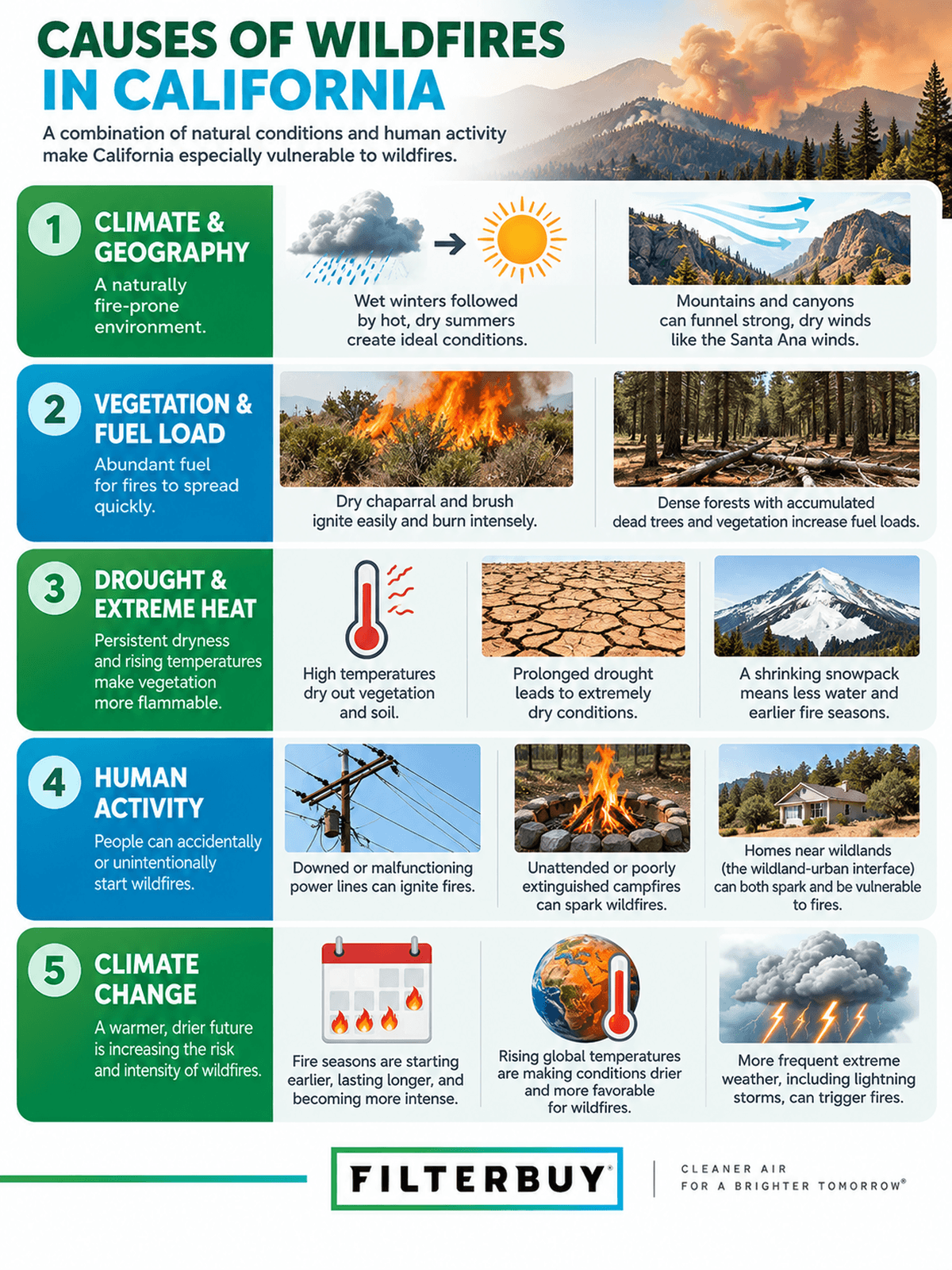
1. Climate and Geography
Much of California has a Mediterranean climate: cool, wet winters followed by hot, dry summers. Winter rains feed a burst of plant growth. Then the long, dry summer cures all that vegetation into ready-to-burn fuel by late summer and fall.
Geography adds fuel to the fire, literally. Mountainous terrain and narrow canyons act like chimneys, funneling wind and flame uphill at alarming speed.
Then there are the winds. In Southern California, hot, dry Santa Ana winds sweep in from the interior each fall. In the Bay Area and the north, Diablo winds do the same. These powerful gusts can push embers miles ahead of a fire's front, sparking new blazes far from the original flames. Many of the state's most destructive fires trace back to these wind events.
2. Vegetation and Fuel Load
California's native plants are built to burn. Chaparral shrubs contain oils that ignite easily and burn intensely. Dense forests and thick underbrush provide even more fuel. Add in decades of fire suppression, and you get overgrown, tinder-dry fuel beds waiting for a spark.
3. Drought and Extreme Heat
Ongoing droughts have left forests, grasslands, and brush extremely combustible. Shrinking snowpacks mean less moisture reaching the landscape through spring and summer. Record-breaking heatwaves dry out vegetation even further.
Scientists describe this as rising "atmospheric thirst." Warmer air pulls moisture out of plants and soils faster, leaving everything drier and more likely to ignite.
4. Human Activity
Most wildfires in the U.S. start with people, not lightning. Power lines, campfires, vehicles, equipment sparks, fireworks, debris burning, and arson all light fires.
As more homes are built in the wildland-urban interface, the zone where neighborhoods meet flammable landscapes, the number of potential ignition sources climbs. During Santa Ana wind events, human-caused ignitions are especially dangerous because the wind spreads them so fast.
5. Climate Change
A warming climate raises the baseline risk for everything above. Fire seasons now stretch longer, sometimes running year-round in parts of the state. Higher temperatures dry out fuels sooner. Rainfall grows less predictable, and extreme weather, including lightning outbreaks that can spark dozens of fires at once, becomes more common.
Climate change does not create fires on its own, but it loads the dice heavily in favor of bigger, faster, more frequent blazes.
California Wildfire Facts and Statistics
The numbers tell a sobering story.
| Record | Details |
|---|---|
| Deadliest and most destructive fire | The 2018 Camp Fire killed 85 people and destroyed more than 18,000 structures |
| Worst single year | In 2020, wildfires burned roughly 4.3 million acres, more than 4% of California's total land area |
| First "gigafire" | The August Complex of 2020 topped 1,000,000 acres across seven counties |
| Season length | Fire risk peaked from late summer into fall. Active fires now strike well into winter in some regions |
Beyond the acreage, the human and economic toll is staggering: billions of dollars in damages, thousands of homes lost, and lasting health effects from smoke that can travel hundreds of miles.
What Is Being Done to Prevent and Fight Wildfires?
The response to California's fire crisis is evolving on several fronts.
• Fuel reduction. Land managers are returning to prescribed burns and forest thinning to reduce the fuel that suppression has let build up.
• Utility safety. Power companies now shut off power during high-risk wind events and harden infrastructure to prevent power-line ignitions.
• Community preparedness. Fire-resilient building codes, defensible-space requirements, and detailed evacuation plans are becoming standard in high-risk areas.
• Early detection. Drones, satellites, and AI models help spot fires earlier and predict how they will spread.
• Response capacity. Firefighter training and aerial support continue to advance, giving crews better tools on the ground.
How Homeowners Can Protect Their Home and Indoor Air
You cannot control the wind or the weather, but you can prepare your home and protect the air inside it. Here is where to focus.
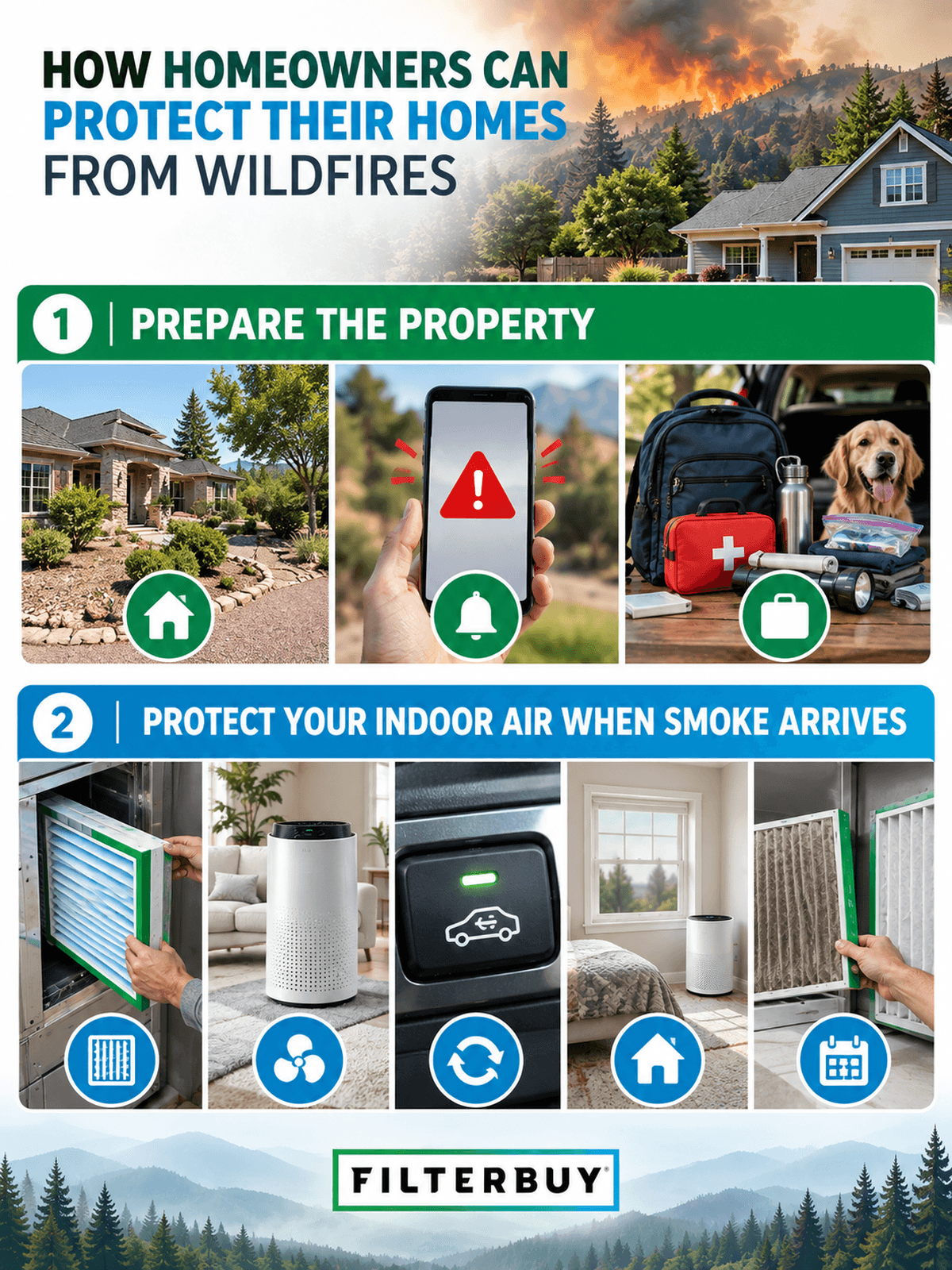
Prepare the Property
1. Create defensible space. Clear dead vegetation, trim branches, and maintain a buffer zone around your home. Use fire-resistant landscaping and building materials wherever you can.
2. Sign up for local alerts. Register for your county's emergency notification system so evacuation orders reach you quickly.
3. Prepare a go-bag and evacuation plan. Pack essentials, medications, and important documents ahead of time. Know your routes and have a plan for pets.
Protect Your Indoor Air When Smoke Arrives
This step matters even if the nearest fire is hundreds of miles away. Wildfire smoke carries fine particulate matter (PM2.5) that slips into homes through gaps, doors, and HVAC systems, degrading indoor air quality for days or weeks.
• Upgrade your HVAC filter. Use the highest-rated filter your system can handle. Many public-health resources recommend MERV 13 or higher to capture fine smoke particles. Check your manual first to confirm your system can accommodate the added airflow resistance.
• Add a HEPA purifier. Run a portable air cleaner with True HEPA filtration in the rooms you use most. It cleans a single space very effectively and complements your HVAC filter.
• Set your HVAC to recirculate. Close the outdoor air intake so you are not pulling smoky air inside, and run the fan to move more air through your filter.
• Build a clean room. Pick one room, keep doors and windows closed, and run your portable HEPA cleaner there. Avoid activities that add particles indoors, like frying food or burning candles.
• Change filters on time. Smoke loads a filter faster than normal. Replace on schedule, and sooner after heavy smoke. Activated carbon filters, like Filterbuy's Odor Eliminator, also help cut the smoke odors that standard filters miss.
A quick reminder on fit: use the exact filter size printed on your current filter or measured from the opening. A loose or wobbly fit lets air and smoke particles slip right past.
Living With Fire, Preparing for the Future
Fire is woven into California's landscape, and it is not going away. But the scale of today's blazes reflects a mix of natural conditions, past decisions, and a warming climate, and much of that damage can be reduced. Awareness, preparation, and responsible action make a real difference for individual homes and entire communities.
You cannot stop the next wildfire from starting. What you can do is protect your family and your home when smoke rolls in. Start by upgrading to a MERV 13 filter your system supports, adding a HEPA purifier to your most-used rooms, and stocking up on replacement filters before fire season peaks.
Ready to breathe easier this fire season? Explore Filterbuy's smoke-fighting filters and air quality solutions, and take the first step toward cleaner indoor air before the next smoky day arrives.
Frequently Asked Questions
Why Does California Have So Many Wildfires Compared To Other States?
California combines more risk factors than almost anywhere else in the U.S.: a Mediterranean climate that dries vegetation every summer, oil-rich chaparral and dense forests, canyon terrain that channels flame, seasonal Santa Ana and Diablo winds, a large population living in the wildland-urban interface, and decades of accumulated fuel from fire suppression.
When Is Wildfire Season In California?
Fire season traditionally ran from late summer through fall, peaking with autumn wind events. Warmer temperatures and longer droughts have stretched that window, and significant fires now occur nearly year-round in parts of the state.
What Percentage Of California Wildfires Are Caused By Humans?
The large majority of U.S. wildfires are human-caused rather than started by lightning. Common ignition sources include power lines, vehicles, equipment sparks, campfires, fireworks, debris burning, and arson.
What MERV Rating Is Best For Wildfire Smoke?
MERV 13 or higher is widely recommended for capturing PM2.5 from wildfire smoke. Confirm your HVAC system supports that rating before upgrading, since higher-MERV filters create more airflow resistance.
Does An Air Purifier Help With Wildfire Smoke?
Yes. A portable air cleaner with True HEPA filtration removes fine smoke particles from a single room very effectively. Pairing one with a high-MERV HVAC filter gives you whole-home filtration plus a dedicated clean room.
How Often Should I Change My Air Filter During Fire Season?
More often than usual. Smoke loads filters faster, so replace them on your normal schedule at minimum and sooner after any heavy smoke event.
See More
Hear a quick breakdown of why wildfires are so common in California and the conditions that make the state especially vulnerable.
Explore a visual overview of California wildfires, including the factors that contribute to fire risk and seasonal patterns.
Take a closer look at California wildfire conditions and the environmental factors that can contribute to their frequency and severity.