January 22, 2026

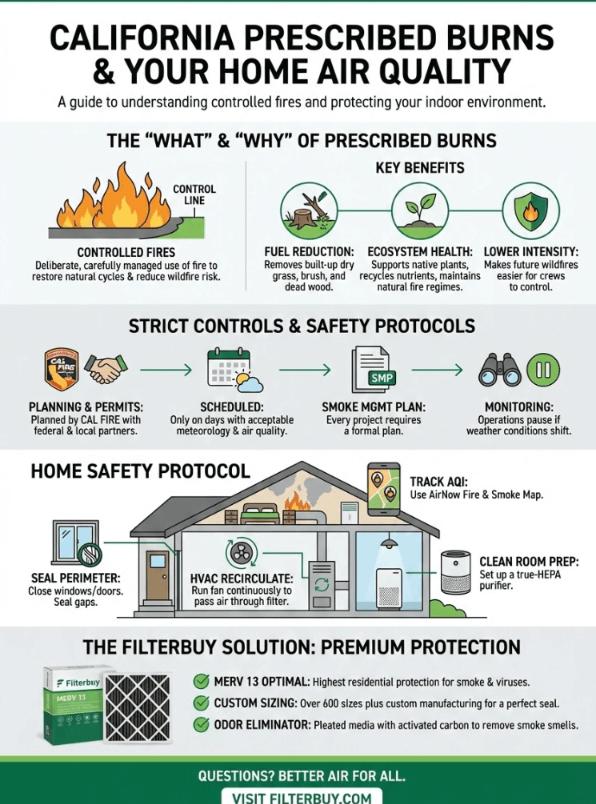
Yes. California conducts prescribed (controlled) burns to reduce hazardous vegetation, restore ecosystems, and lower severe-wildfire risk. These projects are planned, permitted, and crewed by CAL FIRE with partners such as the U.S. Forest Service, tribes, local fire agencies, and private landowners, and they proceed only when weather and air-quality conditions are acceptable.
Yes — and the state is actively expanding the practice. California conducts prescribed burns through multiple agencies, including CAL FIRE, the U.S. Forest Service, California State Parks, and tribal organizations that have practiced cultural burning for thousands of years.
Prescribed burning is the controlled application of fire to the land to reduce wildfire hazards, clear downed trees, control plant diseases, improve rangeland and wildlife habitats, and restore natural ecosystems. According to the California Air Resources Board (CARB), roughly 125,000 acres of wildlands are treated each year in California using prescribed burning, and that number is expected to rise.
Why it matters for your indoor air: Prescribed burns produce far less harmful smoke than uncontrolled wildfires. A Stanford-led study found that prescribed burns generate only about 17% of the fine particle pollution (PM2.5) that a wildfire would produce in the same area. That said, even controlled burns can temporarily affect local air quality, so it's smart to keep your HVAC filters fresh during burn season — typically fall and winter — especially if you live near planned burn zones.
California uses prescribed burns that are planned, permitted, and conducted only on approved burn days.
The goal is to reduce built-up fuels, lower wildfire intensity, and support ecosystem health.
Brief local smoke is possible even with careful timing and size controls.
Protect indoor air by setting up a clean room with a true-HEPA purifier and upgrading your HVAC filter to the highest MERV your system allows (ideally 13)
Filterbuy offers a precise-fit MERV 11–13 and an Odor Eliminator option.
A prescribed burn is the deliberate, carefully managed use of fire on a defined area to remove built-up fuels—dry grass, brush, and dead wood—and to re-establish natural fire cycles. A written plan specifies the objectives, unit boundaries, ignition pattern, crew assignments, equipment, and start/stop conditions. If forecasts are unfavorable, the burn is delayed.
It’s a shared effort across state, federal, tribal, local, and private lands. Projects are typically scheduled outside peak fire season when temperatures are cooler and humidity is higher, and they complement other work like thinning, pile burning, and defensible-space maintenance.
California uses a statewide smoke-management framework so burns happen only when dispersion is good and public health impacts are minimized. Before lighting, burners must:
Register the burn with the local air district
Obtain permits
Submit a Smoke Management Plan (SMP)
Receive approval.
Projects then proceed only on authorized “burn days,” which are determined using meteorology and air-quality forecasts. If conditions shift, air districts and CAL FIRE can scale down, postpone, or cancel.
Long dry periods cure vegetation into fuel. Planned, low-intensity fire reduces surface fuels, so future wildfires burn less intensely and are easier to control. Prescribed burns also support native plants and wildlife, recycle nutrients, and maintain the natural fire regimes many California ecosystems depend on.
Burn plans include control lines, crew roles, communications, and shutdown criteria. Ignition is paced to keep flame length and spread within targets. Smoke is managed through timing, size, and location, with required Smoke Management Plans, public notifications, and contingencies if smoke pools in populated areas. Sensitive people may still notice brief smoke.
Nearby residents may see signage and light smoke during ignition hours and receive advance alerts. Crews ignite, hold, and mop up until completion criteria are met. Larger projects are often divided into smaller units over multiple days to keep behavior and smoke within objectives. If weather shifts, operations pause until conditions return to acceptable ranges.
Smoke-day home protocol: before, during, after
Before smoke arrives:
Seal obvious gaps (fresh weather-strip)
Confirm the fireplace damper closes tightly
Pre-measure your HVAC return so the correctly sized replacement filter is ready
Stage your room purifier and check its filter status
During a smoky day:
Keep windows and exterior doors closed and set the HVAC to recirculate (turn off any fresh-air intake)
Run the central fan on On/Circulate so air continuously passes through the return filter
Avoid creating indoor particles, including smoking, candles, high-heat frying, or vacuuming, unless you use a HEPA-equipped vacuum
Track conditions with the AirNow Fire & Smoke Map to decide when to tighten up or briefly air out if levels drop
After conditions improve:
Air out the home when AQI improves
Clean settled residue with a HEPA-vacuum
Damp-dust hard surface
Inspect the HVAC filter (if it’s dark or smells smoky, replace it sooner than usual)
Keep two correctly sized return filters per smoke season so you can swap without delay. Filterbuy offers MERV 11–13 pleated filters in standard and custom sizes for a snug, bypass-free fit, plus an Odor Eliminator option that pairs pleated media with activated carbon for homes that notice persistent smells. Filters are USA-made and ship fast and free!
Yes. CAL FIRE and partners conduct prescribed burns under permits and written plans when conditions are safe.
CAL FIRE, the U.S. Forest Service, tribes, local fire agencies, and approved private landowners working under local air-district and fire-authority rules.
Mostly outside peak fire season, on approved “burn days” with suitable weather and smoke dispersion.
Projects require permits, a Smoke Management Plan, and air-district authorization. If conditions change, agencies scale down, postpone, or cancel.
They are carefully planned with control lines, trained crews, communications, and shutdown criteria. Risk isn’t zero, but procedures are designed to keep fire behavior within plan limits.
Possibly for a short time. Agencies plan timing and size to reduce impacts, but sensitive people may notice brief smoke.
Close windows and doors, set the HVAC to recirculate, and run a true-HEPA purifier in a clean room. Avoid indoor particle sources like candles and high-heat frying.
Use MERV 13 if your system can handle it. Otherwise, use the highest MERV your blower supports (often MERV 11). Replace sooner after heavy smoke.
Carbon reduces odors and some gases. Fine particles (PM2.5) are removed by HEPA/MERV filtration.
Use CADR. A simple rule is smoke CADR = two-thirds of the room’s square footage. Run it continuously.
Check your equipment manual or ask an HVAC technician. Signs of too much resistance include weak airflow or rooms feeling stuffy.
Filterbuy offers USA-made MERV 11–13 pleated filters in standard and custom sizes, plus an Odor Eliminator option, with fast, free shipping and optional Auto Delivery.
Prescribed burns mean healthier forests — but the smoke doesn't have to end up in your lungs. Browse Filterbuy's MERV 11 and MERV 13 filters to keep your indoor air clean and your family breathing easy, no matter what's burning outside.
