
Do Air Conditioners Filter Wildfire Smoke?
May 5, 2026

By Michelle Wan, Brand Manager and Air Quality Writer at Filterbuy · Reviewed by David Clark, Licensed HVAC Technician and CEO of Filterbuy HVAC Solutions · Updated September 9, 2026
No. An air conditioner does not filter wildfire smoke — the filter inside it does. A central AC, ducted heat pump, or ductless mini-split recirculates the air already in your home, so what comes back out depends entirely on the filter in the return. Window units, single-hose portable ACs, and swamp coolers work differently: they pull air in from outdoors.
Which means the rating on that filter is the decision that matters:
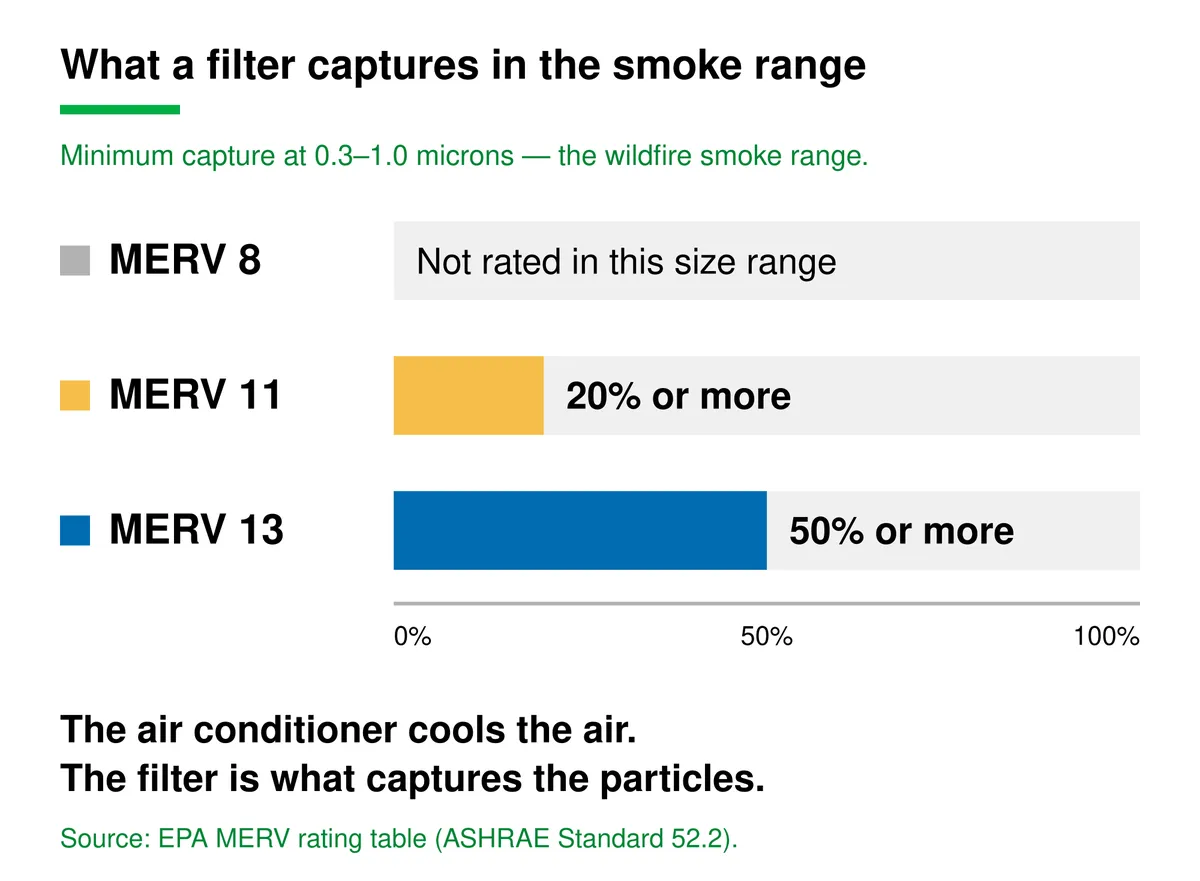
- MERV 8 — larger debris, dust, and dust mites. Not rated in the 0.3–1.0 micron range where wildfire smoke sits.
- MERV 11 — finer particles like pet dander and mold spores. Captures 20% or more in that range.
- MERV 13 — microscopic particles; highest residential filtration. Captures 50% or more, and it is the rating the EPA points to during smoky periods.
- Odor Eliminator (OE) — activated carbon for odor reduction, for the campfire smell that standard media passes straight through.
Filterbuy has built air filters in the USA since 2013, in more than 600 sizes plus custom cuts, so the rating you choose actually fits the slot you have.
Not sure what your system takes? Answer a few quick questions and we will match you to the right filter.
TL;DR
An air conditioner does not filter wildfire smoke. The filter inside it does. A central AC or HVAC system running a MERV 13 filter, set to recirculate with the fan on "On," captures a large share of the fine particles in smoke. Window units, portables, and swamp coolers do very little, and several pull smoky air in from outdoors.
Key Takeaways
A MERV 13 filter, or the highest rating your system accepts, is the most effective single change you can make. The EPA recommends MERV 13 or higher during smoky periods.
Most central air conditioners do not take in air from outside. Window units, single-hose portables, and swamp coolers do.
Set the HVAC fan to "On," not "Auto," so air cycles through the filter continuously. Add a portable air cleaner sized by smoke CADR where you sleep.
MERV 13 filters lose efficiency as they load with smoke. A 2026 Indoor Air study measured removal falling from roughly 80% to 30% across 100 exposures.
Do Air Conditioners Take In Air From Outside?
Most residential air conditioners do not take in air from outside. A central AC, ducted heat pump, and ductless mini-split recirculate the air already inside your home; the outdoor unit moves heat, not air. The exceptions matter in a wildfire: window and portable units, swamp coolers, and central systems with a fresh-air intake, ERV, or HRV.
Guidance on dampers and evaporative coolers follows the EPA, Wildfires and Indoor Air Quality.
With a window or portable unit, a portable air cleaner, not the AC, is your real defense. The EPA specifically warns against single-hose portable air conditioners and swamp coolers in smoke.
Does An Air Conditioner Purify The Air?
An air conditioner cools air. It does not purify air. The filter in the return is what cleans it, and the air conditioner is indifferent to which one you install. A MERV 8 cools exactly as well as a MERV 13. Only the MERV 13 meaningfully reduces the fine particulate in smoke.
Cooling removes heat and humidity, which every air conditioner does by design.
Filtering removes particles as the air passes through the media, and the filter alone decides how much comes out.
Purifying removes gases and odors, which takes activated carbon rather than standard media. That is why a campfire smell can linger after the haze clears.
Wildfire smoke is mostly PM2.5: fine particles that are small enough to reach deep into the lungs. Our guide to what PM2.5 is and why it matters goes deeper.
Which MERV Rating Stops Wildfire Smoke?
MERV 13 is the rating federal guidance points to for wildfire smoke, and the highest rating homes can run without airflow problems. MERV, the Minimum Efficiency Reporting Value, is the scale rating of how much particulate a filter captures at each particle size.
Minimum average capture efficiency by particle size, per the EPA’s MERV table (test method: ASHRAE Standard 52.2). MERV 8 carries no rating in the 0.3–1.0 µm band where wildfire smoke sits.
The gap shows up in real buildings. A study of 24 Alberta campus buildings published in ACS ES&T Air measured indoor-to-outdoor PM2.5 ratios during smoke events: MERV 13 buildings held a ratio of 0.12, against 0.28 for MERV 8.
If your system cannot take MERV 13, use the highest rating it accepts and make sure it seals in the slot. A well-fitted MERV 11 beats a leaking MERV 13.
Filterbuy has made filters in the USA since 2013, in more than 600 sizes plus custom cuts, which is exactly why we keep coming back to fit. Slot dimensions vary more than most homeowners expect, and a MERV 13 that leaves a gap at the edge of the slot lets air bypass the media entirely. No rating printed on the label fixes that, which makes it the most common reason a filter upgrade disappoints.
Here is something a filter manufacturer probably should not admit: for most homes, Filterbuy stops recommending upward at MERV 13. Higher ratings restrict airflow more than a typical residential blower is built for.
Shop MERV 13 filters · custom-size filters · MERV rating chart
What A MERV 13 Filter Will Not Do
A MERV 13 filter captures at least 50% of particles in the smoke range on a single pass, not 99%. That surprises people who expect a smoke filter to work like a sieve. The protection comes from repetition: with the fan set to "On," indoor air cycles through the filter several times an hour, and each pass removes half of what is left behind.
That is why the fan setting matters as much as the filter rating, and why a MERV 13 left on "Auto" will underperform a MERV 8 that runs constantly.
Filterbuy builds these filters, so take the following as the manufacturer being straight with you about four limits:
It does not remove gases or odor. The acrid smell is due to volatile compounds passing straight through the media, which is what the carbon filters are for.
It cannot outrun a leaky house. If smoke is pouring in around a door, sealing comes first and filtration second.
It does nothing in rooms the air does not reach. Closed supply vents and shut doors leave dead zones that the system never treats.
It stops working before it looks finished. Efficiency falls as the media loads, well before the filter looks spent from the front.
How To Close The Fresh Air Intake On Your AC
If your HVAC system has a fresh-air intake, closing it during a smoke event is the highest-value five-minute job in the house. A fresh-air intake is a small filtered duct pulling outdoor air into the return side of your air handler. It earns its keep the other fifty weeks of the year. During a wildfire, it is an open door.
Check the thermostat first. Look for recirculate or inside air. On a motorized damper, this closes the intake for you.
Find the intake. Usually a duct from an exterior vent to the return side of the air handler, often in an attic, closet, or garage.
Close the damper. Turn the handle so it sits perpendicular to the duct run, or slide a plate damper fully closed.
Switch off any intake fan. Some setups run the intake on a small powered ventilator with its own switch nearby.
Close window unit vents. Set the front-panel lever marked vent to closed and seal gaps with foam weatherstripping.
Reopen it when the air clears. Closing it is temporary.
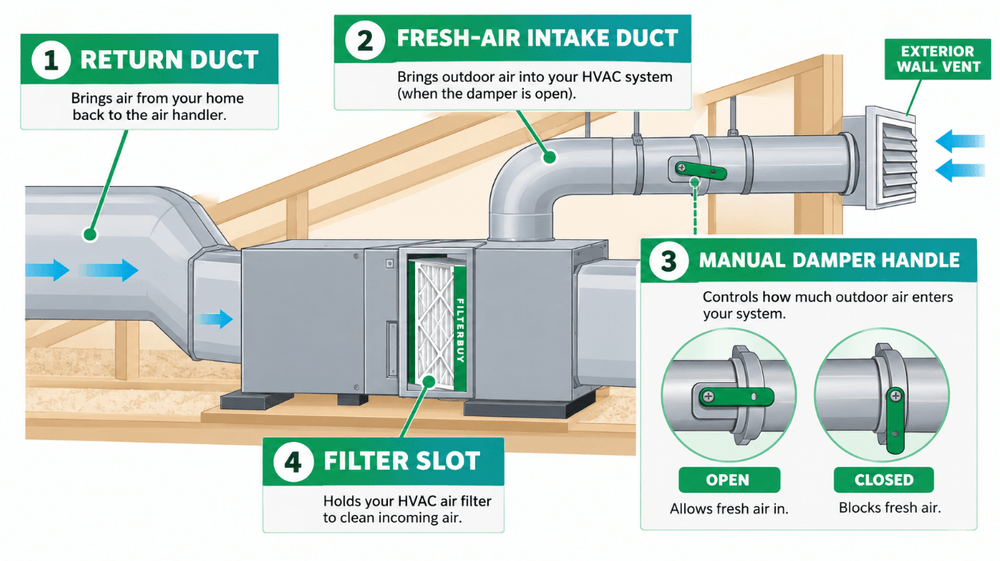
One safety rule worth more than all the six steps
Never block an intake with rags, insulation, or a curtain. Use the damper the system came with. An intake serving a combustion appliance, such as a gas furnace, water heater, or boiler, supplies the air combustion needs. Blocking it can create negative pressure that backdrafts carbon monoxide indoors. If you cannot reach it safely, call an HVAC technician.
Most homeowners have no idea whether they even have a fresh-air intake until they go looking for one. If you cannot identify it, that is the moment to call a technician rather than start covering things up.
— David Clark, Licensed HVAC Technician and CEO of Filterbuy HVAC Solutions
How To Choose An Air Purifier For Wildfire Smoke
Choose a portable air cleaner by its smoke CADR rating and the size of the room it will sit in, not by the square footage on the box. CADR, the Clean Air Delivery Rate, is rated separately for smoke, dust, and pollen: a unit advertising a 400 dust CADR might post a smoke CADR of 220. Only the smoke number counts.
The rule of thumb from the Association of Home Appliance Manufacturers is a smoke CADR of about two-thirds the room’s square footage. In heavily smoke-affected areas, AHAM advises matching CADR to room size instead. The American Lung Association simplifies it: up to 200 cfm for a small room, 200–300 for a medium one, above 300 for a large one.
Four things to check before buying:
The AHAM Verifide mark means the unit has been independently tested for smoke, dust, and pollen removal.
CARB certification: the California Air Resources Board list covers ozone emissions, not cleaning power. It sorts units into Mechanical (filtration only, no ozone or ions) and Electronic. Choose Mechanical.
Activated carbon by weight matters because HEPA media catches particles but does nothing for odor, and a carbon-dusted pre-filter is mostly decorative.
Noise at the speed you’ll actually run it. Ratings are measured at full speed, so a unit you have to turn down to sleep is performing below its number all night.
The cheap option that works: tape a MERV 13 filter to the intake side of a box fan. EPA testing found that a 4-inch MERV 13 raises CADR by 123% over a 1-inch, and a cardboard shroud adds 40% for free. Use a fan made in 2012 or later. For lingering odor, an Odor Eliminator filter from Filterbuy catches what standard media cannot; our MERV 13 vs HEPA comparison explains why HEPA belongs in a portable unit, not your ducts. Filterbuy sells filters, so a $20 box fan is not our best sales pitch, but it is the honest answer when the shelves are empty.
Worth knowing: commercial CADR ratings are measured against tobacco smoke. EPA measured these DIY designs against simulated wildfire smoke directly, which makes the numbers below unusually relevant here.
EPA chamber testing, simulated wildfire smoke. A cardboard shroud costs nothing and adds roughly 40%.
How Often Should You Change Your Filter During A Smoke Event?
Change it far more often than your normal schedule. This cuts against the familiar claim that a dirty filter works better because the caked layer catches more. That holds for some kinds of dust loading, but it does not hold for wildfire smoke.
A 2026 bench-scale study in Indoor Air (Obadi et al.) ran MERV 7 and MERV 13 in-duct filters through 100 measured exposures of simulated smoke.
MERV 13 filters started at roughly 80% mass-based removal efficiency and finished at roughly 30%. At 3–10 microns, count-based efficiency fell from about 90% to 40%.
So a filter doing its job in May can be doing less than half of it by October, all while still looking serviceable from the front. Separate EPA testing of DIY air cleaners points the same way: those units were almost completely ineffective with dirty filters.
Install a fresh MERV 13 before fire season, not during it.
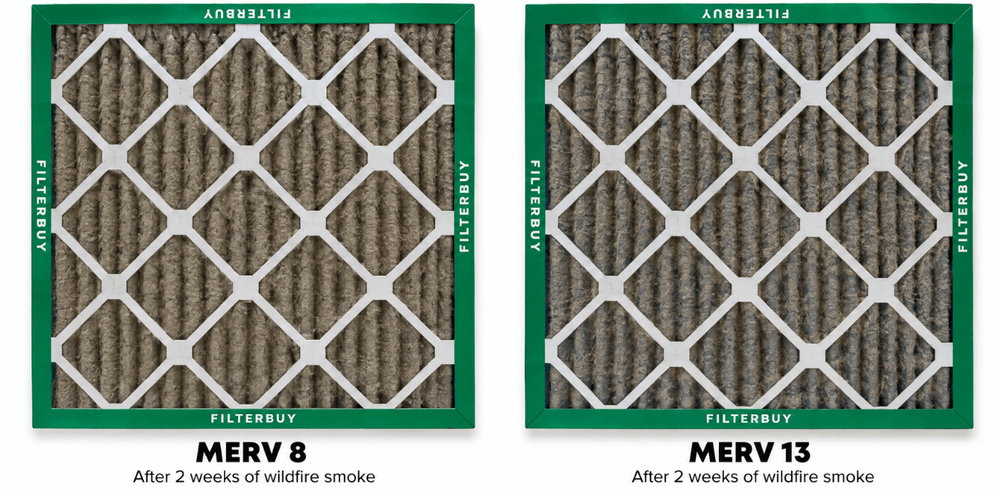
Check it every 7–10 days during an active event; replace it as soon as the media looks gray.
Keep a spare; regional smoke events clear local shelves in days. Filter auto-delivery handles the remembering.
The filter is the one part of this system you actually control, and it is the part people forget. I would rather someone run a MERV 13 filter that they change on time than a higher rating they leave in until winter.
— Michelle Wan, Brand Manager and Air Quality Writer, Filterbuy
How To Protect Yourself From Wildfire Smoke
Protecting yourself from wildfire smoke has three parts: reduce what gets in, clean what is already inside, and cut your exposure when you go out. Filtration handles the middle one, and the AQI tells you when the other two start to matter.
Categories follow the EPA Air Quality Index. During wildfire events the AQI is driven by PM2.5.
Check live wildfire smoke levels in your area on Filterbuy’s live smoke map, cross-check the federal AirNow Fire and Smoke Map, or read our complete guide to the Air Quality Index.
Outdoors, a well-fitted N95 or P100 filters the fine particles in smoke, while cloth and surgical masks block droplets rather than PM2.5. Fit is what makes one work, so facial hair at the seal line defeats it, and our best mask for air pollution guide compares the ratings side by side. In the car, press recirculate.
Set up one clean room. Pick the room where you sleep, close the door, seal the obvious gaps, and run a properly sized air cleaner on high. The EPA publishes a short guide to creating a clean room during a wildfire. Layering works: one residential study measured an indoor-to-outdoor PM2.5 ratio of 0.55 with MERV 13 alone, improving to 0.22 once a portable cleaner was added.
While the smoke is in, skip frying, candles, gas stoves, fireplaces, aerosols, and non-HEPA vacuuming. For the rest, see how to seal your home against wildfire smoke.
What To Do After The Smoke Clears
The work is not finished when the sky turns blue again. Fine ash settles on floors, counters, and soft surfaces, and ordinary cleaning lifts it straight back into the air you just spent a week filtering. These last four steps are the ones most people skip, and they are the difference between clearing a smoke event and living with it for another month.
Reopen the fresh-air intake and air out of the house. Wait for a Good or Moderate AQI reading, then open windows.
Replace the filter, even if it looks acceptable. A filter that carried a smoke event is past its useful life, whoever made it.
Damp-wipe rather than dry-sweep. Sweeping and dusting a dry surface lifts settled ash straight back into the air.
Vacuum only with a HEPA-filtered machine. A standard vacuum exhausts fine particles back into the room.
Supporting Statistics
Three findings from U.S. federal and national health sources. Each links to its primary source.
Asthma ER visits ran 17% above normal on smoke days.
Measured across 19 days of Canadian wildfire smoke in 2023.
The biggest jumps hit regions with the most consecutive smoke days.
Source: CDC, Morbidity and Mortality Weekly Report (4,317 emergency departments).
Americans spend about 90% of their time indoors.
Indoor levels of some pollutants run 2 to 5 times higher than outdoors.
The people most vulnerable to air pollution spend even more time inside.
Source: EPA, Report on the Environment.
61.5 million Americans live in F-grade counties for particle spikes.
Short-term particle spikes are exactly what wildfire smoke produces.
Nationally, 152.3 million people (44%) live where ozone or particle pollution earns a failing grade.
Source: American Lung Association, State of the Air 2026 (2022–2024 monitoring data).
Figures current as of August 2026. Verify against the linked sources at each seasonal refresh.
Frequently Asked Questions
Will a window air conditioner filter wildfire smoke?
Very little. Window units carry a basic screen, not a fine-particle filter, and most have an outdoor damper that draws smoky air in. Close it and seal the gap; the EPA advises not running the unit if the damper cannot close.
Is it safe to use a portable air conditioner or swamp cooler during smoke?
Avoid single-hose portable air conditioners in heavy smoke; they depressurize the room and pull outdoor air through gaps. Evaporative coolers draw outdoor air across a wet pad by design, and the EPA advises against them.
Does a dirty filter filter better?
Not with wildfire smoke. That idea comes from dust loading, where accumulated particles improve capture. Smoke research points the other way: efficiency falls as the filter loads.
Glossary
AQI (Air Quality Index): The EPA’s 0–500 scale for outdoor air pollution, green through maroon. In wildfires, it is driven by PM2.5.
CADR (Clean Air Delivery Rate): Cubic feet per minute of clean air a portable cleaner delivers, rated separately for smoke, dust, and pollen.
CARB (California Air Resources Board): The California agency certifying air cleaners under a 0.050 ppm ozone limit.
Fresh-air intake: A filtered duct bringing outdoor air into an HVAC return. Normally, a liability in smoke.
HEPA: 99.97% capture of 0.3-micron particles. Used in portable air cleaners, not residential HVAC.
MERV (Minimum Efficiency Reporting Value): The 1–16 scale rating how much particulate an HVAC filter captures. MERV 13 is what the EPA points to for smoke.
PM2.5: Fine particulate matter 2.5 microns or smaller, the bulk of wildfire smoke.