
Furnace Replacement Price Guide: Average Cost Estimates, Key Factors, Gas vs Electric Efficiency, AFUE Ratings, Labor Expenses & Available Rebates for Your Home
February 26, 2026

Strange noises. Cold spots. Soaring bills. When your furnace sends these warning signs, replacement becomes reality—but the $2,000 to $12,000 price range leaves most homeowners guessing. After helping thousands of families navigate HVAC decisions, we've learned that understanding AFUE ratings, weighing gas versus electric trade-offs, and knowing which rebates apply to your situation can save you thousands. This guide delivers the straight answers you need to budget confidently and invest wisely in your home's comfort.
TL;DR Quick Answers
How much does furnace replacement cost?
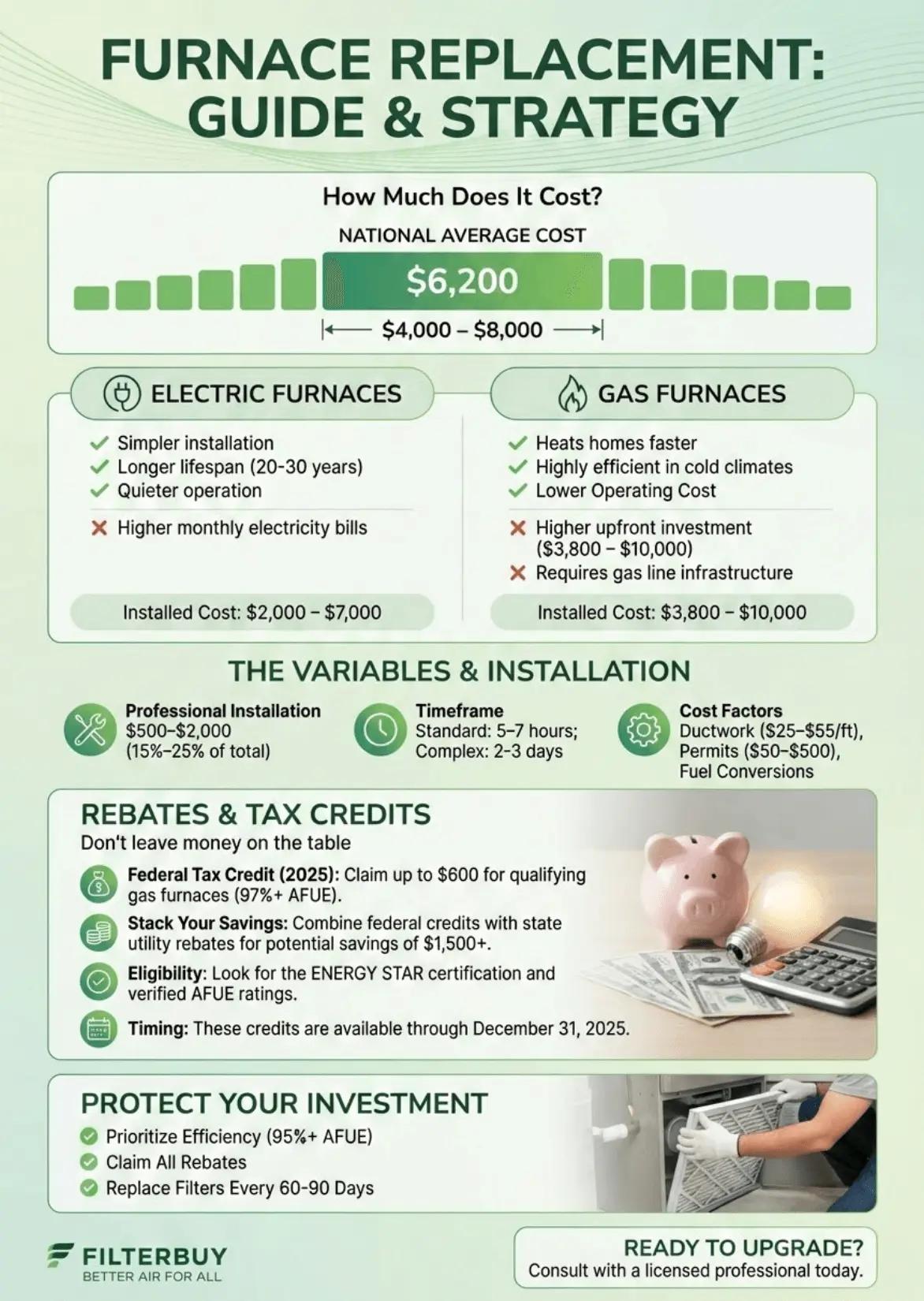
The average furnace replacement costs $4,000 to $8,000 for most homeowners, with the national average around $6,200, including professional installation.
• Electric furnaces: $2,000–$7,000
• Gas furnaces: $3,800–$10,000 (up to $12,000 for high-efficiency)
• Oil furnaces: $6,750–$10,000
• Labor: $500–$2,000 additional
• High-efficiency (95%+ AFUE): Saves $200–$400 annually on heating bills
Top Takeaways
• Typical cost: $4,000–$8,000 installed
• AFUE 95%+ = 95¢ of every fuel dollar heats your home
• Gas furnaces: Higher upfront cost, lower long-term operating expenses
• Labor: 15%–25% of project total (always hire licensed pros)
• 2025 tax credit: Up to $600 for 97%+ AFUE gas furnaces
Understanding Furnace Replacement Costs
Furnace replacement represents one of the most significant home comfort investments you'll make. The national average falls between $4,000 and $8,000 for a complete installation, though prices vary based on furnace type, efficiency rating, home size, and installation complexity.
Gas vs. Electric Efficiency: Which Saves More?
Electric furnaces carry lower purchase prices ($2,000–$7,000) and simpler installations. However, gas furnaces ($3,800–$10,000) typically deliver lower monthly operating costs in regions where natural gas prices remain competitive. The best choice depends on your local utility rates, climate severity, and existing home infrastructure.
AFUE Ratings: Efficiency That Pays You Back
Annual Fuel Utilization Efficiency (AFUE) measures how effectively your furnace converts fuel into heat. The current federal minimum is 80% AFUE—meaning 80 cents of every fuel dollar becomes heat while 20 cents escapes as exhaust. High-efficiency condensing furnaces reach 95%–98.5% AFUE. While these premium units cost 30%–40% more upfront, homeowners in colder climates can save $200–$400 annually—potentially $4,000–$8,000 over a 20-year furnace lifespan.
Labor Expenses: What Pros Actually Charge
Professional installation runs $500–$2,000 depending on job complexity, representing roughly 15%–25% of your total investment. Hourly rates range from $50–$100 for licensed technicians. Factors increasing labor costs include ductwork modifications ($25–$55 per linear foot), permit fees ($50–$500), and fuel-type conversions. A standard replacement takes 5–7 hours.
Available Rebates & Tax Credits
Through December 31, 2025, the federal Energy Efficient Home Improvement Credit offers up to $600 for qualifying gas furnaces meeting 97%+ AFUE requirements. This nonrefundable credit covers 30% of equipment and installation costs. Many state utility programs and manufacturer rebates stack additional savings—some homeowners combine incentives worth $1,500 or more.
"After helping thousands of families navigate HVAC decisions, we've seen firsthand that homeowners who prioritize AFUE ratings over sticker price consistently save more over a furnace's lifetime. A 95%+ efficiency unit isn't a luxury—it's the smarter long-term investment for both your wallet and your home's air quality."
Essential Resources on Furnace Replacement Cost
Claim Your Federal Tax Credit
ENERGY STAR's official guide explains exactly which furnaces qualify for up to $600 in federal tax credits through 2025.
https://www.energystar.gov/about/federal-tax-credits/furnaces-natural-gas-oil
Understand the IRS Credit Requirements
The IRS breaks down eligibility, documentation, and how to file for your Energy Efficient Home Improvement Credit.
https://www.irs.gov/credits-deductions/energy-efficient-home-improvement-credit
Learn Why Efficiency Standards Matter
The U.S. Energy Information Administration explains how furnace efficiency standards have evolved and what changes are coming.
https://www.eia.gov/todayinenergy/detail.php?id=14051
Decode AFUE Ratings Like a Pro
The Department of Energy's guide helps you compare furnace efficiency ratings and calculate real savings.
https://www.energy.gov/energysaver/furnaces-and-boilers
Find State & Local Rebates
DSIRE searches your zip code for utility rebates and state programs that stack with federal credits.
Protect Your Indoor Air Quality
The EPA's resources explain how your furnace impacts the air you breathe—and why regular filter changes matter.
https://www.epa.gov/indoor-air-quality-iaq
Schedule Your HVAC Consultation
Filterbuy HVAC Solutions connects you with certified technicians who help you choose the right furnace—without the hard sell.
https://www.filterbuy.com/hvac-solutions
Supporting Statistics
• 40% of home energy goes to heating — Furnace efficiency directly impacts monthly bills. (U.S. Energy Information Administration)
• 50%+ of new furnaces are high-efficiency — Market shift confirms long-term value of 90%+ AFUE units. (U.S. Department of Energy)
• Up to $600 federal tax credit — Available through December 2025 for 97%+ AFUE furnaces. (ENERGY STAR)
Final Thoughts
Our take after years of helping homeowners:
• Prioritize efficiency over sticker price—you're buying 15–20 years of heating, not just a unit
• The $2,000 premium for 95%+ AFUE typically returns $4,000–$8,000 over the furnace's lifespan
• Quality filters + quality furnace = maximum performance and longevity
• Don't leave money on the table—claim every rebate and tax credit available
Next Steps
1. Check your current furnace's age and AFUE rating — Find the yellow EnergyGuide label inside the unit
2. Get 3 quotes from licensed HVAC contractors — Compare equipment, warranties, and total installed prices
3. Search for rebates — Use DSIRE.org and your utility's website for local incentives
4. Verify 2025 tax credit eligibility — Confirm 97%+ AFUE and ENERGY STAR certification
5. Schedule installation before heating season — Off-peak timing often means better availability
6. Set up a filter replacement schedule — Change filters every 60–90 days to protect your investment
FAQ on Furnace Replacement Cost
Q: Is it worth replacing a 20-year-old furnace?
A: Yes—almost always. We've seen 20-year-old furnaces operating at 60%–70% of original efficiency. Modern 95%+ AFUE units can cut heating bills by 25%–35%, often paying back the upgrade cost within 5–7 years.
Q: What's the difference between 80% and 95% AFUE?
A: An 80% AFUE furnace converts 80 cents of every fuel dollar to heat; 20 cents escapes. A 95% AFUE condensing furnace captures that lost heat, converting 95 cents to usable warmth. Over 15 years, this can mean $3,000–$6,000 in savings.
Q: Can I claim both federal tax credits and utility rebates?
A: Yes! Federal credits and local rebates typically stack. We've seen homeowners combine $600 federal credits with $500–$1,000 in utility incentives.
Q: How long does furnace installation take?
A: Standard replacements take 5–7 hours. Installations requiring ductwork modifications or fuel-type conversions may extend to 2–3 days.
Q: Why shouldn't I install a furnace myself?
A: DIY installation voids warranties and carries serious safety risks, including carbon monoxide poisoning. Many jurisdictions require licensed contractor installation by law. The $500–$2,000 labor cost protects both your investment and your family.
Ready to Breathe Easier with Your New Furnace?
Don't let furnace replacement costs catch you off guard—use this guide to budget smart, prioritize efficiency, and claim every rebate available. When you're ready to protect your new investment, Filterbuy has the high-quality air filters to keep your system running at peak performance, shipped free and factory-direct to your door.