
Furnace Blower Motor Replacement Cost Guide: Parts vs. Labor, Warranty Basics, PSC vs. ECM Motors, and Ways to Save
January 22, 2026

A failing blower motor can stop airflow, reduce comfort, and strain other HVAC (heating, ventilation, and air conditioning) components. If your furnace runs but the airflow is weak, or it will not turn on at all, this guide explains what blower motor replacement typically costs, what affects the price, and how to avoid paying for the wrong repair.
TL;DR Quick Answers
Furnace blower motor replacement cost
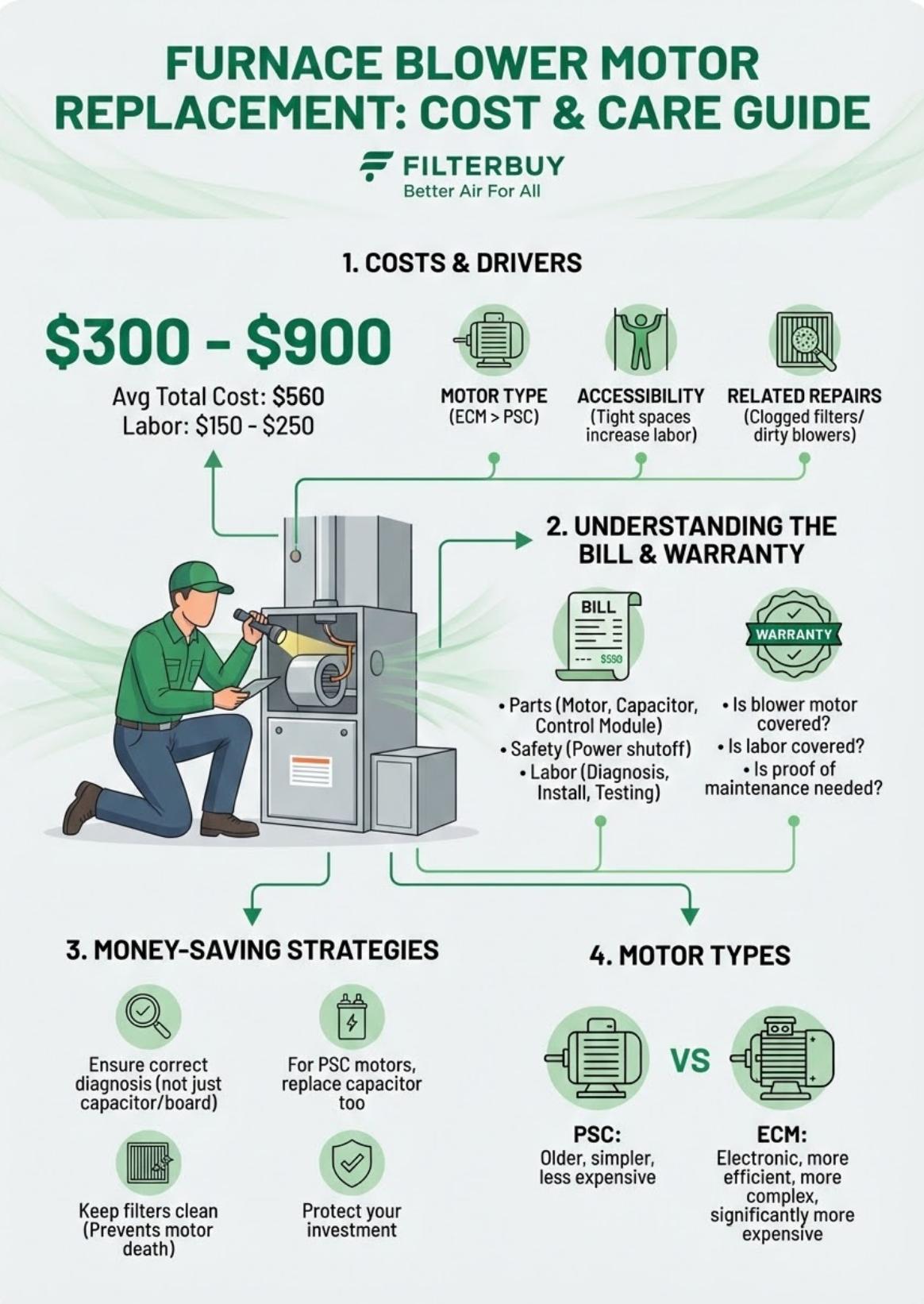
Expect to pay $300–$900 for a furnace blower motor replacement, including parts and labor. Here's the breakdown:
Motor only: $50–$450 (single-speed motors cost less; variable-speed motors run higher)
Labor: $150–$400 (typically 1–2 hours of work)
Emergency/after-hours service: Add $100–$200
Key cost factors:
Motor type (PSC, ECM, or variable-speed)
Brand and warranty status
Accessibility of your furnace unit
Regional labor rates
DIY note: Handy homeowners can purchase a motor for $50–$250 and save on labor, but incorrect installation can void warranties or create safety hazards.
Key Takeaways
Most blower motor replacements land around $300–$900 total, but motor type and access drive the final price.
PSC motors usually cost less to replace than ECM motors.
Labor includes diagnosis, safe installation, and testing, and not just swapping a part.
Manufacturer warranties often help with parts, but labor is commonly out-of-pocket unless you have labor coverage.
Restricted airflow (often from a dirty filter) can increase motor strain and contribute to failures.
A correct diagnosis and fixing the root cause helps prevent repeat repairs.
Why Blower Motors Fail (And Why Airflow Matters)
A blower motor works hardest when airflow is restricted. A dirty air filter is one common cause of low airflow, which can increase strain on the motor over time. Regular filter changes help protect airflow, and Filterbuy sells replacement HVAC filters in common efficiency levels, including MERV 8, MERV 11, and MERV 13.
Typical Replacement Cost Range
Most blower motor replacements fall into a few predictable buckets. Your total depends on the motor type, your system design, and how hard the job is to access.
Common Price Estimates (Parts + Labor):
Average total cost: $560
Most common total range: $300–$900
Typical labor: $150–$250
Typical motor part cost: $350–$1,150
These are estimates, not a quote. Your final price can change based on your location, your furnace model, and whether you need any related repairs.
Use the ranges above to set expectations, then confirm pricing with an on-site diagnosis.
Cost drivers
A blower motor is not a one-size-fits-all part. The same “blowing air” job can require very different motors and labor time.
The Biggest Factors Are:
Motor type (PSC vs. ECM). ECM motors typically cost more than PSC motors.
Brand and part matching. Some systems need an OEM (original equipment manufacturer) motor or a specific replacement kit.
Accessibility. Tight closets, attic installs, or packed mechanical rooms often take longer.
Added parts. Some jobs also need a capacitor (common with PSC), a control module (common with ECM assemblies), mounting hardware, or wiring repairs.
Related damage. A clogged filter, dirty blower wheel, or overheated wiring can add work.
When a quote seems high, it is usually labor time, motor type, or extra parts, rather than the motor alone.
Labor Vs. Parts Pricing (What You’re Actually Paying For)
A professional replacement is more than “swap the motor.” The technician must make sure the system is safe, wired correctly, and delivering proper airflow.
Parts usually include:
The blower motor (and sometimes the entire blower assembly)
Sometimes a run capacitor (PSC systems)
Sometimes a control module or programmed motor assembly (some ECM setups)
Small materials (connectors, screws, mounts)
Labor usually covers:
Confirming the motor is the problem (not a board, capacitor, or thermostat issue)
Power shutoff and safe disassembly
Motor removal, installation, and wiring
Basic testing and airflow checks
Verifying the system starts, runs, and cycles correctly
A good installer charges for correct diagnosis and safe, tested operation, not just the part swap.
Warranty Basics (What Many Warranties Do And Do Not Cover)
Warranties vary by brand and installer, but most homeowners see the same general structure.
You may have more than one warranty:
Manufacturer parts warranty: Often covers the cost of the failed part if it is a covered defect.
Installer labor warranty: Covers labor for a set period (this is separate from the manufacturer).
Extended labor plan (optional): Some homeowners buy added coverage that helps with labor costs later.
Before you approve work, ask these simple questions:
“Is the blower motor covered under my parts warranty?”
“If it’s covered, do I still pay labor?”
“Do I need proof of maintenance or registration to use the warranty?”
“Will you handle the warranty claim, or do I need to?”
The most common surprise is that even when the motor is covered under warranty, homeowners often still have to pay for labor.
Psc Vs. Ecm Blower Motors (What They Are And Why It Changes Cost)
These abbreviations matter because they affect both price and performance.
Psc (Permanent Split Capacitor) Motors
PSC motors are common in older and basic systems.
Usually run at one or a few set speeds
Commonly use a capacitor to help start and run
Often cost less to replace than ECM designs
PSC is usually the simpler and lower-cost path, when your system uses it.
Ecm (Electronically Commutated Motor) Motors
ECM motors are common in many newer, higher-efficiency systems.
Use electronics to control motor operation
Can adjust speed to maintain airflow more consistently (system-dependent)
Often cost more to replace, especially if the motor and control are sold as an assembly
ECM replacements often cost more upfront, but they can provide more consistent airflow control in systems designed for it. As a general rule, many older or single-stage furnaces use PSC motors, while newer variable-speed systems often use ECM motors. A technician can help confirm what your system uses before ordering parts.
Quick Comparison
| Feature | PSC motor | ECM motor |
|---|---|---|
| Common in | Older/basic systems | Many newer systems |
| Speed control | Limited (fixed taps) | Electronic control (varies by system) |
| Typical replacement cost | Lower | Higher |
| Common extra part | Capacitor | Control/module (sometimes integrated) |
Money-Saving Strategies That Do Not Cut Corners
You can reduce cost without risking system reliability. The goal is to avoid repeat failures and avoid paying for the wrong repair.
Smart Ways To Save:
Confirm diagnosis. Ask what test results point to the motor (and not the capacitor, board, or thermostat).
Replace the capacitor when appropriate. If your system uses a PSC motor and the capacitor is weak, replacing it can prevent early motor stress.
Fix the root cause. Overheating from restricted airflow is a common contributor. A severely clogged filter or dirty blower wheel can shorten motor life.
Keep filter changes consistent. A clean filter helps maintain airflow and reduces strain on the blower.
Avoid emergency rates if you can. If the system is safe to leave off overnight, scheduled service often costs less.
Ask about repair vs. replace. If your furnace is older and has multiple major issues, putting money toward a full system plan can sometimes make more sense.
Replace filters on schedule. One simple way to protect airflow is to replace filters on schedule. Filterbuy sells common efficiency options (including MERV 8, MERV 11, and MERV 13), ships free, and offers Auto-Delivery so replacements arrive automatically.
The best savings usually come from correct diagnosis and preventing the next failure.
After The Repair: What To Do Next
Once the motor is replaced, a few habits help protect your investment.
Do This In The First Week:
Listen for new noises (rubbing, rattling, or squealing).
Confirm steady airflow from vents.
Replace your air filter if it is even moderately dirty.
Do This Monthly During Heavy Use:
Check the filter and replace it on schedule.
Keep return vents unblocked.
A blower motor lasts longer when airflow stays consistent and the system stays clean.
Blower motor replacement costs usually come down to motor type, labor time, and whether extra parts are required. Use the price ranges as a guide but rely on an on-site diagnosis for a real number. If you keep airflow steady with regular filter changes, you reduce strain on the blower and help the system run more reliably.
FAQs
How much does a furnace blower motor replacement usually cost?
Most replacements fall around $300–$900 total (parts + labor). Some simpler jobs cost less, and some ECM jobs cost more.
Why is my quote higher than expected?
The most common reasons are an ECM motor, difficult access (attic/closet), or extra parts like a capacitor, module, or wiring repairs.
What is the difference between a PSC and an ECM blower motor?
PSC (Permanent Split Capacitor) motors are simpler and usually cheaper to replace. ECM (Electronically Commutated Motor) motors use electronic control and often cost more, especially if the control is integrated with the motor.
Can a dirty air filter cause blower motor problems?
It can contribute. A clogged filter can restrict airflow and make the blower work harder. It will not “break” every motor, but it can increase stress and heat over time.
How do I know it’s the motor and not the capacitor or control board?
Ask the technician what tests point to the motor. On PSC systems, a weak capacitor can mimic motor failure. A good diagnosis should explain why the motor is the confirmed issue.
Will my warranty cover the blower motor?
Sometimes. Many manufacturer warranties cover parts, but labor coverage depends on the installer’s labor warranty or an extended plan. Always ask whether labor is included.
Should I replace the capacitor when replacing a PSC motor?
Often, yes, if the system uses one and it tests weak or is near end-of-life. A failing capacitor can stress the new motor.