July 23, 2026

Getting the right filter size is simpler than it looks. This guide walks you through reading the label on your existing filter, taking manual measurements when the label is missing, and understanding why the number you order is slightly different from what you measure.
Even a half-inch gap around your filter can reduce filtration effectiveness by 20–30%. That gap lets unfiltered air bypass your MERV-rated filter entirely — circulating dust, allergens, and contaminants through your home without you knowing.
Unfiltered particles circulate freely through every room
System works harder to compensate for air bypass or restriction
Contaminants reach sensitive components, causing premature failure
Your MERV rating is worthless if air flows around the filter
Start here — it's the fastest method. Look along the cardboard frame of your current filter. Most filters display two measurements side by side.
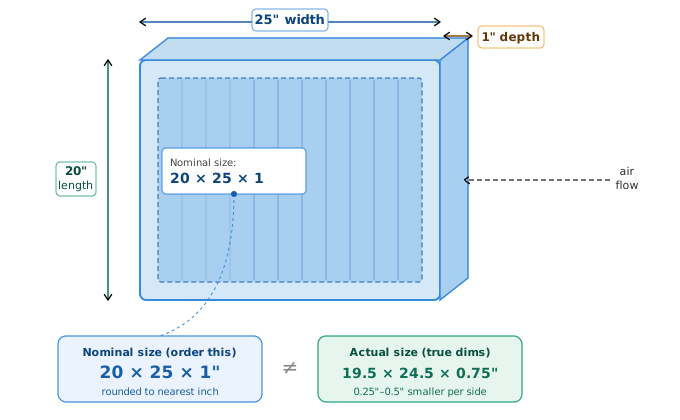
Printed in large type on the frame. This is the rounded ordering size — the number you use when buying a replacement.
Printed in smaller type. The filter's true physical dimensions — always slightly smaller than the nominal size.
If your label is faded, torn, or missing, grab a tape measure and follow these steps.
The shorter horizontal edge, measured from frame edge to frame edge.
The longer horizontal edge, measured from frame edge to frame edge.
The thickness of the filter. This is the dimension most people forget.
Round to the nearest whole inch — 19.5" becomes 20". That's your nominal size to order.
Always measure all three dimensions — not just length and width. A wrong depth is the most common ordering mistake we see.
This is the single concept that trips up most homeowners. Filters are deliberately made slightly smaller than their labeled size — that small clearance is what lets them slide into the housing without binding.
Nominal and actual size typically differ by 0.25" to 0.5" per side. A filter labeled 20×25×1 actually measures around 19.5×24.5×0.75. This is standard across the industry — not a defect.
Depth is the dimension that determines compatibility with your HVAC unit. Always verify which depths your system supports before ordering a thicker filter.
| Nominal depth | Actual depth | Best for |
|---|---|---|
| 1"Most common | 0.75" | Standard residential HVAC systems |
| 2" | 1.75" | Upgraded residential, longer change intervals |
| 4" | 3.75" | High-capacity systems, commercial use |
| 5" | 4.75" | Whole-home filtration systems |
Before you pull out the old filter, run through these four steps.
Always power down at the thermostat first. Removing a filter while the system runs pulls unfiltered air and debris into the unit.
Every filter frame has printed arrows. Photograph or memorize the direction before pulling it out — your replacement must go in the same way.
Run your hand around the edges after inserting the new filter. Any air movement means a gap — and a gap means the filter isn't working.
Look for warping, cracks, or buildup on the housing walls. Damage here can affect fit regardless of filter quality.
Older homes, custom builds, and certain HVAC models often use non-standard dimensions. If your measurements don't match any common size, don't try to modify a standard filter to fit — the resulting gaps undo any filtration benefit. Custom filter manufacturers can produce filters to exact dimensions. When ordering, use your actual measured dimensions (before rounding) so the manufacturer can size the nominal correctly for your housing.
The easiest method: Remove your current filter and check the printed nominal size on the frame—this is the size you need to order.
If no size is printed: Measure the filter's length, width, and depth in inches using a tape measure. Round up to the nearest whole number for each dimension.
Pro Tip from our manufacturing team: The nominal size (what you order) is typically ¼" to ½" larger than the actual dimensions. After manufacturing filters for over a decade, we've found that measuring all three dimensions—not just length and width—prevents the most common ordering mistakes.
Quick measurement steps:
Turn off your HVAC system
Remove the existing filter
Measure length × width × depth
Round each measurement up to the nearest inch
Common depths: 1", 2", 4", or 5"
Need a size you can't find? Filterbuy manufactures over 600 standard sizes plus custom filters in any dimension—because protecting your home's air quality shouldn't be complicated by hard-to-find sizes.
Your air filter size can be determined in two simple ways. First, check the filter frame for printed dimensions, typically displayed as length x width x depth (example: 20x25x1). If dimensions aren't printed, use a tape measure to measure all three sides in inches. Remember that actual dimensions are typically 0.5 inches smaller than the nominal size printed on the frame, which accounts for proper fitting in your system.
Calculate your air filter size by measuring three dimensions with a tape measure: length (shortest side), width (longest side), and depth (thickness). Measure from edge to edge in inches, rounding up to the nearest inch for each measurement. For example, if your measurements are 19.5" x 24.5" x 0.75", your filter size would be 20" x 25" x 1". Always record measurements in the standardized order of length, width, and depth for accurate replacement ordering.
Air filtration is measured using the MERV (Minimum Efficiency Reporting Values) scale, which ranges from 1 to 20. The scale indicates how effectively a filter captures airborne particles of different sizes. MERV 8 captures 70% of particles 3-10 microns in size, MERV 11 traps 85% of particles 1-3 microns, and MERV 13 filters 98% of particles as small as 0.3 microns. Higher MERV ratings indicate superior filtration capabilities for smaller particles.
Your car's correct air filter size can be found in three ways. The most reliable method is checking your vehicle's owner's manual for specifications. Alternatively, you can look up the size using your vehicle identification number (VIN), or measure your current filter's dimensions. Always note your car's make, model, and year when ordering replacements, as most auto parts retailers can cross-reference this information with their database of filter sizes.
Normal residential HVAC filter sizes typically range from 16x20x1 to 20x25x1 inches, with 20x20x1 being the most common dimension. Standard depths range from 1 to 4 inches, with 1-inch being the most frequently used in residential systems. Commercial buildings often require larger sizes, typically up to 24x24x4 inches, though these variations depend on the specific HVAC system specifications.
The most common standard air filter size in residential HVAC systems is 20x20x1 inches, followed closely by 20x25x1 inches. Actual sizes are typically a half-inch smaller than the nominal size to ensure proper fit. For example, a filter labeled as 20x20x1 will actually measure approximately 19.5x19.5x0.75 inches. This size difference is standard across the industry and ensures proper installation and function.
To measure your AC unit's air filter, first turn off the system and carefully remove the current filter. Using a tape measure, record the length (shortest side), width (longest side), and depth (thickness), measuring from edge to edge. Round each measurement up to the nearest inch. Pay special attention to the airflow direction indicated by arrows on the current filter, as this orientation must be maintained with the replacement filter for proper system function.
Air filter replacement frequency depends on several environmental factors. For basic residential environments, replace filters every 90 days. Homes with pets should change filters every 60 days, while households with allergy sufferers need changes every 30-45 days. During peak usage seasons or in areas with high pollution, monthly checks and more frequent changes may be necessary to maintain optimal air quality and system efficiency.
Exact sizing is crucial for air filter performance. Using a filter with more than 0.25 inches variance can reduce filtration efficiency by 20% and increase energy costs by 15%. A properly sized filter creates an airtight seal within the housing, ensuring all air passes through the filter material. This precise fit maintains optimal system performance and protects your HVAC equipment from harmful dust and debris.
Using the wrong size air filter can severely impact your HVAC system's performance and longevity. Incorrect sizing can increase energy costs by 15-25%, reduce system efficiency by up to 30%, and potentially damage expensive components. Additionally, improper filter size may void your manufacturer's warranty and significantly decrease indoor air quality. Always use the exact size specified for your system to ensure proper function and protection.
Selecting the right engine air filter requires considering multiple factors. Start with your vehicle's make, model, and year to ensure compatibility. Consider the manufacturer's specifications, filter material quality, and filtration rating. Factor in your typical driving conditions, as city driving or dusty environments may require higher-grade filters. Always verify the warranty coverage and ensure the filter meets OEM specifications for optimal engine protection.
Car air filters are not standardized and vary significantly based on vehicle make, model, and year. Compact cars typically use filters 5-8 inches wide, mid-size vehicles require 6-10 inch filters, and SUVs or trucks need larger 8-12 inch filters. Always verify the exact specifications in your owner's manual or through your vehicle's manufacturer part numbers to ensure proper fit and function.
