Mini Split AC in Seattle, WA
Installation, Costs & Filter Guide (WA Climate)
Author: Michelle Wan | Reviewed by: David Clark, Licensed HVAC Technician | Published: August 23, 2026 | Updated: August 23, 2026
A ductless mini split in Seattle runs about $5,000 to $9,000 installed for one room, and only a licensed refrigeration contractor can pull the permit. That permit rule is the one most searches miss: Seattle requires a refrigeration permit for any split-system heat pump, and a homeowner cannot obtain one.
Cost climbs with the number of rooms you condition, not with the size of the house. City permits add roughly $250 on top.
Not sure how many zones you need? The quick match below sizes it for you.

Answer 3 quick questions and we'll match you to the right mini split size.
Know your size already? Shop Filterbuy single-zone mini split systems with published prices and free 2-day delivery on in-stock systems.
Professional installation required; self-installing voids the warranty. Prices are 2026 market estimates, not quotes.
Mini Split AC in Seattle, WA: What It Costs and What the City Requires
A ductless mini split is a heat pump that cools and heats one room without ductwork, and in Seattle it typically runs $5,000–$9,000 installed for a single zone. Seattle adds two rules most cities do not: a refrigeration permit only a licensed refrigeration contractor can pull, and a 45-decibel property-line limit.
TL;DR
Mini splits fit Seattle’s housing stock because so many older homes have no ductwork. Expect $5,000–$9,000 for a single zone. You cannot pull the refrigeration permit yourself, oil-heat households face a September 30 rebate deadline, and the unit will not filter your air.
Key Takeaways
Heat pumps were 81% of Seattle home heating upgrades in 2024, per City of Seattle permit data.
Only a licensed refrigeration contractor can pull a Seattle refrigeration permit. SDCI requires it for any split-system heat pump, ruling out a DIY install.
Oversizing is the most common Seattle sizing error. Zone 4C cooling loads are small; an oversized head short-cycles instead of dehumidifying.
Wildfire smoke is not Seattle’s only particle problem. In 2025 the Puget Sound Clean Air Agency logged more days over its health goal from winter wood smoke than from wildfire smoke.
A mini split’s mesh screen protects the coil, not your air. Filtration stays with your central filter.
What Does a Mini Split Cost in Seattle in 2026?
A single-zone ductless mini split in Seattle generally costs $5,000–$9,000 installed; whole-home conversions commonly quote $12,000–$20,000. Seattle sits in the upper half of Washington’s range because metro HVAC labor runs above the national average, and estimates vary threefold by scope.
2026 market estimates, not quotes. Get at least three bids from Washington L&I-registered contractors.
Why our permit number is a number. Every other Seattle page we read lists permits as “varies.” Filterbuy pulled the City’s 2026 fee tables and added them up, below. The rest of the spread is line-set routing: narrow lots and 1920s floor plans push lines through crawlspaces or up exterior walls, and that is where bids diverge.
Heating With Oil? Your Deadline Is September 30, 2026
Seattle’s Clean Heat Program takes $2,000 off the invoice when you switch from oil, plus a $4,000 bonus at 81–150% of area median income. The bonus only covers installs completed by September 30, 2026. Three conditions most pages omit:
The equipment is restricted. The rebate requires a qualified Mitsubishi Electric heat pump from a participating contractor. Filterbuy mini splits do not qualify, and Filterbuy is not affiliated with or endorsed by Mitsubishi Electric. Better you hear that now than at the invoice.
You must decommission the oil tank to Seattle Fire Department requirements.
Below the lower income limit, you may pay nothing. The Office of Housing runs free conversions; renters can qualify via their landlord.
What Size Mini Split Does a Seattle Home Need?
Seattle homes need less cooling capacity than most of the country, and the usual mistake is buying too much. The Washington State Energy Code places Seattle in Climate Zone 4C: mild summers, short cooling season. An oversized head satisfies the thermostat in minutes, never running long enough to pull moisture from the air.
Ask for the Manual J load calculation in writing before you sign. A contractor sizing off square footage is guessing, and inspectors can flag oversized equipment when it is missing.
Filterbuy weights this differently than an installer would, because we sell both the mini split and the filters that outlive it. That shows us the back half: an oversized head in Zone 4C does not just waste energy, it leaves the coil damp, an odor problem long before a compressor problem.
One head cools its room plus modest spillover; three bedrooms means three heads. See our buying guide and ENERGY STAR’s ductless guide.
Which Seattle Homes Are the Best Fit for Ductless?
Ductless suits Seattle homes that never had ducts, which here usually means pre-war housing on radiators or baseboards. Where ducts exist, a ducted heat pump is often the better buy.
What Permits Does Seattle Require for a Mini Split?
Seattle requires a refrigeration permit for any split-system heat pump, plus a separate electrical permit. The surprise: only a licensed refrigeration contractor can hold a refrigeration license, so a homeowner cannot permit this work, though Seattle does let them pull furnace permits. Professional installation is required on most systems, including ours, and self-installing voids the warranty.
Per the 2026 SDCI Fee Subtitle, a single zone runs about $250:
Source: SDCI 2026 Fee Subtitle, Tables D-10 and D-15. Because the fee follows compressor tonnage, a multi-zone system on one outdoor unit under five tons costs the same as a single zone. Confirm amounts before budgeting.
It needs two SDCI inspections: a cover after rough-in and a final at completion.
Seattle’s 45-Decibel Noise Rule
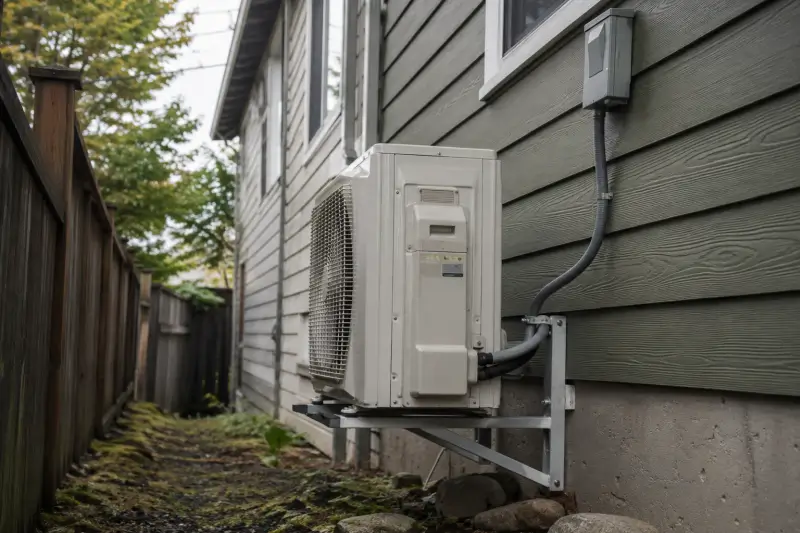
Seattle limits heat pumps to 45 decibels at the property line, day or night. Air conditioners get 55 by day (7:00 a.m.–10:00 p.m.) and 45 at night. Side-yard equipment needs a noise review.
Ductless is exempt from that review. That exemption ends the moment a neighbor files a noise complaint. On narrow lots, where a condenser may sit fifteen feet from a neighbor’s window, exempt from review is not exempt from the limit. Get the rated sound level and confirm placement before install day.
Before You Sign With a Contractor
Verify L&I registration with the free L&I lookup, required above $2,000.
Confirm they hold a refrigeration license, not just registration.
Get the Manual J load calculation with the bid.
Confirm in writing who pulls permits.
Get the AHRI Certified Reference Number from the AHRI Directory. Most rebates require it, and mismatched pairs get denied.
What a Mini Split Does and Does Not Do for Seattle’s Air
A ductless mini split recirculates room air. It does not filter fine particles or bring in fresh air. Its mesh screen keeps lint off the coil. The EPA recommends MERV 13 or higher during smoke events, a level no mini split screen reaches.
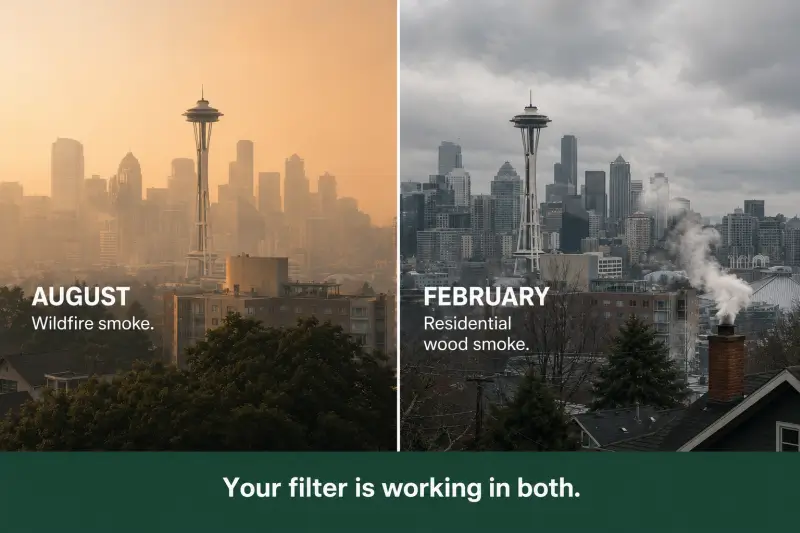
Summer: wildfire smoke. Less constant than headlines suggest, but when it arrives a mini split lets you keep windows shut.
Winter: wood smoke. PSCAA names residential wood burning a main source of fine particles, and Seattle’s damp, still air holds it low.
Three things to do about it:
Rinse the mesh screens monthly during smoke season, every two to three months otherwise. A loaded screen chokes airflow and erodes the efficiency you paid for. Here is how to clean them.
Run fan or dry mode after cooling. In a marine climate, a coil that never dries is how an indoor head starts to smell musty.
If you kept a furnace or air handler, its filter is your real filtration. A MERV 13 air filter is the practical choice; confirm your system handles MERV 13 airflow first, and compare MERV 13 vs. HEPA. Older Seattle homes often have odd-size returns; Filterbuy makes custom sizes to fit them, with auto-delivery through smoke season.
Track the Seattle smoke map before smoke season.
WHERE WE STAND ON THIS
Filterbuy sells ductless mini split systems, and separately manufactures air filters in the USA. That puts us on both sides of this purchase, which is why we say the unpopular part plainly: a mini split is a comfort and efficiency upgrade, not a filtration upgrade. Better you hear it from us in March than learn it in August.
The Filterbuy team
Supporting Statistics: What the Research Shows
Three numbers explain why Seattle homes are adding mini splits, and why the filter question outlasts the install. Filterbuy checked each against the issuing agency, not other blogs.
1. 249 Heat-Related ER Visits in King County in One Day
Date: June 28, 2021.
Share of all ED visits that day: 11%.
Previous daily peak (2019): under 10.
Why it matters: cooling stopped being optional here after 2021.
Source: King County, Extreme Heat Mitigation Strategy, July 2024 (PDF)
2. Winter Wood Smoke Beats Wildfire Smoke 6 Days to 2
Days in 2025 above the Puget Sound Clean Air Agency’s 25 µg/m³ health goal:
Wildfire smoke: 2 days, in September.
Residential wood burning: up to 6 days, winter.
Ratio: three times as many exceedance days from wood smoke.
Why it matters: a filter bought for August works hardest in January.
Source: Puget Sound Clean Air Agency, 2025 Data Summary
3. A High-Efficiency Filter Cuts Indoor PM2.5 by About 50%
EPA figures for indoor PM2.5 reduction with the fan running continuously:
High-efficiency filter: about 50% lower.
Low-efficiency filter: about 24% lower.
What drives it: the filter and fan setting, not the equipment.
Why it matters: a mini split has neither of those.
Source: U.S. EPA, Strategies to Reduce Exposure Indoors
Frequently Asked Questions
Can I install a mini split myself in Seattle?
No, not legally in city limits. SDCI requires a refrigeration permit, and only a licensed refrigeration contractor can obtain the license to pull it.
Do I need a cold-climate mini split in Seattle?
Rarely. Essential in Spokane or Yakima; in Seattle’s mild Zone 4C it is an upgrade, not a requirement.
Does a mini split help with wildfire smoke in Seattle?
Indirectly. It lets you keep windows closed but does not capture fine smoke particles. See mini split vs. air purifier.
Are mini split rebates available in Seattle?
Yes. Clean Heat pays oil conversions; PSE and HEAR cover others. See our Washington rebate guide.
Glossary
Ductless mini split: A heat pump linking an outdoor compressor by refrigerant lines to indoor heads.
Climate Zone 4C: The marine climate the Washington State Energy Code assigns to Seattle.
Manual J: The ACCA room-by-room load calculation used for sizing.
Refrigeration permit: Required for field-installed refrigerant piping; only a licensed refrigeration contractor can obtain one.
SDCI: Seattle Department of Construction and Inspections, which issues these permits.
PM2.5: Airborne particles 2.5 microns and smaller.
MERV: The 1–16 particle-capture scale. See which MERV rating to use.
AHRI Certified Reference Number: Confirms an indoor/outdoor pairing performs as rated; required by most rebates.