Adding a Mini Split AC System in South Carolina:
The Rebates You Can Actually Get in 2026
By Michelle Wan · Reviewed by David Clark, Licensed HVAC Technician · Published July 20, 2026 · Updated July 20, 2026
Yes, you can get money back, but in 2026 it comes from your utility, not the old federal tax credit. South Carolina’s big state rebates (HEAR and HOMES) haven’t opened yet, and the federal $2,000 tax credit ended December 31, 2025. Where the savings stand today:
- Federal tax credit: ended December 31, 2025.
- State HEAR and HOMES rebates: expected to open in 2026.
- Utility rebates (Duke, Dominion, Santee Cooper): available now.
Your mini split has to be a heat pump to qualify for any of them. Not sure which system fits your home? Take the quick quiz below, or browse mini split systems.

Answer 3 quick questions and we’ll match you to a mini split system that fits your home.
Prefer to browse first? See all mini split systems.
TL;DR
Adding a ductless mini split in South Carolina can qualify for rebates, but timing matters. The state’s two big IRA-funded programs, HOMES and HEAR, are not open yet (the South Carolina Energy Office expects them to launch in 2026), and the federal $2,000 tax credit expired December 31, 2025. Right now, the savings you can actually claim come from utility rebates through Duke Energy, Dominion Energy, and Santee Cooper. If you can wait for HEAR or HOMES to open, and your mini split adds heating-and-cooling rather than replacing an existing heat pump, the rebate stack can be much larger.
Key Takeaways
South Carolina’s HOMES and HEAR rebates are not available yet. The SC Energy Office lists both as "expected to launch in 2026." Plan around them, but you can’t apply today.
The federal mini split tax credit (Section 25C) is gone. It ended December 31, 2025 under the One Big Beautiful Bill Act; systems installed in 2026 don’t qualify for the old $2,000 credit.
"Adding" a mini split usually helps your eligibility. Per DOE guidance, replacing an existing heat pump is not rebate-eligible, but adding one where you didn’t have one, or replacing window units or a gas/electric-resistance system, generally is.
For a rebate, your mini split must be a heat pump (heating and cooling), not a cooling-only AC unit.
Utility rebates are available now and can stack with HEAR/HOMES later, just not on the same individual upgrade.
Can You Get a Rebate for Adding a Mini Split AC in South Carolina?
Yes, but as of July 2026, not from the program most articles point you to. South Carolina’s flagship rebates (HOMES and HEAR) are still in development and haven’t opened, and the federal tax credit that covered mini splits expired at the end of 2025. The incentives you can claim today are utility rebates from Duke Energy, Dominion Energy, and Santee Cooper. The bigger state rebates are coming in 2026, so timing your install can significantly change what you get back.
A quick but important distinction: a ductless mini split can be either a cooling-only air conditioner or a heat pump that both heats and cools. Nearly every rebate on this page requires a heat pump mini split, because the programs reward electrification and year-round efficiency, not cooling alone. If comfort in South Carolina’s hot, humid summers and mild winters is the goal, a mini split heat pump is usually the smarter buy anyway.
This is where our experience comes in. Filterbuy has spent more than a decade in HVAC and home air quality, and we sell and support mini split systems ourselves, so this is a question we field from homeowners constantly. The honest answer has shifted a lot in the past year: someone who read a 2024 guide and someone shopping today are working from completely different rules. That gap is exactly why we built this page. It gives you the 2026 reality, not last year’s.
South Carolina’s HOMES and HEAR Rebates: What’s Coming in 2026
South Carolina received Inflation Reduction Act funding for two home energy rebate programs, both administered by the South Carolina Energy Office. Neither is open yet. The state’s official rebate page lists both as expected to launch statewide in 2026, but the table below shows what to expect so you can plan your install.
Source: South Carolina Energy Office, energy.sc.gov/rebates.
One rule worth knowing early: you can participate in both programs, but you can’t apply both rebates to the same upgrade, and HOMES/HEAR dollars can’t be combined with other federal incentives on the same component. You can, however, layer a utility rebate on a different part of your project.
Does "Adding" a Mini Split Qualify, or Only Replacing an Old System?
This is the detail that trips people up, and it’s good news if you’re adding comfort to a space that never had ductwork rather than swapping like-for-like. According to U.S. Department of Energy guidance that South Carolina follows, replacing an existing heat pump, even with a more efficient one, is not eligible for a rebate. So the word "adding" in your search actually works in your favor.
“The mistake I see most often is folks assuming any new mini split qualifies. Swap out a working heat pump and you’ll usually come up empty, but add comfort to a room that never had it, or pull out old electric baseboard, and that’s exactly what these programs were built for.”
David Clark, Licensed HVAC Technician
Likely Eligible
Adding a mini split to a room, garage, sunroom, or addition that had no heat pump.
Replacing window AC units, or replacing a gas furnace or electric-resistance (baseboard/strip) heat with a mini split heat pump.
Likely Not Eligible for HEAR/HOMES
Tearing out a working central heat pump and installing a mini split in its place.
If your project is a straight heat-pump-for-heat-pump swap, a utility rebate (below) is usually your best available path, since those rules differ from the federal programs.
Utility Rebates You Can Use Right Now
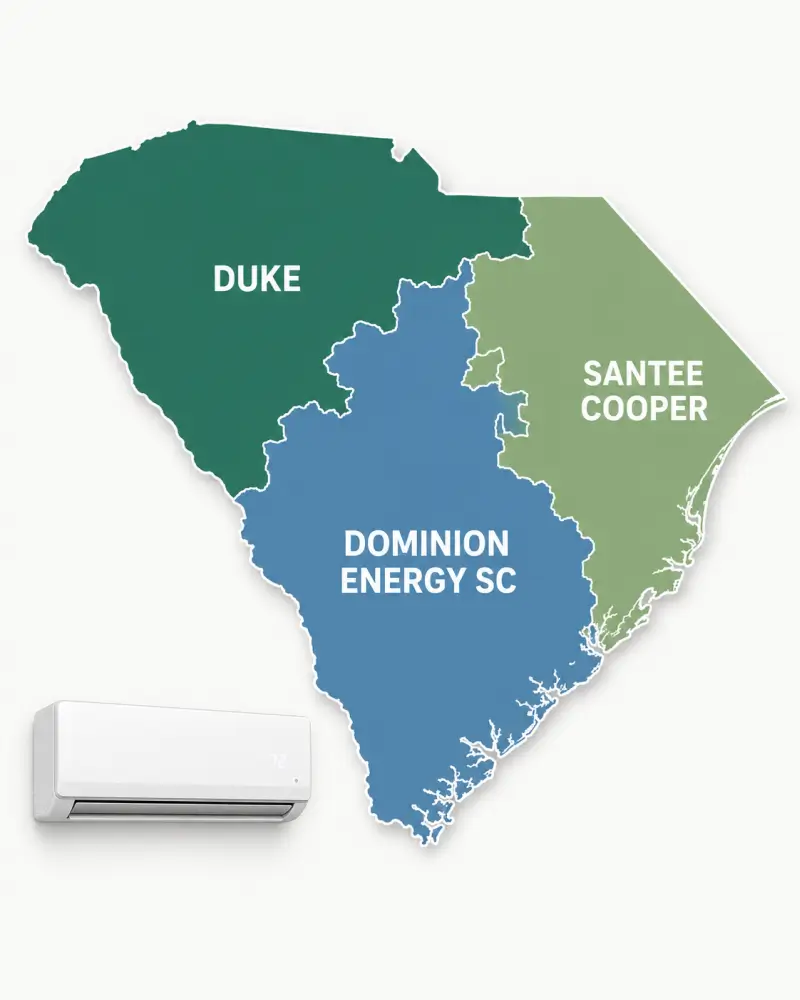
While HOMES and HEAR are still in development, South Carolina’s major utilities (Duke Energy, Dominion Energy South Carolina, and Santee Cooper) already run efficiency rebate programs, and the state itself directs homeowners to them for upgrades that can’t wait. Availability and amounts depend on your utility, your equipment’s efficiency rating (look for a high SEER2), and whether a mini split heat pump specifically qualifies, so confirm the current offer before you buy.
Source: South Carolina Energy Office referrals, energy.sc.gov/rebates.
Utility rebates can stack with a future HEAR or HOMES rebate, as long as you don’t fund the same individual upgrade twice.
What Happened to the Federal Mini Split Tax Credit?
If you’ve read that you can get 30% or $2,000 back from the IRS for a mini split in 2026, that information is out of date. The federal Section 25C Energy Efficient Home Improvement Credit, which covered up to $2,000 for qualifying heat pumps, expired December 31, 2025, ended early by the One Big Beautiful Bill Act (signed July 2025). Mini splits installed in 2026 or later do not qualify for that credit. Systems installed on or before December 31, 2025 can still be claimed on your 2025 tax return using IRS Form 5695.
The federal rebate money (HEAR and HOMES) survived that law. It’s just administered by the state, which is why South Carolina’s 2026 launch matters so much. For the full federal breakdown, see Filterbuy’s guide to the 2026 mini split tax credit.
One thing we’ll flag from experience: the most common planning mistake we see right now is a homeowner still budgeting for that $2,000 credit. Build your numbers around the rebates that are actually coming, not the credit that’s already gone.
How to Stack Your Savings the Right Way
The winning move in South Carolina is sequencing, not double-dipping. Get the eligibility rules right, keep every receipt, and don’t apply two funding sources to the same line item.
Confirm your system is a heat pump mini split with a strong SEER2 rating. Cooling-only units are excluded from most rebates. You can compare heat pump models on Filterbuy’s mini split systems page.
Check your utility’s current rebate (Duke, Dominion, or Santee Cooper). This is what you can claim now.
Watch for HEAR/HOMES to open in 2026, and sign up for updates at energy.sc.gov/rebates. If you may qualify by income (HEAR) or want whole-home savings (HOMES), waiting can be worth thousands.
Use a program-approved contractor once state rebates launch. For heat pumps, that’s required, and DIY heat pump installs won’t qualify.
Keep funding separate per upgrade. Utility rebate on one measure, HEAR/HOMES on another, never both on the same one.
Should You Wait for the Rebates, or Install Now?
It comes down to two things: your income and how long you can wait. If you might qualify for HEAR (under 150% of your area’s median income) or you’re planning bigger efficiency work, waiting for the state programs to open in 2026 could be worth thousands. If your system is failing now, or you earn above the HEAR limit, a utility rebate today plus a smart install is usually the better move. This is how we’d think it through with you.
Lean Toward Waiting If
You may qualify by income (under 150% AMI). HEAR is a point-of-sale discount worth up to $14,000, applied at purchase through an approved contractor, so you generally need the program live to capture it.
You’re planning whole-home efficiency work (insulation and air sealing alongside the heat pump). HOMES pays more for bigger modeled energy savings.
Your current system still works, so you’re not racing the next heat wave.
Lean Toward Installing Now If
Your AC or heat is failing and you can’t wait out a South Carolina summer.
Your household earns above the HEAR income limit, so HEAR won’t apply either way, and a utility rebate now is your path.
You just need one room or an addition covered, where a utility rebate is likely all that’s on the table regardless.
Whichever way you lean, a few moves keep your options open and protect a future rebate:
Don’t tear out a working heat pump. That’s the one swap DOE guidance excludes from HEAR and HOMES.
Choose an ENERGY STAR–certified, AHRI-matched heat pump mini split; cooling-only and uncertified units are shut out of most programs.
Use a licensed contractor (and, once programs open, a program-approved one). DIY heat pump installs don’t qualify.
Keep every receipt, model number, and your AHRI certificate, since you’ll need them to claim.
Join the SC Energy Office list so you can apply the day HEAR or HOMES opens.
None of this has to be overwhelming. Filterbuy has spent more than a decade making home comfort simpler (from air filters to mini split systems), so if you want a hand comparing heat pump options or figuring out what actually fits your space, that’s exactly the kind of question our team is glad to help with.
Frequently Asked Questions
Bookmark These 7 Resources Before You Add a Mini Split in South Carolina
Rebate programs move fast, and the rules can get technical in a hurry. So we pulled together the seven sources we’d point a neighbor to: the official ones that tell you what’s open, what you qualify for, and whether your system makes the cut. Every link below goes straight to a government, nonprofit, or industry source. No sales pitch, just the stuff that actually helps.
1. See When South Carolina’s Rebates Actually Go Live
South Carolina’s HOMES and HEAR rebates aren’t open yet, and this is the page that’ll tell you the moment they are. It’s run by the South Carolina Energy Office, so you’ll also find the income rules and the approved-contractor list here, so join their email list and you won’t miss the window.
Start here: energy.sc.gov/rebates
2. Get the Full Story on the Federal Rebate Money
HEAR and HOMES are funded by the U.S. Department of Energy, and this page lays out how they work and which upgrades count. Think of it as the rulebook your South Carolina program has to play by.
Start here: www.energy.gov/save/home-upgrades
3. Double-Check the $2,000 Tax Credit (Yep, It’s Gone)
Heard you can still get $2,000 back from the IRS for a mini split? Not anymore. This official IRS fact sheet shows the Section 25C credit ended December 31, 2025. It’s worth a quick look before you trust a page that says otherwise.
4. Check If Your Income Qualifies You for HEAR
HEAR is only for households earning under 150% of the area median income, and this HUD tool tells you your county’s number in about two minutes. Look it up before you count on that upfront discount.
Start here: www.huduser.gov/portal/datasets/il.html
5. Find Every Rebate in Your ZIP Code (Even the Ones You Missed)
Punch in your ZIP and DSIRE shows you every state, utility, and local incentive you might qualify for. It’s run by NC State’s Clean Energy Technology Center and catches the programs your utility doesn’t always advertise.
Start here: dsireusa.org
6. Pick a Mini Split That Actually Qualifies
Most rebates want an ENERGY STAR–certified system, and this page walks you through the efficiency ratings, right-sizing, and cold-weather performance in plain English. There’s a rebate finder built right in, too.
Start here: www.energystar.gov/products/ductless_heating_cooling
7. Make Sure Your Equipment Checks Out Before You File
Rebate programs and the IRS both want proof your mini split is a certified match, and the AHRI Directory is where you confirm it. Grab your AHRI reference number here (or from your installer) and filing gets a whole lot smoother.
Start here: www.ahrinet.org/certification/ahri-directory
Supporting Statistics
The research backs this up. Three numbers worth knowing:
Heating and cooling eat up 52% of a typical home’s energy. It’s your biggest energy bill, so efficiency pays. (EIA, 2020)
Mini split heat pumps use up to 60% less energy than electric resistance heat. Same comfort, far less electricity, and the efficiency most rebates want. (ENERGY STAR)
A heat pump saved households about $310 a year and paid for itself in just over two years, with nearly $4,000 in savings over 15 years. Proof it pays off on its own, credit or no credit (hot-climate Texas study). (ACEEE, 2024)
Glossary
Mini split (ductless): A heating and/or cooling system with an outdoor compressor connected to one or more wall-mounted indoor "head" units, installed without ductwork.
Mini split heat pump: A mini split that both heats and cools by moving heat rather than generating it; the type most rebates require.
HEAR (Home Electrification and Appliance Rebates): A federally funded, state-administered point-of-sale rebate program for income-qualified households (under 150% AMI), also called HEEHRA. Covers electric heat pumps, up to $14,000 per household.
HOMES (Home Efficiency Rebates): A federally funded, state-administered rebate program open to all incomes, paying $2,000–$16,000 based on whole-home energy savings.
AMI (Area Median Income): The midpoint household income for a county, used to set rebate eligibility; varies by county and household size (look it up via HUD’s Income Limits tool).
Section 25C: The federal Energy Efficient Home Improvement Credit (up to $2,000 for heat pumps), which expired December 31, 2025.
IRA (Inflation Reduction Act of 2022): The federal law that funded the HOMES and HEAR rebate programs.
SEER2: The current efficiency rating for cooling equipment; higher numbers mean lower operating costs. The Southeast’s heat makes a high SEER2 especially valuable.
SC Energy Office: The South Carolina agency administering the state’s Home Energy Rebate programs (energy.sc.gov/rebates).
Related reading on Filterbuy: shop ductless mini split systems · what is a ductless mini split · heating & cooling without ductwork · the 2026 mini split tax credit explained
This article is for general information and is not tax or financial advice. Rebate programs change; confirm current details with the South Carolina Energy Office and your utility before purchasing.