Installation, Costs & Rebates (NE Guide)
By Michelle Wan · Reviewed by David Clark, Licensed HVAC Technician · Published July 8, 2026 · Updated July 8, 2026
In Nebraska, a single-zone mini split runs about $3,000 to $6,000 installed, and a whole-home system runs $9,000 to $15,000 or more. The federal tax credit ended after 2025, so your savings now come from your electric utility: OPPD pays $525, LES pays $1,000 (up to $3,800 with the City of Lincoln), and NPPD EnergyWise pays $400 to $1,200.
One ductless system cools all summer and heats through a sub-zero Nebraska winter, with no ductwork. Not sure which size fits your space? Take the quick match quiz below.
Shop mini split systems Reviewed by a licensed HVAC technician.

Answer a few quick questions and we will match you to the right mini split for your space.
Adding a mini split AC system in Nebraska costs $3,000–$6,000 for a single zone and $9,000–$15,000+ for a whole-home multi-zone system in 2026, before rebates. The federal heat-pump tax credit expired December 31, 2025, so Nebraska savings now come from utility rebates: OPPD pays a flat $525, LES pays $1,000 (up to $3,800 combined with the City of Lincoln), and NPPD's EnergyWise program pays $400–$1,200. For Nebraska's below-zero winters, choose a cold-climate (ccASHP) model.
A ductless mini split heats and cools from one system, needs no ductwork, and gives room-by-room control, ideal for Nebraska additions, basements, garages, and homes without ducts.
The federal 25C tax credit ($2,000 for heat pumps) ended December 31, 2025 under the One Big Beautiful Bill Act; a mini split placed in service in 2026 does not qualify.
Nebraska rebates depend on your electric utility: OPPD $525 (Omaha metro), LES $1,000 (Lincoln, up to $3,800 with the city), NPPD EnergyWise $400–$1,200 (rural), Beatrice BPW up to $3,000.
Nebraska's Dollar and Energy Saving Loan finances qualifying heat pumps at rates as low as 1.5%, but NPPD-territory homeowners must choose the loan or the rebate, not both.
Cold-climate models are essential in Nebraska. Units like Mitsubishi Hyper-Heat and Fujitsu XLTH hold heating capacity to roughly –13°F to –15°F; many homeowners pair one with a gas furnace in a dual-fuel setup.
If you have a bonus room that never cools in July, a basement that's freezing by February, or a house with no ductwork at all, adding a mini split is one of the most practical comfort upgrades a Nebraska homeowner can make. This guide covers what it costs in 2026, which rebates you can still claim, how the install works, and how to keep the system running clean. It was reviewed for accuracy by a licensed HVAC technician.
Where this comes from: Filterbuy is North America's largest air filter manufacturer, and through our Filterbuy HVAC Solutions team we install and service ductless mini splits ourselves, single- and multi-zone, down to the line sets and drain lines. So the advice below reflects both sides of the system: the install and the airflow. For the install itself, we'll always point you to a licensed Nebraska pro, but the judgment calls here come from hands-on experience with these units, not a spec sheet.
A ductless mini split fits Nebraska's mixed climate because it delivers heating and cooling from one system, installs without ductwork, and gives room-by-room control. Most of Nebraska sits in DOE Climate Zone 5A, with the Omaha–Lincoln corridor on the 4A–5A line: humid summers along the Missouri River and winters that regularly drop below 0°F. A mini split handles both seasons efficiently in that environment.
Two systems in one. A mini split heat pump cools in summer and heats in winter, replacing a separate AC and furnace for a given space.
Room-by-room zoning. Each indoor head runs independently, so you stop paying to condition rooms nobody is using.
No ductwork required. For older Nebraska homes, additions, garages, and basements, skipping ducts saves thousands and avoids invasive construction.
The one Nebraska-specific catch: not every mini split holds its heating output when it's brutally cold. That is why cold-climate equipment, covered below, matters more here than in mild regions.
Adding a mini split in Nebraska costs $3,000–$6,000 for a single zone and $9,000–$15,000+ for a whole-home multi-zone system in 2026, installed and before rebates. Price scales with the number of zones, the efficiency tier, and install complexity. Cold-climate models, recommended for Nebraska, typically add 10–20% over standard units.
Ranges reflect 2026 national installed pricing; the Omaha and Lincoln metros track close to these figures, while rural Nebraska can run higher.
For a fuller national breakdown by zone and size, see Filterbuy's mini split installation cost guide, and what a mini split costs to run each month once it's installed.
Four factors move a Nebraska quote the most:
Cold-climate equipment carries a premium. A whole-home cold-climate ductless system in Nebraska commonly lands in the $7,000–$11,500 range before rebates.
Labor is roughly 30–50% of the total. Licensed technicians charge about $75–$150 per hour, and a clean single-zone install runs 4–8 hours.
Extras add up. Longer refrigerant line sets, second-floor or ceiling-cassette mounts, and electrical-panel upgrades all raise the price. Always request an itemized quote.
New refrigerants are now standard. Most 2026 systems use low-GWP A2L refrigerants (R-32 or R-454B), which require updated installer handling, one reason to use a licensed pro, not a DIY kit.
Nebraska mini split rebates in 2026 come almost entirely from local electric utilities, because the federal heat-pump tax credit expired at the end of 2025. OPPD pays a flat $525, LES pays $1,000 (up to $3,800 combined with the City of Lincoln), NPPD's EnergyWise program pays $400–$1,200, and Beatrice BPW pays up to $3,000. Which one you qualify for depends entirely on your electric provider.
The Section 25C Energy Efficient Home Improvement Credit, the federal credit that gave up to $2,000 for a qualifying heat pump, expired December 31, 2025, eliminated by the One Big Beautiful Bill Act (Public Law 119-21, signed July 4, 2025). The Section 25D credit for geothermal ended on the same date. The IRS uses a "placed in service" trigger, so a mini split placed in service in 2026 does not qualify, regardless of contract date. Systems operational by December 31, 2025 can still be claimed on a 2025 return via IRS Form 5695.
For the full picture on how the credit changed and which 2026 rebates replace it, see Filterbuy's guide to mini split tax credits and rebates in 2026.
The federally funded HEAR and HOMES rebate programs (up to $8,000 for income-qualified households) survived that law, but Nebraska has not launched them as of mid-2026. The state's roughly $91 million allocation remains in "Preparing Application" status with no set date.
Verify current amounts at oppd.com, les.com, lincoln.ne.gov, and nppd.energywisenebraska.com before selecting equipment.
OPPD adds an ongoing rate benefit. Beyond the $525, OPPD's Residential Conservation Rate 115 gives heat-pump customers a lower winter rate (October–May) when the system supplies at least half of space conditioning. Over several years, that can exceed the one-time rebate.
NPPD makes you choose. In NPPD territory you generally take either the EnergyWise rebate or the state's 1.5% energy loan, not both.
Nebraska's Dollar and Energy Saving Loan, run through the Nebraska Department of Water, Energy, and Environment, finances qualifying heat pumps at rates as low as 1.5% interest. One quirk: homes built within the last five years aren't eligible for the loan but can still take the utility rebate.
Verify current figures with each program before you buy: OPPD HVAC Smart Rebates, the LES Sustainable Energy Program, City of Lincoln heat pump incentives, and NPPD EnergyWise. Rebate amounts and rules change annually.
Nebraska is the only U.S. state where every electric utility is publicly owned, so you can't shop providers, and your address alone decides who serves you. That matters here because your utility determines your rebate. Your provider is printed on your electric bill; use this quick map to place yourself:
Omaha metro + 13 eastern counties → OPPD. Covers Omaha, Bellevue, Papillion, and La Vista. Rebate: flat $525.
Lincoln + Lancaster County → LES. Lincoln Electric System serves Lincoln, Waverly, and nearby towns. Rebate: $1,000, or up to $3,800 combined with the City of Lincoln for income-qualified homes.
Most rural & outstate Nebraska → a local public power district partnered with NPPD. NPPD supplies power to more than 100 Nebraska communities and 24 rural districts. Rebate: EnergyWise, $400–$1,200.
Your own city utility → check locally. Some municipalities run their own programs. For example, the Beatrice Board of Public Works offers up to $3,000.
When in doubt, call the customer-service number on your bill and ask one question: "Do you offer a heat pump or mini split rebate, and how much is it right now?" The answer comes straight from the source that pays it.
Filterbuy built this comparison because most rebate pages stop at the sticker discount. Here is the net installed cost of a single-zone cold-climate mini split, using a representative $5,000 install, after each Nebraska utility's current rebate, using 2026 cost data mapped to each provider's specific incentive.
Illustrative only, using a representative $5,000 single-zone cold-climate install. OPPD customers also gain ongoing Rate 115 winter savings; NPPD homeowners may choose the 1.5% state loan instead of the rebate. Your quote and current program terms determine the real figure.

Adding a mini split is a five-step process a licensed installer completes in one to three days: a load calculation, zone and head placement, mounting the outdoor unit and line set, electrical and permits, then charging and commissioning. The load calculation is the step you cannot skip. It sizes the system to your actual home rather than a rule of thumb.
Load calculation. A pro runs a Manual J–style calc to size the system to your square footage and insulation. An oversized unit short-cycles, wastes energy, and loses humidity control.
Zone and head placement. You choose how many rooms get a head and where each mounts. Wall-mounted heads are cheapest; ceiling cassettes and floor units cost more per zone.
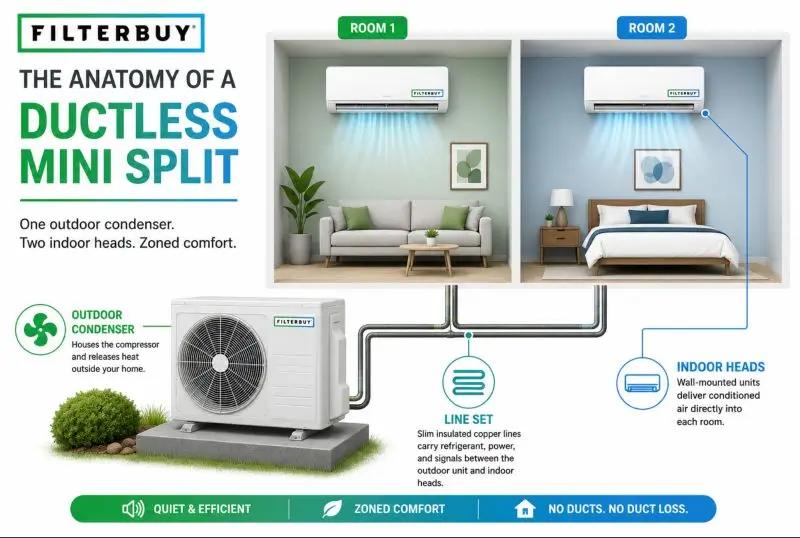
Outdoor unit and line set. The outdoor condenser mounts on a pad or bracket, connected to each indoor head by a slim refrigerant line (standard runs are 15–25 feet).
Electrical and permits. Most Nebraska installs need a dedicated circuit plus mechanical and electrical permits; some panels need an upgrade.
Charge, test, commission. The technician vacuums the lines, charges refrigerant, and verifies performance. This is where DIY kits fail and where rebates and warranties can be voided.
From our own installs, two steps separate a mini split that performs from one that disappoints, and both are easy to shortchange. The first is the load calculation: we've been called out to "fix" underperforming systems that were simply the wrong size, short-cycling all day. The second is the refrigerant work, a proper vacuum and charge. Rushed line-set and vacuum steps are the failure we see most, and they're exactly what a rock-bottom bid tends to skip. If a quote seems far cheaper than the rest, that's usually where the corner is being cut.
“A mini split is only as good as its install. We tell homeowners the same thing every time: get the load calculation done properly and don't let anyone rush the vacuum and charge. Nail those two, and a cold-climate unit will carry you through a Nebraska winter for years.”
For Nebraska, a cold-climate mini split (a ccASHP, or cold-climate air-source heat pump) is essential for any unit you rely on for heat. A cold-climate model is engineered to hold heating capacity far below freezing, where a standard mini split loses output. Mitsubishi Hyper-Heat, Fujitsu XLTH, and Daikin Aurora are the three most-installed cold-climate lines for sub-zero conditions. In our own ductless work at Filterbuy HVAC Solutions we lean on Mitsubishi, which is why Hyper-Heat tops our list, but Fujitsu and Daikin are strong too, and the best pick is often the one your local installer stocks and knows how to service. The U.S. Department of Energy's ductless mini split overview is a solid primer on how these systems work.
Check each model's published low-ambient heating capacity and AHRI certificate for your specific home.
When a unit is your primary heat source through a Nebraska January, check the model's published low-ambient heating capacity and its AHRI certificate, not just the headline SEER2 rating.
A Nebraska-smart option is dual-fuel. If you already have natural gas, pairing a mini split heat pump with your existing gas furnace lets the heat pump handle the efficient 80–90% of the heating season while the furnace covers the coldest days. You get heat-pump efficiency without betting comfort on the single coldest night of the year.
A mini split only delivers clean, efficient air if its filtration stays maintained, and this is the part we know best. A ductless head uses a thin washable mesh filter that needs rinsing every few weeks during heavy use; skipping it chokes airflow, raises energy bills, and shortens equipment life. In our experience, forgetting that filter is the single most common maintenance miss on a new ductless system. Just as important: most Nebraska homes that add a mini split keep their central furnace and AC as the whole-home backbone, and that system still runs on a standard replacement filter doing the heavy lifting on dust, dander, and allergens.
That central filter is where Filterbuy fits your home. As North America's largest air filter manufacturer, Filterbuy makes HVAC air filters in the USA in 600+ sizes, ships them factory-direct (fast and free), and offers auto-delivery so the right size arrives exactly when it's time to change it. Upgrading your comfort is a good moment to upgrade how you handle your air filters. Better Air For All.
Three figures from U.S. government sources back the case for adding a mini split and keeping its filters clean:
30%+
Ductwork can lose more than 30% of a home's heating and cooling energy.
• A ductless mini split skips ducts, so that loss disappears, a core reason it runs efficiently in Nebraska homes.
Source: U.S. Department of Energy: Building America Solution Center
Up to 60%
ENERGY STAR mini split heat pumps use up to 60% less energy than electric resistance heat.
• Real savings for Nebraska homes on baseboard or resistance heat, especially with a cold-climate or dual-fuel setup.
Source: ENERGY STAR (U.S. EPA / U.S. DOE)
90%
Americans spend about 90% of their time indoors.
• Indoor pollutant levels can run 2–5x higher than outdoors, so a clean mini split filter and central filter matter.
Source: U.S. Environmental Protection Agency: Report on the Environment
Use this as your step-by-step before you sign anything. It folds everything above into one sequence built around your interests, not the seller's:
Find your utility on your electric bill and confirm its current rebate amount, since the programs reset each year.
Insist on a Manual J load calculation. Right-sizing matters more than raw capacity; oversized units short-cycle and waste money.
Choose a cold-climate (ccASHP) model with a published low-temperature heating rating and an AHRI certificate. In Nebraska this isn't optional.
Confirm the exact model qualifies for your rebate (usually an ENERGY STAR or efficiency-tier requirement) before you buy, not after.
Ask who files the rebate paperwork. Many installers handle it for you, so get that in writing.
In NPPD territory, pick the rebate or the 1.5% loan. You generally can't take both, so have your installer run the numbers each way.
Budget for electrical and permits, and confirm your installer pulls them. Some panels need an upgrade.
Plan filter maintenance from day one: rinse the head's washable filter every few weeks, and keep your central system's filters stocked with Filterbuy auto-delivery.
Mini split (ductless mini split): A heating and cooling system with an outdoor condenser connected by refrigerant lines to one or more indoor "head" units, requiring no ductwork.
Ductless heat pump: The same equipment described by its function: a mini split that both heats and cools by moving heat rather than burning fuel.
Zone: One indoor head serving one area. A single-zone system has one head; a multi-zone system has several on one outdoor unit.
Cold-climate heat pump (ccASHP): An air-source heat pump engineered to retain heating capacity in sub-freezing temperatures, appropriate for Nebraska winters.
SEER2 / HSPF2: The 2023-onward efficiency ratings for cooling (SEER2) and heating (HSPF2); higher numbers mean lower operating cost.
AHRI certificate: An independent performance rating verifying an equipment combination's published capacity and efficiency.
A2L refrigerant (R-32 / R-454B): Low-global-warming refrigerants now standard in 2026 systems; mildly flammable and requiring updated installer handling.
Section 25C: The federal Energy Efficient Home Improvement Credit (up to $2,000 for heat pumps) that expired December 31, 2025.
HEAR / HOMES: Federally funded home-electrification rebate programs; not yet launched in Nebraska as of mid-2026.
Dual-fuel: A setup pairing a heat pump with a gas furnace, letting each handle the part of the season it does best.
Dollar and Energy Saving Loan: A Nebraska state program financing qualifying efficiency upgrades at rates as low as 1.5%.
OPPD / LES / NPPD: Omaha Public Power District, Lincoln Electric System, and Nebraska Public Power District. These are the utilities whose territory determines your rebate.
No. The federal Section 25C credit (up to $2,000 for heat pumps) expired December 31, 2025. A mini split placed in service in 2026 or later does not qualify. Nebraska savings now come from utility rebates and the state's low-interest energy loan.
It depends on your electric utility. OPPD (Omaha metro) pays a flat $525, LES (Lincoln) pays $1,000 with a combined City of Lincoln incentive up to $3,800, and NPPD's EnergyWise program pays $400–$1,200. Beatrice BPW pays up to $3,000. Verify the current amount with your provider before buying.
A single-zone system typically costs $3,000–$6,000 installed, and a whole-home multi-zone system costs $9,000–$15,000+ in 2026, before rebates. Cold-climate models, recommended for Nebraska, add roughly 10–20%.
Yes, with a cold-climate model. Mitsubishi Hyper-Heat and Fujitsu XLTH hold heating capacity down to roughly –13°F to –15°F. For the coldest snaps, many Nebraska homeowners run a dual-fuel setup with a backup gas furnace.
Yes. Speccing a multi-zone outdoor condenser upfront is usually cheaper than adding a zone as a separate project later, even if you activate only one head at first.
Yes. Mini split heads have washable filters that need regular rinsing, and if you keep a central furnace or AC as backup, that system needs quality replacement filters. Find your Filterbuy filter size and set up auto-delivery.
Adding a mini split protects your greatest assets: you, your home, and your HVAC. Weighing an install? Start by exploring Filterbuy's mini split systems and lining up a licensed Nebraska installer for the work. And once your system is in, keep it running clean: find your exact filter size and set up auto-delivery so fresh filters arrive on schedule. Little effort, big impact.
Every link below was checked and confirmed live on July 8, 2026.
U.S. Department of Energy: Ductless (Mini-Split) Heat Pumps (Building America) · duct losses can exceed 30% of heating/cooling energy
ENERGY STAR: Ductless Heating & Cooling · certified mini splits use up to 60% less energy than electric resistance heat
U.S. EPA: Indoor Air Quality (Report on the Environment) · Americans spend ~90% of time indoors; pollutants 2–5x higher
IRS: 25C/25D termination under the One Big Beautiful Bill (FS-2025-05) · confirms 25C ends for property placed in service after Dec 31, 2025
IRS: About Form 5695, Residential Energy Credits · for eligible 2025 installs
ENERGY STAR: Federal Tax Credits for Air-Source Heat Pumps · cold-climate efficiency tiers
AHRI Certified Products Directory · verify equipment performance ratings
OPPD: HVAC Smart Rebates · flat $525 heat-pump rebate + Rate 115 (Omaha metro)
LES: Sustainable Energy Program · $1,000 heat-pump incentive (Lincoln)
City of Lincoln: Heat Pump Incentives · up to $3,800 combined with LES
NPPD: EnergyWise Residential Incentives · $400–$1,200 (rural/outstate Nebraska)
Nebraska DWEE: Dollar and Energy Saving Loans · financing as low as 1.5%
Mini Split Installation Cost (2026) · national cost breakdown by zone & size
Mini Split Tax Credits & Rebates in 2026 · what replaced the federal credit
What a Mini Split Costs to Run Per Month · operating-cost math
Filterbuy Mini Split Systems · shop the lineup
Filterbuy HVAC Solutions: Ductless Install & Service · Filterbuy's own HVAC arm (FL/Orlando) that installs & services mini splits
Filterbuy Air Filter Subscription · auto-delivery for your central system