Installation, Costs & Filter Guide (IL Climate)
Author: Michelle Wan, Brand Manager and Air Quality Writer · Technically reviewed by: David Clark, Licensed HVAC Technician Published: August 25, 2026 · Updated: August 25, 2026
A single-zone mini split installed in Chicago costs $2,500 to $7,000 in 2026, or roughly $1,500 to $6,000 after ComEd's ductless rebate. Multi-zone systems run $6,500 to $15,000 or more.
That range is wide because an installed price is four separate line items, not one number. Equipment, labor, the city permit, and the electrical circuit each move independently. It is why one quote reads $1,400 and the next reads $4,200 for the same job.
Take the quiz below and we will point you to the size and system that fit your room.

Answer a few quick questions and we will match you to a mini split that fits your space.
Prefer to browse first? Shop Filterbuy mini split systems , published prices from $799, free 2-day delivery on in-stock systems, and a 7-year compressor warranty. Single zone; professional installation required.
A single-zone mini split installed in Chicago costs $2,500 to $7,000 in 2026, and ComEd takes up to $1,000 off qualifying ductless heat pumps at the point of sale. Chicago sits in IECC Climate Zone 5A with a winter design temperature near −4°F, so the unit must be cold-climate rated to carry heat in January. The washable mesh filter inside the head needs cleaning every two to four weeks. It is a comfort filter, not a health filter.
• A single-zone install in Chicago runs $2,500 to $7,000 in 2026; multi-zone reaches $15,000 or more.
• ComEd pays up to $1,000 on a qualifying ductless heat pump, as an instant discount through a participating contractor.
• The federal 25C tax credit ended December 31, 2025 and does not apply to 2026 installs.
• A mini split is the wrong tool if you already have working ductwork or only need one room cool for eight weeks.
• Chicago’s 99% winter design temperature is roughly −4°F, which is why cold-climate certification and a Manual J are not optional here.
• The mesh filter needs cleaning every 2 to 4 weeks, about six times as often as a furnace filter.
Mini split installation in Chicago costs $2,500 to $7,000 for a single zone in 2026, and $6,500 to $15,000 or more for multi-zone. Chicago runs above the national average of roughly $3,000 per zone because labor costs more here and the city requires a permitted, inspected install. Labor runs $120 to $240 per hour and accounts for 40% to 60% of the total. Most quotes bury that in one line. Here is the same job, itemized:
• Equipment (head, condenser, line set): $700 – $1,800. Driven by BTU size, SEER2 rating and brand tier.
• Labor, per zone: $500 – $2,000. Driven by line-set run and wall material.
• Permit and mechanical inspection: $350 – $900. Landmark and high-rise buildings cost more.
• Electrical, new 230V circuit: $500 – $1,500. Skipped entirely on a 115V unit.
• Installed total, single zone: $2,500 – $7,000.
• ComEd ductless rebate: up to $1,000 off, taken as an instant discount at the point of sale.
• Typical net after rebate: roughly $1,500 – $6,000.
Filterbuy itemizes it this way because of the question we field most: why one quote says $1,400 and the next says $4,200. Usually it is the same job. One priced the box. The other priced the box plus labor, permit and electrical. If a quote sits far below this range, check what it left out; that is where cheap mini split shopping goes wrong.
ComEd offers up to $1,000 toward a qualifying ductless mini split heat pump and up to $1,400 toward a ducted air-source heat pump, as an instant discount at the point of sale. ComEd serves Chicago and most of Chicagoland, so it applies to nearly every Chicago address.
Two conditions decide it: the equipment must meet ComEd’s efficiency thresholds, and the installer must be a participating ComEd trade ally. ComEd moved to tonnage-based tiers on March 1, 2026, so pull current numbers from ComEd’s discounts page first.
The Section 25C credit, which covered 30% of heat pump costs up to $2,000, ended December 31, 2025. IRS guidance states it is not allowed for property placed in service after that date. Many contractor sites have not caught up. If a quote still shows a $2,000 federal credit, that number is wrong. Confirm your own eligibility for any credit or rebate with a tax professional.
Illinois EPA’s income-qualified HEAR program is still pending federal approval as of mid-2026. For the full state picture, see mini split installation cost in Illinois.
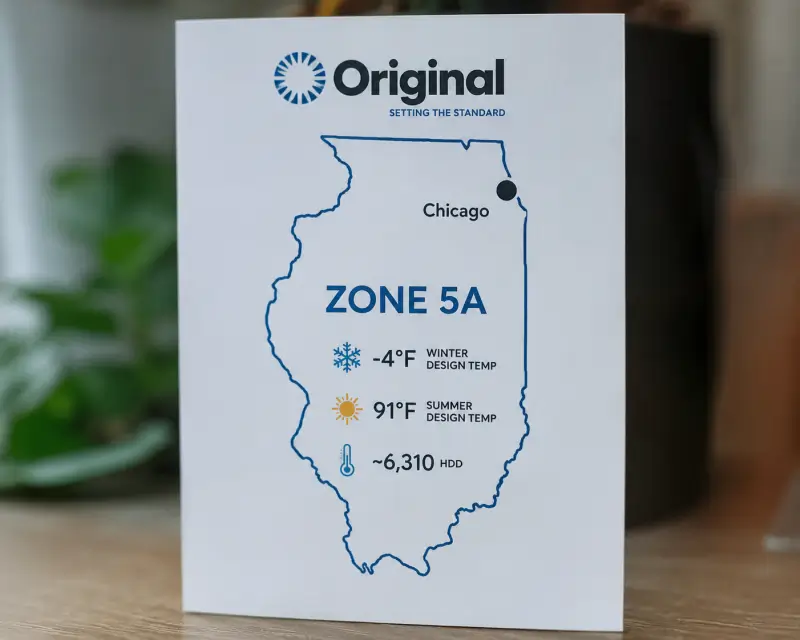
Chicago sits in IECC Climate Zone 5A (cool-humid), with a 99% winter design temperature near −4°F and a 1% summer design temperature around 91°F. O’Hare records roughly 6,310 heating degree days a year. Sizing here is a heating problem first, the reverse of how these systems are marketed. That creates two requirements milder-climate guides skip:
1. Cold-climate certification. ENERGY STAR Cold Climate criteria require a minimum 1.75 COP at 5°F and at least 70% of the unit’s 47°F heating capacity at 5°F, third-party verified.
2. A Manual J load calculation. ENERGY STAR’s ductless guidance tells homeowners to have the contractor verify system size with Manual J. Square-footage rules of thumb oversize cooling and undersize heating in a leaky bungalow.
An honest note about our own equipment. Filterbuy sells ductless systems, so read this section with that in mind. Our line starts at $799 with free 2-day delivery on in-stock systems and a 7-year compressor / 3-year parts warranty, at a published price with no quote form. It is a single-zone system rated for reliable heating down to 5°F, and professional installation is required; the warranty is void if self-installed.
That 5°F rating is the number that matters for this page. If this unit is the only thing heating a Chicago room in January, buy a cold-climate certified system instead. Ours is built for value in a supplemental zone: a bedroom, home office, workshop, or a room the central system never reaches. For whole-home winter heat, the Filterbuy roundup of the most reliable mini split brands names the cold-climate leaders, including the ones that beat us.
Installing new permanent air conditioning equipment in Chicago requires a permit from the Chicago Department of Buildings. One detail trips up almost every national cost guide: the City of Chicago has no specialty HVAC license. A contractor doing permit work must hold a City of Chicago license, usually a general contractor license. Electrical work goes to a City-licensed electrical contractor. Single-space installs qualify for the Express Permit Program, issued in one to two business days.
Ask every contractor these five questions:
1. Are you a participating ComEd trade ally? If not, the rebate is off the table.
2. Will you run a Manual J, and can I see it? A quote with no load calculation is a guess.
3. Who pulls the permit and schedules inspection? The answer should be “we do,” in writing.
4. Do you hold EPA Section 608 certification? Federal law requires it for refrigerant work.
5. Where will the condenser sit? Gangway placement and noise rules are the most common Chicago snag.
The install is priced by your building, not your square footage. Chicago’s housing stock is unusually varied, and each type runs into a different obstacle. Filterbuy built this from the questions Chicagoland homeowners actually send us.
• Brick bungalow (1910–40), usually 1 to 2 zones. Solid masonry coring, a shallow attic that rules out easy ductwork, and a condenser that ends up in the gangway.
• Two-flat or three-flat, one system per unit. Contested condenser space and the question of who pays the electric.
• Greystone, usually 2 to 4 zones. High ceilings you do not want soffited, and facade rules that may govern where the exterior unit sits.
• Frame cottage or Cape Cod, usually 1 to 2 zones. The easiest coring of the group. Upstairs heat is normally what drives the project.
• Condo or high-rise, usually 1 to 2 zones. Association approval and exterior placement rules make this the longest timeline by far.
Filterbuy sells mini splits, and we would still rather you skip the purchase than regret it. Three cases where something else wins:
• You already have working ductwork. Adding central AC to your existing furnace is normally cheaper than multi-zone ductless. Get both quotes.
• You want whole-home cooling in a greystone. Small-duct high-velocity systems (Unico, SpacePak) thread 2-inch duct through walls without soffits, preserving ceilings. Budget $30,000 to $60,000. That is more than ductless, but it is the right tool if ceilings are the priority.
• You need one room cool for eight weeks a year. A window unit is defensible. A $2,500 mini split will not pay that back on cooling alone.
A mini split earns its cost when you need year-round conditioning where ductwork cannot reach: a converted attic, an addition, a bonus room over the garage, a home office that never matches the rest of the house.
Filterbuy is not affiliated with or endorsed by Unico, SpacePak, or any other manufacturer named on this page. Comparisons use published specifications only.
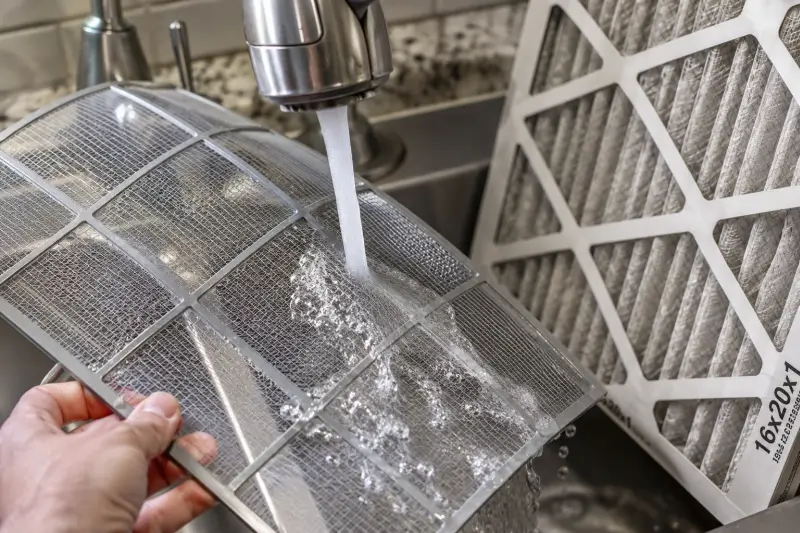
Every mini split indoor head contains a washable mesh pre-filter that should be cleaned every two to four weeks, and every two weeks during heavy use. The mesh is reusable and usually lasts the life of the unit. Some models add secondary inserts, described by their manufacturers as carbon or anti-allergen, which are replaced rather than washed. See how to clean a mini split filter for the ten-minute version.
Filterbuy has manufactured replacement filters for every major mini split brand for more than a decade, across four U.S. factories, and that work taught us a distinction most maintenance advice skips: the mesh pre-filter is a comfort filter, not a health filter. It is engineered to keep dust off the coil and protect airflow, not to capture the fine particles you breathe. Cleaning it protects efficiency and keeps the coil dry, but it does not do the job a pleated filter does in a ducted system. The U.S. Environmental Protection Agency recommends a filter rated MERV 13, or the highest rating your system can accommodate. Higher-MERV media adds airflow resistance, so check your blower and filter slot before upgrading, or ask your technician. Filterbuy makes MERV 13 pleated filters in over 600 sizes. Treat the mesh as the floor for your air quality, not the ceiling.
That gap matters more in Chicago than in most of the country. In the American Lung Association’s State of the Air 2026 report, the Chicago-Naperville metro ranked 15th worst in the nation for ozone pollution and 13th worst for year-round particle pollution, with failing grades in Cook County for both.
Manuals give one number: clean every two weeks. But what a Chicago filter faces in July is not what it faces in January, so Filterbuy mapped the schedule to the city’s pollution seasons instead.
• March to May: every 2 weeks. Tree and grass pollen, plus construction dust.
• June to September: every 2 weeks, weekly during smoke. Ozone, urban PM2.5 and drifting wildfire smoke.
• October to November: every 3 to 4 weeks. Decaying leaf debris and first-startup dust from the heating side.
• December to February: every 3 to 4 weeks. Closed-house dander, dust and cooking particulate.
If you run a mini split in one room and a furnace elsewhere, the furnace filter does the heavy lifting for the rest of the house. Change it every 90 days, more often with pets or in smoke season. Each head has its own filter, so three rooms means three.
A professional mini split tune-up costs $150 to $350, and Chicago’s climate justifies two visits a year: one before cooling season, one before the first hard freeze. That visit covers the coil and blower wheel, refrigerant charge, electrical connections and the condensate drain. The Filterbuy guide to how often to service a mini split splits the year into homeowner and pro tasks.
The most common ductless service call is the most preventable: a clogged mesh filter freezes the coil, and the melt overwhelms the drain pan. Coils and drain line need attention too, which is why cleaning a mini split means more than rinsing the filter.
What actually brings a Chicago technician out, roughly in order of frequency:
• Water running down the wall. Almost always a clogged condensate drain line, not a leak in the unit.
• Weak or no cooling. Usually a dirty filter or coil. Sometimes low refrigerant, which means a leak worth finding rather than topping off.
• Musty smell. Usually traced to a damp coil or standing water in the drain pan, the classic result of cleaning the filter and skipping everything behind it.
• Ice on the outdoor unit in winter. Normal defrost cycling looks alarming and usually is not. Persistent ice buildup is not normal in Zone 5A and needs a look.
• The unit runs but the room never gets there. Frequently a sizing problem, which is a Manual J issue and not a repair.
Mini split maintenance is what prevents most of that list. If a system is past 10 to 12 years and needs repeated repairs, price a replacement against the repair before spending again.
“After walking thousands of homeowners through this, I can tell you the pattern almost never changes: people rinse the filter, skip the coils and drain line, then call us a month later about a musty smell. Cleaning a mini split isn’t hard. It’s just easy to do half of it and assume you’re done.”
Michelle Wan, Brand Manager and Air Quality Writer, Filterbuy
Three findings explain why Chicago mini splits are sized and filtered differently.
• Space heating is 53% of all energy use in Midwest homes.
• 27% of midwestern homes built before 1970 report poor or no insulation, versus 11% of newer homes.
• Pre-1950 homes burn 74.8 MMBtu for space heating; post-2010 homes burn 48.9.
• Midwest households use 34% more natural gas than the national average.
Why it matters: Chicago’s stock is old. A square-footage estimate understates the heating load. That is the case for Manual J.
Source: U.S. Energy Information Administration, 2020 RECS
• Chicago-Naperville ranks 13th worst of 211 metros for year-round particle pollution, with Cook County failing.
• 2,206,982 Illinois children live with unhealthy air.
Why it matters: Particle pollution is what a filter captures. Ozone is not. This ranking, not the ozone number, should drive your filter choice.
Source: American Lung Association, “State of the Air” 2026, Illinois
• Americans spend about 90% of their time indoors.
• Some pollutants run 2 to 5 times higher indoors than outdoors.
• Indoor levels have risen as buildings got more airtight without added ventilation.
Why it matters: A sealed Chicago house in January is that condition exactly. A mesh screen built to protect a coil is not air filtration.
Source: U.S. EPA, Report on the Environment: Indoor Air Quality
Yes, if the unit is cold-climate certified. ENERGY STAR Cold Climate models deliver at least 70% of their 47°F heating capacity at 5°F, and keep running below that.
A single-zone ductless AC installation costs $2,500 to $7,000 in 2026 before rebates, or roughly $1,500 to $6,000 after the ComEd ductless discount.
A straightforward single-zone install is usually a one-day job once the permit is issued. The permit is the variable: single-space Express Permits are typically issued in one to two business days, while condo association approval can add weeks.
Expect 15 to 20 years with regular maintenance. Past 10 to 12 years, weigh the cost of repeated repairs against replacement.
Every two to four weeks, and every two weeks during heavy use. That is roughly six times more often than a furnace filter, which is swapped about every 90 days.
Chicago’s 2022 Cooling Ordinance requires permanent air conditioning in indoor common areas of buildings over 80 feet tall, buildings with 100+ units, and housing for older persons. Ductless mini splits qualify; 120-volt plug-in units do not.
Michelle Wan is Brand Manager and Air Quality Writer at Filterbuy and fronts much of the brand’s educational video content. She earned her B.A. from the University of California, Santa Cruz, and works directly with Filterbuy’s U.S. manufacturing teams in Alabama, Florida, Pennsylvania and Utah, so she writes from how filters are built and used, not from spec sheets.
Technically reviewed by David Clark, a Licensed HVAC Technician with Filterbuy HVAC Solutions, who reviews Filterbuy’s maintenance and system-compatibility guidance for accuracy.
Disclosure: Filterbuy manufactures air filters and sells ductless mini split systems, and our reviewer is affiliated with Filterbuy HVAC Solutions. Cost, rebate and code figures here are sourced to the independent authorities below.
All statistics above link to their primary source. Additional references: Chicago DOB, 2022 Cooling Ordinance · ComEd Heating & Cooling Discounts · ENERGY STAR Ductless · ENERGY STAR ASHP v6.2 · IRS FS-2025-05 · ASHRAE Fundamentals 2021 · NOAA NCEI · Angi Chicago, April 2026
Mini split (ductless mini split). A system connecting an outdoor compressor to indoor air handlers via refrigerant lines, no ductwork.
Manual J. The ACCA-standard room-by-room load calculation used to size HVAC equipment.
Cold-climate heat pump (CCHP). A heat pump certified to hold most of its heating capacity at low outdoor temperatures.
Mesh pre-filter. The washable screen inside a mini split indoor head. It protects the coil and airflow, not your lungs.
MERV. Minimum Efficiency Reporting Value, the 1 to 16 scale for a pleated filter’s particle capture. The EPA recommends MERV 13 or the highest rating a system can accommodate; higher MERV adds airflow resistance.