Mini Splits for Rental Properties: A Landlord's Guide to Installation and ROI
Mini Splits For Rental Properties: What They Cost And Whether They Pay Off
A ductless mini split costs $2,000 to $7,000 per zone installed, and in a rental it adds year-round heating and cooling to rooms that have no ducts. The payoff does not come from a federal tax credit, because Section 25C never applied to owners who do not live in the home and it ended for equipment placed in service after December 31, 2025. The return sits in energy savings where you pay the utility, fewer window units, and lower turnover.
- Single zone, $2,000 to $6,000. Studio, one bedroom, attic or basement unit.
- Two to three zones, $4,000 to $11,000. Two-bedroom apartment or small single-family.
- Four to five zones, $7,500 to $14,500. Whole-house rental or small multifamily.
Not sure how many zones the property needs? The quick match below sizes it for you.

Answer a few quick questions and we will match your rental to a mini split size.
Already know the size you need? Shop Filterbuy mini split systems.
TL;DR
A ductless mini split costs $2,000 to $7,000 per zone installed, and for a rental with no ductwork it is often the best cooling upgrade available. But the federal tax credit landlords keep reading about never applied to them, and it ended for equipment placed in service after December 31, 2025. The return comes from energy savings, fewer window units, and lower turnover.
Key Takeaways
A single-zone mini split costs $2,000 to $6,000 installed, averaging $3,000 to $4,000.
Landlords never qualified for the 25C tax credit. The IRS states you cannot claim it if you own the property but do not live in it, and it ended after December 31, 2025.
Mini split HVAC in a residential rental depreciates over 27.5 years, straight-line. IRS Publication 527 treats it as a capitalized improvement, so neither Section 179 nor bonus depreciation applies.
The mesh screen in a mini split is a coil guard, not an air filter. The EPA states it does not remove fine particles.
Budget $250 to $495 per head for professional deep cleaning every 12 to 24 months. Most landlord ROI models leave that out.
What Does It Cost To Install A Mini Split In A Rental Property?
Installed pricing runs $2,000 to $7,000 per zone in 2026. A single zone for a studio or one bedroom averages $3,000 to $4,000, and multi-zone systems land between $4,000 and $14,500.
Labor is the line item landlords most often underestimate, running 30 to 50 percent of the total at $75 to $150 per hour. New A2L refrigerants add another 10 to 15 percent versus the R-410A units you priced a few years ago.
Installed Cost By Configuration
2026 national averages; permits add $100–$400.
Panel upgrades are quoted separately. Professional installation is the norm, and self-installing typically voids the manufacturer warranty. For a full breakdown, see our guides to mini split installation cost and mini split cost.
Do Landlords Get A Tax Credit For Installing A Mini Split?
No. Section 25C, the Energy Efficient Home Improvement Credit, was never available to owners who do not live in the home, as the IRS states plainly, and Congress terminated it altogether for property placed in service after December 31, 2025. Here is what applies instead.
What Landlords Read Vs. What The Code Allows
Filterbuy is a filter manufacturer, not a tax advisor. Confirm your facts with a licensed tax professional.
The $2,000 heat pump credit is the most repeated wrong answer in landlord content right now. It never applied to a property you do not live in, and after December 2025 it applies to no one. If you are modeling this upgrade, the money is in the utility bill and the turnover, not the tax return.
— Michelle Wan, Brand Manager and Air Quality Writer, Filterbuy
IRS Publication 527 lists heating and air conditioning among the improvements that must be capitalized, though two things still help. Its routine maintenance safe harbor generally makes ongoing service currently deductible, and a partial disposition election can write off the remaining basis of the old system. Raise both with your CPA.
Is A Mini Split Worth It For A Rental Property?
Often, but not for the reason most landlords expect. Depreciating a $3,500 single-zone install over 27.5 years produces an annual deduction of about $127, worth roughly $31 a year at a 24% marginal rate. The return sits in four other places.
1. Energy savings, if you pay the utility. ENERGY STAR-certified mini splits use up to 60% less energy than standard electric resistance heat, so in a baseboard building where heat sits on your bill, this is the largest lever available. Where tenants pay their own utilities, the savings go to them instead.
2. Fewer window units. At $150 to $400 apiece, replaced every five to eight years and carrying labor at each install and removal, window units accumulate cost quietly. A mini split lasts 15 to 20 years.
3. Turnover. Year-round zoned heating and cooling is a genuine listing differentiator in older stock with no central air.
4. Scarcity. The EIA's Residential Energy Consumption Survey found air conditioning in 90% of single-family detached homes but only 80% of two-to-four-unit buildings, and households without it skew toward renters. Small multifamily is where cooling is scarcest and ductwork usually absent.
What Tenants Actually Gain
Tenants get room-by-room control, quiet operation, and a window they can open. Each head carries its own thermostat, so a tenant conditions only the room they occupy, which lowers their bill when they pay the utility and cuts complaint calls when you do.
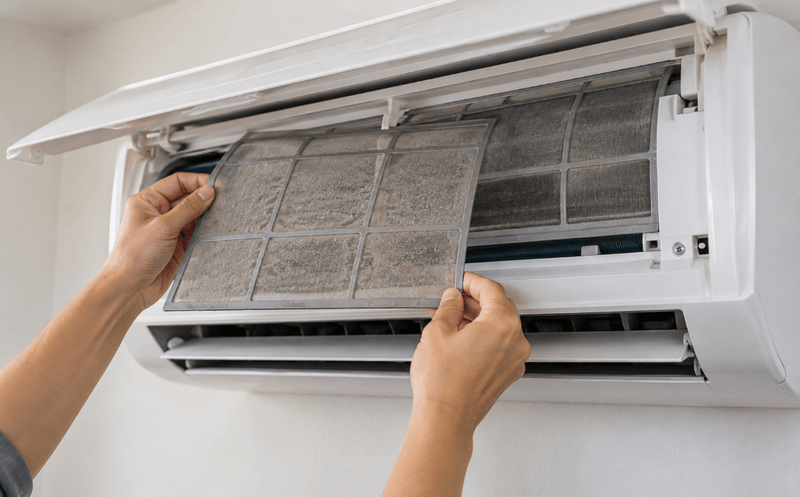
One benefit tenants assume they get and do not is clean air. The screen behind the panel is a coil guard, not a filter, and the U.S. Environmental Protection Agency states that ductless mini splits generally do not remove fine particles, treating only the room where they are mounted and only while the system runs. Our guide to mini splits and indoor air quality covers what that means room by room. That gap is where the maintenance obligation lives.
The Maintenance Problem Nobody Budgets For
A mini split wants its mesh rinsed every two to four weeks, against one to three months for a central filter, and tenants rarely keep that cadence. A clogged mesh then does real damage, because restricted airflow keeps the coil wet longer, growing mold on blower wheels and producing the musty "dirty sock" smell that becomes a service call. Filterbuy has manufactured air filters in the United States since 2013, and one pattern holds across every system we supply: the rating matters far less than whether anyone changes it.
Maintenance Responsibilities And Costs
In-place coil and blower-wheel service, per indoor head. Costs vary by market.
Three habits make this work. Write filter cleaning into the lease with the frequency stated, mount the heads where a tenant can reach the panel, and schedule deep cleans at turnover. Our guide to cleaning a mini split filter fits a welcome packet.
Filter Replacement Protocol For Landlords
The mini split mesh is washable and lasts the life of the unit, but everything else in the air path needs replacing on a schedule.
Filterbuy’s house rule for rentals: the rinse belongs to the tenant, the schedule belongs to you. That split appears in no federal guidance. It is our own position, drawn from a decade of watching which filters actually get changed, which are the ones that arrive at the door.
If the property also has central HVAC or ducted zones, that return-air filter carries the whole-home load and changes every one to three months. The EPA recommends at least MERV 13, or the highest rating the system fan and filter slot can accommodate.
Specialized inserts, deodorizing or anti-allergen, are replaced rather than washed, every three to six months.
Ship filters to the property address, not yours. Auto-delivery puts the right size in the tenant’s hands and removes the usual excuse for a filter going unchanged.
Older rental stock teaches one lesson quickly: pre-1980 filter slots rarely match a catalog size. Filterbuy cuts MERV 8, 11 and 13 in 600+ standard sizes plus custom air filters for the sizes nothing off the shelf fits. See also do mini splits have filters?
When A Mini Split Is The Wrong Call For A Rental
The upgrade does not always pencil out. Where a property has sound ductwork and a working air handler, replacing equipment that works rarely earns its cost back. The same holds if you are selling within two to three years, if tenants pay all utilities in a market that does not price cooling into rent, or on a seasonal short-term rental, since you carry the cost and someone else collects the benefit.
Supporting Statistics
Each verified with the issuing agency on September 7, 2026.
Sources, verified September 7, 2026: energystar.gov/saveathome/heating-cooling/maintenance-checklist · eia.gov/tools/faqs/faq.php?id=1174 · cdc.gov/climate-health/media/pdfs/332952-A_FS_HeatHealth-508.pdf
Frequently Asked Questions
Glossary
Ductless mini split. One outdoor compressor paired with one or more indoor heads, conditioning rooms without ductwork.
MERV. Minimum Efficiency Reporting Value, the 1–16 scale for particle capture. The EPA recommends MERV 13, or the highest rating your system can accommodate.
Mesh pre-filter. The washable screen behind a mini split's front panel, which protects the coil and is not rated for fine-particle capture.
Blower wheel. The cylindrical fan inside a mini split head, where dust and moisture collect and musty odors start.
MACRS. The IRS depreciation framework, under which rental property and its structural components depreciate over 27.5 years.
Section 25C. The Energy Efficient Home Improvement Credit. Excluded non-resident owners; ended after December 31, 2025.
Filterbuy. A family-owned American air filter manufacturer, building in the U.S. since 2013 and the publisher of this guide.
Author And Review
Michelle Wan is Brand Manager and Air Quality Writer at Filterbuy, where she translates MERV ratings, filtration, and HVAC efficiency into plain-English guidance for homeowners. She works directly with Filterbuy’s U.S. manufacturing team, so her writing is grounded in how filters are built, tested, and used in real homes rather than in spec sheets. She holds a B.A. in Sociology from the University of California, Santa Cruz. She also appears in Filterbuy’s educational videos and social content.
Reviewed for technical accuracy by David Clark, Licensed HVAC Technician. Published September 9, 2026
About Filterbuy. Filterbuy is a family-owned American manufacturer that has built air filters in the United States since 2013, from factories in Alabama, Florida, Pennsylvania, and Utah. Its catalog runs to 600+ standard sizes plus custom dimensions, pleated in Talladega, Alabama, and shipped factory-direct.
This guide covers general federal tax treatment and is not tax advice. Rules vary by entity and state. Consult a licensed tax professional.
Sources
U.S. EPA, Do ductless mini-split heat pumps filter fine particles out of indoor air?
IRS, Energy Efficient Home Improvement Credit (25C eligibility and termination)
IRS Publication 527, Residential Rental Property (depreciation, improvements, safe harbors)
ENERGY STAR, Maintenance Checklist (airflow and system efficiency)
U.S. Energy Information Administration, How much electricity is used for air conditioning?
U.S. Centers for Disease Control and Prevention, Heat & Health Tracker fact sheet