Mini Split AC in San Diego, CA
Installation, Costs & Filter Guide (CA Climate)
Author: Michelle Wan | Reviewed by: David Clark, Licensed HVAC Technician Published: September 1, 2026 · Updated: September 1, 2026
A single-zone ductless mini split in San Diego costs roughly $3,500 to $7,500 installed in 2026. The right size depends on where in the county you live, not just how big the room is. A coastal room often does fine on 12,000 BTU, while the same room inland needs 18,000 BTU because of afternoon sun on west-facing walls. San Diego spans two California climate zones, and the energy code treats the inland half like Riverside.
Filterbuy sells single-zone systems in three sizes:
- 12,000 BTU covers up to 550 sq ft. Bedrooms, studios, small living rooms.
- 18,000 BTU covers up to 850 sq ft. Large living rooms and open plans.
- 24,000 BTU covers up to 1,200 sq ft. Large open areas and combined spaces.
All three are single zone, 17 SEER2, R-32, ETL and AHRI certified, with free 2-day delivery on in-stock systems and a 7-year compressor warranty. Professional installation is required, and the warranty is void if self-installed. For multi-zone, look to other brands. See all mini split systems

Not sure which size fits your room? Answer a few quick questions and we will match you to the right system.
TL;DR
A ductless mini split in San Diego costs roughly $3,500 to $7,500 installed for a single zone and $8,000 to $18,000 or more for a multi-zone system in 2026. The federal 25C tax credit no longer applies, and the main state rebate has been fully reserved since January. The mesh screen inside the indoor head is a coil guard, not an air filter. It will not capture the fine particles that pushed San Diego to 5th worst in the nation for year-round particle pollution.
Key Takeaways
Single-zone ductless mini split installation in San Diego runs about $3,500 to $7,500 in 2026, with multi-zone systems from roughly $8,000 to $18,000 or more depending on head count.
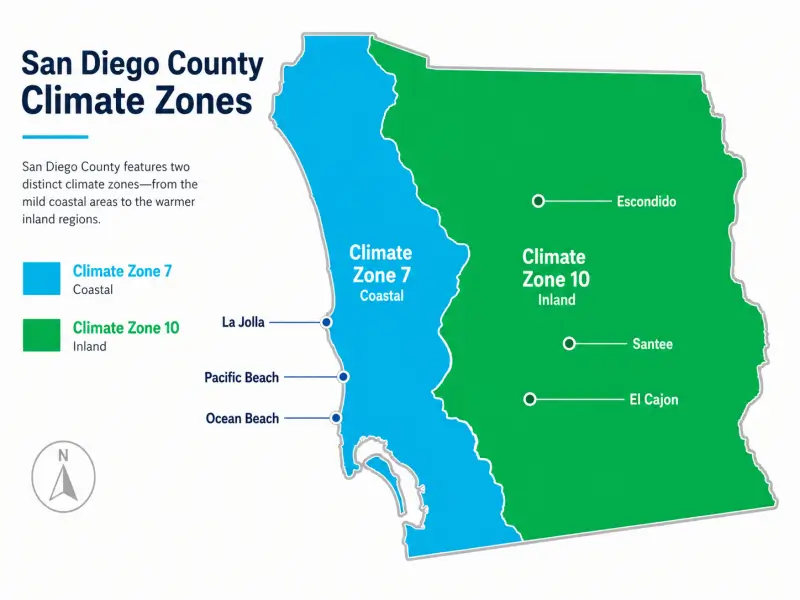
San Diego County straddles California Energy Commission climate zones 7 and 10, so a coastal La Jolla home and an inland Santee home need different sizing and coil protection.
The washable mesh filter in a mini split head carries no MERV rating. It stops hair and dust from coating the coil. It does not capture PM2.5.
Mini splits recirculate room air. No outdoor air comes in. That helps during a smoke event and does nothing for filtration.
Why Trust Filterbuy on Mini Split Filters?
Filterbuy manufactures air filters in the USA. Separately, we sell single-zone ductless mini split systems, which are not U.S.-manufactured.
That's a conflict worth naming up front: we make money on both sides of this page. So when we tell you the filter inside a mini split isn't doing what homeowners assume, and that we deliberately don't sell a replacement, read it as the exception it is.
What Does a Mini Split Cost in San Diego in 2026?
A single-zone ductless mini split in San Diego costs roughly $3,500 to $7,500 installed in 2026. Two- and three-zone systems land between $8,000 and $16,000; four or more heads run $13,000 to $18,000 and up, including labor and permits.
How Do You Size a Mini Split for San Diego's Microclimates?
Many coastal homeowners want cooling only for the handful of Santa Ana days each year, so a single zone in the room you actually use is often right-sized. Filterbuy's ductless mini split systems are single-zone, 12,000 to 24,000 BTU, at published prices with free 2-day delivery on in-stock systems. For multi-zone, look to other brands.
Professional installation is required on our units, and the warranty is void if self-installed. Get three written bids from contractors holding an active C-20 HVAC license, each pricing the same head count, coil coating, and electrical scope.
Which Mini Split Rebates Still Apply in San Diego?
The incentive picture changed sharply between 2025 and 2026, and most cost guides have not caught up. Per the IRS, the Section 25C credit, worth up to $2,000 for heat pumps, applies only to property placed in service before December 31, 2025. It does not apply to a 2026 install. Confirm your own eligibility with a tax professional.
The state side closed earlier than most homeowners realize. TECH Clean California stopped taking new single-family reservations on November 14, 2025, and per its incentives status page, HEEHRA rebates for Southern California have been fully reserved since January 7, 2026. New requests go to a waitlist, and a project only qualifies if the heat pump is installed after approval. Don't let a contractor price a rebate into a bid without an approved reservation.
So a mini split here has to earn its keep on the energy math. SDG&E's April 2026 rate change alert put the bundled residential average at 46.4 cents per kilowatt-hour, up from 45.7. One nuance in SDG&E's favor: the same filing expanded the super-off-peak window, so when you run the system matters as much as how long. The Filterbuy SEER2 rating chart explains how to read the efficiency label on a bid.
Ask Which Refrigerant the System Uses
A mini split quoted in San Diego today may still be an R-410A unit, the refrigerant being phased out, and that is entirely legal. Manufacturing of new R-410A residential systems stopped January 1, 2025. But an EPA final rule effective July 27, 2026 removed the installation deadline, so contractors can keep installing pre-2025 inventory until it runs out.
A quiet trap for buyers this year:
R-410A production steps down to 15% of current output by 2036; recharge cost rises with it.
An R-410A system cannot be converted later. The components are built differently.
New equipment uses R-454B or R-32, both well under the 700 GWP limit.
Ask one question before you sign: "Is this unit R-410A, or A2L?" A discount on old stock is a fair trade if you're moving in eight years, worse if you're staying twenty. Either way, know which you're buying. Filterbuy's own mini splits use R-32.
How do you size a mini split for San Diego's microclimates?
San Diego is not one climate, and sizing a mini split as though it were is the most common local mistake. The county straddles two California Energy Commission building climate zones: zone 7, represented by San Diego–Lindbergh, and inland zone 10, represented by Riverside. The energy code treats inland San Diego as Riverside-like.
Coastal rooms often do fine with a 9,000 or 12,000 BTU head; comparable inland rooms need 12,000 to 18,000 BTU because of afternoon solar gain through west-facing walls. A contractor who quotes capacity off square footage alone, without asking about orientation, insulation, and windows, is guessing.
Oversizing hurts more here than in hot climates. An oversized unit short-cycles, never runs long enough to pull moisture from marine-layer air, and leaves a clammy room.
What Permits Does a Mini Split Installation Need in San Diego?
A mini split installation in San Diego requires a mechanical permit, and almost always a separate electrical permit. A C-20 contractor files the mechanical; a C-10 electrician the electrical. This is new equipment, not a repair, so there's no exemption.
With no ducts, HERS duct leakage verification doesn't apply. Refrigerant charge and airflow verification still does. Unpermitted work surfaces at resale and voids warranties.
Does a Mini Split Filter Wildfire Smoke and San Diego Allergens?
No. The washable mesh screen behind the front panel of a mini split head is a coil guard, not an air filter. It carries no MERV rating. It catches pet hair, lint, and dust so they don't coat the evaporator coil and choke capacity. PM2.5, the fine fraction of wildfire smoke, passes straight through.
Manufacturers say so themselves. MRCOOL, a ductless system maker Filterbuy is not affiliated with or endorsed by, states in its own support guidance that its mini splits are not designed to purify or filter hazardous air, including wildfire smoke. Filterbuy does not make a replacement filter for a ductless mesh screen, because that screen isn't doing the job people assume it is.
"A decade of building filters taught us one distinction that saves people money: the mesh screen in a ductless head is a comfort filter, not a health filter. It protects the coil, not the air in the room. Clean the one you have, and put the money toward the filter that does the work."
Michelle Wan.
This matters more here than it did a year ago. The American Lung Association's State of the Air 2026 report ranked the San Diego–Chula Vista–Carlsbad metro tied for 5th worst in the nation for year-round particle pollution, up from 59th, and 7th worst for ozone. Part of that jump reflects new monitors near the border crossings rather than a sudden change in the air. The readings are real either way.
So what actually cleans the air in a room with a mini split?
If your home also has central HVAC, that system does the heavy lifting. EPA guidance for smoke events recommends MERV 13 or higher, and notes most systems accommodate it if the filter is changed often. Confirm your system can handle the added resistance first. Filterbuy makes MERV 13 filters; the MERV 13 vs. HEPA guide covers the tradeoffs.
In a room served only by a mini split, a portable HEPA air cleaner is the practical route. EPA advises a tobacco-smoke Clean Air Delivery Rate at least two-thirds of the room's square footage, so a 120-square-foot bedroom needs a CADR near 80. Compare both in mini split vs. air purifier.
Skip add-ons that promise more than they deliver. Ionizer, plasma, and UV modules sold as mini split upgrades can emit ozone. Check the CARB certified air cleaner list.
The Filterbuy live San Diego AQI map shows real-time readings countywide.
A San Diego Maintenance Calendar for Your Mini Split
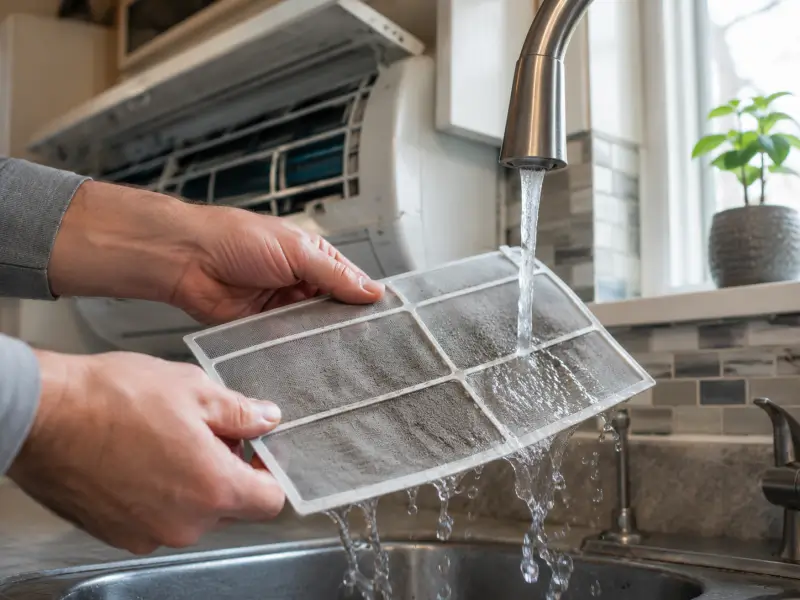
Rinse the mesh filters every two to four weeks during heavy use, and more often during a smoke event or Santa Ana episode. Power down, slide them out, vacuum, rinse in lukewarm water, and let them dry completely before they go back in.
Then tie the rest to San Diego's calendar:
Spring: pollen. Check filters every two weeks; rinse the outdoor coil.
Summer: peak ozone. Confirm the condensate drain is clear.
Fall: wildfire and Santa Ana season. Inspect after every smoke event.
Winter: book annual service; rinse salt off a coastal condenser.
Full walkthrough by brand: how to clean mini split filters. If you also run central HVAC, Filterbuy auto-delivery sends a fresh filter on schedule.
Supporting Statistics
Three federal datasets sit behind the guidance above.
1. Only 49% of homes in the Pacific Coast marine climate region use air conditioning.
Nationally, 88% of U.S. households use AC.
Among marine-climate homes built before 1950, just 39% do.
Why it matters: coastal San Diego's pre-war stock was built for ocean breezes, not equipment. A ductless retrofit beats inventing a duct system.
Source: U.S. Energy Information Administration, 2020 Residential Energy Consumption Survey
2. Duct losses can account for more than 30% of a home's energy use for space conditioning.
That is energy you pay for and never receive.
At SDG&E's 46.4-cent rate, it's the costliest flaw a San Diego system can carry.
Why it matters: a ductless head sits inside the room it conditions, so the loss disappears by design.
Source: ENERGY STAR (U.S. EPA), Certified Mini Split Heat Pumps
3. Indoor concentrations of some pollutants run 2 to 5 times higher than typical outdoor levels.
Americans spend roughly 90% of their time indoors.
Why it matters: closing the windows and running the mini split does not clean the air. The unit recirculates what's already in the room.
Comfort equipment and filtration equipment are two different purchases.
Source: U.S. EPA, Report on the Environment: Indoor Air Quality
Frequently Asked Questions
Is a mini split cheaper than central air in San Diego?
For a home with no ductwork, usually yes. Retrofitting ducts into an older bungalow costs more than the mini split itself. For a post-1980 home with good ducts, a central heat pump is comparable.
Do mini splits bring in fresh outdoor air?
No. Mini splits recirculate room air. Outdoor air exchange needs ventilation or an open window.
Can I put a MERV 13 filter in my mini split?
No. Mini split blowers cannot overcome the airflow resistance of thick pleated media without starving the system. Factory screen for the coil, portable HEPA for the air.
Glossary
Ductless mini split: An outdoor compressor connected by refrigerant lines to wall-mounted indoor heads, no ductwork.
A2L refrigerants: The lower-GWP class replacing R-410A, chiefly R-454B and R-32.
GWP (Global Warming Potential): A refrigerant's heat-trapping strength relative to carbon dioxide. New residential systems must sit under 700.
HEEHRA: California's federally funded Home Electrification and Appliance Rebates program, run through TECH Clean California.
Mesh pre-filter: The washable screen behind a mini split head's front panel. It protects the evaporator coil from hair and dust, and is not MERV-rated.
MERV: Minimum Efficiency Reporting Value, the 1-to-16 scale for how well a filter captures particles. MERV 8 catches dust and pollen; MERV 13 catches smoke.
PM2.5: Fine particulate matter 2.5 microns or smaller, including wildfire smoke, fine enough to pass through a coarse screen and stay suspended indoors.
CADR: Clean Air Delivery Rate, used to size a portable air cleaner.
SEER2 / HSPF2: Current U.S. efficiency ratings for cooling and heating.
Heat pump: A system that moves heat both directions. Every ductless mini split sold today is one.
CEC climate zone: One of 16 California Energy Commission zones for energy code compliance. San Diego spans zones 7 and 10.
HERS verification: Third-party testing required under Title 24 to verify refrigerant charge and airflow.
C-20 contractor: The California license class for HVAC contractors.
Marine layer: Cool, moist air pushing inland along the coast, common May to August.
Santa Ana winds: Hot, dry offshore winds raising coastal temperatures and fire risk, September to November.