Mini Split AC in Sacramento, CA: Installation, Costs & Filter Guide (CA Climate)
By Michelle Wan, Brand Manager and Air Quality Writer, Filterbuy | Reviewed by David Clark, Licensed HVAC Technician
Published September 8, 2026 | Updated September 8, 2026
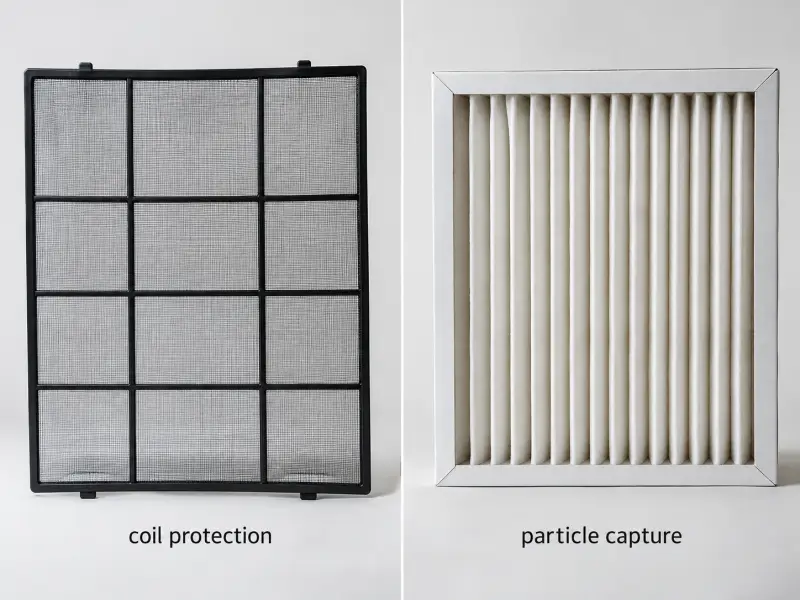
A single-zone mini split installation in Sacramento runs about $4,500 to $7,500, and a three-to-four-zone system runs about $9,000 to $14,000. The mesh screen inside the indoor head carries no MERV rating. It is there to keep dust off the coil, so particle filtration happens at your central system return instead.
What each part actually does:
- Mesh pre-filter: washable, protects the evaporator coil, no MERV rating
- MERV 8: larger debris, dust, and dust mites
- MERV 11: finer particles like pet dander and mold spores
- MERV 13: microscopic particles

Not sure what size or rating your system takes? Answer a few quick questions and we will match you to the right filter.
TL;DR
Mini split installation in Sacramento runs roughly $4,500 to $7,500 for a single-zone system and $9,000 to $14,000 for three to four zones in 2026. Sacramento sits in California Climate Zone 12, where triple-digit summers and a long smoke season shape both sizing and filtration. SMUD pays up to $3,000, but only for a gas-to-electric conversion. A mini split cools a room efficiently. The washable mesh screen inside it is not a smoke filter.
Key Takeaways
Electrical capacity is the variable that moves a Sacramento quote most. Homes still on 100-amp panels should expect $500 to $2,000 in added subpanel or circuit work.
SMUD pays up to $3,000 for a heat pump HVAC conversion, but only when it replaces gas heat. Adding a mini split alongside an existing furnace, which is the most common Sacramento project, usually qualifies for nothing.
Federal Section 25C and 25D tax credits ended December 31, 2025, so no federal credit applies to a Sacramento mini split installed in 2026.
The mesh screen inside a mini split indoor head is a coil guard, not a health filter, and the EPA recommends a portable air cleaner for rooms conditioned only by ductless equipment.
Sacramento averages 22 days a year at or above 100 degrees and five at or above 105, per National Weather Service normals, and that peak is what a mini split must be sized against.
How Much Does A Mini Split Cost In Sacramento In 2026?
Mini split installation in Sacramento costs about $4,500 to $7,500 for a single-zone system and $9,000 to $14,000 for a three-to-four-zone system in 2026, according to pricing published by Sacramento-area contractors. Whole-home multi-zone projects in larger or older houses can reach $22,000. Electrical capacity and line-set routing are the two variables that move a Sacramento quote the most.
Zone count drives the base price. One head on one outdoor condenser is the least expensive way into ductless cooling, which is why the format suits sunrooms, converted garages, and accessory dwelling units. Every additional head adds labor, line set, and electrical work.
Electrical work is the quiet line item. Most mini splits need a dedicated 240-volt circuit and a disconnect at the outdoor unit. Sacramento neighborhoods built between the 1950s and the 1980s, including much of Land Park, Tahoe Park, and East Sacramento, commonly still run 100-amp service panels. If the panel is full or sits on the opposite side of the house from the install, expect a subpanel or a long circuit run to add $500 to $2,000.
Permits are not optional and they are not expensive. Sacramento County and surrounding cities require a permit for mini split installation, with fees generally in the $150 to $400 range. A contractor willing to skip it is creating a problem that surfaces at resale.
For a statewide view of pricing and program availability, see the Filterbuy guide to California mini split costs and rebates.
What Size Mini Split Does A Sacramento Home Need?
Sacramento sits in California Climate Zone 12, the Sacramento Valley zone defined by hot dry summers and cool damp winters. National Weather Service normals put the city at 22 days a year at or above 100 degrees and five at or above 105, against an all-time downtown high of 114 degrees. Size a ductless system against those days, not the seasonal average. The average is not when a system fails you.
Capacity rules of thumb travel badly into Zone 12. A 9,000 BTU head that comfortably covers 400 square feet in a mild coastal zone will struggle in a west-facing Sacramento bedroom with single-pane windows and R-11 wall insulation, typical of the region's mid-century housing stock. Rooms with heavy afternoon sun, vaulted ceilings, or western glass need the next capacity step up.
Oversizing carries its own penalty and is the more common mistake. An oversized mini split reaches setpoint fast, shuts down, and repeats, which is called short cycling. Short cycling wastes electricity, wears the compressor, and leaves the room feeling clammy because the coil never runs long enough to pull moisture out of the air. Sacramento's dry summer heat masks this problem until a humid monsoonal stretch arrives in late summer.
One Sacramento-specific savings note before the sizing math. A mini split is a heat pump, and heat pump buyers are routinely steered toward cold-climate models rated for sub-zero operation. Sacramento does not need one. NWS normals put the city at fewer than five nights a year at or below freezing, against an all-time low of 17 degrees. A standard variable-speed system covers Zone 12 winters without difficulty. Cold-climate hardware is money that belongs in the Sierra foothills, not on the valley floor.
The reliable answer is a room-by-room load calculation, called a Manual J, performed at your address. Any Sacramento contractor quoting capacity from square footage alone over the phone is guessing. For accessory dwelling units under 800 square feet, which Sacramento permits in volume, a 12,000 to 18,000 BTU single-zone system usually fits the load. As a reference point, the Filterbuy ductless line is rated at 17 SEER2 with reliable heating down to 5 degrees, and covers up to 550 square feet at 12,000 BTU, 850 at 18,000, and 1,200 at 24,000. These are single-zone systems, so a multi-zone project means a different brand. Professional installation is required, and the warranty is void if the unit is self-installed.
What Rebates Are Still Available For Sacramento Mini Splits In 2026?
SMUD pays up to $3,000 for a gas-to-electric heat pump HVAC conversion and $1,000 for an electric-to-electric heat pump upgrade as of 2026. Mini splits are heat pumps, so they generally qualify when installed as a primary heat source. Federal Section 25C and 25D tax credits expired December 31, 2025, and state incentive funding has run out, which makes SMUD the practical starting point for Sacramento homeowners.
SMUD raised these rebate levels in February 2026 and said plainly why. The utility announced the increase to help customers electrify while offsetting the recent expiration of federal tax credits and state incentive programs. SMUD reports that more than 23,000 gas-fired space and water heating systems have already been replaced with high-efficiency electric heat pumps through its Advanced Home Solutions program.
Here is the part that catches most Sacramento buyers. SMUD's largest rebate requires a gas-to-electric conversion, which means the mini split becomes the home's primary heat and the gas furnace comes out. Adding a ductless head to a bonus room or an ADU while the furnace stays put is the far more common project, and it does not qualify for the $3,000. Often it qualifies for nothing. Budget the installation at full price and treat any rebate as recovered cost afterward, not as a discount you have already spent. These rebates also apply to SMUD electric customers only, so homes in PG&E territory around Roseville, Rocklin, and Davis sit outside the program entirely.
Any contractor or article presenting the federal heat pump tax credit as available in 2026 is working from outdated information. Public Law 119-21, signed July 4, 2025, terminated those credits for property placed in service after December 31, 2025. Confirm your own eligibility with a tax professional.
Why A Mini Split Alone Will Not Clear Wildfire Smoke From Your Home
A mini split does not filter wildfire smoke. The screen behind the front panel of a ductless indoor head is a washable mesh pre-filter designed to keep dust and lint off the evaporator coil, and it carries no MERV rating. The EPA recommends a MERV 13 or higher filter during smoke events, and specifically recommends a portable air cleaner for rooms conditioned by ductless mini splits, where a high-efficiency HVAC filter is not available.
The distinction matters more in Sacramento than almost anywhere else in the country. The valley catches smoke from fires across the Sierra Nevada, the Coast Range, and the northern Sacramento Valley, and summer inversions hold it in place. The Sacramento Metropolitan Air Quality Management District tracks these episodes through the regional Spare The Air network, and the AirNow Fire and Smoke Map shows current conditions at monitor level.
Here is the practical layering that actually works in a Sacramento home during smoke season. If your house has central ducted heating and cooling in addition to the ductless heads, the central system's filter carries the whole-house particle load, and upgrading that filter is where a real improvement shows up. Filterbuy MERV 13 pleated filters capture 98% of airborne particles and are built in 600 sizes, including custom sizes for odd returns. Check your blower's airflow tolerance before stepping up a MERV level, because not every system is rated for higher-resistance media.
If a room is served only by a mini split with no ducted system behind it, the mesh screen will not close that gap and no amount of cleaning changes its rating. Follow the EPA guidance and add a portable air cleaner sized to the room. Run the fan continuously during smoke events rather than on auto, keep windows closed, and avoid indoor combustion sources.
Here is where this guide's incentives sit, because it should change how you read it. Filterbuy manufactures its pleated air filters in the United States. The ductless systems are a separate product line. Either way, it stocks no brand-specific mini split mesh panels at all. There is no mesh panel for us to sell you, which is precisely why the advice here is to wash the screen you already own rather than replace it. The honest summary is that a mini split solves the temperature problem and a filter solves the particle problem. They are two different jobs, and buying the first does not accomplish the second. The Filterbuy breakdown of mini split replacement filters covers which components in a ductless head are washable and which are replaceable.
How To Hire A Mini Split Installer In Sacramento
Verify three things before signing: an active California CSLB contractor license, a written room-by-room load calculation, and a permit pulled in your jurisdiction. A Sacramento mini split installation is a permitted, inspected job, and California's Title 24 energy code adds refrigerant charge verification and commissioning documentation on top of the standard electrical and mechanical inspection.
Ask what happens to the gas furnace. If the mini split is replacing gas heat, that is the configuration that unlocks the largest SMUD rebate, and it also changes the inspection path. If the mini split is supplementing an existing furnace, say so up front so nobody builds a rebate expectation into your quote that the project cannot support.
Collect at least three written quotes that itemize equipment model numbers, zone count and capacity per head, electrical scope, line-set length, permit fees, and startup commissioning. A single lump sum makes it impossible to tell whether the low bid skipped the panel work or the permit.
How To Maintain A Mini Split Through Sacramento Dust And Smoke Season
Wash the mesh filters every two weeks during heavy use, which in Sacramento means roughly May through October. Vacuum the loose dust first, wash in warm water with mild soap, and let the screens dry completely before reinstalling. Smoke and Central Valley agricultural dust load these screens faster than a typical climate does, so two weeks is a floor and not a ceiling.
Replacement cadence shifts in smoke season as well. A MERV 13 filter that comfortably lasts 90 days through a normal Sacramento spring can load up in 30 to 45 days during an active fire episode. Inspect it monthly through July, August, September and October rather than trusting the interval printed on the box.
Check whether your indoor head carries a secondary panel behind the mesh. Carbon, silver-ion, and photocatalytic filters are replaced on a schedule rather than washed, and soaking them destroys them. Beyond the filters, the annual items are the evaporator coil, the condensate drain line, and the outdoor condenser, where valley dust and cottonwood fluff restrict airflow.
Step-by-step instructions are in the Filterbuy guide to how to clean mini split filters, and the full seasonal routine is covered in our mini split maintenance guide.
Supporting Statistics
Three published figures behind the recommendations above. Each is federal or national nonprofit, and each is dated.
1. California Electricity Costs Roughly Double The National Average
California: 28.50 cents per kilowatt-hour. National: 14.48 cents. June 2026.
Every kilowatt-hour a right-sized inverter system avoids is worth about twice as much in Sacramento as it is nationally.
Correct sizing and variable-speed operation matter more here than equipment brand.
Source: U.S. Energy Information Administration, Electricity Monthly Update, June 2026 data.
2. Sacramento's Annual Particle Levels Improved. Its Spikes Did Not.
Sacramento-Roseville moved from a failing to a passing grade for year-round particle pollution and posted its lowest annual level on record.
The exposure problem here is episodic, not constant.
Filter upgrades and portable air cleaners earn their cost during smoke events, not year-round.
Source: American Lung Association, State of the Air 2026, released April 2026.
3. What Burns Changes What You Are Filtering
Lead in fine particulate matter rose roughly 110-fold during the January 2025 Los Angeles fires.
Urban fires consume painted surfaces, pipes, plastics, and vehicles.
The CDC notes those pollutants pose risks different from conventional wildfires.
A mesh screen carrying no efficiency rating is not a response to that.
Source: CDC Morbidity and Mortality Weekly Report, February 2025.
Frequently Asked Questions
Glossary
Mini split (ductless mini split): A heating and cooling system pairing one outdoor condenser with one or more wall-mounted indoor heads, connected by refrigerant lines instead of ductwork.
MERV: Minimum Efficiency Reporting Value, the ASHRAE 52.2 scale rating how effectively an air filter captures airborne particles. Higher numbers indicate greater capture efficiency.
Mesh pre-filter: The washable plastic-framed screen behind a mini split's front panel. The screen protects the evaporator coil from dust and lint and carries no MERV rating.
Climate Zone 12: The California Energy Commission building climate zone covering Sacramento and the surrounding valley, defined by hot dry summers and cool damp winters.
Manual J: The ACCA-standard room-by-room heating and cooling load calculation used to determine correct equipment capacity for a specific home.
Short cycling: A pattern where oversized equipment reaches setpoint quickly and shuts off repeatedly. It wastes electricity and shortens compressor life.
SMUD: The Sacramento Municipal Utility District, the community-owned electric utility serving Sacramento County.
AQI: Air Quality Index, the EPA scale reporting daily air pollution levels, including fine particle pollution from wildfire smoke.
PM2.5: Fine particulate matter 2.5 micrometers in diameter or smaller, the primary health-relevant component of wildfire smoke.
Title 24: California's building energy efficiency standards, which govern permitting, refrigerant charge verification, and commissioning documentation for HVAC installations.