
Tip: Ensure you buy the exact air filter size for your system. Certain brands have precise dimensions that only fit their specific models. See related filters
Actual Size: 19.56x22x5.25"
 Free Delivery
  Factory-Direct Low Prices, Made in the USA
 Hassle-Free Returns & Free Exchanges
RESIDENTIAL AND/OR COMMERCIAL USE
Change Every 3 Months
Tip: Ensure you buy the exact air filter size for your system. Certain brands have precise dimensions that only fit their specific models. See related filters
Actual Size: 19.56x22x5.25"
Free Delivery Factory-Direct Low Prices, Made in the USAHassle-Free Returns & Free ExchangesRESIDENTIAL AND/OR COMMERCIAL USE
Change Every 3 Months
Tip: Ensure you buy the exact air filter size for your system. Certain brands have precise dimensions that only fit their specific models. See related filters
Actual Size: 19.56x22x5.25"
Free Delivery Factory-Direct Low Prices, Made in the USAHassle-Free Returns & Free ExchangesRESIDENTIAL AND/OR COMMERCIAL USE
Change Every 3 Months
At Filterbuy, we don't cut corners—we craft high-quality air filters right here in the USA and ship them to your doorstep for free. No delays, no gimmicks—just clean air, made easy. With thousands of five-star reviews and filters built for real life & every HVAC system, it's no wonder why over 4 million families trust Filterbuy.

Proudly Made In The USA

Fast, Free Shipping on Every Order

Premium Materials That Go The Distance

85,000+ 5-Star Reviews From Happy Customers

Save Up to 70% Per Filter with Packs


Measure length × width × depth with a tape measure to find the actual size.

Round up each dimension to the nearest whole number to get the nominal size. Example: 19.56x22x5.25" in → 20X22X5 nominal.

Search by nominal size on our site for the best fit.


5″ filters give you maximum filtration with minimal maintenance — lasting up to 12 months while handling higher MERV ratings without restricting airflow.
Sizing note:

If the filter you buy doesn't fit, we'll send you a better size.
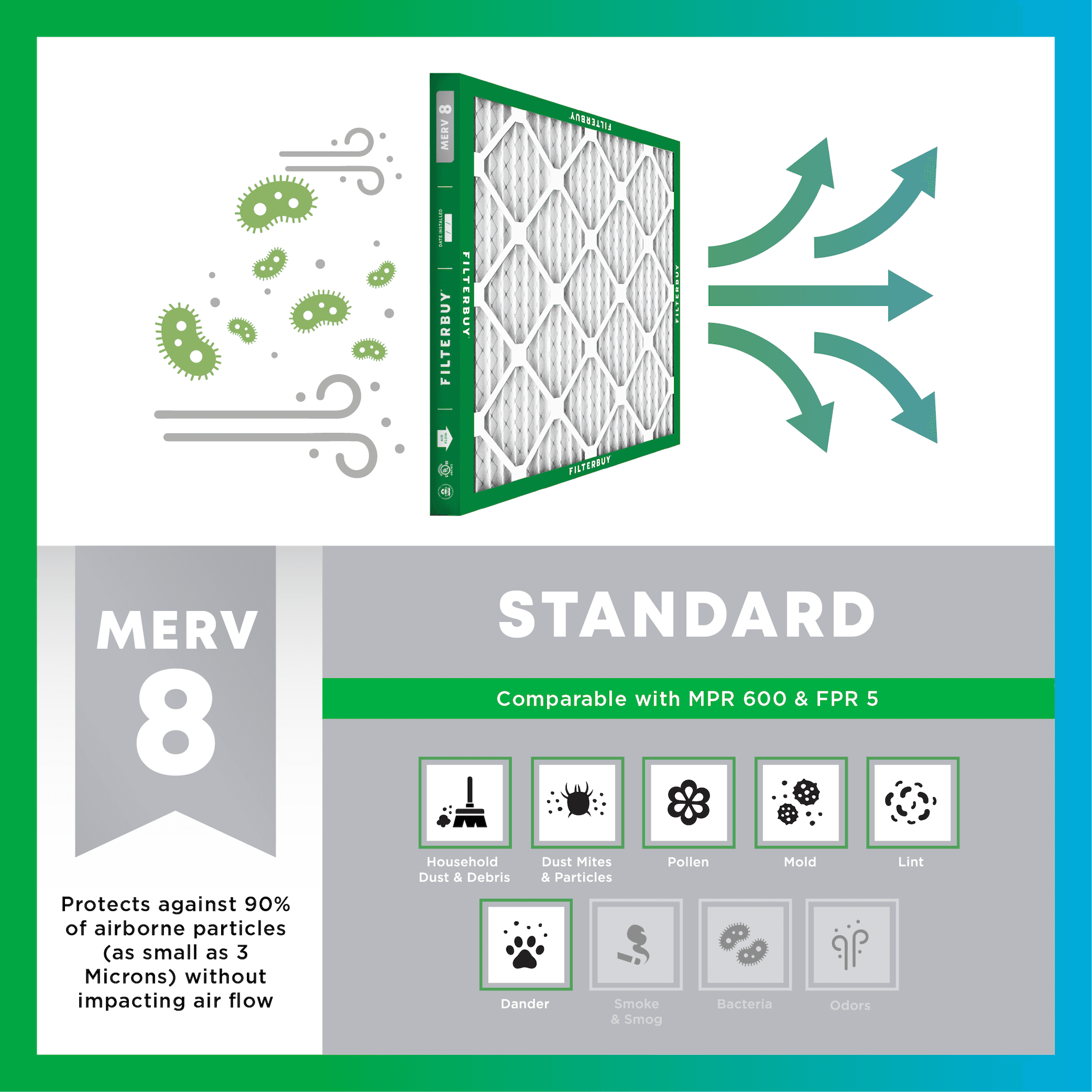
MERV stands for Minimum Efficiency Reporting Value—but don't let the technical name fool you. It's just a way to rate how well an air filter traps stuff like dust, pollen, pet dander, and smoke. The higher the MERV number, the more particles it catches—and the cleaner your air will be.

Comparable to:FPR: 4-7
MPR: 600-1000
 Dust & Debris
 Dust Mites & Particles
 Pollen
 Mold
Mold Lint
Lint Dander
Comparable to:FPR: 6-9
MPR: 1200-1550
Dust & DebrisDust Mites & ParticlesPollenMoldLintDander Smoke & Smog
Comparable to:FPR: 10
MPR: 1900-2800
Dust & DebrisDust Mites & ParticlesPollenMoldLintDanderSmoke & Smog Bacteria


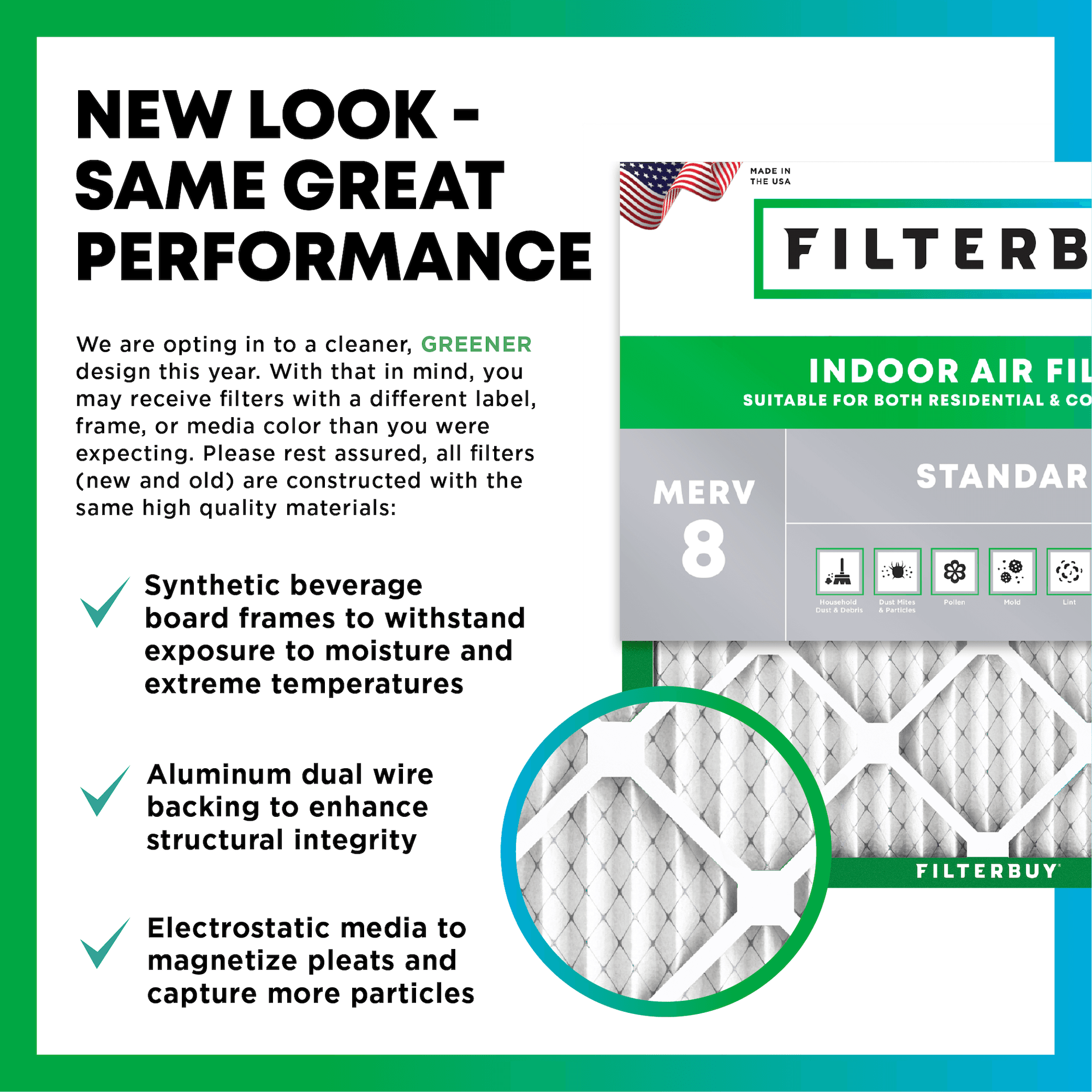
We build every Filterbuy filter to deliver reliable 90-day performance—thanks to smart design and premium materials that do the heavy lifting. Here's what makes the difference:
More pleats = more surface area to capture dust and debris, keeping your air cleaner longer.
Pleats are magnetized to attract and trap microscopic particles—like pet dander, pollen, and smoke.
Engineered to resist warping in extreme temperatures and high humidity.

A layer of metal reinforcement keeps pleats evenly spaced and structurally sound—no sagging, even at high airflow.
Assembled with care. Built to perform. Ships fast, free, and reliably from our U.S. facilities.

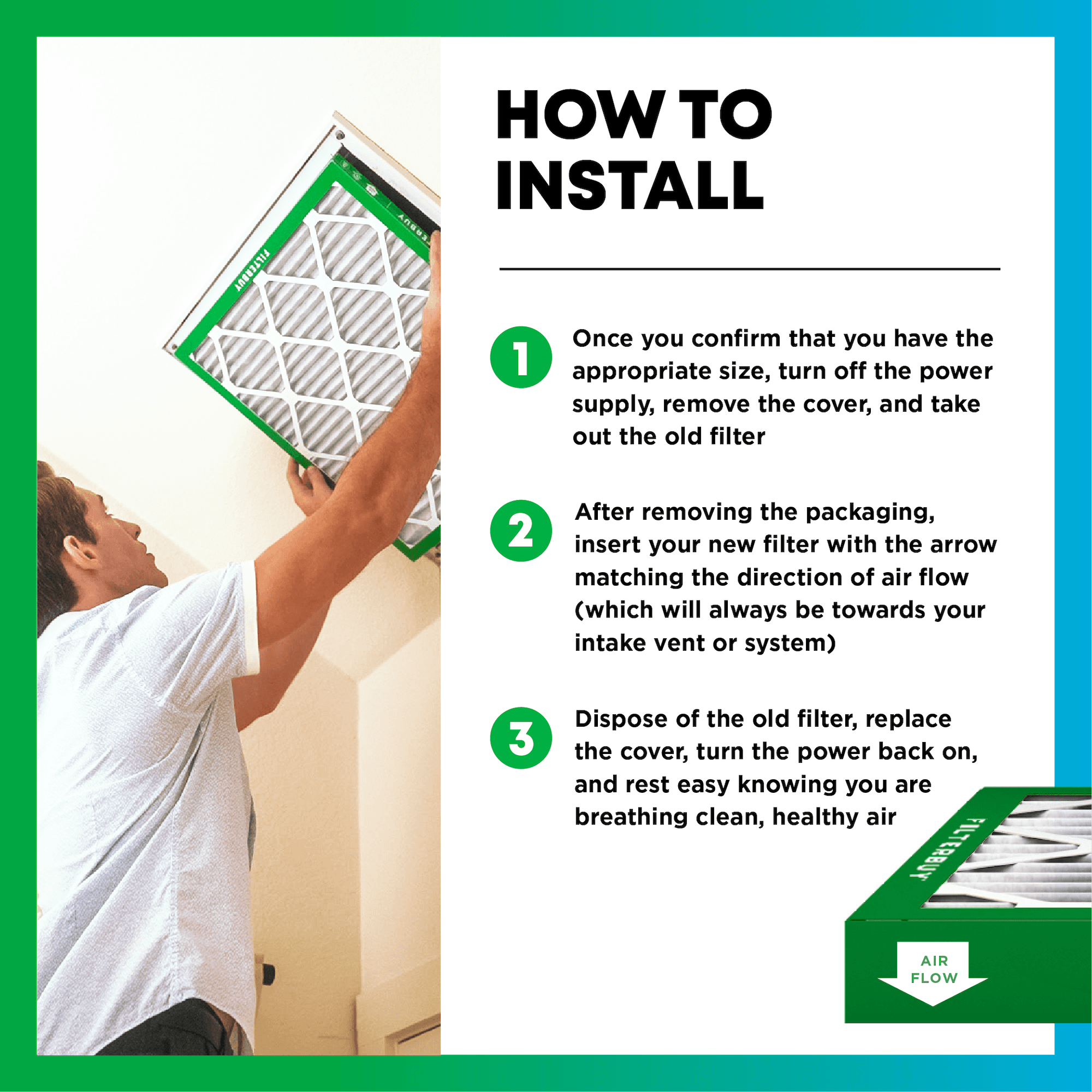
Turn Off Your HVAC SystemSafety first.

Remove The Old FilterLook for the airflow arrow and make note of the direction.

Slide In Your New FilterArrow should point toward the system (same direction as before).

Turn Your System Back OnAnd enjoy the fresh, clean air.

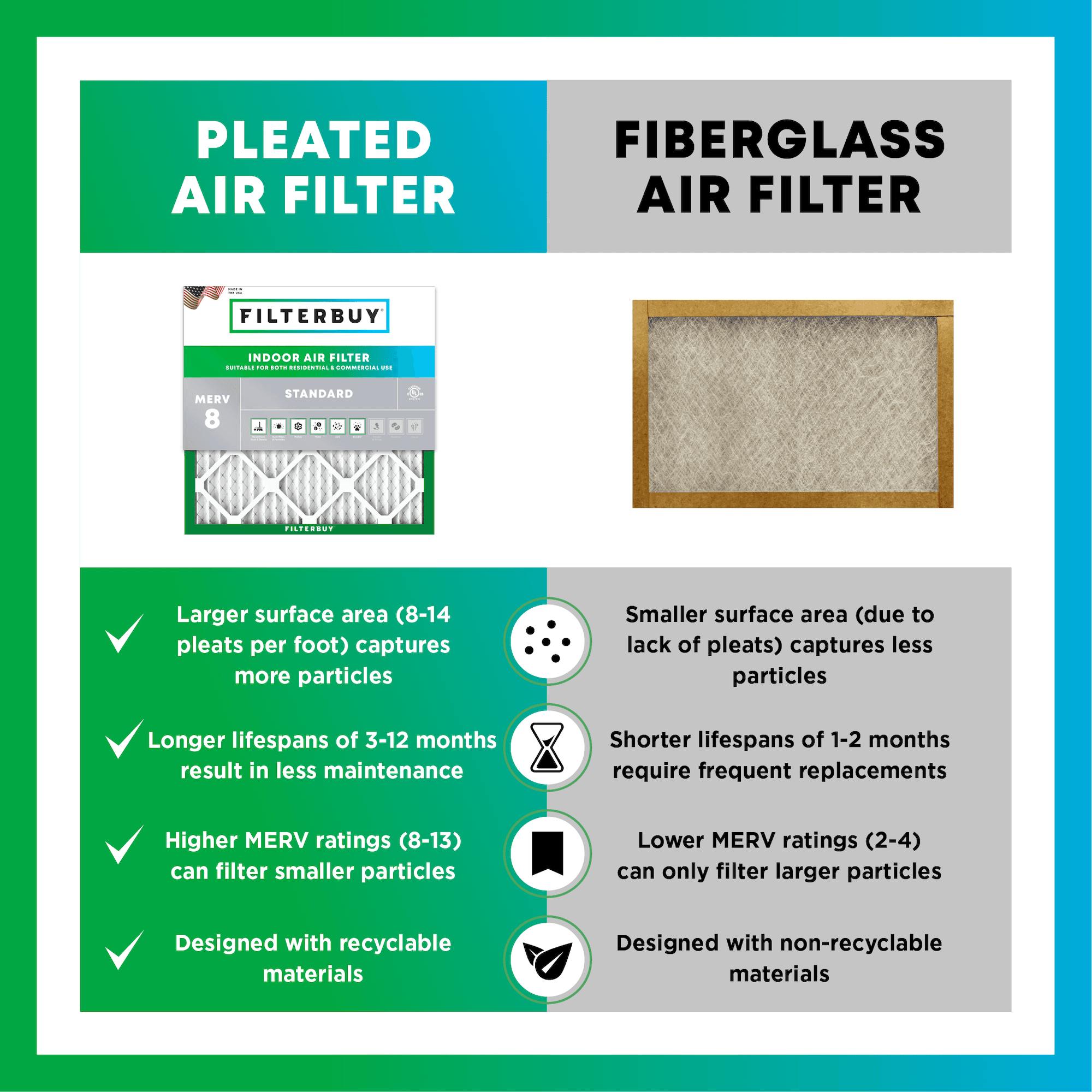
Not all air filters are created equal. Pleated filters don't just last longer—they actually clean your air better. Here's how they stack up:

Efficiency:
High (MERV 8–13) – Traps more particles
Lifespan:
90 days – Long-lasting performance
Air Quality:
Excellent – Cleaner, healthier air
Materials:
Recyclable and durable

Efficiency:
Low (MERV 4 or less) – Misses small stuff
Lifespan:
30 days or less – Replace often
Air Quality:
Minimal – Basic protection only
Materials:
Thin, flimsy, and not recyclable
Pleated filters are a no-brainer—more protection, less hassle, and better air for your home.
Changing your filter on time keeps your HVAC system running efficiently—and helps protect your lungs from dust, allergens, and airborne irritants. Here's how often to swap it out based on your needs:

For most homes without pets or special air quality concerns. Great for general upkeep and energy efficiency.

Shedding fur, dander, and allergy triggers can build up fast. Changing your filter every two months helps keep the air fresher and symptoms at bay.

For households affected by smoke, pollution, or respiratory conditions, monthly changes ensure maximum protection.

| Nominal Size | 20X22X5 |
| Actual Size | 19.56 x 22 x 5.25" inches |
| Filter Type | Pleated |
| Media | Electrostatically Charged |
| Frame | Beverage Board |
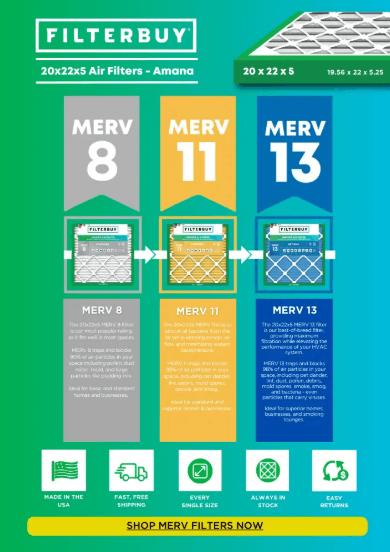
| MERV Ratings Available | 8, 11, 13 |
| Lifespan | Up to 12 Months |
| Origin | Made in USA |
Seasonal allergies, pet dander, and household dust don't stand a chance when your Amana system has the right filter working for it. After manufacturing millions of MERV 8 filters and hearing directly from allergy sufferers across the country, we've seen firsthand how this efficiency rating performs against the allergens making families miserable.
Here's what our manufacturing experience has taught us: a MERV 8 20x22x5 amana air filter captures the majority of common household allergens—pollen, dust mites, mold spores, and pet dander—while maintaining the airflow your Amana system needs to run efficiently. Customers tell us they notice a real difference within days of their first filter change, especially during peak allergy seasons.
On this page, we'll share exactly how MERV 8 filtration traps these irritants, what particle sizes you can expect it to catch, and whether this rating matches your household's allergy concerns—insights drawn from over a decade of filter manufacturing and millions of customer conversations.
A MERV 8 20x22x5 air filter is a 5-inch deep pleated filter designed to fit Amana HVAC systems. After manufacturing millions of these filters, here's what we know:
What it does:
Captures particles 3-10 microns at 70-85% efficiency
Traps pollen, dust mites, mold spores, and pet dander
Maintains airflow while filtering common allergens
Key specs:
Nominal size: 20" x 22" x 5"
MERV rating: 8 (ideal for mild to moderate allergies)
Replacement frequency: Every 6-12 months
Why customers choose it:
Balances allergen capture with energy efficiency
4x more surface area than 1-inch filters
Longer lifespan means fewer replacements
Compatible with Amana residential HVAC systems
Best for: Households managing seasonal allergies, pet dander, or general dust control without severe respiratory concerns.
Our recommendation: MERV 8 delivers effective allergen relief for most families. Ensure proper installation with the airflow arrow pointing toward the blower and no gaps around edges.
MERV 8 captures common allergens. Pollen, dust mites, mold spores, and pet dander fall within its 3-10 micron capture range.
5-inch depth outperforms standard filters. 4x more surface area, better airflow, and 6-12 months between changes.
Indoor air quality matters most. 90% of our time is spent indoors where pollutant levels run 2-5x higher than outside.
Clean filters save 5-15% on energy costs. Clogged filters waste energy and shorten equipment life.
Installation matters. Arrow toward blower, no gaps at edges, monthly inspections during allergy season.
MERV 8 represents the efficiency sweet spot for most households dealing with common allergens. This rating means your filter captures particles between 3.0 and 10.0 microns with approximately 70-85% efficiency—and that range covers the allergens causing most indoor discomfort.
From our experience manufacturing filters at this rating, we know MERV 8 effectively traps pollen, dust mite debris, mold spores, pet dander, and household dust. These are the irritants customers ask us about most frequently, and MERV 8 handles all of them while keeping energy costs in check. The filter's density strikes the right balance: tight enough to catch allergens, open enough to let your Amana system breathe properly.
Your 20x22x5 filter works through mechanical filtration—allergen particles physically collide with filter fibers and get stuck as air passes through. The five-inch depth gives particles more opportunities to make contact compared to standard one-inch filters, which is why customers with allergies often report better results after switching to this size.
Pollen particles typically measure 10-100 microns, making them easy targets for MERV 8 media. Dust mite debris falls in the 10-25 micron range and gets captured consistently. Mold spores range from 3-30 microns, with MERV 8 catching most airborne spores before they circulate through your home. Pet dander varies widely but commonly falls within MERV 8's capture range, especially the larger particles that trigger reactions.
The five-inch depth isn't just about longer filter life—though customers tell us they appreciate going 6-12 months between changes. That extra depth means more filter media working to capture allergens with every air cycle.
After manufacturing millions of these deep-pleat filters, we've learned that the extended surface area reduces air resistance while increasing particle capture. Your Amana system pulls air through more filter material without working harder, and allergens have more fiber contact points where they get trapped permanently.
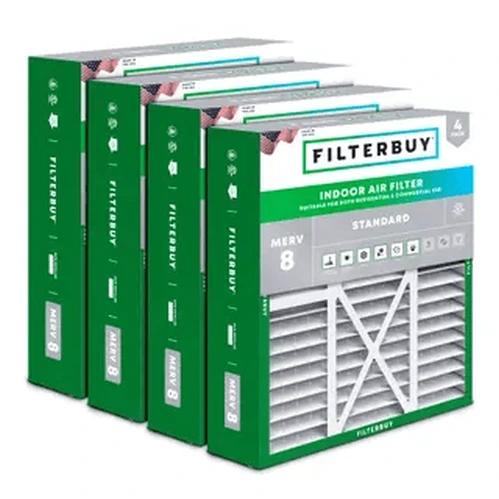
"After manufacturing millions of MERV 8 filters and talking with customers who struggle with seasonal allergies, we've consistently found that this efficiency rating captures the allergens causing most household discomfort—pollen, dust mites, pet dander—without forcing your HVAC system to work overtime. It's the balance point we recommend most often for families wanting real allergen relief and efficient system performance."
— FilterBuy Air Quality Team
Choosing the right air filter requires trusted information from authoritative sources. These seven resources provide the foundation for understanding MERV ratings, allergen control, and filter performance.
Source: U.S. Environmental Protection Agency (EPA)
The EPA explains how MERV ratings measure a filter's ability to capture particles between 0.3 and 10 microns. This foundational knowledge helps you understand why MERV 8 effectively traps common household allergens.
Resource: https://www.epa.gov/indoor-air-quality-iaq/what-merv-rating
Source: U.S. Environmental Protection Agency (EPA)
The EPA's comprehensive air cleaner guide covers filter selection, HVAC compatibility, and how to balance filtration efficiency with proper airflow. Essential reading before upgrading your Amana system's filter.
Resource: https://www.epa.gov/indoor-air-quality-iaq/guide-air-cleaners-home
Source: American Society of Heating, Refrigerating and Air-Conditioning Engineers (ASHRAE)
ASHRAE created the MERV rating system and sets residential filtration standards. Their technical guidance confirms MERV 8 as the recommended minimum for quality indoor air in homes.
Resource: https://www.ashrae.org/technical-resources/filtration-and-disinfection-faq
Source: Asthma and Allergy Foundation of America (AAFA)
The AAFA provides evidence-based strategies for controlling dust mites, pet dander, pollen, and mold spores. Learn how air filtration works alongside other allergen-reduction methods.
Resource: https://aafa.org/allergies/prevent-allergies/control-indoor-allergens/
Source: American College of Allergy, Asthma & Immunology (ACAAI)
The ACAAI explains how dust mite debris, pet dander, and pollen particles trigger allergic reactions. Understanding allergen particle sizes helps you evaluate whether MERV 8 meets your household's needs.
Resource: https://acaai.org/allergies/allergic-conditions/dust-allergies/
Source: U.S. Department of Energy (ENERGY STAR)
ENERGY STAR research shows clean filters reduce HVAC energy consumption by up to 15%. This resource explains why regular filter changes protect both air quality and utility costs.
Resource: https://www.energystar.gov/saveathome/heating-cooling
Source: Filterbuy
Five-inch deep-pleated filters offer 4x the surface area of standard filters, lasting 9-12 months while maintaining better airflow. This resource details why filter depth matters for allergen capture and system efficiency.
Resource: https://filterbuy.com/resources/air-filter-maintenance/why-does-furnace-filter-thickness-matter/
After manufacturing millions of air filters and speaking with customers nationwide, we've seen how these research-backed statistics translate into real results for families managing allergens.
The Research: The U.S. Environmental Protection Agency reports that Americans spend approximately 90% of their time indoors. Indoor pollutant concentrations often measure 2 to 5 times higher than outdoor levels.
What We've Learned:
Customers consistently report the biggest improvements in how they feel at home—not outside
Your HVAC filter works around the clock in spaces where your family spends nearly all their time
Filter quality directly impacts daily comfort and respiratory health
Source: U.S. Environmental Protection Agency https://www.epa.gov/report-environment/indoor-air-quality
The Research: The Asthma and Allergy Foundation of America reports:
8 out of 10 people are exposed to dust mites
6 out of 10 encounter cat or dog dander regularly
What We've Learned:
These statistics represent the sneezing, congestion, and discomfort driving customers to seek better filtration
MERV 8 captures dust mite debris effectively within its 3-10 micron range
Customers with mild to moderate allergies report noticeable relief within the first week
Source: Asthma and Allergy Foundation of America https://aafa.org/allergies/prevent-allergies/control-indoor-allergens/
The Research: The U.S. Department of Energy estimates replacing a dirty filter with a clean one lowers energy consumption by 5 to 15 percent.
What We've Learned:
5-inch deep-pleated filters maintain optimal airflow longer than 1-inch options
Greater surface area prevents the airflow restriction that drives up utility bills
Customers switching to 20x22x5 filters report quieter systems and stabilized energy costs
Source: U.S. Department of Energy / ENERGY STAR https://www.energystar.gov/saveathome/heating-cooling
After over a decade of manufacturing air filters and helping millions of customers, we've developed a clear perspective on MERV 8 filtration for allergy management.
MERV 8 hits the sweet spot for most households dealing with common allergens. It's not the highest efficiency rating available—but for families managing seasonal allergies, pet dander, and everyday dust, it delivers meaningful relief without the tradeoffs of higher-rated filters.
MERV 8 works best when:
Allergy symptoms are mild to moderate
Your household includes pets but no severe allergy sufferers
You want effective filtration without risking airflow restriction
Energy efficiency matters as much as air quality
Consider MERV 11 or 13 when:
Family members have severe allergies or asthma
Someone in the home is immunocompromised
You live in areas with high pollution or wildfire smoke
Customers often ask whether filter size matters beyond fit. Our honest assessment: the 5-inch depth is one of the smartest choices for an Amana system.
What extended depth delivers:
More allergens captured per air cycle
Less frequent replacements (6-12 months vs. 1-3 months for 1-inch filters)
Consistent airflow even as the filter loads with particles
Lower long-term cost despite higher upfront price
We've manufactured both 1-inch and 5-inch filters for years. The performance difference isn't marketing—it's physics.
Ready to improve your indoor air quality? Follow these steps to find the right MERV 8 20x22x5 filter for your home.
How to check:
Remove your current filter and read the size on the frame
Measure the filter slot (length x width x depth)
Check your Amana owner's manual
Note: Nominal size (20x22x5) differs slightly from actual size. Our filters fit standard Amana slots precisely.
Household Situation
Recommended Rating
General dust control
MERV 8
Mild allergies, pets
MERV 8
Moderate allergies, multiple pets
Severe allergies, asthma
Not sure? Start with MERV 8. Upgrade later if needed.
For 5-inch filters:
Standard households: Every 9-12 months
Homes with pets: Every 6-9 months
Allergy sufferers: Every 6 months
Check monthly during peak seasons
Pro tip: Set a calendar reminder or subscribe for automatic delivery.
Before installation:
Locate your filter slot near the air handler
Note the airflow direction arrow
Have a garbage bag ready for the old filter
During installation:
Turn off your HVAC system
Remove old filter carefully
Insert new filter with arrow pointing toward blower
Ensure edges seal snugly—no gaps
Restore power
Immediate actions:
Run fan on "continuous" during allergy season
Keep windows closed on high pollen days
Vacuum weekly with HEPA-equipped vacuum
Wash bedding in hot water weekly
Ongoing maintenance:
Inspect filter monthly
Note unusual sounds or reduced airflow
Schedule annual HVAC maintenance
A: After manufacturing MERV 8 filters for over a decade, we know exactly what this rating captures.
Particle range: 3-10 microns at 70-85% efficiency
Common allergens captured:
Pollen
Dust mite debris
Mold spores
Pet dander
Household dust
Our experience: Customers with mild to moderate allergies consistently report noticeable relief without airflow restriction.
A: Based on feedback from millions of customers, replacement timing depends on your household.
Recommended schedules:
Standard households: 9-12 months
Homes with pets: 6-9 months
Allergy sufferers: 6 months
High-dust environments: 6 months
Pro tip: Check monthly during peak allergy seasons. When the filter looks gray and matted, replace it regardless of timeline.
A: After helping countless allergy sufferers, we've learned MERV 8 works well for most households.
MERV 8 is ideal for:
Mild to moderate allergy symptoms
General dust and dander control
Pet owners without severe sensitivities
Consider MERV 11 or 13 for:
Severe allergies or asthma
Immunocompromised family members
Respiratory conditions
Important: Verify your Amana system can handle higher ratings. We've seen systems struggle when filters exceed airflow capacity.
A: We manufacture both sizes. The performance difference is significant.
5-inch filter benefits:
Approximately 4x the surface area
More allergens captured per air cycle
Better airflow maintenance as particles accumulate
Longer filter life
What customers tell us:
Fewer replacements (2-3 yearly vs. monthly)
Quieter system operation
More consistent performance over time
A: Proper installation makes all the difference. We hear from customers who struggled with allergies only to discover gaps around their filter edges.
Installation steps:
Turn off your HVAC system
Locate the filter slot near air handler or return duct
Remove old filter carefully to avoid releasing trapped particles
Insert new filter with airflow arrow pointing toward blower motor
Run your hand around all edges to confirm snug seal
Restore power and listen for normal operation
Key point: A well-sealed MERV 8 works as intended. A poorly installed one lets allergens bypass entirely.
Now that you understand how a MERV 8 filter handles common allergens, take the next step toward cleaner indoor air. Shop FilterBuy's selection of American-made 20x22x5 Amana-compatible filters and start breathing easier today.

