By Michelle Wan, Brand Manager and Air Quality Writer. Reviewed for technical accuracy by David Clark, Licensed HVAC Technician. Published August 24, 2026. Last updated August 24, 2026.
Nearly every auto parts chain stocks cabin air filters, so you can usually have one in hand within the hour for $15 to $50. A factory-direct order from Filterbuy ships free anywhere in the continental United States, though nothing shipped arrives this afternoon. Distance turns out to be the wrong thing to weigh. What matters is whether you need a filter today or you are replacing on schedule, and whether the media grade sitting on the local shelf is the one your air actually needs.
Auto parts chains, Walmart, and dealership parts counters all stock cabin air filters, typically priced $15 to $50 for the part by itself.
A shop or dealership replacement runs roughly $50 to $150 including labor, even though the job takes about ten minutes on most vehicles.
Every Filterbuy order ships free inside the continental United States with no minimum. Alaska, Hawaii, and international addresses are excluded, and no shipped order arrives the same day you place it.
Media grade varies far more than price does. One published commuter-exposure study rated the factory filters in its test vehicles at roughly 20 percent efficiency for particles between 0.3 and 0.5 microns.
Buy locally when you need it today. Order direct when you are replacing on schedule or want a media grade the local shelf does not carry.
Cabin air filters are among the most widely stocked maintenance parts in the country. AutoZone, O’Reilly Auto Parts, Advance Auto Parts, Walmart, and dealership parts departments all carry them, and most chains let you confirm stock for your exact year, make, and model online before you drive over. If your vents smell musty this morning, a local parts counter is the fastest fix available to you.
Two things are worth knowing before you go. The counter matches your filter from a catalog rather than from the part in your car, so look up your cabin air filter part number first, or bring the old one with you. And while the big chains will happily sell you a filter, most of them will not fit it. Free service at those counters covers wipers, bulbs, and batteries, which leaves the cabin filter to you or to a shop.
| Source | Typical speed | Part price | Installs it? |
|---|---|---|---|
| Auto parts chain | Same day, in stock | $15-$50 | Generally no |
| Walmart | Same day, narrower range | $12-$35 | No |
| Dealership parts counter | Same day or next day | $25-$70 | Yes, at shop rates |
| Independent shop | Same day with appointment | Bundled with labor | Yes |
| Filterbuy, factory-direct | Ships free, not same-day | Shipping free, no minimum | No |
A new filter does not fix every problem people buy one for, and two quick checks will tell you whether yours is one of them.
If the complaint is a smell. A musty odor usually comes from mold on the damp evaporator core behind your dash, and the Filterbuy odor guide is blunt about the limit here: a filter change alone cannot reach it. Run the air conditioning for a minute and look underneath for a puddle. No drip points to a clogged drain rather than a clogged filter. A gasoline or exhaust smell is a different problem entirely, and it is the one case where the answer is to stop driving and call a shop today.
If you are buying blind. Some vehicles take two filters in one housing, so buying a single filter leaves half the intake uncovered, and a few base trims ship with a blanking plate and no filter at all. Both are worth confirming before you spend a trip on it.
Expect $15 to $50 for the filter alone at a parts chain, with standard particulate filters at the low end and activated carbon or high-efficiency media at the top. A dealership or independent shop typically charges $50 to $150 for the same job once labor is included. On the majority of vehicles the filter sits behind the glove box and the swap takes about ten minutes, so most of that quote is labor you can keep.
Filterbuy publishes a plain test for deciding whether to pay someone. If the filter lives behind the glove box, do it yourself. If it sits under the dash, under the cowl, or behind a trim panel, pay the shop, because a handful of broken trim clips costs more than the labor you saved. The full breakdown lives in our guide to cabin air filter replacement cost.
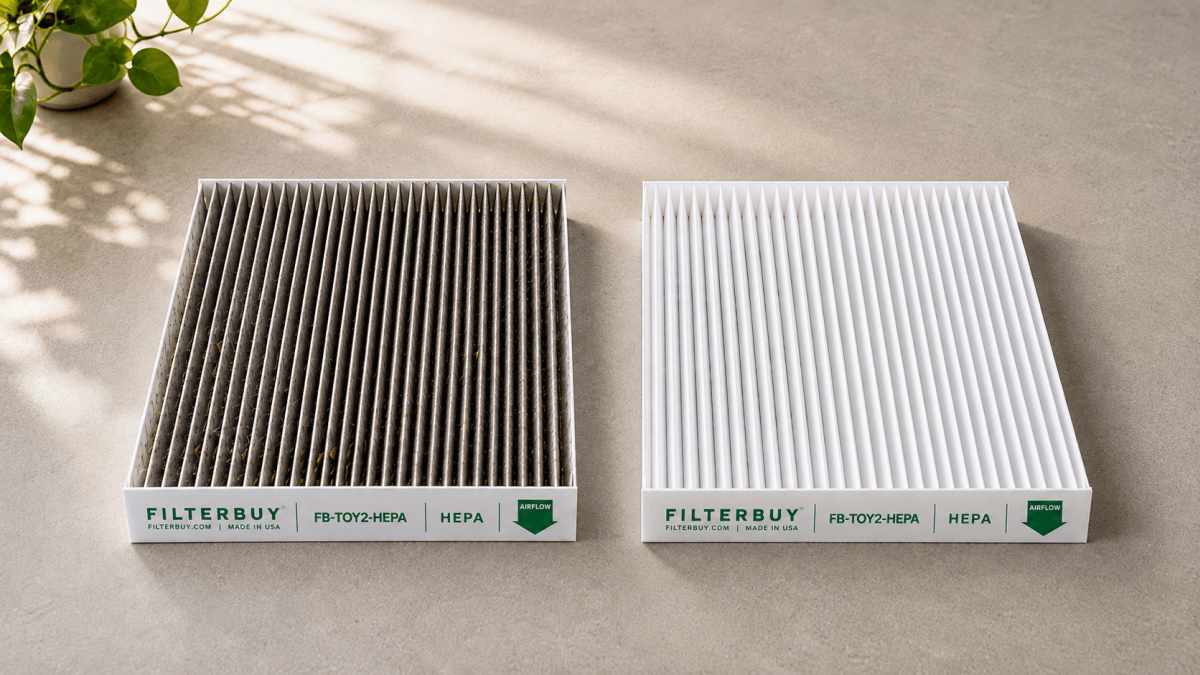
Buy locally when the need is immediate, and order factory-direct when the replacement is planned. That is the whole decision. Sort it by timing rather than by loyalty and people end up with a better filter more reliably than any sales pitch manages.
When choosing where to buy a cabin air filter, the best option depends on your situation. If your vents smell bad and you need to drive tomorrow, or you need a replacement before a Friday road trip, a local counter makes the most sense because shipping cannot beat same-day pickup.
If your owner’s manual says the filter is due but you still have a few days, factory-direct gives you time to choose better filter media. Factory-direct is also a good choice when allergy season or wildfire smoke is approaching, since high-efficiency media may not be readily available on store shelves.
If the filter is not located behind the glove box, consider having a shop handle the replacement, as dealing with trim clips may not be worth the labor you would save doing it yourself. And if you tend to forget the replacement every year, Filterbuy auto-delivery can make maintenance easier by ensuring the next filter arrives before you have to think about it.
Proximity is easy to measure, which is probably why it dominates the search. The harder question is what the filter is rated to catch, and that varies far more between products than price does. It is also the one specification the shelf rarely tells you.
Consider what a factory-spec filter is often built to do. In a 2017 commuter-exposure study published in PLOS One, researchers documented the cabin air filters in their test vehicles as carrying an atmospheric dust efficiency rating of 20 percent, plus or minus 10 percent, for particles in the 0.3 to 0.5 micron range. That band is where wildfire smoke, diesel soot, and the fine particulate matter the EPA classifies as PM2.5. A filter can be perfectly fitted, perfectly fresh, and still be a modest barrier against the particles most worth stopping.
That is the honest case for planning a filter purchase instead of grabbing one. Higher-efficiency media exists, but it is rarely what a counter stocks by default, and the label language across the category is loose enough to be worth ignoring. No independent body in the United States certifies cabin filter performance, so a HEPA-grade badge on a box carries no third-party check behind it. Judge the published specification rather than the logo. The Filterbuy guide to how cabin air filter brands compare lays out the four-signal check we use internally.
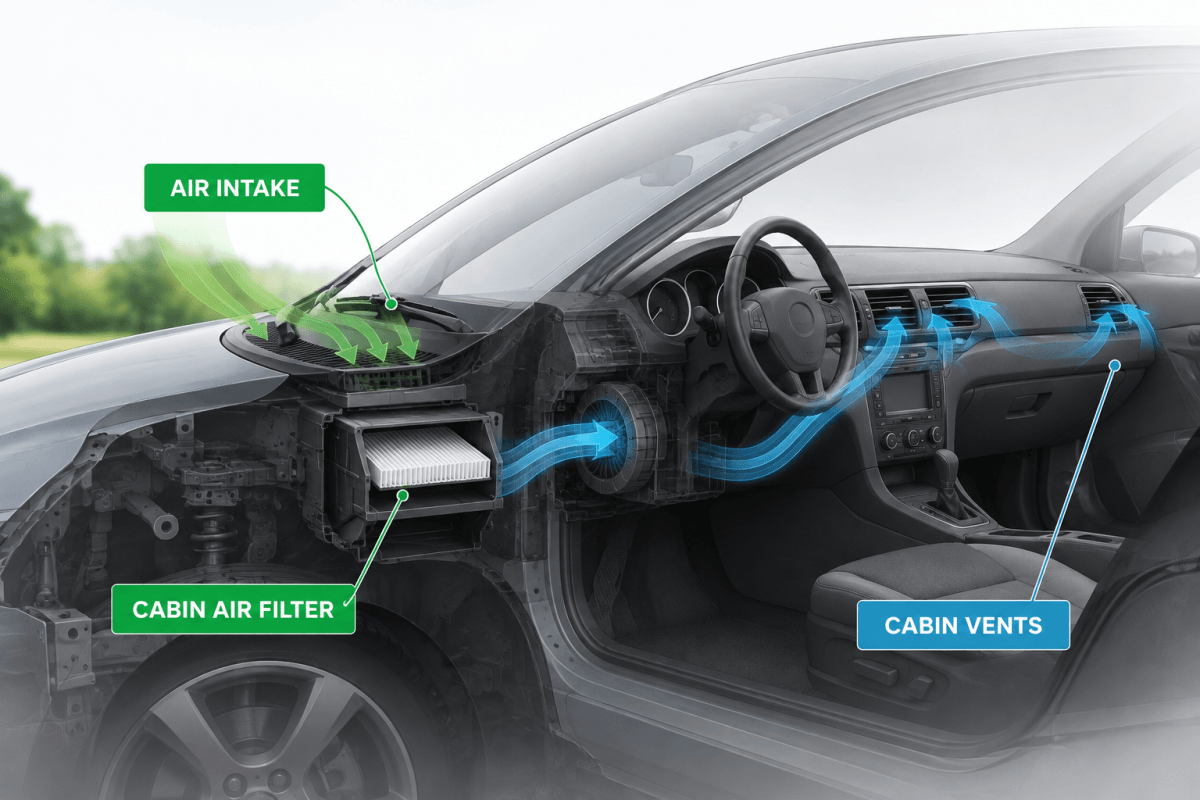
There is a second half to this that spec sheets rarely cover, and from where Filterbuy sits it matters more than the media does. It is the frame.
A filter two millimeters undersized does not filter two percent less. It creates bypass air, which slips around the edge of the frame and into the blower, carrying the road past media that looks correctly installed. Fit is the failure nobody checks, and it becomes invisible the moment the glove box closes. That is why Filterbuy treats fitment as the whole job, cuts to exact OEM tolerances at its four U.S. plants, and why the part number matters more than the brand on the box.
Here is the part most manufacturers leave out. The Filterbuy 99.97 percent capture figure is a manufacturer claim rather than a published ISO/TS 11155-1 result, and it should be read that way until we publish one. Filterbuy makes and sells these filters, so run the same scrutiny on us that you would run on anyone else.
Filterbuy ships every order free within the continental United States, with no order minimum and no threshold to clear. Because filters leave from whichever of those four plants sits closest to you rather than from one central warehouse, the free option does not carry a slow-boat penalty. Orders cannot ship to Alaska, Hawaii, or international addresses, and current delivery windows are listed on our shipping and returns page.
That is why this page opened with the local option instead of burying it. If the filter has to be in the car tonight, a parts counter beats us, and we would rather say so than waste your afternoon. If you are replacing on schedule the trade runs the other way, with no drive, no counter guesswork, and auto-delivery so the next one turns up before you think about it. When you reach that point, find the cabin air filter that fits your vehicle by year, make, and model.
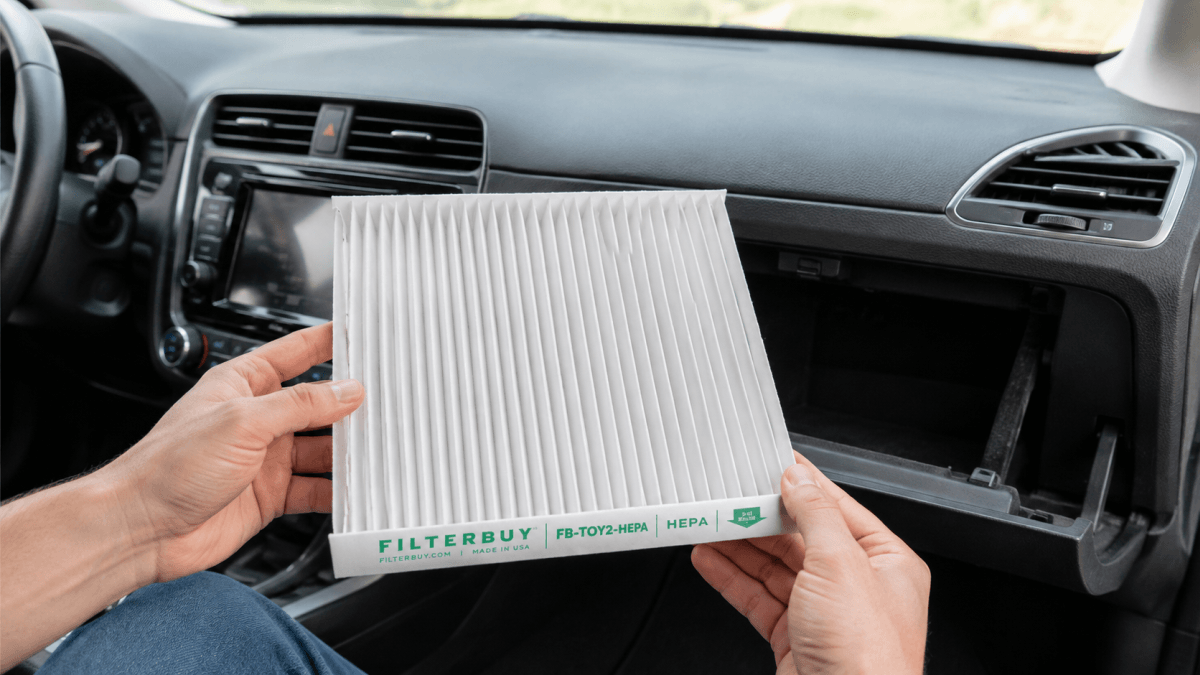
On most vehicles, yes, and without tools. Empty the glove box, squeeze the sides to release the stops, let it swing down, then slide the new filter in with the airflow arrow pointing the way the old one pointed. Close it up and you are done.
If the filter sits somewhere other than behind the glove box, or the panel resists, stop there and let a shop handle it.
The Filterbuy cabin air filter installation instructions cover the step-by-step, and if the glove box turns up nothing, check where the cabin air filter sits in your vehicle.
Three federal datasets, and what each one changes about the decision above.
10,787 miles. The distance the average U.S. light-duty vehicle traveled in 2024.
That is under the 12,000-mile mark where most replacement intervals start.
For most drivers, the calendar comes due before the odometer.
Replace annually. Stop watching the miles.
Source: Federal Highway Administration, Highway Statistics 2024, Table VM-1 (February 2026)
$13,318. Average household transportation spending in 2024. That is 17.0 percent of all spending, second only to housing.
Against that, a $15 to $50 filter is a rounding error.
The money leaks at labor, not at parts.
Check the glove box before you accept a quote.
Source: U.S. Bureau of Labor Statistics, Consumer Expenditure Survey, 2024 (December 2025)
99 percent cleaner. New cars, SUVs, and pickups versus 1970 models, for common pollutants.
Your own tailpipe is not what reaches your vents.
The traffic around you is.
Match the media to your commute, not to your model year.
Source: U.S. Environmental Protection Agency, Accomplishments and Successes of Reducing Air Pollution from Transportation (April 2026)
For most people, an auto parts chain within a few miles. Check stock online for your year, make, and model before driving over.
Yes, from a local parts counter or a dealership parts department. No online order can match same-day pickup, Filterbuy’s included. Filterbuy ships free to continental U.S. addresses, and current delivery windows are published on the shipping and returns page.
Usually not. Free services at the major chains typically cover batteries, wiper blades, and bulbs. Staff will often help you identify the right part and point you to instructions, but the cabin filter swap is generally left to you or to a repair shop.
Roughly $50 to $150 including parts and labor, varying by vehicle and local rates. If the quote is high and your filter sits behind the glove box, ask the shop to separate parts from labor on the estimate and to show you the old filter.
Manufacturer intervals vary widely, commonly falling between 12,000 and 30,000 miles, so your owner’s manual is the authority for your vehicle. Replace sooner if you drive in heavy traffic, dusty conditions, or wildfire smoke.
Often, particularly for higher-efficiency media, because online sellers are not paying for shelf space. The gap narrows on basic filters, and local pickup wins outright when you need the part immediately.
Cabin air filter: The filter that cleans outside air before it enters a vehicle’s passenger compartment through the heating and air conditioning system. It is separate from the engine air filter, which protects the engine rather than the occupants.
Engine air filter: The filter that cleans air entering the engine’s intake. It is a different part, in a different location, on a different replacement schedule.
Activated carbon filter: A cabin filter with a carbon layer that adsorbs odors and gaseous pollutants such as exhaust fumes and volatile organic compounds, in addition to trapping particles.
PM2.5: Fine particulate matter 2.5 microns in diameter or smaller. It is the pollutant class that includes wildfire smoke and diesel soot, and the one high-efficiency cabin media is designed to address.
MERV: Minimum Efficiency Reporting Value, the particle-capture rating scale developed by ASHRAE for building HVAC filters. MERV applies to home and commercial air filters, not to automotive cabin filters.
OEM: Original equipment manufacturer. An OEM cabin filter is the part specified by the automaker for that vehicle.
Bypass air: Unfiltered air that slips around the edges of a poorly fitted filter instead of passing through the media, which reduces real-world filtration regardless of the filter’s rating.
Evaporator core: The cold radiator behind the dashboard that cools cabin air. Moisture condenses on it and normally drains under the vehicle. It sits downstream of the cabin filter, which is why a filter change cannot clear odors that start there.
Blanking plate: A flat panel some base and fleet trims carry in place of a cabin filter. It looks like an empty filter frame until you remove it.
The EPA publishes the full MERV rating scale and what each level captures, which is the clearest reference if you also buy filters for your home system.
