
Coral Springs Real-Time AQI Tracker


Get Alerts For Unhealthy AQI In Your Area
When air quality in your area reaches unhealthy levels, we'll send you a quick alert, along with expert tips on how to reduce your exposure.
What's Actually In Coral Springs Air Today?
What High AQI Means for Your Lungs in Coral Springs
How to Read AQI
The Air Quality Index (AQI) measures how polluted the air is and how it may affect your health.
0–50 (Good): Air quality is satisfactory.
51–100 (Moderate): Acceptable, but some pollutants may pose minor concerns.
101–150 (Unhealthy for Sensitive Groups)
151–200 (Unhealthy)
201–300 (Very Unhealthy)
301+ (Hazardous)
Moderate
Still okay for most, but if you have asthma or allergies, take it easy and avoid long outdoor workouts.
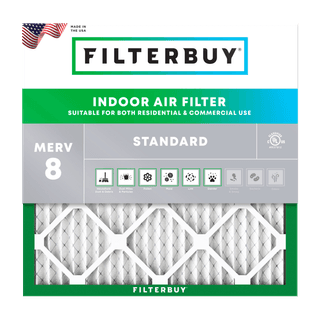
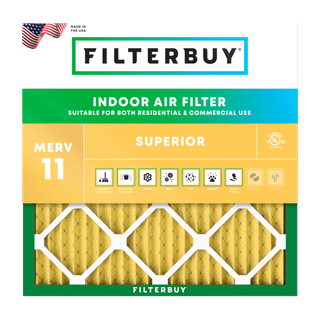
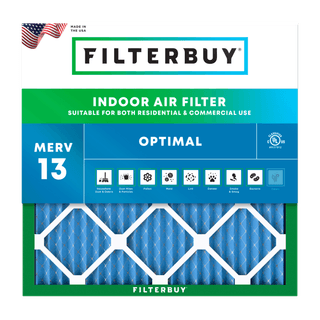
Shop MERV 11 filters→What's the Right Filter for Your AQI Level?

Check Today's Live Real Time Air Quality Index AQI Map in Coral Springs, FL Now
Author: Michelle Wan | Reviewer: David Clark, Licensed HVAC Technician | Publish Date: September 7, 2026 | Updated Date: September 7, 2026
The live map above shows the current Air Quality Index for Coral Springs, Florida, updated hourly from EPA-linked monitors around Broward County. Most days here read Good or Moderate. The bad days arrive from the west, carried in by Everglades burns, agricultural smoke, or Saharan dust, usually before the sky gives anything away.
TL;DR
Coral Springs air quality is Good (AQI 0–50) or Moderate (51–100) on most days. No active regulatory monitor sits inside city limits, so the number comes from Broward stations in Coconut Creek, Pompano Beach, Fort Lauderdale, and Davie. Spikes are seasonal and mostly particulate: Everglades fire season December through May, sugarcane smoke October through May, Saharan dust mid-June through mid-August. At AQI 100 and above, switch to MERV 13, set the thermostat fan to On, run a portable HEPA air cleaner in each occupied room, and close the house up.
Key Takeaways
Coral Springs has no active EPA regulatory monitor. The former Sawgrass Springs Middle School station is listed among the inactive sites in the Florida DEP Broward County monitoring network. Apps interpolate from surrounding monitors, which is why two apps disagree.
The monitor network is shrinking. EPA approved two nearby shutdowns on March 24, 2026: Vista View Park in Davie closed March 31, and Coconut Creek, the closest station, is approved to close once funding is revised, per the Florida DEP 2026 Air Monitoring Network Plan.
Broward has the worst short-term particle pollution in its metro area. In the American Lung Association’s "State of the Air" 2026 report the metro earned a C, averaging 1.5 unhealthy days a year across 2022–2024.
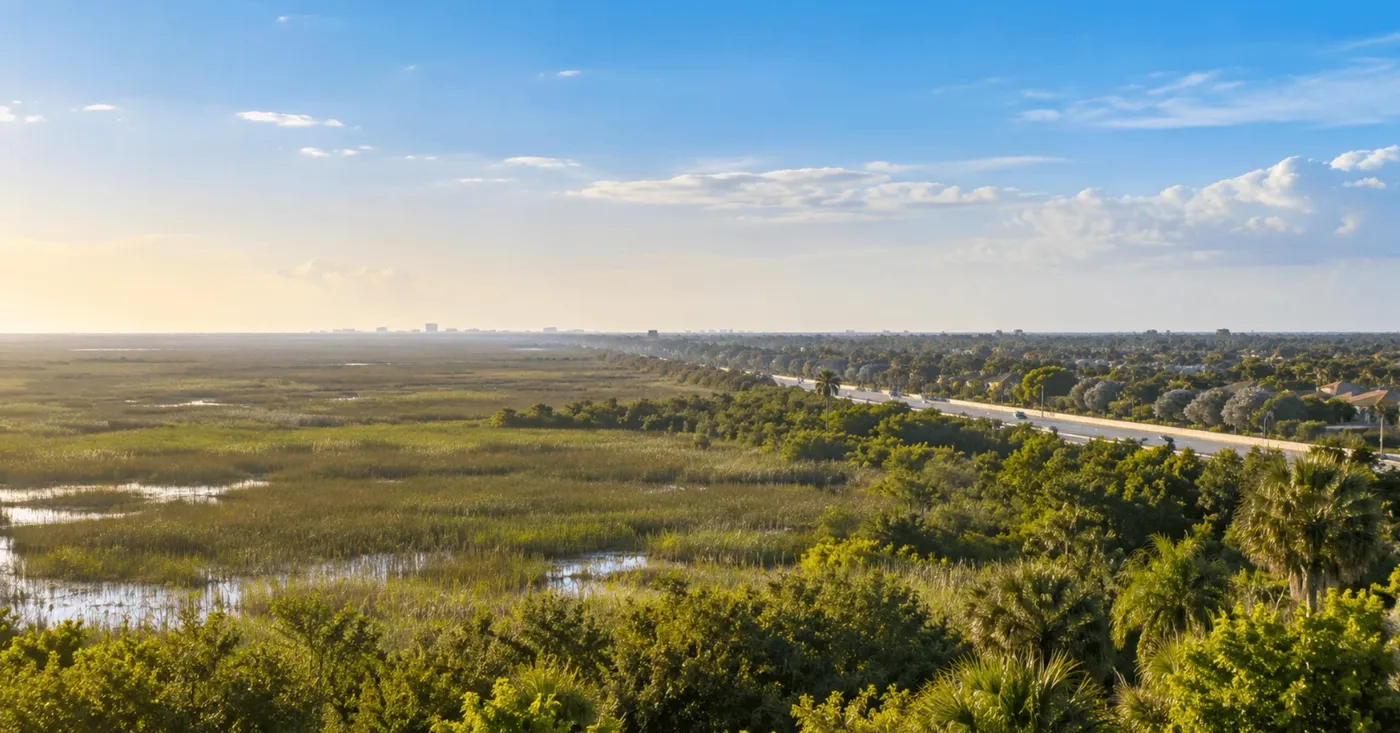
Coral Springs sits on the Everglades edge, not the coast. Bordered west by the Everglades Water Conservation Area and 20 miles northwest of Fort Lauderdale, it gets less of the sea breeze that clears the coast and more of the smoke off the marsh.
Indoor air follows outdoor air. The EPA’s Report on the Environment states Americans spend roughly 90% of their time indoors, where some pollutants run two to five times higher. Your HVAC filter is the one control you own.
Why we’re the ones telling you this: Filterbuy HVAC Solutions runs its Broward office in Pompano Beach, covering Coral Springs and Parkland, and Filterbuy has built air filters in the United States since 2013 across four factories, one in Florida.
What Is the Air Quality in Coral Springs Today?
Check the live AQI map at the top of this page. The Air Quality Index is a 0–500 scale from the U.S. Environmental Protection Agency: 0–50 Good (green), 51–100 Moderate (yellow), 101–150 Unhealthy for Sensitive Groups (orange). Here the pollutant driving it is usually fine particulate matter (PM2.5) or ground-level ozone. For the official view use Florida DEP’s Air Quality Today map or the EPA’s AirNow, by ZIP: 33065, 33071, 33067, and 33076.
Where Does the Coral Springs AQI Number Actually Come From?
Almost no air quality app explains this. There is no active regulatory air monitor inside Coral Springs. The city once hosted a nitrogen dioxide monitor at Sawgrass Springs Middle School, but Florida DEP now lists it among Broward’s inactive sites, so every "Coral Springs AQI" is modeled from instruments in neighboring cities. The closest active ones, per the Florida DEP 2026 network plan:
Straight-line distances from central Coral Springs to coordinates in the Florida DEP 2026 Ambient Air Monitoring Network Plan. Vista View Park closed March 31, 2026.
The network is getting thinner, not denser. Vista View Park closed March 31, 2026, and Coconut Creek is cleared to close once the county budget is revised. Read the map as an early warning and your own eyes, nose, and symptoms as the second signal, because smoke from the northwest reaches western Coral Springs before it registers anywhere. The Pompano Beach EJ monitor sits 6.1 miles out, in the same city as our service office, closer to our dispatch bay than to most Coral Springs living rooms. That is a useful signal, not a reading of your house.
I went looking for the Coral Springs monitor and found out there isn’t one. The honest advice is not trust the number. It’s use the number as a heads-up, then control the air on your side of the wall.
Michelle Wan, Brand Manager and Air Quality Writer, Filterbuy
How to Get a Reading Closer Than Five Miles
The AirNow Fire and Smoke Map carries a crowdsourced sensor layer EPA and the U.S. Forest Service added, in EPA’s words, for "areas where AirNow monitors may not exist." Coral Springs qualifies. Zoom to your ZIP: squares are regulatory monitors, circles are air sensors, often a few blocks away. EPA applies a correction so the two sit on one scale, but notes most sensors are privately owned and not regulatory. Coverage is uneven, so check once on a clear day to learn what your block has.
Why Coral Springs Air Behaves Differently Than Coastal Broward
Coral Springs is bordered west by the Everglades Water Conservation Area. Coastal cities like Fort Lauderdale sit under a sea breeze that dilutes pollution most afternoons, while Coral Springs, 20 miles inland, catches the weak end of that breeze and the leading edge of anything drifting east off the marsh. Four sources drive nearly every bad-air day:
Everglades fire season. The dry season runs December through May. The National Park Service recorded 233,954 acres of prescribed fire across Big Cypress and Everglades National Park in 2024. This smoke is scheduled, not accidental.
Sugarcane pre-harvest burning. The Everglades Agricultural Area, 40 miles northwest around Belle Glade, burns cane October through May. A 2026 GeoHealth study (doi.org/10.1029/2025GH001365) found inland areas had more smoke-affected monitor days than the east coast, though the coast was not exempt.
Saharan dust. NOAA’s Miami-based Atlantic Oceanographic and Meteorological Laboratory reports outbreaks leave Africa every three to five days, peak from late June to mid-August, and can cover an area as large as the lower 48 states.
Ozone and humidity. Ozone peaks between 2 p.m. and 6 p.m., which is school pickup and afternoon practice, so morning activity sidesteps most of it. Humidity feeds mold and dust mites and keeps your HVAC running most of the year.
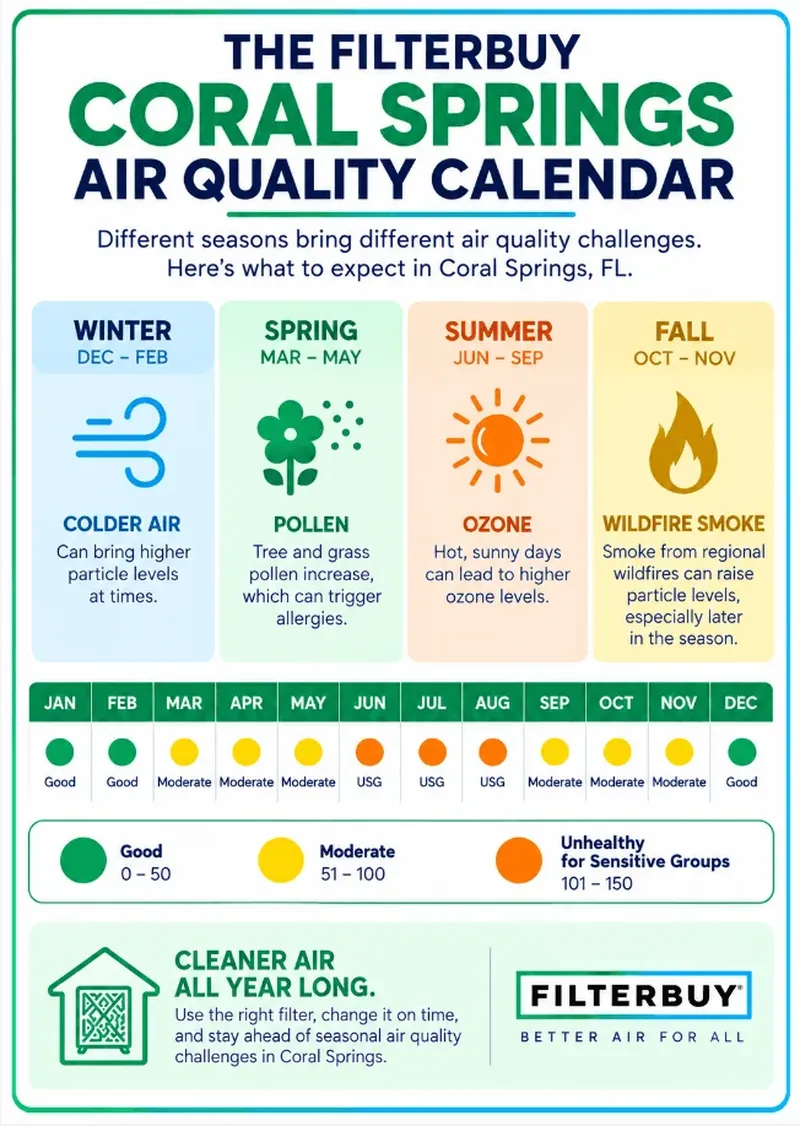
What the AQI Colors Mean in Coral Springs, and What to Do
AQI categories, ranges, and colors follow the U.S. EPA scale. The 100 action line is a Filterbuy trigger, not an EPA boundary.
About that 100: EPA’s category boundary sits at 101, so AQI 100 is still the top of Moderate on the official scale. We move at 100 rather than after crossing it, because waiting for the category to flip costs you a day. That earlier trigger is our editorial call, not an EPA category change.
What to Do Indoors When the Coral Springs AQI Reaches 100
The baseline first: AirNow and Broward County guidance outrank anything on this page. Then four steps, in order:
Switch to MERV 13. The whole-home layer, because your central system moves far more air than any portable unit. EPA recommends a filter rated MERV 13 or higher in a central system during smoke events, and notes most furnaces accommodate it without equipment problems when replaced often. Filterbuy builds it in 600+ sizes.
Set the thermostat fan to On. On Auto the system only filters while heating or cooling. EPA measured roughly a 50% drop in indoor PM2.5 from a high-efficiency filter with the fan running continuously, against about 24% for a low-efficiency filter (Strategies to Reduce Exposure Indoors).
Run a portable HEPA air cleaner in each occupied room. Bedrooms first. The room-level layer, working alongside MERV 13 rather than instead of it. Size it by EPA’s clean-room rule: a smoke CADR at least two-thirds of the room’s square footage, so a 300 square foot bedroom wants about 200. EPA advises against ozone-producing cleaners, so skip ionizers and ozone generators.
Close the house up. Windows and doors shut, and don’t add to the problem indoors: no candles, no frying, no vacuuming without a sealed unit.
No central air? Apartments, window units, and homes without ductwork have no whole-home layer. For those readers portable HEPA cleaners are the primary defense, sized by the same CADR rule.
Two recommendations, two owners. MERV 13 or higher during smoke events is EPA’s. Acting at AQI 100, and running a HEPA cleaner in every occupied room rather than one, is ours. EPA sets no AQI threshold for changing a filter, and its clean-room guidance describes a single room.
On replacement during smoke: use the look test, not the calendar. Replace the filter when it looks dirty, dark brown or black, which EPA notes can come sooner than the normal interval. Keep spares on hand, or set up auto-delivery.
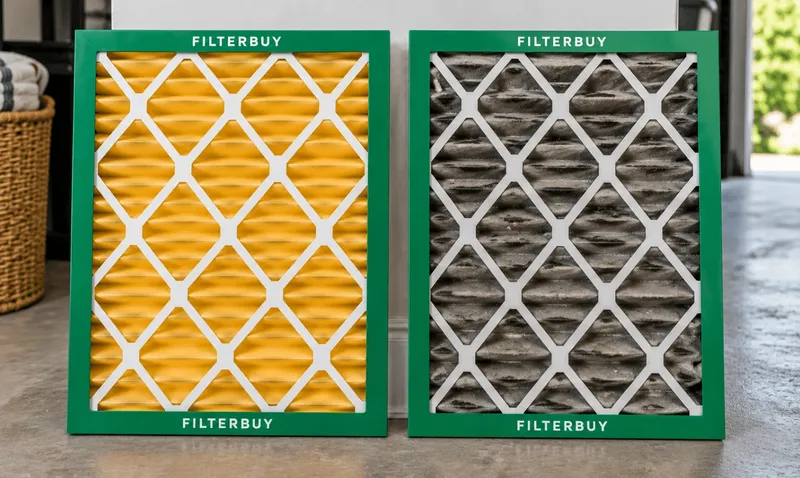
The filter our Broward techs pull from a Coral Springs return in May looks nothing like the one they pull in November. Rate your filter to the season, not the calendar. And the unpopular part: a MERV 11 changed on schedule beats a MERV 13 left in since last winter.
David Clark, Licensed HVAC Technician and CEO of Filterbuy HVAC Solutions
Frequently Asked Questions
Air Quality Glossary
Air Quality Index (AQI): A 0–500 scale from the U.S. EPA reporting daily outdoor air quality for five pollutants in one color-coded number.
PM2.5: Fine particulate matter 2.5 micrometers or smaller, small enough to reach deep lung tissue. The main pollutant behind smoke and dust spikes in Coral Springs.
Ground-Level Ozone: A lung-irritating gas formed when sunlight reacts with vehicle and industrial emissions, peaking on hot, calm afternoons.
MERV: Minimum Efficiency Reporting Value, the 1–16 scale rating how effectively an HVAC filter captures particles.
HEPA: High Efficiency Particulate Air, a filter class for portable air cleaners, not a residential furnace slot.
About Filterbuy: Filterbuy is a family-owned American manufacturer, building pleated MERV 8, 11, 13, and Odor Eliminator filters in the USA since 2013. Filterbuy HVAC Solutions serves Broward, Palm Beach, and Miami-Dade counties.