Actual Size: 11.5x23.38x3.63
 Free Delivery
  Factory-Direct Low Prices, Made in the USA
 Hassle-Free Returns & Free Exchanges
RESIDENTIAL AND/OR COMMERCIAL USE
Change Every 3 Months
Actual Size: 11.5x23.38x3.63
Free Delivery Factory-Direct Low Prices, Made in the USAHassle-Free Returns & Free ExchangesRESIDENTIAL AND/OR COMMERCIAL USE
Change Every 3 Months
Actual Size: 11.5x23.38x3.63
Free Delivery Factory-Direct Low Prices, Made in the USAHassle-Free Returns & Free ExchangesRESIDENTIAL AND/OR COMMERCIAL USE
Change Every 3 Months
At Filterbuy, we don't cut corners—we craft high-quality air filters right here in the USA and ship them to your doorstep for free. No delays, no gimmicks—just clean air, made easy. With thousands of five-star reviews and filters built for real life & every HVAC system, it's no wonder why over 4 million families trust Filterbuy.

Proudly Made In The USA

Fast, Free Shipping on Every Order

Premium Materials That Go The Distance

85,000+ 5-Star Reviews From Happy Customers

Save Up to 70% Per Filter with Packs


Measure length × width × depth with a tape measure to find the actual size.

Round up each dimension to the nearest whole number to get the nominal size. Example: 11.5x23.38x3.63 in → 12x24x4 nominal.

Search by nominal size on our site for the best fit.


4″ filters offer better airflow and a longer life (6–9 months) than standard 1″ or 2″ filters — ideal for homes with pets or allergy concerns.
Sizing note:

If the filter you buy doesn't fit, we'll send you a better size.
MERV stands for Minimum Efficiency Reporting Value—but don't let the technical name fool you. It's just a way to rate how well an air filter traps stuff like dust, pollen, pet dander, and smoke. The higher the MERV number, the more particles it catches—and the cleaner your air will be.

Comparable to:FPR: 4-7
MPR: 600-1000
 Dust & Debris
 Dust Mites & Particles
 Pollen
 Mold
Mold Lint
Lint Dander
Comparable to:FPR: 6-9
MPR: 1200-1550
Dust & DebrisDust Mites & ParticlesPollenMoldLintDander Smoke & Smog
Comparable to:FPR: 10
MPR: 1900-2800
Dust & DebrisDust Mites & ParticlesPollenMoldLintDanderSmoke & Smog Bacteria


We build every Filterbuy filter to deliver reliable 90-day performance—thanks to smart design and premium materials that do the heavy lifting. Here's what makes the difference:
More pleats = more surface area to capture dust and debris, keeping your air cleaner longer.
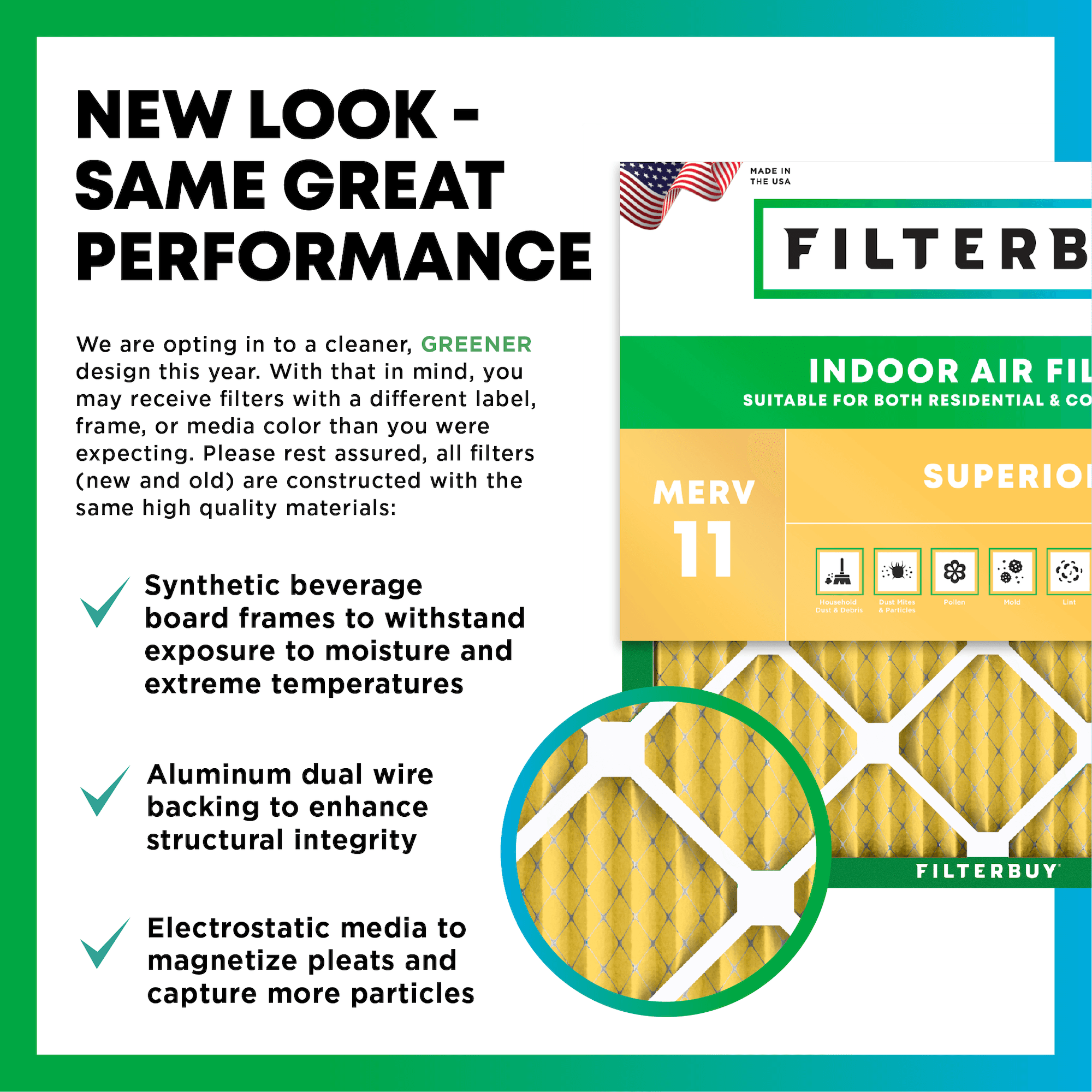
Pleats are magnetized to attract and trap microscopic particles—like pet dander, pollen, and smoke.
Engineered to resist warping in extreme temperatures and high humidity.

A layer of metal reinforcement keeps pleats evenly spaced and structurally sound—no sagging, even at high airflow.
Assembled with care. Built to perform. Ships fast, free, and reliably from our U.S. facilities.

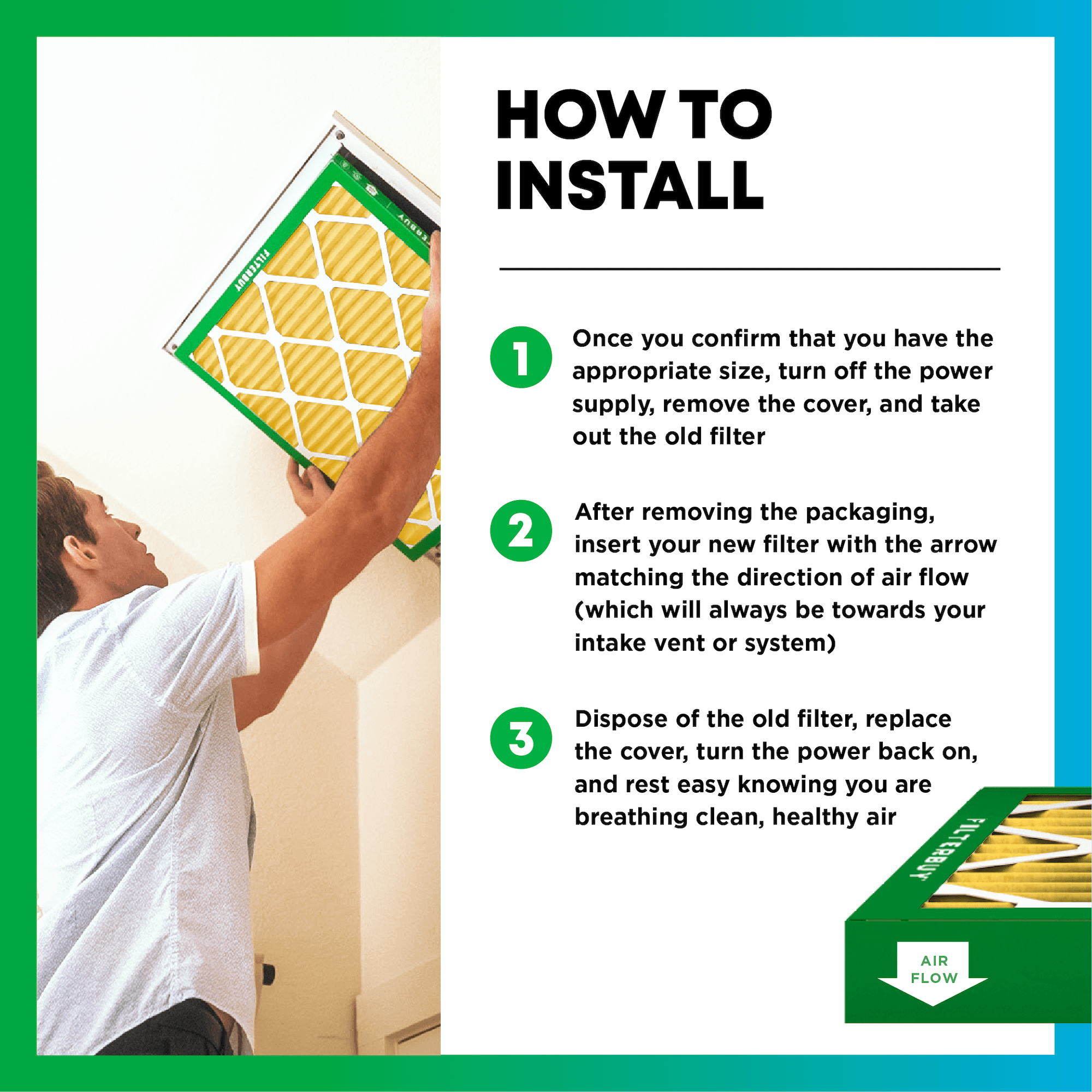
Turn Off Your HVAC SystemSafety first.

Remove The Old FilterLook for the airflow arrow and make note of the direction.

Slide In Your New FilterArrow should point toward the system (same direction as before).

Turn Your System Back OnAnd enjoy the fresh, clean air.

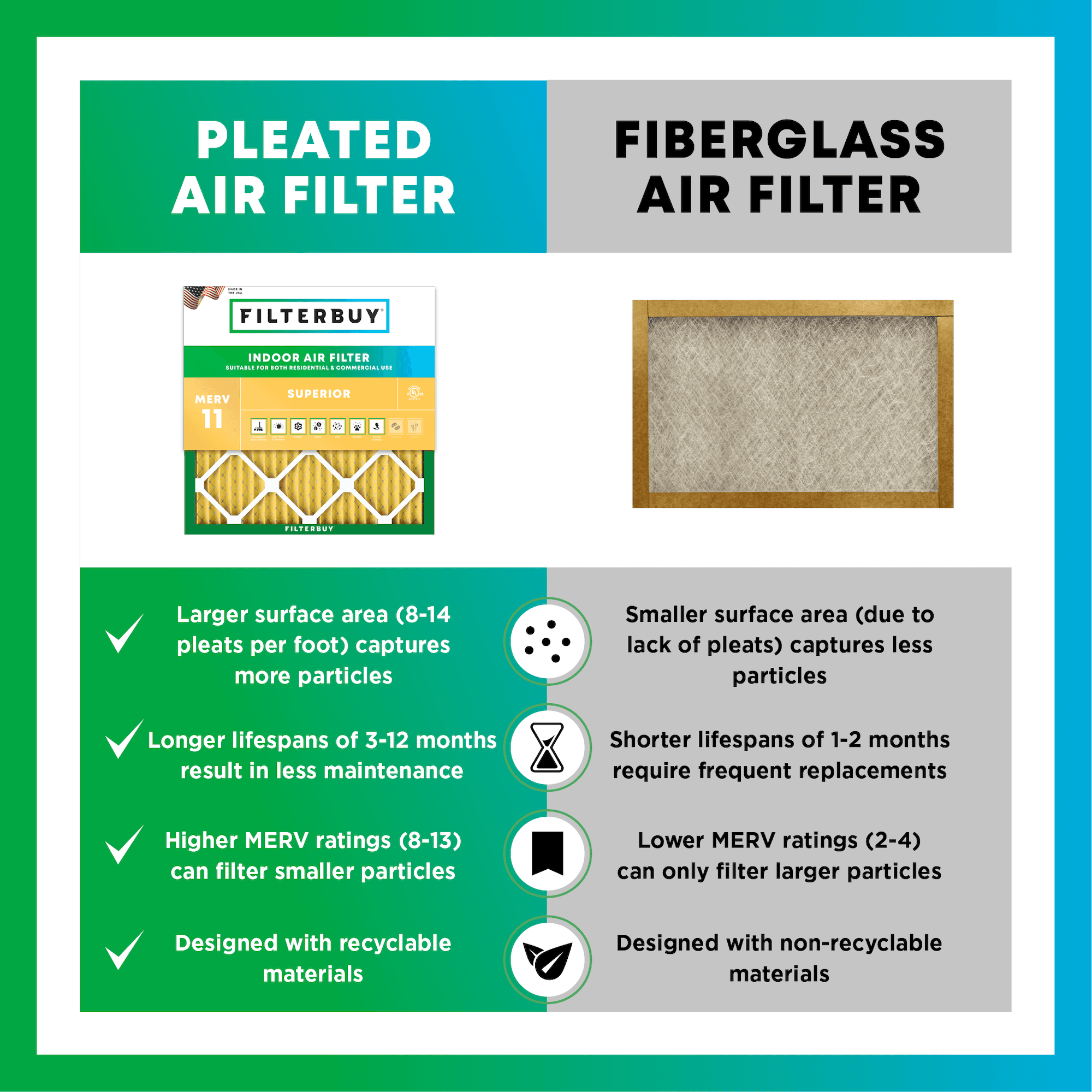
Not all air filters are created equal. Pleated filters don't just last longer—they actually clean your air better. Here's how they stack up:

Efficiency:
High (MERV 8–13) – Traps more particles
Lifespan:
90 days – Long-lasting performance
Air Quality:
Excellent – Cleaner, healthier air
Materials:
Recyclable and durable

Efficiency:
Low (MERV 4 or less) – Misses small stuff
Lifespan:
30 days or less – Replace often
Air Quality:
Minimal – Basic protection only
Materials:
Thin, flimsy, and not recyclable
Pleated filters are a no-brainer—more protection, less hassle, and better air for your home.
Changing your filter on time keeps your HVAC system running efficiently—and helps protect your lungs from dust, allergens, and airborne irritants. Here's how often to swap it out based on your needs:

For most homes without pets or special air quality concerns. Great for general upkeep and energy efficiency.

Shedding fur, dander, and allergy triggers can build up fast. Changing your filter every two months helps keep the air fresher and symptoms at bay.

For households affected by smoke, pollution, or respiratory conditions, monthly changes ensure maximum protection.

| Nominal Size | 12 x 24 x 4 inches |
| Actual Size | 11.5 x 23.38 x 3.63 inches |
| Filter Type | Pleated |
| Media | Electrostatically Charged |
| Frame | Beverage Board |
| MERV Ratings Available | 8, 11, 13 |
| Lifespan | Up to 12 Months |
| Origin | Made in USA |
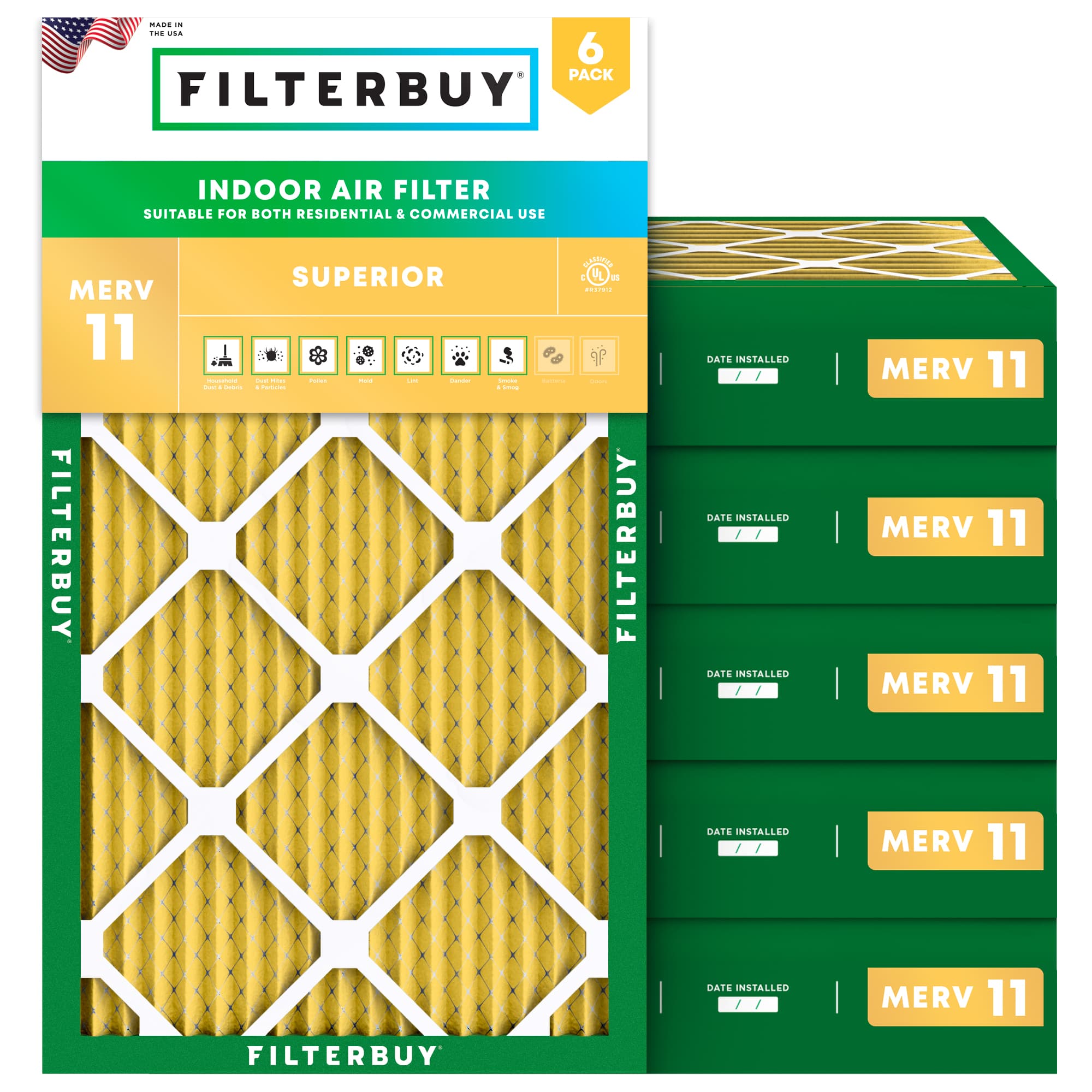
A Filterbuy 12x24x4 MERV 11 filter is built for households dealing with allergies, pets, or pollen. It captures 95% of airborne particles. The four-inch frame holds several times more pleated media than a one-inch panel, so it runs longer between changes. Check your HVAC manual for the tier your system takes, then measure your old filter before you order.
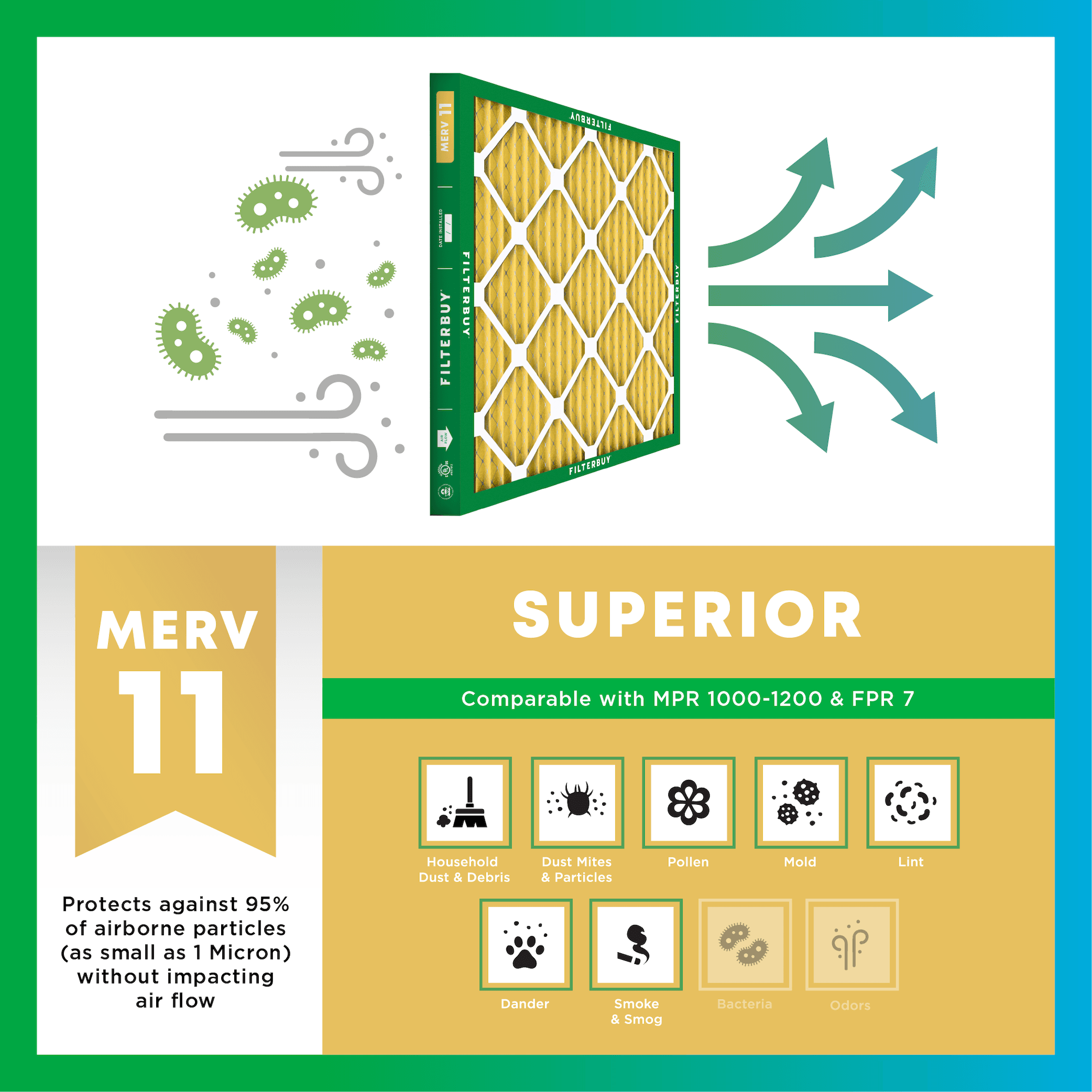
MERV 11 is Filterbuy's Superior tier. It captures 95% of airborne particles and it's comparable to MPR 1000-1200 and FPR 7.
The ladder is short. MERV 8 captures 90% of airborne particles, MERV 11 captures 95%, and MERV 13 captures 98%.
Check your HVAC manual to confirm which MERV tier your system takes, the same way you'd confirm a size.
The Filterbuy 12x24x4 finishes at 11 1/2 by 23 3/8 by 3 5/8 inches. Nominal size is the ordering name, and the cut is smaller by design.
A four-inch filter holds several times more pleated media than a one-inch panel, so it goes longer between changes.
A 12x24x4 MERV 11 air filter is a pleated panel that sits in a four-inch cabinet and cleans the air your HVAC system moves around the house. The name holds two pieces of information. The first, 12 x 24 x 4, is the nominal size you order by. The second, MERV 11, is the filtration tier. MERV stands for Minimum Efficiency Reporting Value, a scale the EPA publishes so you can compare filters across brands.
We're a manufacturer, not a reseller. Filterbuy cuts, pleats, and frames this filter to order in our own US plants. The media is electrostatically charged synthetic, dual wire backing keeps the pleats evenly spaced, and a beverage board frame won't warp the way plain cardboard does in an attic. The same size comes in MERV 8 and MERV 13 as well.
Nominal size and actual size aren't identical, and that catches more people out than anything else here. We cut the 12x24x4 to 11 1/2 by 23 3/8 by 3 5/8 inches. That small clearance is what lets it slide in without forcing.
MERV 11 is our Superior tier, and it captures 95% of airborne particles. It's comparable to MPR 1000-1200 and FPR 7, two third-party rating systems that other manufacturers use, which is why the numbers on two boxes rarely line up.
The full ladder is short enough to hold in your head. MERV 8 is Standard and captures 90% of airborne particles. MERV 11 is Superior at 95%. MERV 13 is Optimal at 98%. MERV 8 is the everyday choice for most homes. MERV 11 is the tier we point allergy and asthma households toward, and it's also the one for pets and pollen. MERV 13 is the one for smoke, and EPA wildfire guidance points the same way when outdoor air turns smoky.
Before you settle on a tier, check your HVAC manual to see which ones your system takes. It's a quick fit check, the same as confirming a size. Our guide to matching a MERV rating to your local air quality index walks through the same comparison if you want it side by side.
A four-inch frame holds several times more pleated media than a one-inch panel. More media means more room for dust to land before the filter fills up.
That's the practical difference. A 12x24x4 goes longer between changes than a one-inch filter in the same house, and that's fewer trips to a cabinet that's often tucked into an attic or a crawlspace you'd rather not visit.
A four-inch filter only fits a four-inch cabinet. If yours is a one-inch slot, adding a cabinet is a job for a technician, and in the meantime a correctly sized one-inch filter will serve you better than a four-inch one that doesn't fit. You can see the full range of four-inch air filters if you're sizing a second return.
Our baseline for this filter is 90 days. Shorten it as your household adds load. Two months suits a home with shedding pets. Six weeks suits a home where someone's managing allergies. Thirty days suits an active renovation or a stretch of smoky air outside.
EPA frames it the same way. The Guide to Air Cleaners in the Home says manufacturers usually recommend every 60 to 90 days, and that a filter which comes out heavily soiled is a sign to change more often.
One detail changes the arithmetic. A filter only cleans air while the system's running, and EPA points out that in many homes that's under 25% of the time during heating and cooling season. A filter that still looks clean after three months in a mild climate may simply not have seen much air.
Finding your size takes about a minute. Slide out the old filter and read the size printed along the frame. If there isn't one in there, measure the slot opening instead and round each dimension up to the nearest inch.
Then order by the nominal 12x24x4. The filter itself finishes at 11 1/2 by 23 3/8 by 3 5/8 inches, and it's meant to. That clearance is what lets it seat cleanly. A filter that has to be bent or crushed to go in is the wrong size, and one that rattles loose lets air slip around the frame instead of passing through the media.
Depth is the one worth double-checking. Some filters labelled four-inch are built for a deeper cabinet and finish around 4 3/8 inches, while ours finishes at 3 5/8. So measure the depth of the filter you pull out. Around 3 3/4 inches or less and a 12x24x4 is your filter. Between 4 1/4 and 4 1/2 inches and you need a five-inch instead.
If your size isn't listed at all, we cut custom sizes to the eighth of an inch.
One more thing while the cabinet's open. Every pleated filter has an airflow arrow printed on the frame. Point it toward the blower, the same way the old one faced.
Hold the filter up to a light. If light doesn't pass through the pleats, it's done, whatever the calendar says. That one test settles most of it, and it takes about ten seconds.
Pull the filter at 45 days and look at the side the air hits. A grey mat spread evenly across the whole face means it's catching what it should. Clean edges around a loaded middle mean something different. Air is finding its way around the frame instead of through the media, and that points to a fit problem rather than a filter problem.
If you've swapped in a fresh filter and the house still feels stuffy or dusty, the filter probably isn't the variable. That's worth a call to an HVAC technician.
Three federal data sources stand behind the guidance above.
Two-thirds of U.S. households run a central heating and cooling system.
Source: U.S. Energy Information Administration. 88% of U.S. households use air conditioning, and two-thirds use central AC or a central heat pump as main equipment. Sample: 18,496 households, 2020 Residential Energy Consumption Survey.
Why it matters: A central system pulls household air through one blower and one filter slot. A 12x24x4 fills that slot for the furnace and the air conditioner alike.
Americans spend about 90% of their time indoors.
Source: U.S. Environmental Protection Agency, Report on the Environment, updated May 2026. The same page reports indoor concentrations of some pollutants running 2 to 5 times higher than typical outdoor levels.
Why it matters: The air your filter treats is the air your household breathes most of the day, so replacement timing carries real weight.
27.8 million Americans had current asthma in 2023.
Source: Centers for Disease Control and Prevention, 27,807,000 people, or 8.4% of the population, from the 2023 National Health Interview Survey.
Why it matters: Roughly one in twelve people lives in a household where indoor air is a daily consideration. MERV 11 is the tier we point those households toward. Anyone managing symptoms should talk to a clinician.
Match the pack to a replacement cycle rather than a price break. On a 90-day schedule, a 4-pack of the 12x24x4 MERV 11 pleated air filter covers a full year for a single-filter system. A 2-pack suits a first-time buyer. A 6-pack suits a two-return home, a rental property, or a household already running on a 60-day cycle.
Per-filter cost drops as pack size rises, and auto delivery from Filterbuy takes the reminder off your plate. Delivery is fast and free 2-day to most US states. The same tier runs across every size in the MERV 11 range if a second return takes another size.
MERV 11 is our Superior tier and it's a common choice for homes. Check your HVAC manual to confirm which tiers your system takes, the same way you'd confirm a size. If the manual isn't handy, an HVAC technician can tell you in a minute.
No. A four-inch filter needs a four-inch cabinet. Forced into a shallower slot the frame bends, and gaps open up that let air slip past the media.
It won't seal. A one-inch filter in a four-inch slot leaves about three inches of gap around the frame, and air takes that path instead of going through the media. Order the correct depth, or have a technician fit a spacer built for the cabinet.
MERV 13. It's our Optimal tier and captures 98% of airborne particles. Check your HVAC manual to confirm your system takes it.
The Filterbuy 12x24x4 finishes at 11 1/2 by 23 3/8 by 3 5/8 inches. Every filter is cut smaller than its nominal name so it seats without binding. Order by nominal size, then check the finished figure against your cabinet.
MERV is the scale the EPA publishes. MPR and FPR are third-party rating systems that other manufacturers use. Our MERV 11 is comparable to MPR 1000-1200 and FPR 7.
MERV. Minimum Efficiency Reporting Value, the scale the EPA publishes so you can compare filters across brands.
Nominal size. The rounded name you order by, such as 12x24x4.
Finished size. The true cut dimensions, always a little under nominal so the filter seats without binding. For the Filterbuy 12x24x4 that's 11 1/2 by 23 3/8 by 3 5/8 inches.
Pleated media. The folded material inside the frame that does the actual catching. More folds mean more surface area.
Filter cabinet. The housing your filter slides into. A four-inch filter needs a four-inch cabinet.
MPR and FPR. Microparticle Performance Rating and Filter Performance Rating, third-party scales used by other manufacturers alongside MERV.
Beverage board. A dense moisture-resistant board used for filter frames. It resists warping in heat and humidity better than plain cardboard.

