
Current Live Wildfire and Smoke Map Kansas City MO Today From Filterbuy.com
By Michelle Wan, Filterbuy Contributor | Reviewed for technical accuracy by David Clark, Licensed HVAC Technician | Published July 6, 2026 | Updated July 6 2026
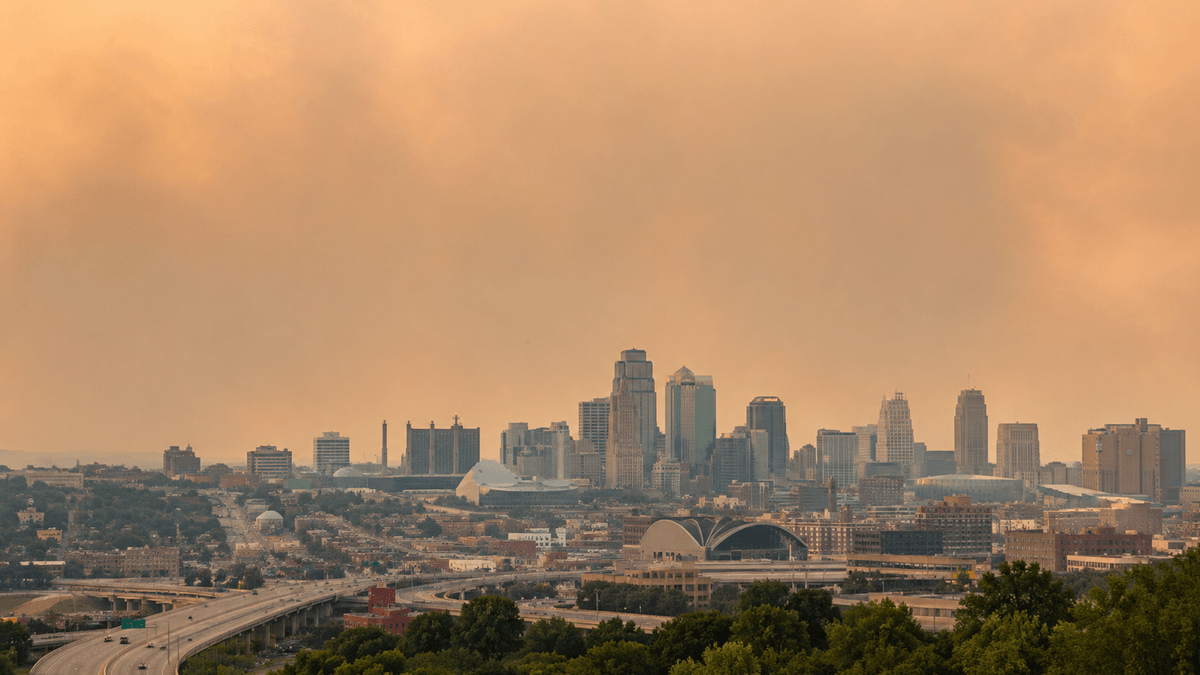
Hazy skies over the Kansas City metro almost always trace back to a fire you cannot see, often burning hundreds or thousands of miles north in Canada or west across the Rockies. This page gives you a live view of that smoke and the air it leaves behind so you can decide, in the next five minutes, whether it is safe to open a window, send the kids outside, or head out for errands. Every fire season, our team hears the same two questions from Kansas City households once the haze arrives. They ask whether it is safe to open the windows, and which filter actually stops the smoke. Filterbuy makes the filters that pull fine smoke from the air your family breathes indoors, and we watch these events closely because smoke has become one of the largest threats to indoor air quality across the middle of the country.
TL;DR Quick Answers
Kansas City sees its worst air on days when wildfire smoke drifts in from Canadian or western U.S. fires, and 2026 is already an unusually early and active fire season. The live map below pulls current air quality readings from federal EPA and Forest Service monitors so you can check smoke and AQI for your zip code right now. When the AQI climbs into the orange range or higher, close up your home, run your HVAC system on recirculate with a MERV 13 filter, and add a portable air cleaner to keep the fine particles you cannot see out of your lungs.
Is the air quality in Kansas City safe today?
Check the live map above for your exact location. As a rule, a green or yellow AQI is acceptable for most people, orange means sensitive groups should limit time outside, and red or higher means everyone should stay indoors with filtered air.
Where is the smoke over Kansas City coming from?
Most heavy smoke over the metro arrives from wildfires in Canada or the western United States, carried thousands of feet up by the jet stream and settling back toward the ground as haze.
What filter should I run during a smoke event?
Federal health agencies point to MERV 13 as the rating that captures fine wildfire particles while still letting most home HVAC systems breathe. Run it on recirculate and replace it more often while smoke lasts.
Check The Live Kansas City Wildfire And Smoke Map
The live map below shows current wildfire smoke and fine particle pollution across the Kansas City area, which Filterbuy pulls from the EPA and U.S. Forest Service AirNow Fire and Smoke Map. Green and yellow markers mean the air is acceptable for most people. Orange, red, and purple mean fine particles have climbed to levels that harm sensitive groups first and then everyone. Check it before any outdoor plans today, because readings can shift within hours.
[PLACEHOLDER - LIVE MAP EMBED: Responsive iframe of the AirNow Fire and Smoke Map (fire.airnow.gov) centered on Kansas City, MO (lat 39.0997, lon -94.5786). Provide a server-rendered fallback link for crawlers and agents. See Technical Build Notes.]
Key Takeaways
Kansas City's unhealthy-air days are driven mostly by wildfire smoke that travels in from Canadian and western U.S. fires, not by local burning.
The EPA and U.S. Forest Service AirNow Fire and Smoke Map is the most reliable free tool for checking current smoke and PM2.5 at your zip code.
An AQI of 101 or higher (orange) signals risk for sensitive groups, and 151 or higher (red) is unhealthy for everyone.
PM2.5, the fine particles in smoke, are small enough to reach deep into the lungs and pass into the bloodstream.
A MERV 13 filter on your HVAC system captures and reduces these fine particles indoors, and works best with the system set to recirculate and the home closed up.
MERV 13 is a high-efficiency HVAC rating, not a HEPA filter, so pairing it with a portable HEPA air cleaner gives the strongest indoor protection.
How To Read The Kansas City Air Quality Index Today
The Air Quality Index turns pollution readings into a single number from 0 to 500 and a color that tells you what to do. During a smoke event, that number is driven by PM2.5, the fine particle in wildfire smoke. The table below shows each category, what it means for your air, and the step a Kansas City household should take at each level. For a fuller walkthrough of the colors, the fire icons, and the smoke layer, read Filterbuy's guide on how to read a wildfire smoke map.
Scale and health categories follow the EPA Air Quality Index used by AirNow. See the 7 Essential Resources on the page for the underlying agency guidance.
Is Today's Haze Wildfire Smoke Or Ozone?
In Kansas City, a hazy sky can mean wildfire smoke or ground-level ozone, and the two call for different responses. Smoke is made of fine particles you can often smell, and a MERV 13 filter captures them indoors. Ozone is an invisible gas that builds on hot, sunny days, and a furnace filter does not remove it. Once you know which one you face, you know whether to run your filter or simply wait out the afternoon heat.
Wildfire smoke: a gray or brown cast and a campfire smell, with the AQI driven by PM2.5. It can arrive any time from late spring through early fall, when Canadian and western fires peak. Seal up, switch to recirculate, and run a MERV 13 filter.
Ground-level ozone: no smoke smell and often a clear-looking sky, worst on hot, still summer afternoons. The Mid-America Regional Council issues a daily SkyCast forecast and Ozone Alerts for the metro from March through October. On an Ozone Alert day, limit hard outdoor activity in the afternoon, because a filter cannot pull ozone gas out of the air.
Humidity haze: a muggy, milky sky with normal air quality readings and no smell. It is water vapor, not a health particle, so it needs no filter response.
The quickest test is your nose and the map. A campfire smell plus a rising PM2.5 reading on the Fire and Smoke Map points to smoke, while a high number on a hot, odorless afternoon usually points to ozone.
Why Kansas City Gets Wildfire Smoke From Fires Hundreds Of Miles Away
Kansas City often breathes smoke from fires it will never see because wildfire plumes ride high-altitude winds for hundreds and sometimes thousands of miles. NOAA satellites have tracked Canadian smoke crossing the entire continent within days. When that high smoke sinks toward the ground over Missouri, it raises PM2.5 and turns the sky milky, even with no fire anywhere near the metro.
The pattern repeats most summers. Fires across the Canadian boreal forest and the western states throw plumes high into the atmosphere, and the jet stream steers them south and east. The Upper Midwest and Great Lakes usually catch the earliest, heaviest smoke, but large events reach well into the Plains and the South. In 2025, smoke from fires in Saskatchewan and Manitoba pushed air quality alerts as far south as Texas, and Kansas City sat under hazy skies on multiple days. For a deeper look at how cross-border smoke behaves, see Filterbuy's guide to Canadian wildfire smoke.
How Wildfire Smoke And PM2.5 Affect Your Health
Wildfire smoke harms health mainly through PM2.5, fine particles less than 2.5 microns across that slip past the body's natural defenses and settle deep in the lungs. The CDC and the American Lung Association warn that these particles can trigger asthma and COPD flare-ups, strain the heart, and send vulnerable people to the emergency room. Children, older adults, pregnant people, and anyone with heart or lung disease face the highest risk.
Smoke is not simply dirty air. It carries a mix of gases and fine particles that reach far deeper into the lungs than larger dust, and some of it crosses into the bloodstream. Research from UC San Diego found that fine particles from wildfire smoke were far more damaging to the respiratory system than the same mass of particle pollution from everyday sources. The harm also builds over consecutive smoky days, which is why a week-long smoke event matters more than a single hazy afternoon. This is health information for general awareness and is not a substitute for advice from your own doctor. If you have a heart or lung condition, talk with your healthcare provider about a plan for smoke events. To limit what reaches your lungs indoors, follow Filterbuy's room-by-room guide on how to keep wildfire smoke out of your house.
How To Protect Your Home's Air During A Smoke Event
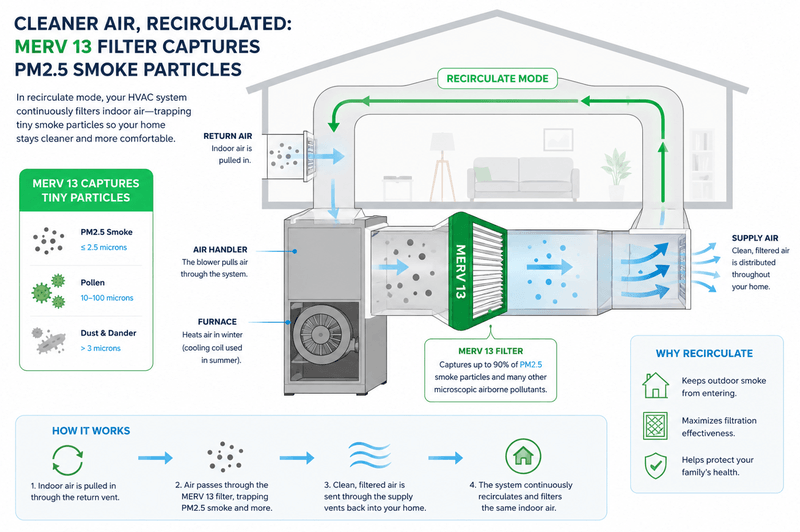
The Filterbuy team boils smoke-day protection down to two jobs: keeping smoke out and filtering what gets in. Close windows and doors, switch your HVAC system to recirculate so it stops pulling in outdoor air, and run a MERV 13 filter to capture and reduce the fine particles already inside. Set up one room with a portable air cleaner as a cleaner-air space for sleeping and for anyone at higher risk.
Work through these steps in order when the map turns orange or worse:
Close up the house. Shut windows, doors, and fireplace dampers to slow how much smoke seeps in.
Set your system to recirculate. This keeps the HVAC from drawing smoky outdoor air into the home.
Upgrade to a MERV 13 filter. This rating captures and reduces the fine PM2.5 that lighter filters let pass.
Add a portable HEPA air cleaner. Size it to the room where your family spends the most time.
Create one cleaner-air space. Pick a room you can close off and keep the portable cleaner running there.
Replace filters more often. Heavy smoke loads a filter faster, so keep spares on hand and swap early.
Keep watching the map. Air out the house only when readings drop back into the green or yellow range.
No central HVAC, or renting a place you cannot change? You still have a solid option. EPA researchers have shown that a box fan paired with a MERV 13 filter works as a low-cost air cleaner that pulls fine smoke from a single room. Use a newer box fan with modern safety features, attach the filter to the intake side with the airflow arrow pointing at the fan, and run it in the room where your family spends the most time.
Choosing The Right Filter For Wildfire Smoke
A MERV 13 filter sits near the top of the residential efficiency scale and captures a large share of the fine PM2.5 that lighter filters let slip through. MERV 13 is not a HEPA filter, and it should not be described as one, but it is the rating federal agencies point to for wildfire smoke because it balances strong particle capture with the airflow a home system needs. For a closer look at how the ratings stack up against smoke, see Filterbuy's guide to the best MERV filter for wildfire smoke. Confirm your HVAC system can handle MERV 13 before switching, then replace the filter more often while smoke lingers because heavy particle loads clog it faster. In our experience helping households through smoke events, that clogging happens fast. A filter that looked clean at the start of a smoky week can come out dark by the end, so at Filterbuy we tell people to check it every few days while the haze holds and swap early instead of waiting for the calendar. Keep a spare on hand for the next smoke event.
After manufacturing filters for over a decade and serving more than two million households, we have watched wildfire smoke turn from a western problem into a national one. The families who stay ahead of it treat their filter as the last line of defense, upgrade to MERV 13 before the smoke arrives, and keep spares on hand so they never run a clogged filter when the air turns.
David Heacock, Founder and Chief Executive Officer, Filterbuy