February 13, 2026
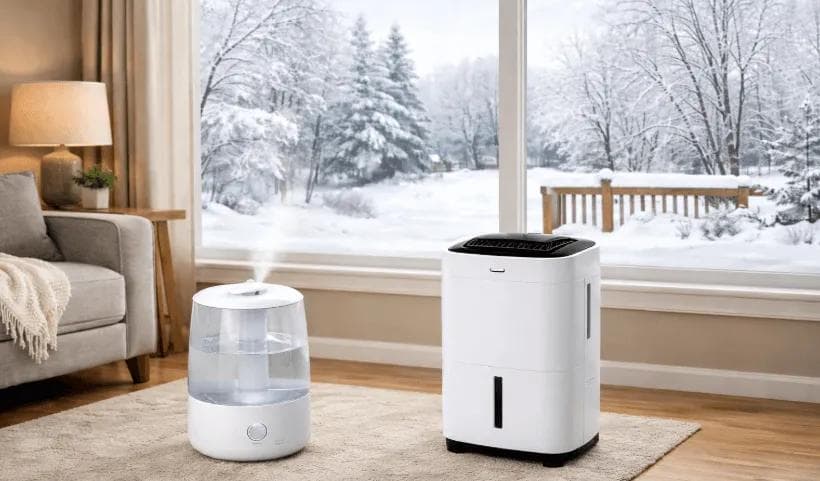
Your heating system is quietly drying out your home every time it runs — and that's only half the problem.
Customers tell us they're shocked to learn their winter air complaints aren't a single issue. Dry skin and static point to low humidity. Foggy windows and musty corners signal too much moisture. Dust that won't quit means filtration isn't keeping up. Most homes are dealing with all three at once and don't realize it.
After manufacturing millions of HVAC filters, we've seen a pattern most guides miss: humidity and filtration aren't separate problems — they're connected. Excess moisture loads filters faster. Over-dry air lets fine particles stay airborne longer. A clogged filter forces your system to work harder, which strips even more moisture from the air. It's a cycle, and fixing only one piece doesn't break it.
That's why winter comfort comes down to balance — the right humidity control paired with the right filter, working together.
This guide walks you through exactly how to identify what your home actually needs, choose the right combination of humidifier, dehumidifier, and HVAC filter, and get your indoor air working for your family instead of against it.
Winter air quality depends on three tools working together — not separately.
Your heating system strips moisture from indoor air. Sealing your home traps pollutants inside. Everyday activities like cooking and showering push humidity back up unevenly. The result is air that feels dry, dusty, and off — often all at once.
After manufacturing millions of HVAC filters, here's what we've learned most guides miss:
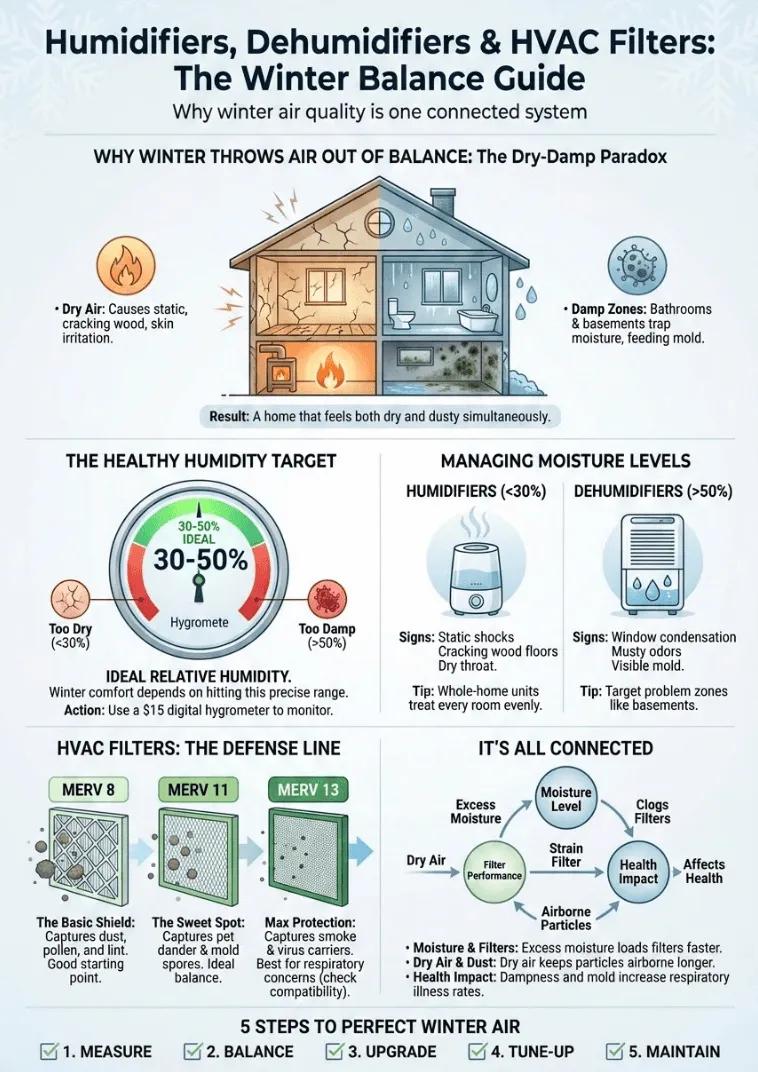
Humidifiers add moisture back when indoor humidity drops below 30%. Signs you need one: static shocks, cracking wood, dry throat, irritated sinuses.
Dehumidifiers remove excess moisture when specific zones climb above 50%. Signs you need one: window condensation, musty odors, visible mold in basements or bathrooms.
HVAC filters capture the dust, allergens, and particles that sealed winter homes recirculate nonstop. Choose MERV 8 for basics, MERV 11 for most homes, or MERV 13 for allergy and respiratory concerns.
The critical insight: these three systems interact. Excess moisture clogs filters faster. Clogged filters trap moisture and feed mold. Dry air keeps particles airborne longer. Fixing one while ignoring the others doesn't solve the problem.
The winter balance in three steps:
Measure your humidity with a digital hygrometer — target 30% to 50%.
Add humidity control where your readings say you need it.
Install the right MERV-rated filter for your system and check it monthly.
Winter air quality is one connected system — not three separate problems. Humidity and filtration interact constantly. Excess moisture loads filter faster. Clogged filters trap moisture and feed mold. Dry air keeps fine particles airborne longer. Fixing one while ignoring the other leaves your family exposed.
The 30% to 50% humidity range is your target. Most homes miss it. A $15 digital hygrometer tells you what your home actually needs — before you spend money on anything else.
Your HVAC filter works hardest in winter. Sealed homes recirculate concentrated pollutants all season. Check your filter monthly. Replace it the moment it shows visible dirt or discoloration. Don't wait for a calendar reminder.
The right MERV rating matches your system — not your worry level. A MERV 13 in a system built for MERV 8 restricts airflow the same way a dirty filter does. Right-sizing protects your air quality and your equipment.
Leaky ducts can cancel out every other improvement. If 20 to 30 percent of conditioned air never reaches your filter, no upgrade fully solves the problem. Get your ducts inspected before assuming your equipment is the issue.
Your furnace or heat pump doesn't just warm the air — it fundamentally changes it.
Heated air holds less relative moisture. The warmer your system pushes indoor temps, the drier your air becomes. Meanwhile, you're sealing windows, closing doors, and tightening up your home against the cold. That traps whatever's floating around — dust, pet dander, allergens, cooking particles — and recirculates it through your system over and over.
The result is a home that feels dry and dusty at the same time. We hear it from customers constantly: "My air feels off, but I can't pinpoint why." It's because winter creates competing air quality problems simultaneously.
Common signs your home's winter air is out of balance include dry or cracking skin, persistent static electricity, sinus irritation or scratchy throat, condensation forming on windows, dust resettling almost immediately after cleaning, and an HVAC system that seems to run nonstop without fully conditioning the space.
If any of that sounds familiar, the fix starts with understanding the three tools that work together to solve it.
A humidifier adds moisture back into the air that your heating system has dried out. If your home drops below 30% relative humidity — and most heated homes do in winter — a humidifier is the most direct solution.
You'll know you need one when wood floors or furniture start cracking, when static shocks become a daily occurrence, or when dry throat and sinus irritation persist despite staying hydrated. These aren't cosmetic problems. Low humidity also forces your HVAC system to work harder because dry air feels cooler, which means your thermostat keeps calling for heat.
Whole-home humidifiers install directly into your HVAC system and treat every room evenly through your existing ductwork. They're the most effective long-term solution and require the least daily maintenance.
Portable units work well for targeting a single room — a nursery or bedroom, for example — but they need constant refilling and cleaning. They also can't keep up with a full house during sustained cold weather.
From what we've seen working with homeowners across different climates, whole-home units deliver more consistent results. But a quality portable humidifier in the right room can make a noticeable difference if a whole-home installation isn't in the budget yet.
The sweet spot for winter is 30% to 50% relative humidity. Below 30%, you'll feel the dryness. Above 50%, you're inviting condensation, mold growth, and a whole different set of problems.
A simple digital hygrometer — available for under $15 at most hardware stores — lets you monitor levels in real time. We recommend placing one in your main living area and one near a problem zone like a basement or bathroom to get an accurate picture of what's happening throughout the house.
This is the part most winter air guides skip entirely.
Even in the coldest months, indoor humidity can spike well above healthy levels. Every hot shower, pot of boiling water, and load of laundry releases moisture into a home that's sealed tight against the cold. Without adequate ventilation, that moisture has nowhere to go.
Customers often tell us they assumed condensation on their windows was normal in winter. It's not — it's a signal that indoor humidity has climbed too high in certain zones, even while other rooms feel bone dry.
Basements are the biggest culprits, especially in older homes with limited ventilation. Bathrooms without exhaust fans or with fans that vent into the attic rather than outside are another common trouble spot. Tightly sealed newer construction can also trap moisture more than homeowners expect.
The risk is real. Excess moisture feeds mold growth, creates musty odors, and accelerates allergen buildup — all of which end up circulating through your HVAC system and into every room.
Like humidifiers, dehumidifiers come in whole-home and portable options. Whole-home units integrate with your HVAC system and manage moisture levels across the entire house automatically. Portable units are effective for isolating problem areas like basements or laundry rooms.
When choosing capacity, match it to the square footage and severity of the moisture issue. A unit that's too small will run continuously without solving the problem, driving up energy costs without delivering results.
Here's what we've learned after manufacturing millions of filters: humidity control without proper filtration only solves half the equation.
Your humidifier and dehumidifier manage moisture. Your HVAC filter manages everything else — dust, allergens, pet dander, smoke particles, and the winter pollutants that accumulate in a sealed-up home. During winter, your system cycles air more frequently because it's running longer to maintain the temperature. Every cycle pushes air through your filter. A clean, properly rated filter captures contaminants each pass. A dirty or underrated filter just recirculates them.
Winter is also when your HVAC system needs the most protection. The system is working harder and running longer. A clogged filter restricts airflow, which strains the blower motor, reduces efficiency, and can lead to costly repairs — exactly when you can least afford a system breakdown.
MERV stands for Minimum Efficiency Reporting Value, and it tells you what size particles a filter can capture.
MERV 8 handles the basics — dust, pollen, and lint. It's a solid starting point for homes without significant allergy concerns or pets.
MERV 11 steps up to capture finer particles, including pet dander, mold spores, and dust mite debris. For most households, this is the performance sweet spot — effective filtration without restricting airflow on standard residential systems.
MERV 13 captures even smaller particles, including some bacteria and virus carriers, smoke, and fine allergens. It's the highest rating most residential systems can handle without airflow modification, and it's what we recommend for homes with allergy sufferers, respiratory concerns, or pets.
One thing we tell every customer: a higher MERV rating only works if your system can support it. An oversized MERV rating on an undersized system creates the same airflow restriction as a dirty filter. If you're unsure what your system can handle, check with your HVAC technician before jumping to the highest available rating.
Winter typically demands more frequent filter changes than other seasons. Your system runs longer, processes more air, and your home is sealed tight — meaning more particulates are cycling through with no escape.
Our general recommendation is to check your filter monthly during winter. Standard 1-inch filters often need replacement every 30 to 60 days during heavy use. Thicker 4- or 5-inch filters can last longer but should still be inspected monthly.
Real-world cues it's time to replace: visible dust or discoloration on the filter media, reduced airflow from your vents, increased dust on surfaces shortly after cleaning, or your system running longer than usual to reach the set temperature. Don't wait for a scheduled date if you're seeing these signs.
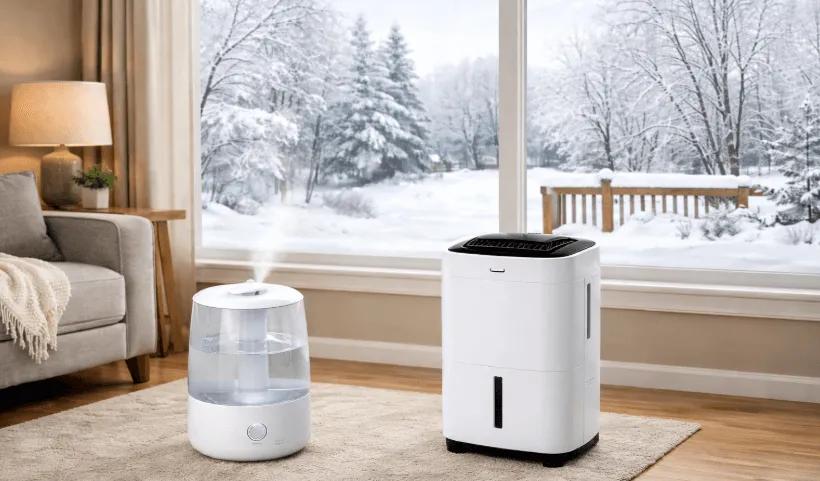
Getting this right doesn't require an engineering degree. It takes five straightforward steps.
First, identify whether your home runs too dry, too damp, or both. Pay attention to the symptoms. Dry skin and static mean low humidity. Condensation and musty smells mean excess moisture. Persistent dust and allergen issues mean filtration isn't keeping up. Many homes have different problems in different rooms.
Second, measure your humidity levels. Place a hygrometer in your main living space and in any area you suspect has issues. Monitor readings over a few days to get an accurate baseline rather than reacting to a single reading.
Third, address humidity with the right tool. If readings consistently fall below 30%, a humidifier is your priority. If specific areas climb above 50%, a dehumidifier solves the moisture problem. Some homes genuinely need both — a humidifier for the main living areas and a dehumidifier for the basement or bathroom.
Fourth, upgrade or replace your HVAC filter. Choose a MERV rating that matches both your air quality concerns and your system's capacity. Install a fresh filter and commit to monthly checks throughout winter.
Fifth, maintain the system seasonally. Humidifiers and dehumidifiers need regular cleaning to function properly. Filters need consistent replacement. And your HVAC system benefits from a professional tune-up before the heating season starts to ensure everything works together efficiently.
The air feels dry, but the windows have condensation. You're likely dealing with uneven humidity — dry in living areas where heat runs most, excessive moisture in kitchens, bathrooms, or poorly ventilated zones. Address both with targeted humidity control by room.
Musty smell despite low humidity readings. This usually points to a filtration or airflow issue rather than a moisture problem. Check your filter first — a clogged filter traps moisture and organic material that creates odor. Also, inspect ductwork for any signs of past moisture damage or mold.
HVAC is running constantly without reaching the set temperature. A clogged filter is the most common cause. Restricted airflow forces the system to run longer without effectively conditioning the space. Replace the filter and monitor. If the problem persists, it may indicate a system issue worth having a technician evaluate.
Dust resettles immediately after cleaning. Your filter's MERV rating is likely too low for your home's particulate load, or the filter is overdue for replacement. Upgrading to MERV 11 or 13 — if your system supports it — typically makes a noticeable difference within days.
"After manufacturing millions of filters and hearing from customers across every climate zone, the biggest winter air quality mistake we see is treating humidity and filtration as separate problems — they're not. When one is off, it drags the other down, and your HVAC system pays the price."
We're obsessed with indoor air quality — and we know you want to make the best decisions for your family. After manufacturing millions of HVAC filters and working with homeowners across every climate, we've learned that the best-informed families are the best-protected families. These are the most authoritative resources behind the guidance in this winter balance guide, handpicked to help you take confident action.
Most homeowners don't realize there's an official recommended range for indoor humidity — and that falling outside it affects everything from your family's health to your HVAC system's lifespan. The EPA's indoor air quality guide establishes the 30% to 50% humidity standard and explains how ventilation, filtration, and moisture control work together. It's the same framework we use when helping customers identify what's really going on with their winter air.
Source: U.S. Environmental Protection Agency — Care for Your Air: A Guide to Indoor Air Quality https://www.epa.gov/indoor-air-quality-iaq/care-your-air-guide-indoor-air-quality
Customers tell us all the time that they bought a humidifier to fix dry winter air — but never learned how to maintain it properly. That's a problem. Mayo Clinic's clinical guide explains when humidifiers genuinely help ease dry skin, sinus irritation, and breathing discomfort, and when poor maintenance turns them into a breeding ground for bacteria and mold. Read this before plugging one in.
Source: Mayo Clinic — Humidifiers: Air Moisture Eases Skin and Breathing Symptoms https://www.mayoclinic.org/diseases-conditions/common-cold/in-depth/humidifiers/art-20048021
Here's something that surprises most homeowners: mold doesn't take a winter break. Excess indoor humidity from cooking, showering, and sealing up your home feeds mold growth even when it's freezing outside. We see the downstream effects constantly — filters loading up faster, musty odors circulating through ductwork, and allergens spiking in homes that look perfectly clean. The EPA's homeowner guide explains exactly how winter moisture problems develop and what stops them.
Source: U.S. Environmental Protection Agency — A Brief Guide to Mold, Moisture and Your Home https://www.epa.gov/mold/brief-guide-mold-moisture-and-your-home
After over a decade of manufacturing filters across every MERV rating, we can tell you that the most common mistake homeowners make is choosing a rating that's either too low for their air quality needs or too high for their system's capacity. ASHRAE — the organization that created the MERV rating system — breaks down how the ratings work, what particle sizes each level captures, and why the right match between filter and system matters more than just grabbing the highest number on the shelf.
Source: American Society of Heating, Refrigerating and Air-Conditioning Engineers — Filtration and Disinfection FAQ https://www.ashrae.org/technical-resources/filtration-and-disinfection-faq
Protecting your family's air shouldn't mean watching your energy bill climb all winter. The U.S. Department of Energy's seasonal guide covers practical HVAC strategies, thermostat recommendations, and system efficiency tips designed specifically for cold weather. We recommend this resource to customers who want to keep their system running efficiently while maintaining the air quality improvements they've made with better filtration and humidity control.
Source: U.S. Department of Energy — Fall and Winter Energy-Saving Tips https://www.energy.gov/energysaver/fall-and-winter-energy-saving-tips
We say it often because it's true: a dirty filter or leaking ductwork undermines every other air quality improvement you make. ENERGY STAR's heating and cooling resource covers monthly filter inspections, duct sealing, and equipment maintenance scheduling that directly impact how well your system filters and circulates air during the months it's working hardest. This is the kind of proactive maintenance that protects your family, your HVAC system, and your investment in cleaner air.
Source: ENERGY STAR — Heat and Cool Efficiently https://www.energystar.gov/saveathome/heating-cooling
Pro tip: after helping millions of customers maintain better indoor air quality, we've seen that the homeowners who schedule a professional HVAC tune-up before heating season starts almost always avoid the emergency calls that come in January. ENERGY STAR's detailed pre-season checklist outlines exactly what a qualified technician should inspect, clean, and adjust — so you know what to expect and can hold your service provider to the right standard.
Source: ENERGY STAR — HVAC Maintenance Checklist https://www.energystar.gov/saveathome/heating-cooling/maintenance-checklist
We don't just manufacture filters — we talk to the homeowners who use them every day. The patterns we see from the production floor to the customer call line align directly with what the research confirms.
After working with millions of customers, one thing is clear. Most families have no idea the air inside their home is often worse than what's outside.
The EPA confirms it. Indoor pollutant concentrations are often 2 to 5 times higher than outdoor levels.
We hear it every winter: "Why is there so much dust when the house has been closed up for weeks?"
The answer is simple. A sealed home concentrates everything your HVAC system recirculates:
Dust and dust mites
Pet dander
Allergens and mold spores
Cooking particles and odors
Volatile organic compounds from household products
Without the right filter working alongside proper humidity control, those pollutants just keep cycling through your air.
It's exactly why we offer over 600 filter sizes and focus on helping homeowners match the right MERV rating to their system and their family's needs.
Source: U.S. Environmental Protection Agency — Indoor Air Quality https://www.epa.gov/report-environment/indoor-air-quality
This is one of the most overlooked issues we encounter. It also explains a problem that customers bring to us constantly.
"I'm changing my filter on schedule, but my house still feels dusty, and my system never stops running."
ENERGY STAR reports the cause. In a typical home, 20 to 30 percent of conditioned air is lost through leaks, holes, and poorly connected ducts.
From our experience, those leaks do more than waste energy. They pull unfiltered air from hidden spaces directly into your living area:
Attics — carrying insulation particles and dust
Crawlspaces — introducing moisture and allergens
Wall cavities — bypassing your filter entirely
We've seen customers upgrade to a MERV 13 filter and still struggle with air quality — only to discover compromised ductwork was the real culprit.
The takeaway is straightforward. A quality filter can only protect what passes through it. If your ducts are leaking, a significant portion of your home's air never gets filtered at all.
Source: ENERGY STAR — Duct Sealing https://www.energystar.gov/saveathome/heating-cooling/duct-sealing
This statistic hits close to home for us. We see the downstream effects in filter performance every day.
Research from Lawrence Berkeley National Laboratory found:
Indoor dampness and mold are associated with 30% to 70% increases in respiratory health problems
Roughly 21% of current U.S. asthma cases are estimated to be linked to dampness and mold exposure in the home
What the research describes, we witness through customer buying patterns and service calls:
Homes with uncontrolled moisture load filters significantly faster.
Customers in humid climates tell us filters are visibly clogged weeks ahead of schedule.
Musty smells in ductwork confirm mold and moisture are compounding the problem.
That's why this guide doesn't treat humidity and filtration as separate topics. After manufacturing millions of filters, we can tell you with certainty — excess moisture and inadequate filtration compound each other. Getting one right while ignoring the other leaves your family exposed and your HVAC system working harder than it should.
Source: Lawrence Berkeley National Laboratory — Indoor Air Quality Scientific Findings Resource Bank: Dampness and Mold https://iaqscience.lbl.gov/dampness-and-mold
Most guides treat humidifiers, dehumidifiers, and HVAC filters as three separate purchases, solving three separate problems.
We get it. They're different products sold in different aisles.
But after manufacturing millions of filters and hearing from homeowners across every climate zone, we've concluded that most content on this topic misses entirely.
Winter air quality is not three problems. It's one system.
Humidity and filtration are in constant conversation inside your home. When one shifts, the other responds:
Excess moisture loads your filter faster.
A clogged filter restricts airflow, traps moisture, and gives mold a foothold.
Dry air keeps fine particles suspended longer, demanding more from your filter.
Every piece affects every other piece.
The homeowners who get the best results aren't the ones who bought the most expensive humidifier or the highest MERV-rated filter. They're the ones who understood the balance.
Start with measurement, not purchases. A $15 hygrometer tells you more about what your home needs than any product listing ever will.
Match your filter to your system, not your anxiety. A MERV 13 in a system built for MERV 8 creates the same airflow problems as a dirty filter. Right-sizing beats upsizing.
Think in zones, not whole-house averages. Your basement and your bedroom are not the same environment. Treat them accordingly.
Check your ducts before blaming your filter. If 20 to 30 percent of your air bypasses filtration through leaky ductwork, no filter upgrade solves the problem alone.
Commit to monthly winter check-ins. A 60-second visual filter check and a glance at your hygrometer once a month prevent most of the problems homeowners call us about in January and February.
We're not saying this is complicated. We're saying it's connected.
The families who breathe the best winter air understand one thing — humidity control and filtration work as partners. Maintaining both consistently matters more than perfecting either one in isolation.
That's the balance. And once you have it, you'll feel the difference every time your system kicks on.
You've got the knowledge. Here's exactly how to put it into action.
These steps are based on what works best after helping millions of homeowners improve their indoor air quality.
Before buying anything, find out what you're actually dealing with.
Get a digital hygrometer. Place one in your main living area. Place a second near a problem zone, like a basement or bathroom. Monitor for 3 to 5 days.
Pull out your current filter. Gray, discolored, or visibly clogged? Replace it now — regardless of the last change date.
Walk through your home room by room. Look for:
Condensation on windows
Static shocks
Musty odors
Dust resettles quickly after cleaning
Rooms that never reach a comfortable temperature
Your hygrometer readings tell you exactly what to do next.
Below 30% consistently → Add a humidifier. Whole-home units deliver the most even results. Portable units work for targeting a single room.
Above 50% in specific areas → Add a dehumidifier. Start with basements, bathrooms, and laundry rooms. Match capacity to square footage.
Mixed readings room to room → You may need both. This is more common than most homeowners expect.
This is the one piece of the system that needs attention most frequently.
Find your size. Check the dimensions printed on your current filter's frame — length × width × depth.
Choose the right MERV rating:
MERV 8 — handles dust, pollen, and lint
MERV 11 — the sweet spot for most homes with pets or mild allergies
MERV 13 — ideal for allergy sufferers and respiratory concerns, if your system supports it
Can't find your size? We manufacture over 600 sizes and make custom filters for hard-to-find dimensions. Shop your size at Filterbuy.
A qualified technician catches what visual inspections miss.
Book early. Contractors fill up fast once temperatures drop. Early fall is the best time.
Ask about duct inspection. Leaky ducts can waste 20 to 30 percent of conditioned air — no filter or humidity fix fully compensates for that.
Know what to expect. Use the ENERGY STAR maintenance checklist as your benchmark.
Consistency separates great winter air from ongoing problems. Once a month:
Check your hygrometer. Adjust humidity settings as outdoor temperatures and indoor activity change.
Inspect your filter. Takes 60 seconds. Catches problems before they affect performance or comfort.
Monitor your energy bills. A sudden spike often signals a clogged filter, duct issue, or humidity imbalance, forcing your system to overwork.
The fastest improvement most homeowners can make is the one they overlook — replacing an old or underperforming filter with the right one for their system.
Find your exact filter size or contact our team for help choosing the right MERV rating. Cleaner winter air is just a click away.
Yes. After working with homeowners across every climate zone, we can tell you it's far more common than people think.
Different rooms create different environments under the same roof:
Dry bedrooms upstairs
Damp basement below
Excess moisture in bathrooms and kitchens
Bone-dry air in rooms closest to the furnace
The key is managing humidity by zone — not treating your whole house as one uniform space. Customers who take this approach tell us they notice the difference within days.
Between 30% and 50% relative humidity.
After manufacturing millions of filters and tracking how humidity affects filter performance, we've seen what happens at both extremes:
Below 30%: Dry skin, static, sinus irritation. Fine particles stay airborne longer and load filters unevenly.
Above 50%: Moisture feeds mold spores, accelerates allergen buildup, and causes filters to clog weeks ahead of schedule.
A digital hygrometer takes the guesswork out of it completely.
They can — but only if the rating exceeds what your system was designed to handle.
Most residential HVAC systems comfortably support MERV 8 through MERV 13. After over a decade of manufacturing filters across every rating, we tell every customer the same thing:
A filter that matches your system outperforms a filter that overwhelms it.
A MERV 13 in a system built for MERV 8 creates the same restriction as a dirty filter.
That defeats the purpose entirely.
When in doubt, check your system specs or ask your HVAC technician before moving above MERV 13.
Customers usually describe it before they can name it. Look for these reliable indicators:
Persistent static shocks on every doorknob
Cracking wood floors or furniture
Peeling wallpaper
Waking up with a scratchy throat or irritated sinuses
Frequent nosebleeds during heating season
Symptoms that clear up once you leave the house
A hygrometer reading consistently below 30% confirms what the symptoms are already telling you. Monitor for a few days before making changes — a single low reading on a cold afternoon doesn't necessarily mean your whole home needs a humidifier.
Start here:
Check your current filter's frame. Most sizes are printed in a standard length × width × depth format.
Label worn off? Measure the filter opening in your HVAC system to the nearest inch.
Can't find your size in stores? You're not alone.
Here's what we've learned after over a decade of manufacturing. Many homes — especially older ones — use uncommon sizes that big box stores don't carry. Customers tell us they've driven to three or four stores before finding us.
We manufacture over 600 standard sizes and make custom filters for hard-to-find dimensions. If your size exists, chances are we make it. Find your size at Filterbuy.
Finding the perfect balance between humidity and filtration starts with a filter that fits your system and matches your air quality needs. Shop over 600 HVAC filter sizes at Filterbuy — or contact our team to get expert help choosing the right MERV rating for your home.
