May 5, 2026
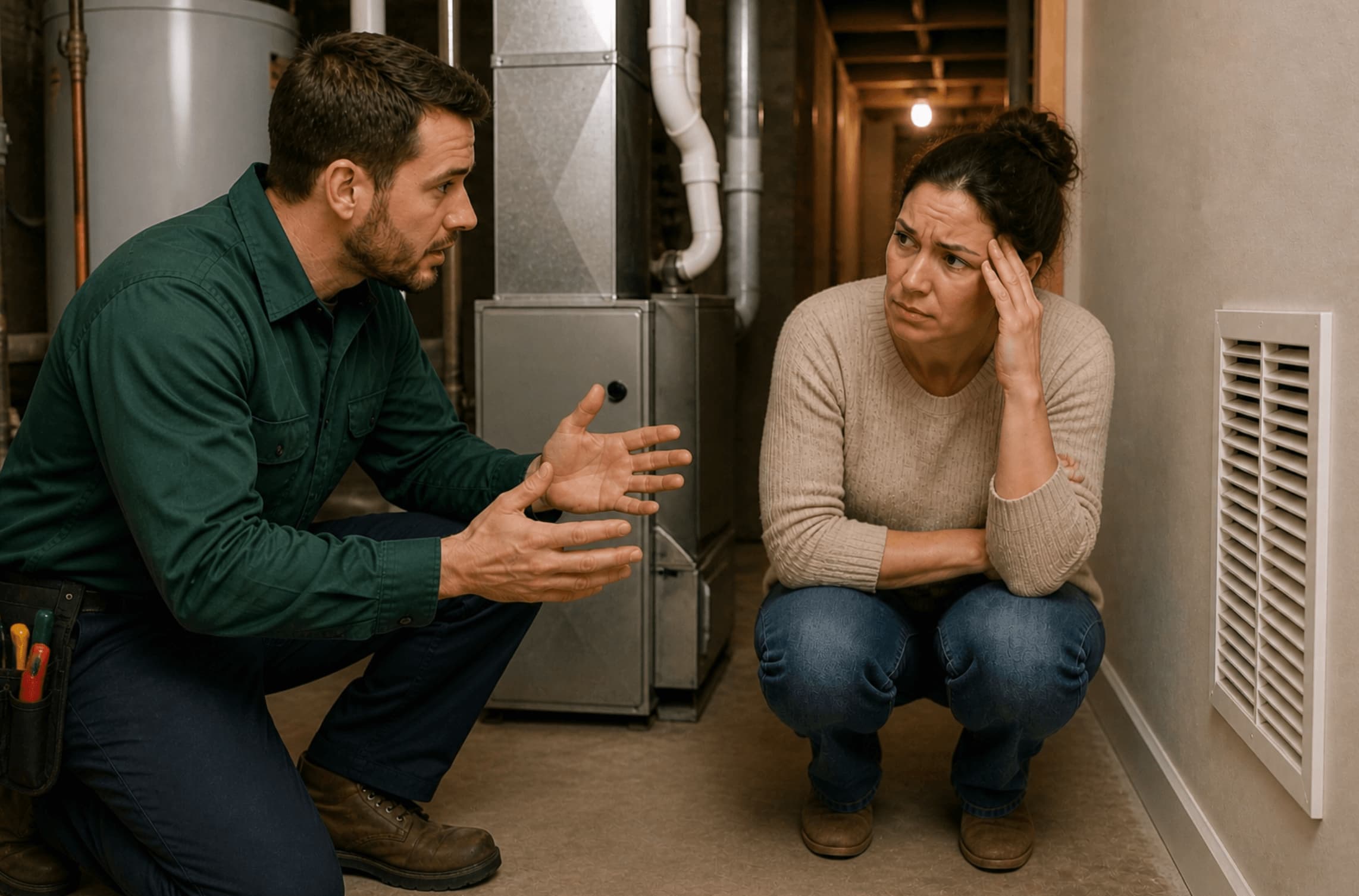
The thermostat reads 70. The kid's bedroom upstairs reads 61, the heating bill keeps climbing, and a closet door down the hall has started slamming on its own. We hear that exact story most weeks between November and February. While homeowners often assume the furnace is dying or the house is haunted, the real culprit is air pressure imbalance — and once you see it, every other symptom on the list makes sense.
Pressure imbalance is the most misdiagnosed problem in American homes during heating season. We've been making pleated furnace filters in the U.S. since 2013, and after shipping millions of them in 600-plus sizes, we recognize the December and January version of this story almost instantly. What feels like random outside air sneaking in is actually your house pulling makeup air through whatever gap it can find, and the consequences run from a higher gas bill to a real safety issue with your HVAC system on the worst days.
This guide walks you through what's happening inside the house, how to confirm it in five minutes with no tools, and which fixes work, ranked from free to professional. Our companion piece on how furnace airflow drives heating efficiency goes deeper on the filter side of the same problem.
Fixing drafts & pressure imbalances for a more comfortable winter starts with one fact most homeowners miss: the cold air sneaking under your door isn't coming from outside on its own — your house is pulling it in. After a decade of helping families troubleshoot January comfort calls, here's the order that actually works:
• Replace the furnace filter first. A clogged filter starves the return side of the system and amplifies every other pressure problem in the house. Free or close to it.
• Uncover return registers and set the thermostat fan to AUTO. Two minutes of work resolves more cold-room complaints than any service call.
• Weatherize for under $100. Door sweeps, weatherstripping, foam outlet gaskets on exterior walls, and attic-hatch insulation seal the home air leaks driving negative pressure.
• Seal accessible duct joints with mastic and UL-181 foil tape. Typical homes leak 20–30% of forced-air heat through ductwork before it reaches a room.
• Call a pro for whole-house air balancing only if the cheap fixes didn't solve it — usually $300 to $800, and the right call for stubborn cold rooms or post-renovation comfort issues.
• Safety overrides every step. If you smell exhaust gases inside or your CO detector alarms, ventilate, leave, and call your gas utility before doing anything else.
Most homes never need to get past step three.
1. Drafts are usually a symptom, not the cause. The actual problem sits somewhere else in the building envelope or the duct system, and the draft is just where the imbalance shows up first.
2. Tighter homes feel pressure imbalance harder than leaky ones. An older drafty farmhouse has natural buffers built into it. A sealed modern home doesn't, and weatherizing without a plan for ventilation can sharpen the very drafts the project was meant to stop.
3. Three rooms tell you the whole story. Walk the coldest bedroom, the room with the slamming door, and the basement near the furnace before you walk anywhere else.
4. Most fixes cost less than $100. A clean filter, weatherstripping, and a roll of UL-181 foil tape resolve more pressure imbalance than people expect before any pro service is needed.
5. Negative pressure plus a combustion appliance is a safety problem first and a comfort problem second. That's the one symptom on this page you don't troubleshoot yourself.
A forced-air heating system does one thing. It moves warm air from the furnace through ducts to every room, then pulls it back through return vents to be reheated. The whole loop depends on balanced airflow. Anything that breaks the loop — a clogged filter, a leaky duct in the attic, a closed bedroom door without a return path, a high-output kitchen hood running for an hour — forces the house to compensate by pulling makeup air through gaps in outlets, recessed lights, and the seam under the front door. Every one of those compensations is a draft.
Winter sharpens every part of this. The temperature gap between an indoor 70°F and an outdoor 20°F drives the stack effect harder than any other season. Warm air rises and escapes through ceiling penetrations on the top floor. Cold air gets pulled in below to replace it. That's why upstairs feels stuffy while the basement feels arctic, and why your floors stay colder than the ceiling fan above them.
• Doors that slam, stick, or whistle. Air rushing through a partially-closed door is the differential pressure announcing itself. If a closet door slams when the dryer kicks on, you've found a clue.
• Cold rooms that the thermostat can't fix. Uneven heating and cooling almost never traces back to the furnace. It's usually a starved return, a closed door with no jumper duct, or an unbalanced damper.
• Drafts where there shouldn't be drafts. Hold your hand near the outlets on every exterior wall on a windy day. If you feel cold air, you've found home air leaks pulling the house toward negative pressure.
• Excessively dry indoor air. If your skin and sinuses are worse this winter than last, your home may be pulling more cold (low-humidity) outdoor air than it should.
• Sulfur, exhaust, or "gas station" smells indoors. Treat this as a safety event, not a comfort issue, and skip down to the safety note.
Before you spend a dollar, do these two free tests. They tell you most of what a service call would tell you, and they cost nothing but time.
1. The tissue test. Tape a strip of toilet paper across an interior doorframe. Watch which way it drifts when you stand still and breathe normally. Now run the dryer and check again. Now turn on the kitchen range hood and the bathroom fans together and check a third time. The direction and intensity of the drift map exactly to the pressure imbalance in the house.
2. The door-close test. Close every interior door except one. If the front door now wants to suck itself shut when you let go, your HVAC return is fighting all those closed doors. The fix is either jumper ducts above the door frames or ¾-inch undercuts on the doors themselves.
Work this list in order. The boring truth is that most homes never need to get past step three.
• Free, tonight. Pull and inspect your furnace filter and replace it if you can't see light through it. Uncover every return register. Set the thermostat fan to AUTO. Put a 30-minute timer on bath fans.
• Under $100, this weekend. Door sweeps, replacement weatherstripping, foam outlet gaskets on exterior walls, attic-hatch insulation, and foam pipe-penetration sealant. These are the highest-ROI weatherization tips of the heating season.
• Under $500, this month. Duct leak repair on every accessible joint with mastic sealant and UL-181 foil tape. Never use cloth duct tape because it fails inside a year. For ducts you can't reach, an Aeroseal-style internal sealing job is the right call.
• Pro service, this season. Whole-house air balancing typically runs $300 to $800. A tech measures CFM at every supply and return and rebalances the dampers. We recommend it for homes with three-plus persistent cold rooms, big heat differentials between floors, or a recent renovation.
A filter alone won't fix a backdrafting water heater or a duct leak in the attic. But a clean, properly-sized filter is the single most controllable variable in the airflow loop, and a clogged one quietly amplifies every other pressure problem the house already has. A loaded filter raises return-side static pressure, makes the blower work harder, and starves the rooms farthest from the air handler. For most homes already fighting drafts, a quality pleated MERV 11, swapped every 30 to 60 days during heating season, is the right default.
Run through these five questions in order. The first answer that fits is your starting point.
1. Smell exhaust gases or hear a CO alarm? Stop. Open windows, leave the house, and call a licensed HVAC tech and your gas utility today. The rest of this list comes after the safety check is clear.
2. Furnace filter older than 30 days, or visibly grey when held to light? Replace it tonight and recheck the symptoms over the next 24 hours.
3. Drafts and door-slams worst when the dryer or range hood is running? That's an exhaust-driven imbalance. Crack a nearby window when these run, install a dryer-aware makeup-air kit, or upgrade the kitchen hood with a tempered-air supply.
4. Cold bedrooms only when the doors are closed? Add jumper ducts above the doorframes, or undercut the doors by ¾ inch.
5. Three or more rooms still imbalanced after you've worked steps 1 through 4? Schedule a whole-house air balancing service or a blower-door test.
Safety note. Negative pressure plus a combustion appliance is the one combination you don't troubleshoot on your own. Backdrafting can pull carbon monoxide from a furnace or water-heater flue back into your living space. If a CO detector alarms or you smell exhaust indoors, leave the home, ventilate, and call your gas utility before doing anything else.
"In over a decade of helping homeowners troubleshoot January comfort calls, the same answer keeps surfacing. The houses that stay comfortable through February aren't the ones with the biggest furnaces — they're the ones whose owners fixed the airflow loop first, starting with a clean filter and an unblocked return."
— The Filterbuy Team
These are the outside references we point homeowners to when they want to dig deeper. Every link goes to a federal agency or recognized standards body.
https://www.energystar.gov/saveathome/heating-cooling
EPA-backed walkthrough of filter checks, duct sealing, smart thermostats, and HVAC efficiency strategy. The starting reference for any winter HVAC project.
https://www.energystar.gov/saveathome/heating-cooling/duct-sealing
A homeowner-focused guide on where ducts leak in a typical home, how much heat is lost, and which materials to use to seal them yourself. Anchor source for the duct-leak repair work in the cost-ranked plan above.
https://www.energystar.gov/saveathome/seal_insulate
How to prioritize air-sealing and insulation projects in the order that delivers the biggest comfort and bill impact. The right starting point for under-$100 weatherization.
https://www.energy.gov/energysaver/air-sealing-your-home
Official DOE guidance on the most common air-leak locations in a typical home, with caulking and weatherstripping techniques homeowners can do themselves.
https://www.energy.gov/energysaver/minimizing-energy-losses-ducts
DOE's technical reference on how forced-air systems leak heat, including jumper ducts, transfer grilles, and the role of return-air capacity in keeping a home pressure-balanced.
https://www.epa.gov/indoor-air-quality-iaq/inside-story-guide-indoor-air-quality
Foundational EPA resource on indoor pollutants, ventilation, and the link between pressure, filtration, and a healthy home. Essential winter context.
https://www.cpsc.gov/Safety-Education/Safety-Education-Centers/Carbon-Monoxide-Information-Center
CPSC safety guidance on CO risks, detector placement, and the combustion-appliance implications of a pressure-imbalanced home.
Each figure below is taken directly from a federal agency page that publishes it as written, the same data we built our recommendations on.
In a typical home, about 20 to 30 percent of the air moving through the duct system is lost to leaks, holes, and poorly connected ducts before it ever reaches a room. That's the single biggest reason a house can run the furnace all day and still feel uneven.
Source: ENERGY STAR — Duct Sealing (https://www.energystar.gov/saveathome/heating-cooling/duct-sealing)
EPA studies have found that levels of common organic pollutants are 2 to 5 times higher inside homes than outside, regardless of whether the home is in a rural or industrial area. A pressure-imbalanced house in winter pulls in unfiltered outdoor air through cracks and gaps, but it also concentrates whatever indoor pollutants are already there.
Source: EPA — The Inside Story: A Guide to Indoor Air Quality (https://www.epa.gov/indoor-air-quality-iaq/inside-story-guide-indoor-air-quality)
CPSC reports that more than 200 people in the United States die every year from accidental, non-fire-related carbon monoxide poisoning tied to consumer products, with home heating equipment among the top contributors. That's the worst-case outcome of a pressure-imbalanced home with a combustion appliance and no working detector.
Source: CPSC — Home Heating Equipment / Carbon Monoxide Information Center (https://www.cpsc.gov/Safety-Education/Safety-Education-Centers/Carbon-Monoxide-Information-Center/Home-Heating-Equipment)
Most articles on this topic split into two camps, and we think both are wrong. The first camp oversimplifies the fix ("just caulk your windows"). The second camp pushes homeowners straight to the most expensive HVAC service on the menu. After a decade of watching pressure-imbalance calls play out across hundreds of thousands of households, the honest version sits in the middle.
In our experience, the majority of pressure imbalances resolve with a small number of low-cost moves: a clean filter, an unblocked return, and a weekend of basic weatherization. The houses that genuinely need a pro and a balancing calculation tend to share specific traits — recent renovations, big additions, or atmospherically-vented appliances inside a tightened envelope. Figuring out which house you have is exactly what the cost-ranked plan above does for you. Cheapest fixes first. Pro service only after the cheap fixes didn't work.
If you want to act on what you just read, here's the order we'd do it in.
1. Tonight: do the tissue test in your draftiest room and the door-close test on every closed bedroom.
2. This week: pull and inspect the furnace filter. Replace it if you can't see light through it.
3. This weekend: walk the perimeter on a windy day with your hand on every outlet, recessed light, and exterior-wall switch. Make a list of the leakers.
4. This month: weatherstrip drafty doors, install foam outlet gaskets, insulate the attic hatch, and seal accessible duct joints with mastic and UL-181 foil tape.
5. Pre-winter, every year: schedule an HVAC tune-up and ask the tech to take a static-pressure reading before they leave.
6. Set it and forget it: stock a multi-pack of the right filter size, or set up auto-delivery so the filter shows up the moment it's due. The most common reason a filter sits past its date is forgetting it exists.
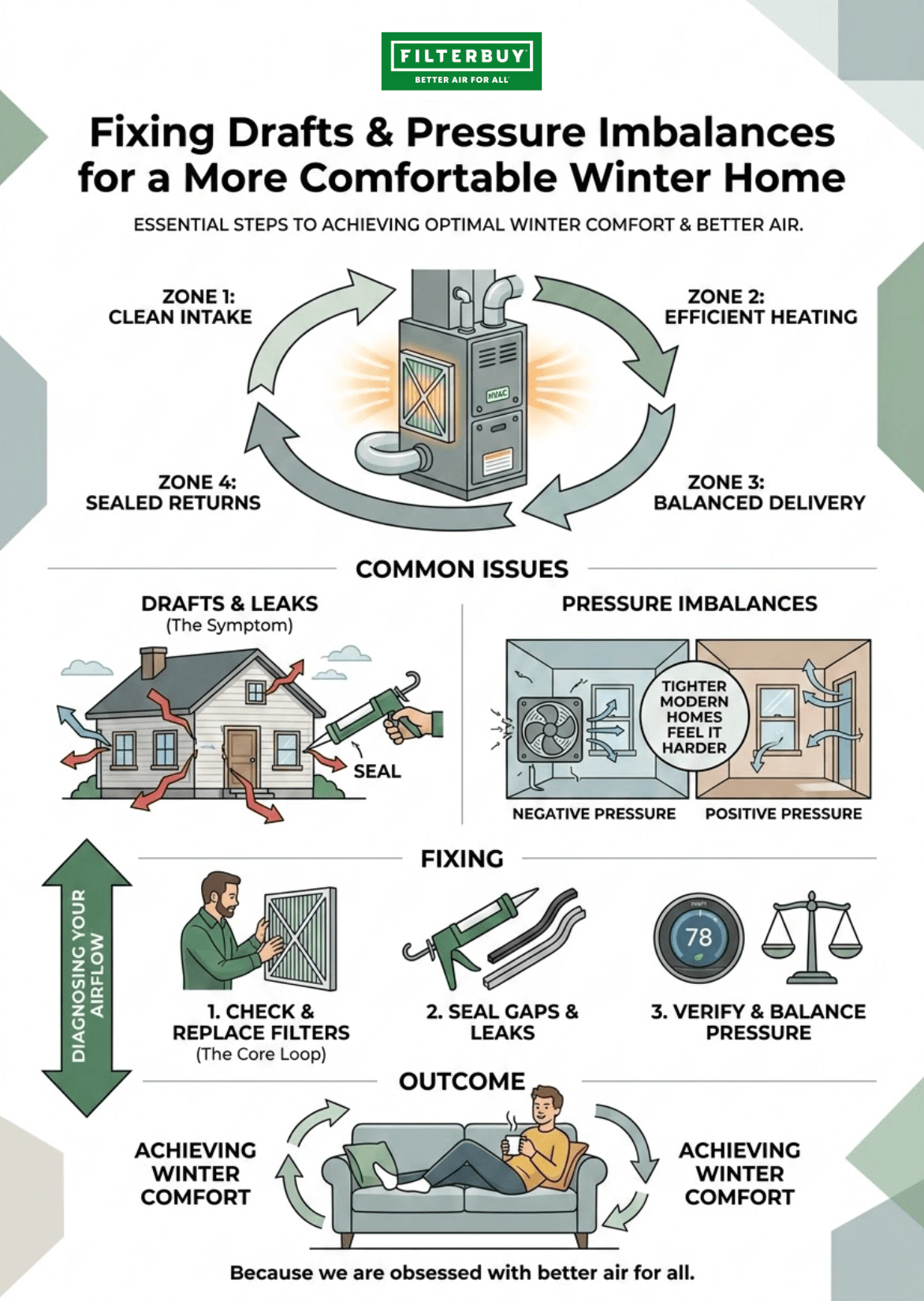
The simplest check is free. Tape a strip of toilet paper to an interior doorframe and watch which way it drifts. If it's sucked into a room, that room is at higher pressure. If it's pulled out, it's lower. Slamming doors, mystery drafts at outlets, and the smell of exhaust indoors are the clearest red flags.
Work the list in this order. Replace your furnace filter, uncover any blocked return registers, set the thermostat fan to AUTO, put a 30-minute timer on bathroom and kitchen exhaust fans, and weatherstrip the drafty doors you can feel with your hand. Most homeowners notice a comfort difference within 24 hours from this five-step pass alone.
Yes. A clogged filter restricts return-side airflow, forces the blower to work harder, and starves the rooms farthest from the air handler. The U.S. Department of Energy notes that obstructed airflow lets dirt bypass the filter and accumulate on the evaporator coil, reducing its heat-absorbing capacity and shortening the life of the system. In a sealed-up winter home, that imbalance amplifies every other pressure problem the house already has.
An HVAC air balancing calculation is a service where a technician measures airflow at every supply and return register in CFM, then adjusts dampers and ductwork so each room gets its designed share of conditioned air. You probably need one if you have more than two persistent cold rooms, a 5°F-plus difference between floors, or a recently renovated home with new ductwork.
They can be. Negative pressure can pull combustion gases, including carbon monoxide, back down a furnace or water-heater flue. The technical name for that is backdrafting. If you smell exhaust or sulfur inside, or your CO detector ever alarms, ventilate the home, turn off the suspect appliance, and call a licensed HVAC technician and your gas utility today.
Uneven heating and cooling almost always comes down to an airflow or pressure problem, not a furnace problem. The most common causes are blocked return vents, closed bedroom doors with no jumper duct, an unbalanced damper, or a clogged filter starving the whole system. The diagnosis is rarely the equipment itself.
It depends on the house. Weatherstripping cuts uncontrolled air leakage, which helps your energy bill. But if your home has a high-output range hood, a large dryer, or an atmospherically-vented gas appliance, sealing without a planned makeup-air path can make backdrafting worse. The building-science principle is "build tight, ventilate right."
Better Air for All. Even when the wind is howling.
Filterbuy builds pleated furnace filters in the United States in over 600 standard sizes, plus custom builds for any opening that doesn't fit a standard. Shipping is free and factory-direct. No middlemen, no markups. Set up auto-delivery once and the right filter shows up the moment it's time to swap. Your furnace, your gas bill, and the air your family breathes will all notice the difference.
