February 12, 2026
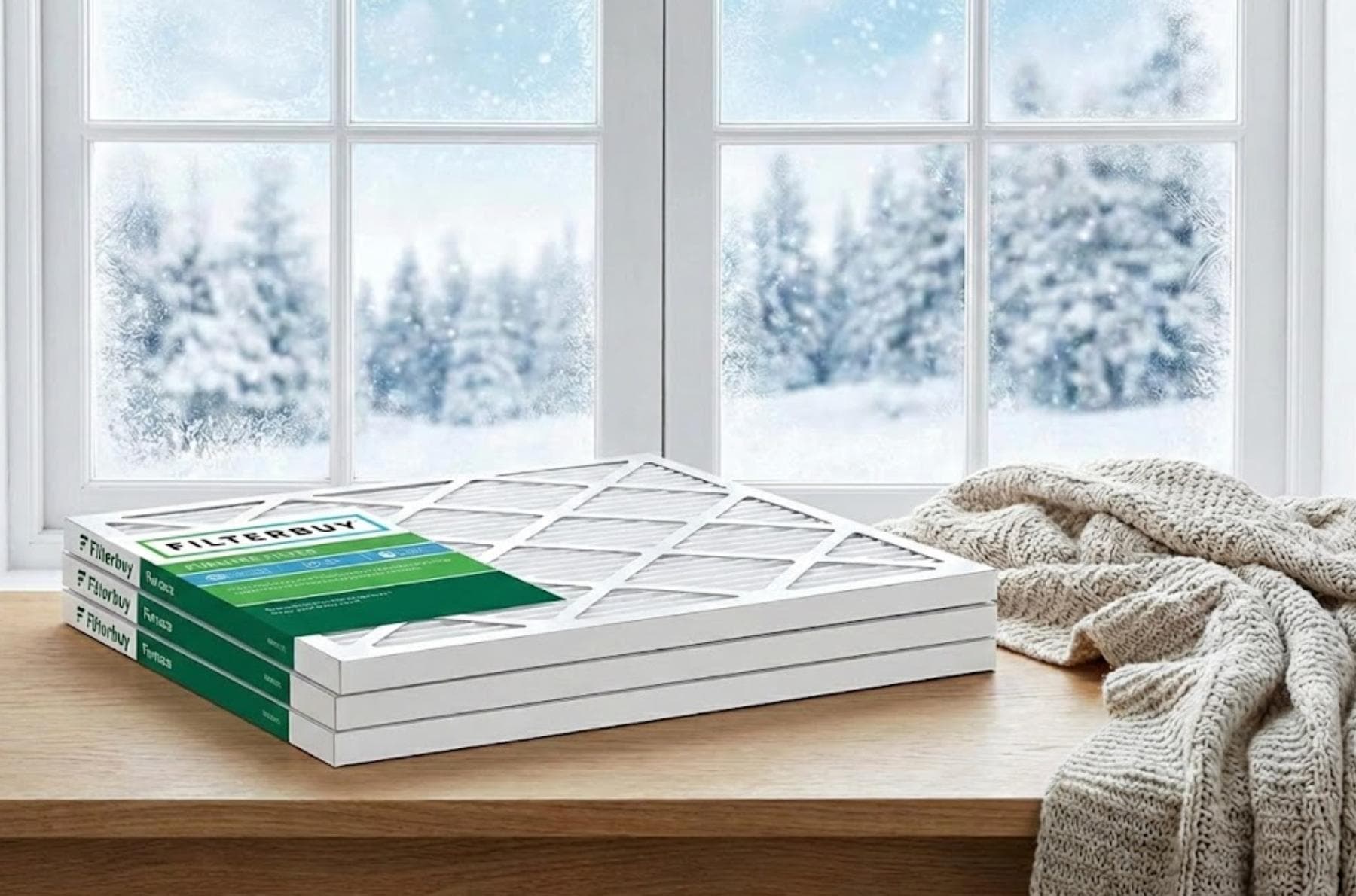
Winter puts your furnace to the test as it works harder than ever to keep your home warm. Your furnace filter plays a crucial role, not only in maintaining indoor air quality by trapping dust, debris, and allergens but also in protecting your system from costly breakdowns during peak usage. Choosing the right filter ensures cleaner air and a more efficient furnace, especially when windows are sealed tight.
This guide highlights the best furnace filters for Winter 2024–2025, ranked by expert MERV ratings. Whether you’re dealing with allergies, pets, or want to lower energy bills, we’ll help you find the perfect filter to meet your needs and keep your home cozy all season long.
The best furnace filters for winter 2024–2025 are pleated filters rated between MERV 8 and MERV 13. After over a decade of manufacturing filters in the U.S. and shipping them to millions of homes, here's what we recommend:
MERV 8 — Best for standard homes. Catches dust, pollen, and dust mites. Affordable, efficient, reliable.
MERV 11 — Best for homes with pets. Adds pet dander and mold spores. The most versatile option for the widest range of households.
MERV 13 — Best for allergies and asthma. Captures bacteria, smoke, and virus carriers. The highest rating recommended for residential systems.
Three things that matter most in winter:
Choose pleated over fiberglass. More surface area, better filtration, longer life between changes.
Change it every 30 days. Your furnace runs harder in winter. Filters clog faster. A dirty MERV 13 performs worse than a fresh MERV 8.
Stay in the MERV 8–13 range. Going above MERV 13 on a residential system restricts airflow and can damage your furnace.
Bottom line: Pick the MERV rating that matches your household. Replace it monthly during heating season. That single habit protects your air quality, your energy bill, and your furnace — all winter long.
Stick to the MERV 8–13 sweet spot. This range covers virtually every residential need. MERV 8 for standard homes. MERV 11 for pet owners. MERV 13 for allergies and asthma. Go higher than 13 on a residential system and you risk choking airflow. Go lower and you're leaving your family exposed.
Change your filter every 30 days in winter. No exceptions. This is the single most impactful habit in the entire guide. Here's why:
A clogged premium filter performs worse than a fresh budget filter
The DOE confirms a clean filter can cut HVAC energy use by 5% to 15%
During peak heating season, that percentage hits your wallet hard
The filter matters — but the schedule matters more
Your indoor air is worse than you think. The EPA reports indoor pollutant levels are often two to five times higher than outdoor levels. In winter, it gets worse:
Windows stay sealed for months
There's virtually no fresh air ventilation
Every particle your filter misses keeps recirculating
A quality pleated filter is your home's first and most effective defense
For 1 in 12 Americans, this is a health decision. Over 28 million people in the U.S. live with asthma. Indoor allergens concentrate during winter — and they're among the most common triggers. If anyone in your home has respiratory sensitivities, stepping up to MERV 11 or 13 isn't a luxury. It's a meaningful step toward fewer flare-ups during the hardest season of the year.
Make the habit effortless so it actually sticks. The best filter in the world only works if it gets replaced on time. Two ways to make sure that happens:
Stock up — grab a 3-pack at the start of the season so fresh filters are always on hand
Set up auto-delivery — the right filter shows up at your door exactly when you need it
Ten minutes of action now protects your furnace, your energy bill, and your family's air quality through the rest of winter.
Your HVAC system operates differently in January than it does in June. During the cold months, your furnace runs for longer cycles to maintain a comfortable temperature. This increased runtime means more air is constantly being pulled through the filter.
Consequently, filters clog much faster in winter. A dirty filter restricts airflow, forcing your furnace to work harder to push heat through the house. This doesn't just drive up your heating bills; it can lead to uneven heating or, in worst-case scenarios, cause the system to overheat and shut down entirely.
Using a high-quality pleated filter is the best defense. Unlike cheap fiberglass options that let particles pass right through, pleated filters offer a larger surface area to trap debris without suffocating your system. They are safe, effective, and the industry standard for reliable winter heating.
When experts rank filters, we don't look at flashy brand names—we look at performance. The most critical factor is the MERV rating (Minimum Efficiency Reporting Value), which tells you how effective the filter is at trapping particles.
Here are the top-ranked filter categories for this winter season.
If you live in a standard residential home without pets or severe allergies, the MERV 8 is your workhorse. It offers the perfect balance of filtration and airflow efficiency.
What it catches: Dust, lint, pollen, and dust mites.
Why it wins for winter: MERV 8 filters provide excellent airflow, which is crucial for older furnace systems that might struggle with higher resistance. They keep the mechanical components of your furnace clean while maintaining lower energy costs.
Verdict: An affordable, efficient choice for basic winter maintenance.
For households with furry friends, a MERV 8 might not cut it. The MERV 11 takes filtration a step further, targeting the invisible irritants that tend to build up when the house is closed up for winter.
What it catches: Everything a MERV 8 catches, plus pet dander and mold spores.
Why it wins for winter: Winter air can get stale. If you have a dog or cat, dander circulates continuously. A MERV 11 filter traps these finer particles, preventing them from settling on your furniture or irritating your nose.
Verdict: The "Goldilocks" option—strong filtration without putting too much strain on modern HVAC systems.
If you want hospital-grade air quality in your living room, the MERV 13 is the top-tier residential choice. This is the highest rating recommended for most home furnaces.
What it catches: Bacteria, smoke particles, virus carriers, and fine allergens.
Why it wins for winter: During flu season and winter months where ventilation is low, trapping microscopic particles is vital. A MERV 13 acts as a powerful shield, scrubbing the air of contaminants that can affect your health.
Verdict: The ultimate winter allergy shield for maximum protection and peace of mind.
You might see flat fiberglass filters at the hardware store for a couple of dollars. While tempting, they are practically useless for winter protection. Experts universally recommend pleated filters for several reasons:
Surface Area: The accordion-style folds (pleats) drastically increase the filter's surface area. This allows it to capture significantly more dust while allowing air to pass through easily.
Longevity: Because they have more surface area, they don't clog as quickly as flat filters.
Fit: Quality pleated filters usually have a sturdy frame that fits securely in the slot, reducing "air bypass"—where unfiltered air sneaks around the edges.
The standard rule of thumb is to change your filter every 1 to 3 months. However, winter is the exception where you should lean closer to the 1-month mark.
According to HVAC experts, including insights from Jarboes and Smart AC Solutions, several factors can shorten your filter's lifespan during the heating season:
High Usage: If your furnace is running 10+ hours a day, the filter loads with dust much faster.
Pets: Winter coats shed. If you have pets, check your filter monthly.
Holiday Traffic: More people in the house means more dust and lint circulation.
Renovations: If you are doing any indoor winter projects, the sawdust and drywall dust will clog a filter in days.
Pro Tip: Don't wait for a specific date. Pull the filter out once a month and hold it up to the light. If you can't see light passing through it, swap it out immediately.
Choosing the best MERV rating for winter isn't just about air quality; it's about system survival.
If you choose a rating that is too low (like a fiberglass filter), dust builds up on the internal blower motor and heat exchanger. This acts as insulation, causing the furnace to overheat and potentially cracking the heat exchanger—a dangerous and expensive repair.
Conversely, if you choose a rating that is too high for an older system (like a commercial-grade MERV 16), the furnace suffocates. It runs longer to satisfy the thermostat, driving up your heating bill and wearing out the motor.
Sticking to the MERV 8–13 range ensures you get the benefits of cleaner air without risking the health of your heating system.
When the snow starts falling, you don't want to be running to the hardware store only to find your size is out of stock.
Filterbuy offers a comprehensive selection of high-quality pleated filters tailored for winter performance. Whether you need the standard protection of a MERV 8 or the advanced filtration of a MERV 13, Filterbuy has you covered.
Made in the USA: Quality you can trust to protect your home.
Custom Sizes: Have an odd-sized vent? No problem.
Subscription Options: Set it and forget it. Get filters delivered to your door exactly when you need to change them, ensuring you never miss a winter maintenance cycle.
Don't wait for your furnace to struggle in the middle of a blizzard. Ensuring you have the right filter is the simplest, most effective way to keep your home warm and your air healthy this season.
Shop Filterbuy’s American-made pleated filters and keep your home warm, healthy, and efficient.
"After manufacturing millions of pleated filters and hearing directly from homeowners every winter, we've seen the same pattern: the families who stay in the MERV 8–13 range and swap their filter monthly are the ones who avoid emergency furnace calls and notice a real difference in their air quality when the house is sealed up tight."
We get it — you just want your house warm, your air clean, and your furnace running without drama. But when you start researching filters, it's easy to end up down a rabbit hole of MERV charts, airflow specs, and conflicting advice. We've been manufacturing filters in the U.S. for over a decade and shipping them to millions of homes just like yours, so we know which resources actually help and which ones just add confusion. These are the seven we'd hand to a friend.
U.S. Environmental Protection Agency — "What Is a MERV Rating?" Before you compare a single filter, it helps to understand what those numbers on the box actually mean. The EPA breaks down how MERV ratings are tested and why higher isn't automatically better for every system. It's a quick read that clears up the most common misconception in filter shopping. 🔗 epa.gov — What Is a MERV Rating?
U.S. Environmental Protection Agency — "Guide to Air Cleaners in the Home" Maybe a good pleated filter handles everything your home needs. Maybe you'd benefit from a portable air purifier, too. This EPA guide helps you figure that out without overcomplicating things — it compares HVAC filters and standalone air cleaners side by side so you can make a smart call based on your home, not a sales pitch. 🔗 epa.gov — Guide to Air Cleaners in the Home
ASHRAE — Residential Filtration Standards and FAQ ASHRAE literally invented the MERV rating scale — so when they weigh in on what works for homes, it's worth paying attention. Their residential FAQ covers minimum ratings, airflow trade-offs, and when it makes sense to call a pro before upgrading. Think of it as the source behind all the other sources. 🔗 ashrae.org — Filtration and Disinfection FAQ
U.S. Department of Energy — "Fall and Winter Energy-Saving Tips" Here's something a lot of homeowners miss: your furnace filter isn't just about air quality — it's one of the easiest ways to keep your heating costs in check. The DOE recommends monthly filter changes during winter and ties that habit directly to real energy savings. When your system doesn't have to fight through a clogged filter, everybody wins — your furnace, your wallet, and your family. 🔗 energy.gov — Fall and Winter Energy-Saving Tips
Asthma and Allergy Foundation of America — "Improving Indoor Air Quality" When it's cold outside, your windows stay shut and everything in your air — pet dander, dust mites, cooking fumes — just keeps recirculating. If anyone in your home deals with allergies or asthma, this AAFA guide spells out exactly how indoor air quality changes in winter and what you can do about it. It's especially helpful if you're deciding between a MERV 8 and stepping up to a MERV 11 or 13. 🔗 aafa.org — Improving Indoor Air Quality
Filterbuy — "How to Measure Your Air Filter" You could buy the highest-rated filter on the market, but if it doesn't fit your system correctly, you're wasting your money. Even a half-inch gap can let 20–30% of your air sneak past unfiltered. Our step-by-step sizing guide walks you through the difference between nominal and actual dimensions and shows you exactly how to measure — no guesswork, no wasted trips. And if your home has an odd-sized vent? We manufacture over 600 sizes plus custom filters built to your exact specs. 🔗 filterbuy.com — How to Measure Your Air Filter
Filterbuy — "Which MERV Rating Should I Use?" Pets? Allergies? An older HVAC system? The "best" MERV rating depends on what's happening in your home, not just what a chart says. This guide breaks down the real-world differences between MERV 8, 11, and 13 based on factors that actually matter to your family — so you can pick with confidence instead of crossing your fingers at checkout. We built it from over a decade of manufacturing experience and feedback from millions of households across the country. 🔗 filterbuy.com — Which MERV Rating Should I Use?
We've manufactured millions of pleated filters across our U.S. facilities in Alabama, Florida, Pennsylvania, and Utah since 2013. We've heard from homeowners in every climate, every season, and every kind of household. Certain patterns keep showing up — and the national data confirms every one of them.
Every January and February, our customer support team fields the same question: "Why does my air feel so stuffy even though the furnace is running?"
After years of hearing it, we know exactly what's happening. With the house sealed tight all winter, your furnace recirculates the same air over and over — and everything in it builds up:
Pet dander and fur from winter-coated animals
Dust stirred up by holiday foot traffic and guests
Cooking particles from heavier, indoor-season meals
Mold spores and allergens with nowhere to escape
Your filter is the only thing standing between that invisible buildup and your family's lungs.
What the EPA found: Americans spend roughly 90% of their time indoors, where concentrations of certain pollutants are often two to five times higher than typical outdoor levels.
That stat surprises most people. It doesn't surprise us. We've seen what comes out of a used filter after just 30 days of winter use — and it's a clear reminder that a quality pleated filter rated MERV 8 or higher isn't optional during heating season.
📄 Source: U.S. Environmental Protection Agency — Indoor Air Quality, Report on the Environment
Here's something we noticed early in our auto-delivery program: customers who switched to monthly winter replacements consistently reported lower heating bills — often before we even mentioned the connection.
It makes sense when you understand what happens inside your system:
A loaded filter chokes airflow to the blower motor
The motor runs longer and harder to push the same amount of warm air
Every extra hour of runtime drives up your gas and electric bill
That strain compounds from November through March
What the DOE found: Replacing a dirty, clogged filter with a clean one can lower your HVAC system's energy consumption by 5% to 15%.
When your furnace is running 10-plus hours a day in the dead of winter, that percentage adds up fast. From our experience manufacturing filters at every MERV level, the homeowners who treat filter changes as a simple monthly habit — not a once-a-season chore — are the ones who get the most out of their system and their budget.
📄 Source: U.S. Department of Energy — Maintaining Your Air Conditioner
Over the years, we've watched a real shift in customer behavior. More and more households are choosing MERV 11 and MERV 13 filters for one specific reason: someone in the home has asthma or allergies. These families aren't shopping by price alone — they're researching which rating captures the finer particles that trigger respiratory flare-ups when the house is buttoned up all winter:
MERV 8 — Catches dust, lint, pollen, and dust mites
MERV 11 — Adds pet dander and mold spores
MERV 13 — Adds bacteria, smoke particles, and virus carriers
What the AAFA found: Over 28 million people in the United States currently have asthma — roughly 1 in 12 Americans.
That's not a small number. And indoor allergens that concentrate during the winter months are among their most common triggers. After working with households managing asthma and allergy symptoms across the country, we've seen firsthand the difference that stepping up from a MERV 8 to a MERV 11 or 13 can make. It's one of the reasons we manufacture every residential MERV level and make it easy to compare them side by side — because for these families, the right filter isn't about preference. It's about breathing easier through the hardest season of the year.
📄 Source: Asthma and Allergy Foundation of America — Asthma Health Outcomes, Asthma Capitals Report
After more than a decade of manufacturing filters in the U.S. and shipping them to millions of homes, we've landed on one conviction: the furnace filter is the most underestimated component in your entire house.
It doesn't make noise. It doesn't have an app. Nobody puts it on a home tour. But from November through March, that single panel of pleated media is quietly doing more for your family's comfort, health, and heating bill than almost anything else behind your walls.
This guide covered a lot of ground. All of it points to the same three takeaways:
The right filter protects your air. With your house sealed tight all winter, a MERV 8 to MERV 13 pleated filter is the only barrier between your family and the invisible particles recirculating through your home.
The right schedule protects your furnace. Monthly changes during peak heating season prevent the airflow restriction that leads to overworked motors, uneven heating, and emergency repair calls in the middle of a cold snap.
The right MERV rating protects the people who need it most. For the 1 in 12 Americans living with asthma — and for every household dealing with pets or allergies — choosing between MERV 8, 11, and 13 is a decision with real, daily consequences.
Here's an opinion not everyone in our industry says out loud:
Most homeowners are overthinking the filter and underthinking the schedule.
We see it constantly:
Someone spends 30 minutes researching the perfect MERV rating
They order the right filter and install it
Then they leave it in there for four or five months
Here's the reality. By month three, even the best MERV 13 on the market performs worse than a fresh MERV 8 straight out of the box. A clogged premium filter doesn't give you premium results. It gives you:
Restricted airflow
Higher energy bills
Air quality that quietly degrades while you assume you're covered
After manufacturing filters at every MERV level and hearing from customers across every season, here's the honest advice we give the people closest to us:
Pick the MERV rating that matches your household:
MERV 8 — Standard homes without pets or severe allergies
MERV 11 — Homes with pets or mild sensitivities
MERV 13 — Homes managing allergies, asthma, or respiratory concerns
Then commit to changing it every 30 days during winter.
That simple routine will outperform any exotic filter technology on the market — if the exotic option sits in your furnace collecting dust for a full season.
The filter itself matters. But the habit of changing it matters more.
That's the insight we keep coming back to after years on the manufacturing floor, thousands of customer conversations, and millions of filters shipped. It's not the most complicated advice we could give. From what we've seen, it's the most impactful.
Want to take even the thinking out of it? Set up auto-delivery and let the right filter come to you exactly when it's time to swap.
No reminders to set
No store runs to squeeze in
No guesswork on timing
Just clean air, showing up at your door on schedule — so you can focus on keeping your family warm this winter instead of worrying about what's in your air.
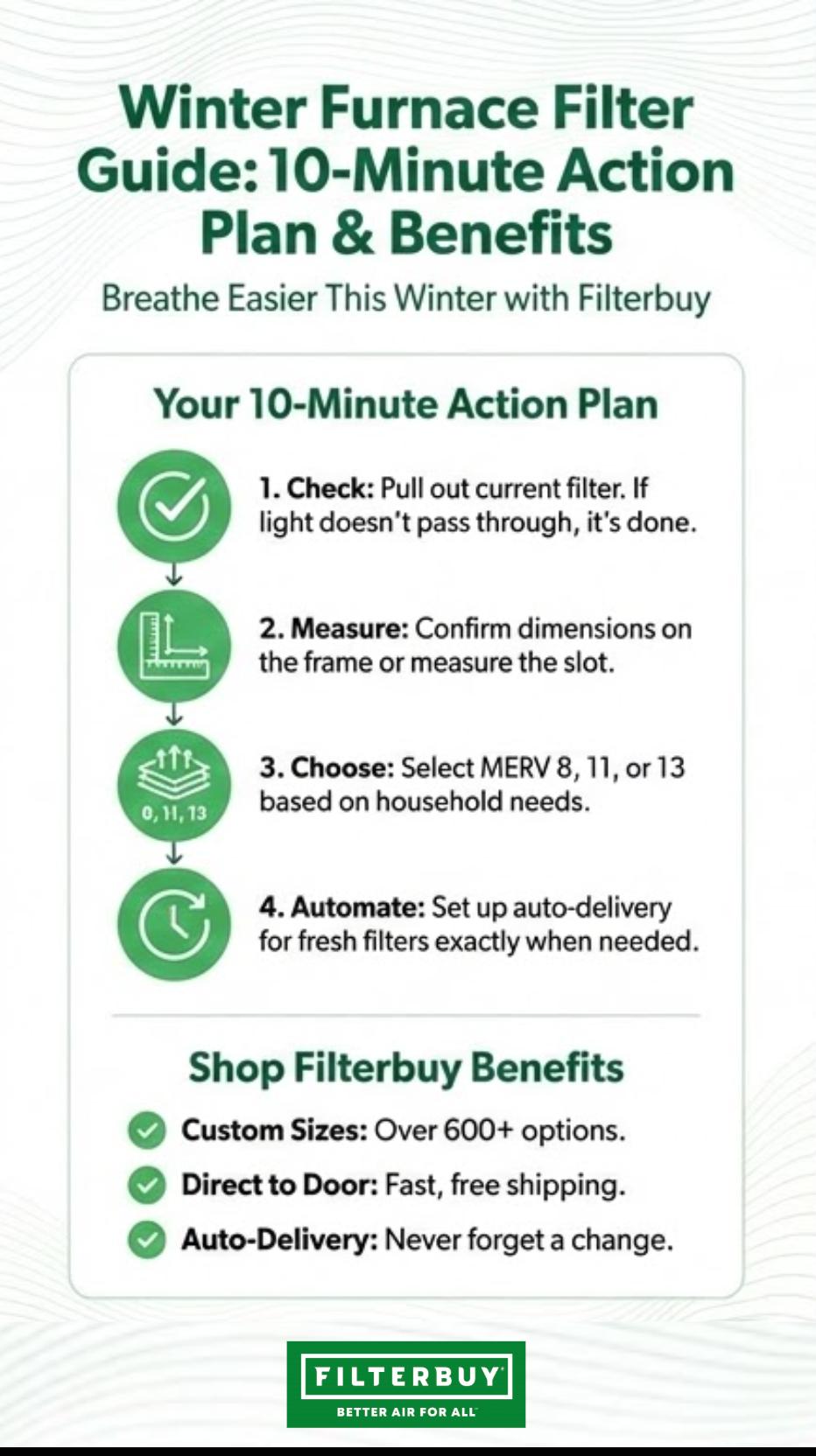
You've got the research. You've got the expert rankings. Now put it into action. These five steps take about 10 minutes total — and they're the fastest way to protect your furnace and clean up your air for the rest of the season.
Pull the filter out of your furnace or return air vent. Hold it up to the light.
You can see light passing through? Still has some life. Note today's date and check again in 30 days.
Can't see any light? That filter is done. Replace it as soon as possible.
A clogged filter means your furnace is working harder than it needs to — and your air quality is dropping every day it stays in.
While you have it out, snap a photo of the size printed on the frame. You'll need it next.
Look for the dimensions printed along one edge of your old filter. It'll be in a format like 20x25x1.
Found it? You're ready to order.
Worn off or missing? Measure the filter slot — length, width, and depth — with a tape measure. Round up to the nearest whole number.
Doesn't match a standard size? Filterbuy manufactures over 600 standard sizes plus custom filters built to your exact specs.
Our filter sizing guide walks you through the whole process in under two minutes.
Match your household to the rating that fits. Based on what we've seen work across millions of homes:
MERV 8 — Standard homes. No pets or severe allergies. Catches dust, lint, pollen, and dust mites.
MERV 11 — Homes with pets or mild sensitivities. Adds pet dander and mold spores.
MERV 13 — Allergies, asthma, or respiratory concerns. Adds bacteria, smoke particles, and virus carriers.
Not sure where you fall? Start with MERV 11. It works for the widest range of households — strong filtration without overworking your system.
Our MERV rating guide breaks down the differences in plain English.
Winter burns through filters faster than any other season. Don't get caught with a clogged filter and an empty shelf in February.
Order at least a 3-pack so you've got fresh filters ready each month through peak heating season.
Fast, free shipping — factory-direct from our U.S. facilities
Every size in stock — including hard-to-find and custom dimensions
Bulk pricing — the more you order, the more you save
Turn a one-time purchase into a year-round habit — with zero effort.
How it works:
Pick your filter size and MERV rating
Choose your delivery frequency — every 30 days for winter, every 60–90 days in milder months
Filters show up at your door exactly when it's time to swap
That's it. No reminders. No store runs. No risk of running a clogged filter for months without realizing it.
Thousands of homeowners have already made this part of their routine.
Check your filter — pull it out, hold it to the light (2 min)
Confirm your size — read the frame or measure the slot (2 min)
Pick your MERV rating — match it to your household (1 min)
Order a 3-pack — stock up for the rest of winter (3 min)
Set up auto-delivery — never think about it again (2 min)
Ten minutes now saves you from emergency furnace calls, higher heating bills, and months of breathing air your filter stopped cleaning weeks ago.
Your furnace is doing its job this winter. Make sure your filter is doing its job, too.
A: We get asked this more than any other question. After manufacturing filters at every MERV level since 2013, our answer always starts the same way: it depends on what's happening inside your house.
Here's the quick match based on what we've seen work across millions of homes:
MERV 8 — Standard homes without pets or major allergy concerns. Catches dust, lint, pollen, and dust mites. Strong airflow for any system type.
MERV 11 — Homes with pets. Captures the dander that MERV 8 wasn't designed to handle. The upgrade most pet owners wish they'd made sooner.
MERV 13 — Allergies, asthma, or respiratory concerns. Captures bacteria, smoke particles, and virus carriers. The top expert pick — especially critical in winter when ventilation drops to near zero.
The honest truth from a decade on the manufacturing floor? The best filter is the one matched to your household and changed every 30 days during peak heating season. A perfectly rated filter left in too long will always underperform a fresh one swapped on schedule.
A: Check it every 30 days. Plan on replacing every one to two months during winter.
Here's why winter is different from every other season:
Your furnace runs significantly longer cycles in cold weather
More air gets pulled through the filter hour after hour
Debris loads up much faster than in spring or fall
We see this firsthand in our auto-delivery data. Customers in northern states consistently replace more frequently in January and February than any other time of year. The ones who shifted to monthly changes tell us they noticed a difference in both air quality and heating performance almost immediately.
Quick gut check: Pull the filter out. Hold it up to a light. Can't see light passing through? Don't wait for a calendar reminder — swap it now.
We've heard from too many homeowners who assumed their three-month-old filter was fine, only to find it completely loaded when they finally checked.
A: No. This is one of the biggest misconceptions we run into — and one we spend a lot of time clearing up.
Here's the nuance:
Within MERV 8–13: Yes, higher ratings capture finer particles. That's a genuine advantage when your home is sealed for months.
Above MERV 13: That's where problems start on residential systems.
We've had customers call in after installing MERV 14 or 16 filters from commercial suppliers. The results were consistent:
Weak airflow throughout the house
Rooms that wouldn't heat evenly
Systems that started short-cycling within days
The extra density creates airflow resistance most residential furnaces weren't built to handle. The blower works harder, runs longer, burns more energy. In older systems, it can trigger overheating.
Our recommendation after years of manufacturing every MERV level: Stay in the MERV 8–13 range. That's where you get the cleanest air without gambling with your heating system's health. It's the same range ASHRAE and HVAC professionals consistently recommend.
A: Yes. We hear this concern regularly — and we understand where it comes from. There's a lot of outdated advice suggesting pleated filters restrict airflow too much for residential systems.
After manufacturing millions of pleated filters and tracking feedback across every major HVAC brand, here's what we know:
More surface area, not less airflow. The accordion-style folds create significantly more filtration surface than flat fiberglass panels.
More even particle loading. Debris distributes across the pleats instead of concentrating in one spot and choking airflow within weeks.
Tested at every MERV level. We verify our pleated filters stay within acceptable pressure drop ranges for residential equipment.
Pleated filters outperform flat fiberglass on every metric that matters:
Filtration efficiency
Longevity between changes
System protection
Indoor air quality
It's what we use in our own homes. It's what we recommend without hesitation. As long as you're in the MERV 8–13 range and replacing on schedule, pleated is the clear choice.
A: We built Filterbuy to solve a problem we kept hearing about: homeowners driving to the hardware store mid-winter only to find their size out of stock — or settling for whatever was left on the shelf.
Here's what makes us different:
Manufactured in-house at our U.S. facilities in Alabama, Florida, Pennsylvania, and Utah
No middlemen. No mystery sourcing. No markup.
Over 600 standard sizes plus custom filters built to your exact dimensions
Every MERV level — 8, 11, and 13 — all in stock and ready to ship
Fast, free shipping — factory-direct to your door
We also created our auto-delivery program because we've seen firsthand how easy it is for busy homeowners to forget a filter change — especially during the holidays and the hectic stretch of winter.
How it works:
Pick your size and MERV rating
Choose your delivery schedule
The right filter shows up when it's time — automatically
No reminders. No store runs. Just the right filter at the right time so your furnace stays protected all season long.
Shop Filterbuy's full lineup of American-made pleated filters in MERV 8, 11, and 13, and have the right filter delivered fast, free, and factory-direct to your door before the next cold snap hits.
