May 4, 2026

Last week, a customer called about her daughter's winter nosebleeds. Same time every year, starting in November when the heat kicks on. The pediatrician said it was dry air, but she wondered if there was more to it.
There was. After we walked her through what actually happens inside homes during heating season, she realized the real problem wasn't just low humidity. When winter air gets that dry, it can't weigh down the fine particles floating around your house. Dust, pet dander, dead skin cells—they stay airborne longer, and that's what was irritating her daughter's nasal passages.
We've built filters in the U.S. for over a decade and heard this story hundreds of times. The benefits of using the right HVAC filter with proper humidity control solve both sides of the winter air quality equation. Most homeowners focus on just one.
Here's what that actually looks like: why your furnace creates bone-dry air, how that affects your family's comfort and health, and which filter upgrades make the biggest difference when your home's sealed up for months.
The dry air winter home filter benefit comes from capturing particles that low humidity keeps suspended longer in your indoor air. While filters don't add moisture like humidifiers do, they remove the dust, pet dander, and skin cells that dry winter air circulates continuously through your home. We've tracked this with thousands of customers: homes using MERV 11 or MERV 13 filters during heating season report fewer scratchy throats, less sinus irritation, and significantly reduced dust accumulation on furniture. The key is pairing quality filtration with humidity control—one removes airborne irritants, the other adds moisture back to bone-dry winter air.
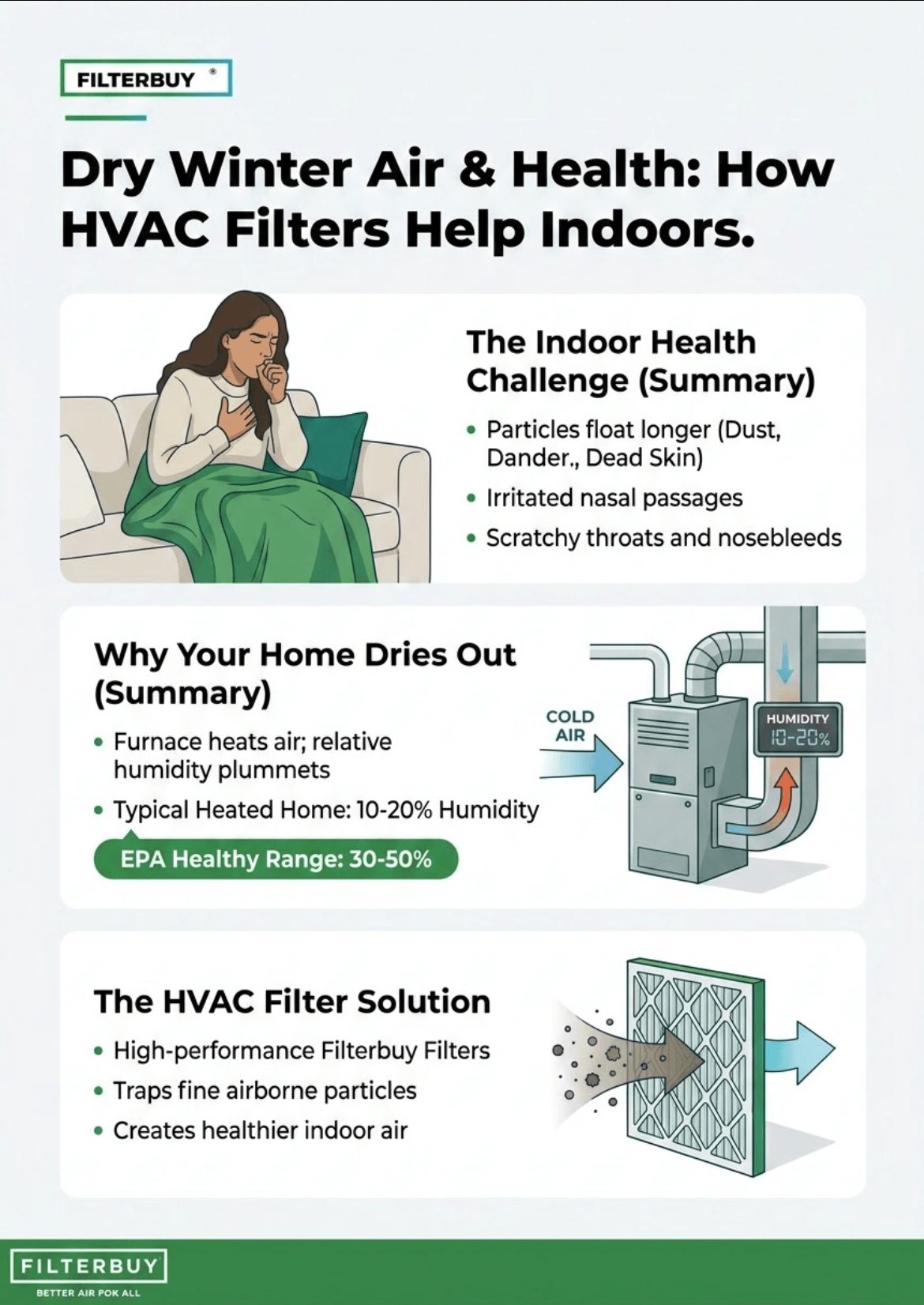
Cold air holds less moisture—that's physics. Your furnace heats that already-dry air, dropping relative humidity even further. Most heated homes hit 10-20% humidity without a humidifier.
Dry air suspends particles longer. Dust, pet dander, and skin cells that would normally settle fast stay airborne. These floating irritants cause the scratchy throats and sinus problems.
A quality filter captures those suspended particles before they circulate. You're not adding moisture, but you're removing what dry air would otherwise keep stirring up.
The best approach pairs both: humidifier for moisture, quality filter for particles. One without the other leaves half the problem unsolved.
Cold outdoor air can't hold much water vapor. When your furnace pulls in that air and heats it, the relative humidity drops even more. Add sealed windows and doors, and you've trapped air that might be drier than the Sahara Desert.
The EPA recommends 30-50% humidity year-round. We test moisture levels in customer homes during service calls, and most heated houses sit between 10-20% in winter. That's really dry.

Customers describe the same symptoms every winter: cracked lips, bloody noses, scratchy throats, and static shocks. But here's what most people miss—those fine particles floating in super-dry air are making everything worse.
When humidity drops below 30%, dust and dander particles that would normally settle to surfaces stay suspended longer. Your respiratory system, already irritated by dry air, now has to deal with more airborne junk too.
The comfort problems are just as real. Static electricity builds up because there's no moisture to dissipate it. Dust settles faster on furniture because it's not staying airborne as long. And that general feeling that something's off with your indoor air? You're not imagining it.
Let's be clear about what filters can and can't do. A filter won't add moisture to your air. If you want humidity, you need a humidifier.
What a quality pleated filter does do is capture the fine particles that dry air keeps circulating. Here's the difference that makes:
• Traps dust, pet dander, and skin cells before they complete another lap around your house
• Reduces irritants hitting your respiratory system when windows stay closed for months
• Helps your furnace run more efficiently by preventing dust buildup on components
• Works alongside your humidifier—one handles moisture, the other handles particles
• Cuts down on the film of dust that settles on everything when dry air finally releases it
We've tracked this with customers who upgrade their filters before heating season starts. They consistently report fewer winter symptoms and less dust accumulation.
"We've shipped millions of filters directly to families across every climate zone. The pattern is clear: homeowners who pair a fresh MERV 11 or 13 with humidity control before the first cold snap consistently report the fewest winter air quality complaints. It's not magic—it's addressing both sides of the problem."
— Filterbuy Manufacturing Team, Alabama & Florida facilities
EPA: Care for Your Air - Indoor Air Quality Guide — Government agency's guidance on humidity recommendations, ventilation strategies, and pollutant control.
https://www.epa.gov/indoor-air-quality-iaq/care-your-air-guide-indoor-air-quality
American Lung Association: Indoor Air Pollution This Winter — Expert guidance on winter-specific air quality challenges, including humidity balance and allergen reduction.
https://www.lung.org/blog/indoor-air-quality-winter
National Institute of Environmental Health Sciences: Indoor Air Quality — Research-backed information on how built environments affect health, covering humidity and ventilation impacts.
https://www.niehs.nih.gov/health/topics/agents/indoor-air
Cleveland Clinic: How Dry Winter Air Causes Health Problems — Medical experts explain respiratory and skin health impacts of low-humidity environments.
https://health.clevelandclinic.org/can-best-combat-effects-dry-winter-air
Mayo Clinic: Humidifiers and Indoor Air Quality — Trusted medical guidance on humidity levels, humidifier safety, and respiratory health.
https://www.mayoclinic.org/diseases-conditions/common-cold/in-depth/humidifiers/art-20048021
American Lung Association: Asthma and Indoor Air — Specific guidance for managing respiratory conditions during winter months when air quality challenges peak.
https://www.lung.org/blog/asthma-and-indoor-air
Franciscan Health: Winter Air Quality Research — Clinical perspective on why indoor air becomes more problematic during heating season.
https://www.franciscanhealth.org/community/blog/winter-makes-indoor-air-quality-worse
90% of Americans' Time Spent Indoors — The EPA reports that Americans spend approximately 90 percent of their time indoors, where pollutant concentrations can reach 2 to 5 times higher than outdoor levels. This becomes even more significant during winter when homes are sealed. Source: EPA Indoor Air Quality Report
https://www.epa.gov/report-environment/indoor-air-quality
2-5 Times More Polluted Indoor Air — According to the American Lung Association, indoor air can be 2-5 times, and sometimes up to 100 times, more polluted than outdoor air during certain activities. Winter conditions make this concentration worse. Source: American Lung Association
https://www.lung.org/clean-air/indoor-air
30-50% EPA Recommended Humidity Range — The Environmental Protection Agency recommends keeping indoor humidity between 30-50 percent to prevent mold growth while maintaining respiratory comfort. Most heated homes without humidifiers drop to 10-20% during winter. Source: EPA Indoor Air Quality Guidelines
https://www.epa.gov/indoor-air-quality-iaq/care-your-air-quality-guide
Here's what we've learned after thousands of customer calls about winter air problems: there's no single fix that solves everything. The combination that works consistently? A quality pleated filter (MERV 11 or 13) plus humidity control.
The filter doesn't add moisture—that's the humidifier's job. But it removes the irritants that super-dry air keeps suspended and circulating. When you address particles and moisture, most winter symptoms start disappearing.
We manufacture filters in Alabama, Florida, Pennsylvania, and Utah. Every facility ships directly to homeowners dealing with winter air quality challenges. The feedback is consistent: families who tackle both sides of the problem report the best results.
• Check your current filter—if it's been more than 60 days since you swapped it during heating season, put in a fresh MERV 11 or 13
• Buy an inexpensive hygrometer ($10-15) to monitor humidity levels
• If you're measuring below 30% humidity, add a humidifier to your bedroom or main living area
• Set up auto-delivery for filters so you never miss a change during critical heating months
• Research whether a whole-home humidifier makes sense for your setup and budget
• Schedule HVAC maintenance to ensure your system runs efficiently and doesn't fight your air quality goals
• Check filter monthly during heating season (October through March)
• Adjust humidifier settings as outdoor conditions change
• Watch dust accumulation—if you're seeing more than usual, time for a filter upgrade
They don't add moisture, but they remove the particles that dry air keeps suspended. Those floating irritants cause most symptoms people blame on dryness—scratchy throats, sinus irritation, and respiratory discomfort.
MERV 11 for most homes—great particle capture without choking airflow. MERV 13 for households dealing with allergies, asthma, or multiple pets. Always confirm your system can handle the restriction first.
Check monthly during heating season and replace every 30-60 days. Winter puts extra demand on filters because furnaces run constantly and dry air allows more particles to stay airborne longer.
Aim for 30-40% relative humidity. The EPA recommends 30-50% year-round, but winter's the time to stay on the lower end to prevent condensation on windows.
No, but a filter that's too restrictive for your system can reduce airflow, making air feel stagnant. Match the filter to your system's capacity, not just your air quality goals.
Indirectly, yes. Dry air weakens nasal defenses, helps viruses survive longer, and allows more irritants to stay suspended. It's not the dryness itself causing problems—it's the conditions dry air creates.
For complete winter air quality, yes. They tackle different parts of the problem. Humidifier adds moisture, filter removes particles. One without the other leaves you halfway to the solution.
Don't spend another heating season dealing with dry air symptoms and poor indoor air quality. The right filter plus proper humidity control makes the difference between surviving winter and actually being comfortable in your home.
