Opened your electric bill and felt the shock? You’re not alone. As temperatures outside start to climb, millions of homeowners experience the same sticker shock.
Keeping a home cool during the hottest months of the year requires a massive amount of power. It prompts many to ask: Why is my electric bill so high in summer? The simple truth is that residential cooling systems work overtime to fight the heat, drawing vast amounts of electricity from the grid.
Understanding exactly what is driving that usage up is the first step toward bringing those costs down. By evaluating your current cooling setup, you can pinpoint the main culprits draining your wallet and implement immediate fixes that make a difference.
Residential cooling systems are the primary contributors to high electricity bills during the summer months.
Understanding your cooling setup and its energy consumption can help identify areas for improvement.
Simple adjustments and optimizations can lead to significant savings on energy costs.
Regular maintenance of cooling systems ensures they run efficiently and reduces unnecessary power usage.
Investing in energy-efficient appliances or alternative cooling methods can lower long-term expenses.
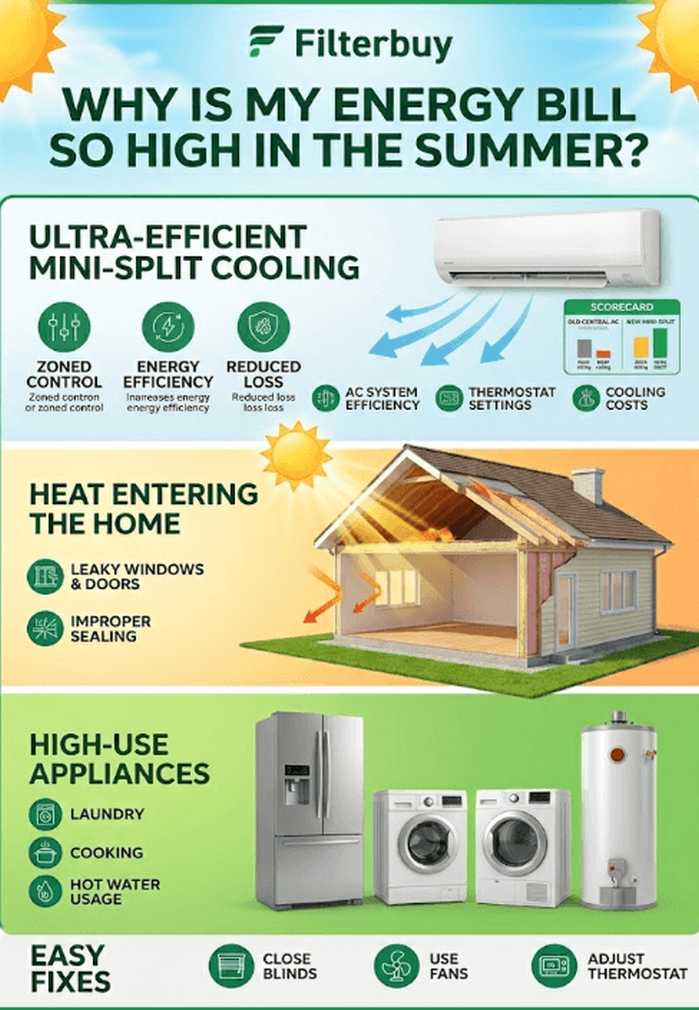
Air conditioning generally accounts for 40% to 50% of a home's total energy use during the peak summer months. When outside temperatures soar, your AC has to run longer and work harder to reach the temperature set on your thermostat.
Other seasonal factors compound the issue. Summer brings more daylight hours, often leading to increased appliance use. Kids are home from school, opening the refrigerator more frequently, watching television, and leaving lights on. The combination of a constantly running AC and higher general household activity creates the perfect storm for a massive utility bill.
Not all air conditioners are created equal. The type of system you use dramatically impacts your monthly power consumption.
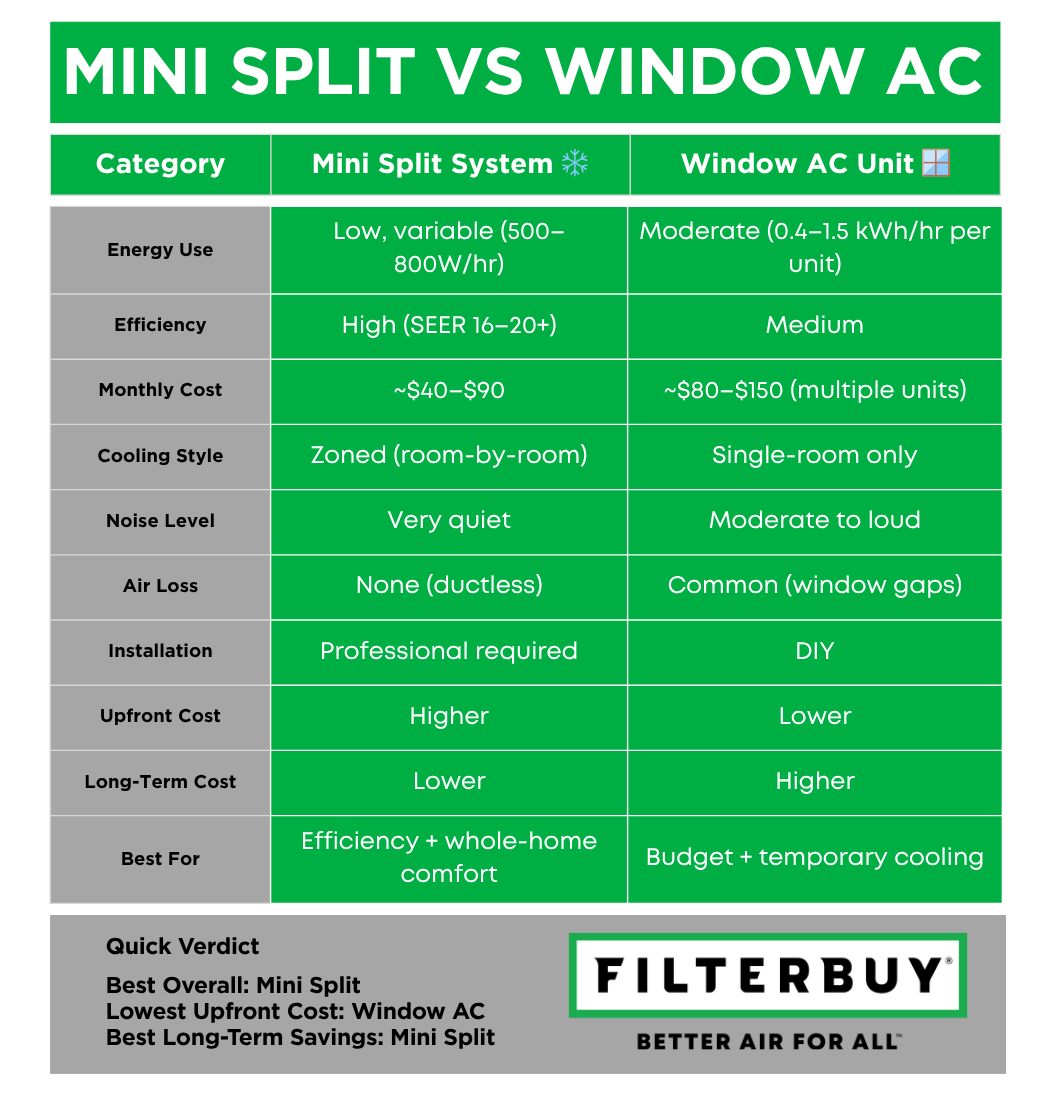
Understanding the energy usage of a mini split AC is key to lowering your bill over the long term. A small to mid-sized ductless mini split system typically consumes about 500 to 800 watts per hour. Over a month, depending on how often you run it, that equals roughly 240 to 360 kWh.
This high level of efficiency comes down to the variable-speed inverter. Instead of blasting at full power and repeatedly shutting off, the inverter adjusts the compressor speed to maintain a steady temperature. It runs smarter, not harder.
Do window AC units increase electric bills? Absolutely. A typical window unit uses between 0.4 and 1.5 kWh per hour. That might not sound terrible for a single room, but cooling a larger space often requires multiple units running simultaneously. When you compound the cost of running three or four window units all day, your electricity usage skyrockets.
To give you a clearer picture of how these cooling methods stack up against each other, consider this simple comparison:
| System | Energy Use | Efficiency | Bill Impact |
|---|---|---|---|
| Mini Split | Lower, variable | High (SEER 16+) | Lower long-term cost |
| Window Units | Moderate per unit | Medium | Higher when multiple units used |
Many homeowners rely on window air conditioners because they are cheap to purchase upfront. But are window AC units energy efficient? Only in specific cases, like cooling a single small room for a few hours. In reality, they often drive up your energy costs for several reasons:
Running two to four units at once multiplies your power draw.
Older models (manufactured before ENERGY STAR standards) are notoriously inefficient.
Poor window installation leads to air leaks, letting cool air escape and hot air enter.
Incorrect sizing causes units to either run continuously or short-cycle, failing to dehumidify the space.
Your mini-split AC electric bill is often lower because ductless systems eliminate the major inefficiencies of traditional cooling systems.
First, there are no duct losses. Central air conditioning can lose up to 30% of its cooling energy through leaky attic ductwork.
Second, mini-splits allow for zoned cooling. You only cool the rooms you are actively using, rather than paying to air-condition an empty guest bedroom.
Lastly, as mentioned, inverter technology avoids the constant stop-and-start power surges that traditional units require, and their high SEER (Seasonal Energy Efficiency Ratio) ratings make them vastly superior at converting electricity into cooling.
Let's look at a realistic monthly cooling scenario for a 500 to 700-square-foot living space.
If you attempt to cool that space using two to three standard window units running most of the day, you can expect to add about $80 to $150 to your monthly electric bill.
If you cool that same space with a highly efficient SEER 17 mini split, your monthly cost would likely drop to between $40 and $90. The energy savings become obvious very quickly.
You do not need to replace your entire HVAC system today to start seeing savings. Here are practical steps you can take immediately:
Raise your thermostat by 2 to 4 degrees.
Use ceiling fans to circulate cool air, allowing you to set the AC higher without feeling warmer.
Seal window leaks with weatherstripping or caulk.
Close blinds and curtains during peak afternoon sun to block out radiant heat.
Clean or replace your AC filters monthly to ensure proper airflow.
Avoid cooling empty rooms by shutting doors and vents in unused spaces.
Upgrade to a highly efficient cooling system when your current one begins to fail.
Eventually, simple fixes won't be enough. If your air conditioner is running constantly without reaching the desired temperature, producing uneven cooling throughout the house, or if your bills are rising significantly year after year despite identical usage, your system is failing.
When you are ready to make a change, ductless mini-splits offer a massive upgrade in comfort and efficiency. Filterbuy offers premium mini-split systems featuring SEER 17 efficiency and advanced variable-speed inverters to keep your power draw low.
With smart WiFi control, a 24-hour timer, and eco-friendly R32 refrigerant, these systems give you total control over your cooling costs. Filterbuy provides fast, free shipping and easy ordering so you can get your system quickly. We highly recommend hiring a licensed HVAC professional for the installation to ensure optimal performance and warranty compliance.
You don't have to accept painfully high utility costs as a mandatory summer tax. By understanding the true efficiency of mini split ACs compared to older methods, sealing up your home, and making smart thermostat choices, you can stay cool without breaking the bank.
Explore energy-efficient mini split systems from Filterbuy today and see how much you could save over the long haul.
Yes, window AC units can significantly increase your electric bill, especially if you run multiple units simultaneously, use older models, or fail to properly seal the window gaps.
They are generally less efficient than modern ductless mini splits or high-efficiency central air systems. While they work fine for temporarily cooling a single small room, using them to cool large spaces is highly inefficient.
It is generally much cheaper to run a ductless mini split than a window AC. Mini splits are more energy-efficient, using advanced inverter technology to modulate power consumption, resulting in lower long-term operating costs.
To improve efficiency, ensure the unit is the correct size for your room, clean the filter regularly, and use weatherstripping or foam insulation to seal all gaps around the unit in the window frame. Setting the thermostat to a reasonable temperature (e.g., 78°F) can also help save energy.
The main advantages of a mini split are superior energy efficiency, quieter operation, and better zoned cooling capabilities. Unlike window units, they don't block your window view or create a security risk. They provide both heating and cooling, offering a year-round solution.