If your energy bill makes you cringe every summer, you are definitely not alone. Rising electricity costs across the United States have made keeping a home cool more expensive than ever. Many homeowners are paying upwards of $150 to $250 a month just to beat the heat, and outdated cooling technology is often the primary culprit.
For decades, window air conditioning units were the default choice for cooling individual rooms. They provided a quick fix for sweltering July afternoons. However, these bulky boxes come with a host of frustrating downsides. They block your natural light, sound like a jet engine starting up in your bedroom, and offer terrible energy efficiency. They also pose a significant security risk by providing an easy access point for intruders.
You do not have to settle for loud, inefficient cooling anymore. HVAC technology has advanced significantly, offering solutions that provide better comfort and drastically lower energy bills. This guide breaks down the best alternatives to window AC units available in 2026. We will compare upfront costs, long-term savings, and installation requirements to help you choose the smartest upgrade for your home.
Window AC units may be affordable but come with drawbacks such as inefficiency, noise, and potential security vulnerabilities.
Modern HVAC options provide quieter operation, enhanced comfort, and significant energy savings compared to traditional window units.
When exploring alternatives, consider factors like initial cost, long-term energy savings, and installation requirements to make an informed decision.
Upgrading to advanced cooling solutions in 2026 can enhance your home's comfort while reducing your environmental footprint.
The average U.S. household is feeling the squeeze of rising utility rates. Relying on an old window unit is essentially a hidden tax on your wallet. These systems operate using outdated compressors that cycle on and off loudly, consuming massive amounts of electricity with every cycle.
Beyond the financial drain, window units simply make living spaces less enjoyable. The constant rattling makes it hard to watch television or sleep peacefully. Furthermore, sacrificing a beautiful window view for a heavy plastic box is a compromise few homeowners want to make year after year. Removing them during the winter is a physical chore, while leaving them installed creates drafty gaps that let cold air inside.
So what actually works better? The market now offers several highly efficient upgrades that solve these exact problems.
To help you understand your options, here is a quick breakdown of how the top cooling alternatives compare to a standard window unit.
| System Type | Efficiency Rating | Average Lifespan | Noise Level | Installation | Best Use Case |
|---|---|---|---|---|---|
| Standard Window AC | 9–12 CEER | 5–8 Years | High | DIY | Absolute budget emergencies |
| Ductless Mini Split | 20+ SEER | 15–20 Years | Ultra-Low | Professional | Maximum long-term ROI |
| Portable AC | 8–10 CEER | 5–10 Years | Medium-High | DIY | Renters with window restrictions |
| Inverter Window Unit | 15 CEER | 7–10 Years | Medium-Low | DIY | Budget-conscious upgrades |
| Evaporative Cooler | N/A | 10–15 Years | Medium | DIY/Pro | Dry climates (Southwest US) |
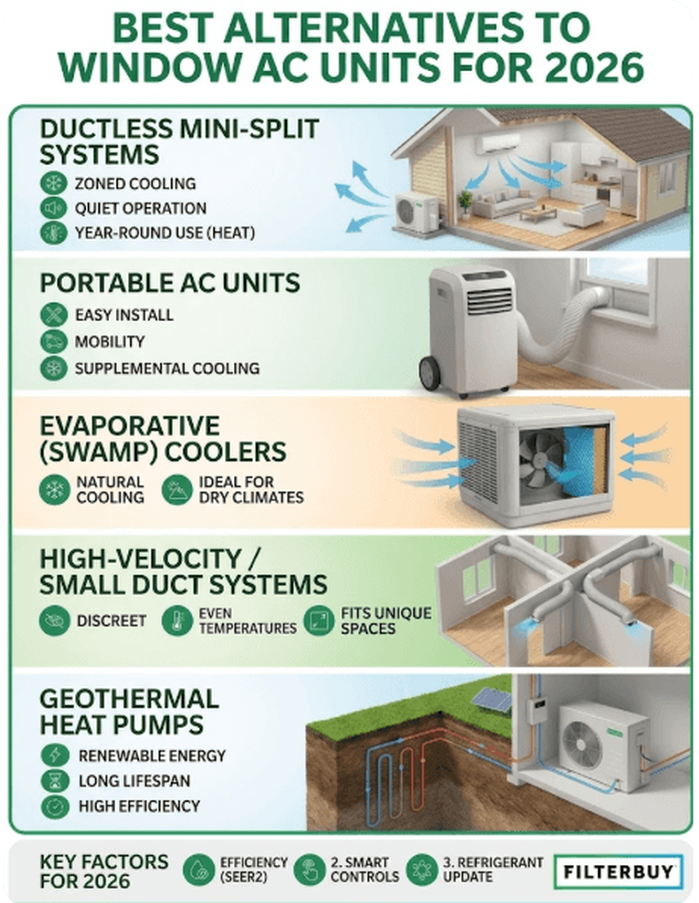
When comparing a mini split vs window AC, the ductless system wins almost every time. HVAC professionals recommend mini splits as the absolute best alternative to window AC units for homeowners looking to maximize comfort and savings.
Ductless mini splits deliver cool air directly into different zones of your home. Because they do not rely on ductwork, they avoid the energy loss associated with central air. Modern mini splits boast efficiency ratings of 20 SEER (Seasonal Energy Efficiency Ratio) or higher. Upgrading to one of these systems usually results in 25% to 50% energy savings. You also gain the ability to set different temperatures for different rooms, ensuring you only cool the spaces you are actively using.
Let us look at the math. A standard window AC might cost $300 upfront, but it runs up your electricity bill quickly. If you currently pay around $210 a month for cooling, a mini split can reduce that cost by 30% to 50%. While a mini split requires a larger initial investment for professional installation, the monthly energy savings completely offset the price tag over the system's lifespan.
The upfront cost of a mini split is much more manageable thanks to current federal incentives. Under the latest energy initiatives, homeowners can claim a 30% federal tax credit for installing high-efficiency heat pumps and mini splits. This credit maxes out at $2,000. Think of this as a massive hidden discount provided by the government to help you upgrade your home.
Mini splits are the ultimate choice for homeowners with a long-term savings mindset who want quiet, permanent, and highly efficient temperature control.
If you live in an apartment where modifying the exterior is strictly prohibited, a portable AC unit offers a viable workaround. These units sit on the floor inside your room and vent hot air through a small hose placed in the window.
The setup is incredibly easy. You can move the unit from your home office during the day to your bedroom at night. They are an excellent choice for renters who cannot permanently alter their living space.
When evaluating a portable AC vs window AC, portable models generally consume more energy. They use indoor air to cool their internal components, which eventually pulls warm air into the room through tiny cracks and gaps in your house. They also take up floor space and can be quite noisy.
Portable AC units work well for temporary cooling needs or for apartment dwellers dealing with strict HOA window restrictions.
If a mini split is completely out of your budget, you do not have to stick with a traditional window unit. Smart inverter window units provide a massive upgrade over their older counterparts.
Instead of the compressor blasting at 100% capacity and shutting off repeatedly, inverter technology allows the compressor to adjust its speed gradually. This makes them up to 35% more efficient. Many feature a U-shaped design that allows your window to close almost entirely, which blocks the noisy compressor outside and secures your home.
These units are perfect for budget-conscious upgrades. They provide a noticeable drop in noise and energy usage without the professional installation costs associated with ductless systems.
Also known as swamp coolers, evaporative coolers offer an incredibly cheap alternative to traditional air conditioning, but they only work in very specific environments.
Evaporative coolers draw warm outside air through water-saturated pads. The water evaporates, naturally chilling the air before a fan blows it into your home. They use a fraction of the electricity required by standard AC compressors.
These coolers thrive in the Southwest United States. If you live in a very dry climate like Arizona or Nevada, an evaporative cooler is a fantastic, energy-efficient cooling option.
If you live in a humid state like Florida or Georgia, do not buy an evaporative cooler. Adding more moisture to already humid air will simply make your home feel sticky and uncomfortable.
It is easy to delay an HVAC upgrade because the upfront cost feels intimidating. However, holding onto a window unit is much more expensive than you think.
If you spend $210 a month on summer cooling, that easily translates to $2,500 a year for a household running multiple units. Over a five to ten-year period, you will spend tens of thousands of dollars just to stay mildly comfortable in a noisy room.
Framing this inefficiency as a hidden tax helps put the true cost into perspective. Investing in a high-efficiency alternative stops that financial leak immediately.
Choosing the best cooling option comes down to your living situation and your financial goals.
If you want the absolute lowest long-term cost and quietest operation, choose a Ductless Mini Split.
If you rent your home and cannot permanently modify your windows, choose a Portable AC or a Smart Inverter unit.
If you live in a deeply arid climate and want to cut electricity use drastically, choose an Evaporative Cooler.
Window AC units are rapidly becoming outdated, expensive relics of the past. The financial drain and lack of comfort they provide simply do not make sense anymore. Ductless mini splits stand out as the financially smarter upgrade, transforming your home into a quiet, perfectly chilled environment while slashing your monthly utility bills.
Even the best AC system needs proper airflow to function efficiently. Whether you decide to install a brand-new mini split or maximize the lifespan of your current central system, indoor air quality matters.
Lower your energy bills today with high-efficiency air filters from Filterbuy. Fresh filters reduce the strain on your cooling system, lower your electricity costs, and help your family breathe easier. Optimize your cooling system before upgrading and shop Filterbuy filters now.
Yes. Mini splits are significantly quieter, up to 50% more energy-efficient, and provide better air distribution. They also do not block your windows or create security vulnerabilities.
Fans and evaporative coolers are the cheapest alternatives to traditional air conditioning. However, evaporative coolers only work effectively in dry climates with low humidity.
Portable AC units are worth it if you are a renter or if your building's rules prohibit window AC units. Keep in mind that they use more electricity and provide less cooling power than mini splits or inverter window units.
Yes, you can leave a ductless mini split on all the time. They are designed to run continuously and maintain a consistent temperature, which can be more energy-efficient than turning them on and off.
The main disadvantages of a mini split are the higher upfront installation cost compared to window units and the need for professional installation. The indoor unit is also visible on the wall, which some may find less aesthetically pleasing than central AC vents.
Yes, installing a ductless mini split system can increase your home's value. They are seen as a modern, energy-efficient upgrade that improves comfort, making them an attractive feature for potential buyers.