
Repair or Replace? Heat Pump Costs, Repairs & Warning Signs
March 19, 2026
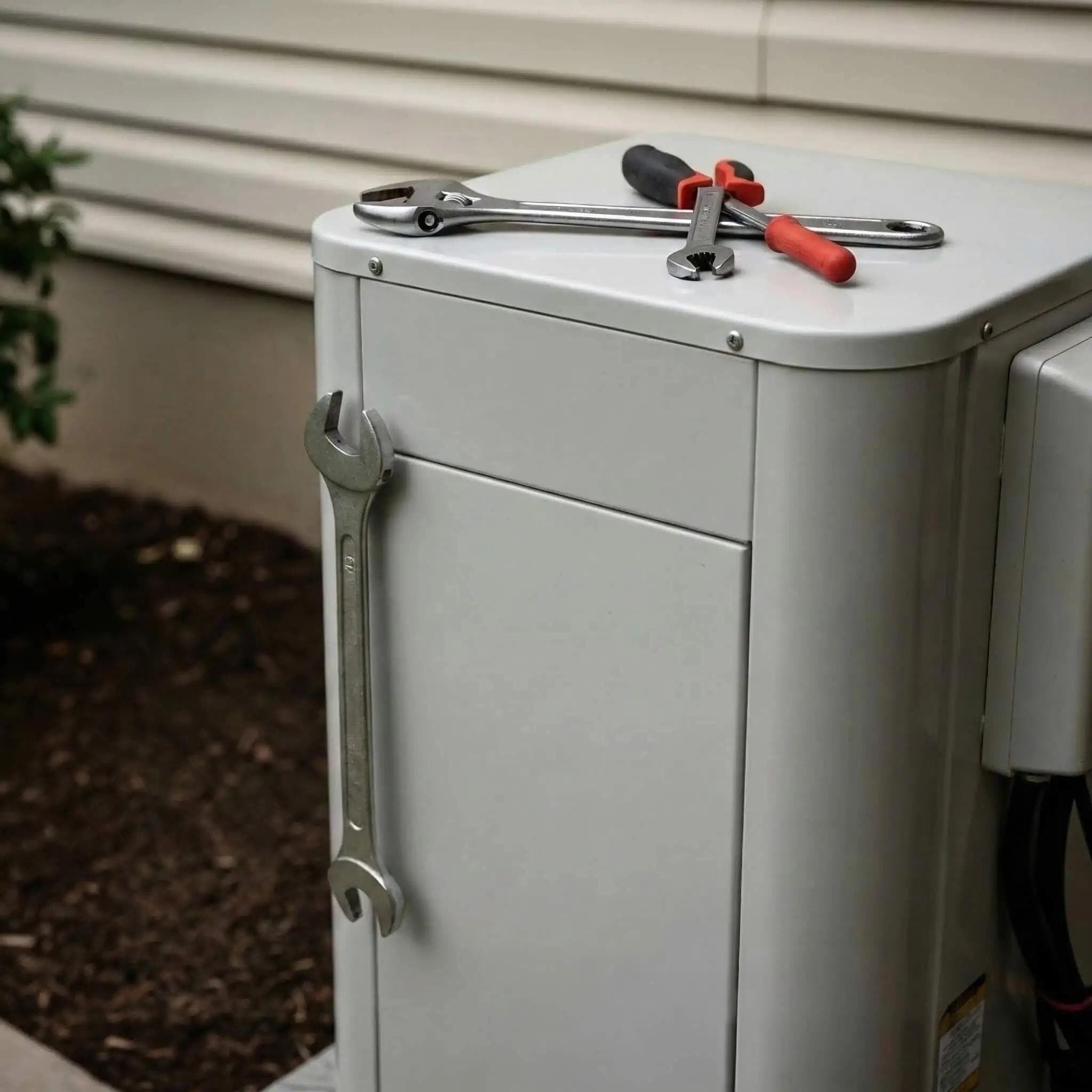
Here's the call we field more than any other: 'My heat pump ran all night, and the bill jumped $80. What happened?' Nine times out of ten, we find a filter that hasn't been changed in months. A $15 part turned into a $600 service call. We've watched that happen enough times to build this entire guide around it.
Most heat pump problems follow a predictable pattern, and most repairs are manageable when you catch them early. The difference between a $150 fix and a $2,500 emergency almost always comes down to one thing: how quickly you recognize what's going wrong.
We'll cover what repairs actually cost, how to diagnose the most common problems, a maintenance checklist you can use right now, and a simple formula for deciding when fixing the system stops making financial sense.
What you'll find in this guide: average heat pump repair costs by problem type, nine warning signs your system needs attention, a troubleshooting guide, a seasonal maintenance checklist, the 5,000 Rule for repair vs. replace decisions, and seven verified expert resources.
TL;DR Quick Answers
Heat Pump Repair
Heat pump repair costs typically run $150 to $700 for the most common issues. Major repairs — like compressor replacement — can reach $800 to $2,800.
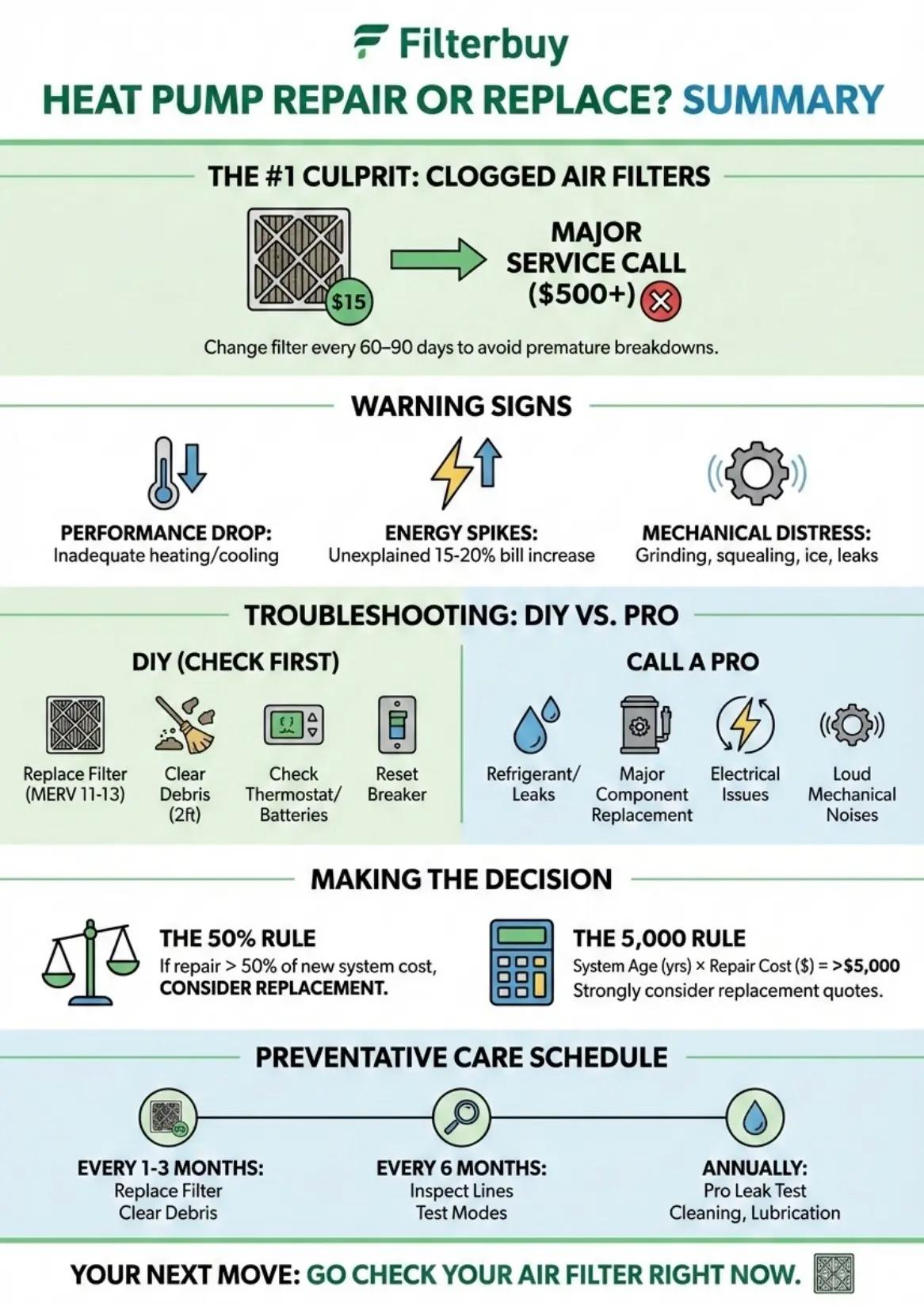
Most heat pump problems trace back to one root cause: a clogged air filter. Restricted airflow forces every component to overwork, and what starts as a $15 filter turns into a $500+ service call.
What you can fix yourself:
Replace the air filter (MERV 11 or MERV 13 recommended for heat pump systems)
Clear debris from the outdoor unit
Reset a tripped breaker
Check thermostat settings and battery
When to call a licensed HVAC technician:
Refrigerant recharge or leak repair
Compressor, fan motor, or reversing valve replacement
Electrical or control board issues
The repair vs. replace rule: Multiply your system's age by the repair cost. If the result exceeds $5,000, start getting replacement quotes. Under $5,000 with a well-maintained system, repair is usually the right call.
The single most effective way to prevent heat pump repairs: change your air filter every 60–90 days.
Top Takeaways
The seven things most worth remembering from everything above:
Most heat pump failures are preventable. A dirty air filter is the number one avoidable cause of premature breakdowns and expensive service calls.
Average repair costs run $150 to $700, but major repairs like compressor replacement can reach $2,800. Know the benchmarks before you accept a quote.
Nine warning signs demand attention: inadequate output, unusual noises, ice buildup, constant running, energy spikes, short cycling, wrong-temperature air, leaks, and age-related decline.
Use the troubleshooting guide in Section 2 before calling a technician. Many common problems have a DIY fix, and knowing which ones don't saves time and money.
Maintain your system on a schedule: filter every 60-90 days, a seasonal check every 6 months, and professional service annually.
Apply the 5,000 Rule (age x repair cost) before any major repair. Over $5,000, get a replacement quote.
Heat pumps last 15-20 years with proper care. Skipping maintenance shortens that and significantly increases the total cost of ownership.
What Is a Heat Pump — and Why Does It Break Down?
A heat pump doesn't generate heat the way a furnace does. It moves heat, pulling warmth from outside air or the ground and transferring it indoors in winter, then reversing the process in summer. That efficiency is real, but it comes with mechanical complexity: a refrigeration cycle, a reversing valve, a compressor, a blower motor, and two sets of coils all working together. When one component fails, everything else feels it.
The U.S. Department of Energy reports that heat pumps can cut electricity used for heating by up to 65% compared to electric resistance heating. That advantage disappears fast when the system isn't maintained. The most common reason it isn't: a dirty air filter blocking airflow and forcing every other component to work twice as hard.
The 9 Warning Signs You Cannot Ignore
After years of working with homeowners from Miami to Minneapolis, we've seen which symptoms show up right before the worst breakdowns. These nine come up over and over, usually right before the most expensive repair calls:
Inadequate heating or cooling: System runs but can't reach your set temperature, even on mild days.
Unusual noises: Grinding, squealing, or banging sounds indicate mechanical wear.
Ice buildup on the unit: In cooling mode, this usually means low refrigerant or blocked airflow.
Constant running: The system never shuts off, and the temperature never stabilizes.
Sudden energy bill spike: A 15-20% unexplained increase often signals a failing component.
Short cycling: Turning on and off every few minutes is a sign the system is struggling.
Wrong-temperature air: Warm air blowing in cooling mode, or cool air in heating mode.
Moisture or refrigerant leaks: Pooling water or an oily residue around the unit.
Age-related decline: Any system over 12-15 years old showing reduced performance.
Heat Pump Repair Cost: What You'll Actually Pay
Repair costs vary by problem, region, and labor rates, based on service data compiled by Angi (2024-2025). Minor fixes sit at the low end of the range. Major component work can approach or exceed the cost of a new system.
Refrigerant recharges and leak repairs run $200 to $1,500, with R-22 systems costing significantly more because that refrigerant is no longer manufactured domestically. Compressor replacement is the most expensive single repair at $800 to $2,800 — if you're facing that number, always weigh it against replacement cost before approving the work. A reversing valve failure, which happens when the system won't switch between heating and cooling modes, typically runs $450 to $1,200.
Smaller fixes are far more manageable. A faulty capacitor or starter usually costs $90 to $350 and is often a same-day repair. Fan motor replacement runs $200 to $650, depending on whether it's the indoor or outdoor unit. Thermostat replacement is $75 to $300 — and worth diagnosing first before authorizing anything bigger. Drain line cleaning, which is largely preventable with regular filter changes, runs $75 to $200. Electrical and control repairs, covering wiring, circuit boards, and sensors, range between $150 and $500.
Full system replacement starts at $3,500 and can exceed $12,000 depending on system type and installation complexity. As a general rule, if your repair quote exceeds 50% of what a new system costs, replacement is the stronger financial move.
Troubleshooting Guide: Diagnose Your Problem Fast
Start here before you call anyone. Many common heat pump problems have a DIY fix, and knowing which ones don't will save you the time and cost of a service call you didn't need.
If you're getting no heating or cooling at all, check the breaker and your thermostat setting before anything else, then replace the filter if it's overdue. Most no-function calls trace back to one of those three things. If the problem persists after those checks, then you need a technician.
Ice on the outdoor unit in summer almost always means low refrigerant or blocked airflow. Replace the filter yourself, but refrigerant requires a pro. Ice in winter is often normal, depending on the temperature — the defrost cycle should clear it. If the defrost cycle isn't activating, that's a pro call.
Loud grinding or squealing points to worn motor bearings or a failing fan. Don't delay on this one — continued operation worsens the damage and raises the repair cost. Call a technician immediately.
Short cycling, where the system turns on and off every few minutes, can come from an oversized system, low refrigerant, or a dirty filter. Check the filter first. If the cycling continues after a clean filter, refrigerant diagnosis requires a pro.
A spike in energy bills without a change in usage usually points to a dirty filter, low refrigerant, or an aging compressor working harder than it should. Handle the filter yourself. Refrigerant and compressor work requires a licensed technician. No airflow from vents suggests a blower motor failure or a severe blockage — check the filter and visible vents first, then call for motor diagnosis if those are clear.
Heat Pump Maintenance Checklist
Most heat pump failures are preventable. Skipping basic maintenance, especially routine filter changes, is the most common and most costly mistake homeowners make. Here's the schedule we recommend:
Every 1-3 Months:
Replace your air filter. For heat pump systems, we recommend MERV 11 or MERV 13. A clogged filter restricts airflow, strains the blower motor, and can cause the coils to ice over.
Clear debris from around your outdoor unit (maintain at least a 2-foot clearance).
Check thermostat batteries and confirm mode settings are correct for the season.
Every 6 Months:
Inspect refrigerant lines for wear, damage, or missing insulation.
Test both heating and cooling modes even outside their primary season.
Check the condensate drain line for clogs; a blocked drain causes moisture damage.
Inspect electrical connections at the air handler for any loose or corroded terminals.
Annually (Call a Pro):
Full refrigerant level inspection and leak test.
Coil cleaning on both indoor and outdoor units.
Lubrication of all moving parts, including fan motors and bearings.
Full electrical systems test: capacitors, contactors, and wiring.
Airflow and duct connection check.
Repair vs. Replace: The 5,000 Rule
Repair or replace? It's the question every heat pump owner dreads, usually at the worst possible time. HVAC pros use a simple formula to cut through it:
Age of System (years) x Repair Cost ($) = Decision Number
Over $5,000: strongly consider replacement. Under $5,000: repair is likely the better move.
Example: Your 10-year-old heat pump needs a $600 capacitor fix. 10 x $600 = $6,000. The 5,000 Rule says replace, though not urgently. A $200 fan motor on the same system? 10 x $200 = $2,000. Fix it.
Age matters too. Systems under 8 years old are almost always worth repairing. Systems over 15 years old are approaching the end of their lifespan, regardless, so factor in rising energy costs, declining efficiency, and what a modern replacement would actually save you over time.
For a deeper look at heat pump efficiency ratings and installation cost comparisons, visit our Heat Pump Basics Guide. For a foundational overview of how heat pumps work, the Wikipedia entry on heat pumps is a good place to start.
"We've watched a $15 filter turn into a $600 service call enough times to build this entire guide around it — and after years of working with homeowners from Miami to Minneapolis, the pattern is always the same: the most expensive heat pump repairs aren't caused by bad systems, they're caused by ignored warning signs and skipped maintenance."
- Filterbuy Team
7 Essential Resources
Seven resources worth bookmarking: government tools, certification directories, and cost benchmarks grounded in real repair data. Each one is free, and together they'll give you more context than any single contractor quote.
1. U.S. Department of Energy — Heat Pump Systems
The federal government's own resource on heat pump technology, efficiency ratings, installation guidance, and energy savings data. Start here if you're evaluating the total cost of ownership.
The EPA's ENERGY STAR program certifies the most efficient heat pump models on the market. Use this to compare SEER and HSPF ratings before any replacement purchase.
3. AHRI — Certified Products Directory
The Air-Conditioning, Heating, and Refrigeration Institute keeps a searchable database of certified HVAC equipment. Useful for verifying contractor claims about system performance ratings.
4. NATE — Find a Certified Technician
North American Technician Excellence sets the standard for HVAC certification. Use their directory to find a NATE-certified technician in your area before hiring anyone.
A thorough, well-cited overview of how heat pumps work, the refrigeration cycle, system types, and the history of the technology. Good foundational reading before any major decision.
6. Filterbuy — Heat Pump Basics Guide
Our own resource covering heat pump heating costs, installation, operating efficiency, and savings comparisons. The best companion piece to this repair guide.
7. Angi — Heat Pump Repair Cost Guide
One of the most detailed crowd-sourced databases of real heat pump repair costs, organized by problem type, system size, and region. Useful for benchmarking quotes before you commit.
3 Statistics Worth Knowing
Three numbers worth knowing before your next service call or repair decision:
Up to 65% — that's how much heat pumps can reduce electricity used for heating compared to electric resistance heating, according to the U.S. Department of Energy. That efficiency advantage is real, but it depends entirely on a properly maintained system.
Source: U.S. Department of Energy — Energy Saver: Heat Pump Systems
$150 to $700 — the typical cost range for heat pump repairs, based on real service data from Angi. Knowing this benchmark before you get a quote protects you from overpaying and helps you spot when a number is off.
Source: Angi — Heat Pump Repair Cost Guide (2024-2025 data)
15 to 20 years — the expected lifespan of a properly maintained heat pump, per the U.S. Department of Energy. Systems that skip filter changes and annual service often fail years earlier, at significantly higher cost.
Source: U.S. Department of Energy — Energy Saver: Heat Pump Systems
Final Thoughts & Our Honest Opinion
We'll give it to you straight.
Heat pump repair can be straightforward or expensive, and the difference is almost always preparation. The homeowners who end up in the most painful situations didn't have bad systems. They ignored warning signs for too long or let maintenance slide for a season too many.
The repair vs. replace decision is never purely financial. The 5,000 Rule gives you a useful starting point, but a 14-year-old system that just needed a capacitor replaced is still a 14-year-old system. The next repair is coming. Factor in your peace of mind, your family's comfort, and the actual energy cost of running an aging, less-efficient unit.
Our honest take:
If your heat pump is under 10 years old and the repair is under $600, fix it without hesitation and commit to better maintenance going forward. If it's over 12 years old and you're looking at a second major repair in two years, start getting replacement quotes now — not because the repair isn't worth it today, but because the pattern is telling you something. And wherever you land on that decision: change your air filter. That $15 fix does more to protect a $5,000 system than anything else in this guide.
Next Steps
Whether your system is acting up right now, you've got a repair quote you're second-guessing, or you just want to get ahead of it: here's where to start.
Check your air filter right now. Pull it out. If it's gray, clogged, or you can't remember the last change, that's your first repair call waiting to happen. Replace it before anything else.
Note the warning signs. Walk through the nine warning signs in Section 2 and document anything you recognize. The more specifically you can describe symptoms, the faster any service call will go.
Run the troubleshooting guide. For common issues, Section 2's troubleshooting breakdown can save you a service call entirely. Start there before picking up the phone.
Get at least two quotes for any repair over $500. Cost varies significantly by region and contractor. Getting a second opinion on major repairs is standard practice, not an insult.
Ask for NATE certification. When calling contractors, ask if their technicians are NATE-certified. It's the most reliable indicator of professional competence in the HVAC industry.
Apply the 5,000 Rule. Before authorizing any repair over $300, do the math: system age x repair cost. If the number tops $5,000, get a replacement quote before you commit.
Set up a filter change schedule. Whether you use our auto-delivery program or a phone reminder, commit to changing your filter every 60-90 days. That one habit prevents more service calls than anything else.
Frequently Asked Questions
The questions homeowners ask us most, with answers written to give you what you actually need to make a smart decision.
How much does heat pump repair cost on average?
Most heat pump repairs fall between $150 and $700. Minor fixes, like replacing a capacitor, cleaning a drain line, or resetting a thermostat, sit at the lower end. Major repairs like compressor replacement or a refrigerant leak fix can run $800 to $2,800 or more. Get at least two quotes for any repair over $500, and ask your technician to explain exactly what failed and why before you approve the work.
What is the most common cause of heat pump failure?
A clogged air filter, by a wide margin. When airflow is blocked, the system overworks every component: the blower motor, the coils, the compressor. What starts as a dirty filter becomes a $500 repair call. Changing your filter every 60-90 days is the single most effective thing you can do to prevent heat pump failures.
Can I repair a heat pump myself?
Some tasks are safe for homeowners: replacing the air filter, clearing debris from the outdoor unit, checking thermostat settings, resetting a tripped breaker, and cleaning accessible coil surfaces. Anything involving refrigerant, electrical components, or internal motor work requires a licensed HVAC technician. Handling refrigerant without EPA certification is illegal and potentially dangerous.
How do I know if my heat pump needs refrigerant?
The most reliable signs of low refrigerant are ice forming on the refrigerant lines, especially in summer, reduced heating or cooling output even when the system is running, a hissing or bubbling noise near the unit, and a noticeable increase in energy bills. A technician uses pressure gauges to confirm the diagnosis. Only EPA 608-certified technicians can legally purchase and handle refrigerant.
What does 'emergency heat' mean on my thermostat?
Emergency Heat (EM Heat) activates a backup electric resistance heating strip when your primary heat pump can't operate. It's there for genuine emergencies, not as a comfort setting. Running EM Heat continuously can increase your heating costs by 50-100% compared to normal heat pump operation. If you need it for more than a day or two, call a technician.
How long should a heat pump last?
With consistent maintenance, heat pumps typically last 15-20 years. Systems that skip filter changes and annual professional service often fail at 10-12 years. Geography matters too: heat pumps in coastal or humid climates tend to experience more coil corrosion and shorter lifespans. If your system is over 15 years old and facing a significant repair, replacement is often the smarter long-term call.
Is it worth repairing an older heat pump?
Run the 5,000 Rule: multiply the system's age in years by the repair cost in dollars. If the result tops $5,000, replacement is typically more cost-effective when you factor in improved energy efficiency and lower future repair frequency. Under $5,000, and the system has been reasonably maintained? Repair is usually the right call.
How often should I have my heat pump professionally serviced?
At a minimum, once a year. Twice is better: spring for the cooling season, fall for the heating season. Annual professional service typically covers a refrigerant level check, coil cleaning, electrical inspection, lubrication, and an airflow check. The average cost runs $75-$200 and frequently prevents repair bills ten times higher.
Your Next Move Starts with One Simple Step
One question before you go: When did you last change your heat pump's air filter?
If it took more than three seconds to answer, it's time. The filter is the $15 fix that protects your $5,000 system. Every maintenance schedule, every repair decision, every efficiency gain in this guide depends on that one swap happening on schedule.