
Heat Pump Tune-Up Checklist
April 29, 2026
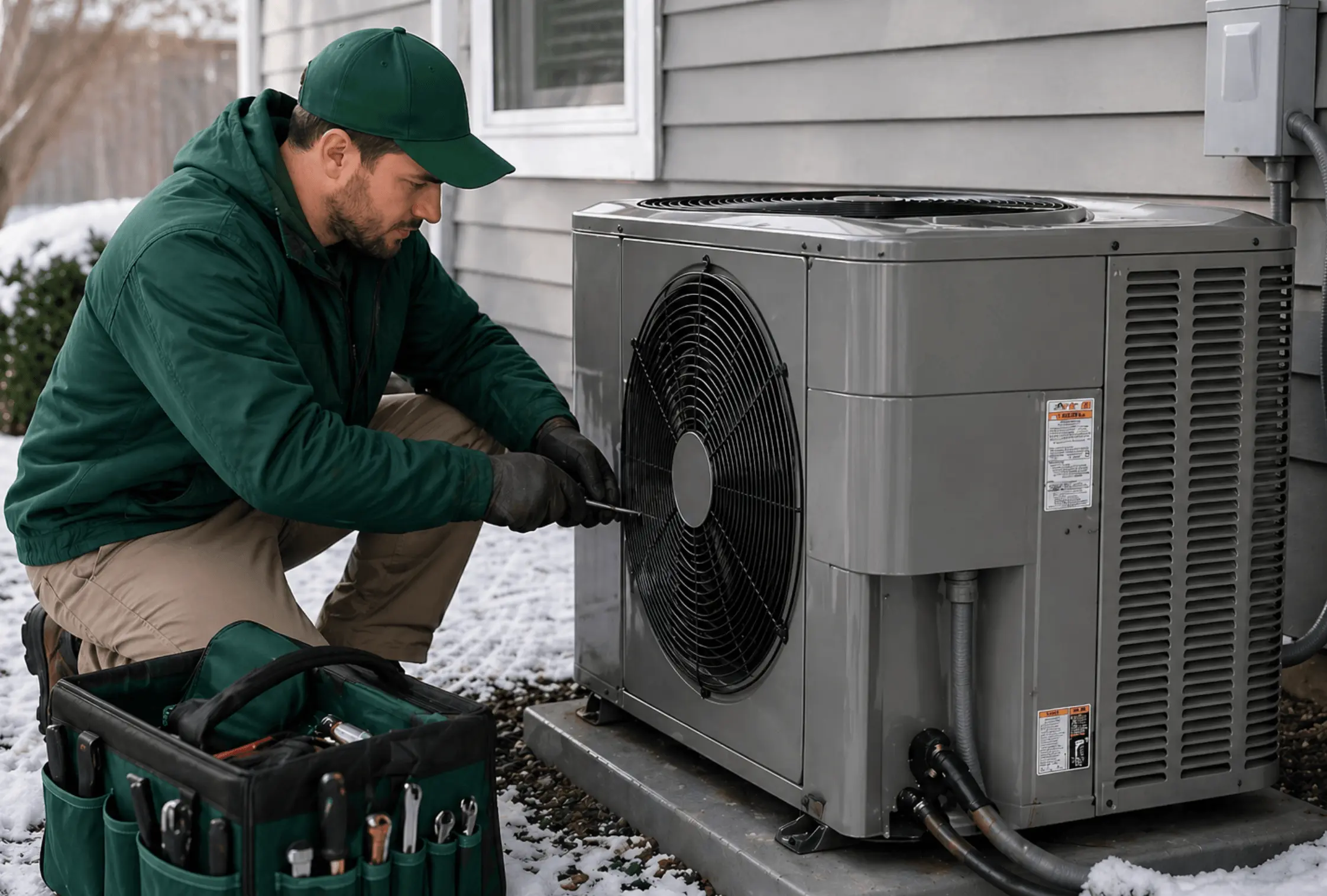
Your heat pump runs every day of the year. It heats in winter and cools in summer on the same hardware, which puts about twice the wear on the system compared with a furnace and AC that split the year. One service visit a year keeps it running at the efficiency you paid for. Skip those visits long enough and you'll meet the alternative on the hottest day of July, when every tech in your zip code is booked.
This page is the working heat pump maintenance checklist we'd hand a friend who wants to do this right. You'll find what a qualified technician should run through every year, what you can handle yourself between visits, what a fair tune-up costs in 2026, and how to spot the warning signs that mean your system needs service before peak season hits.
TL;DR — Quick Answers
What is a heat pump tune-up checklist?
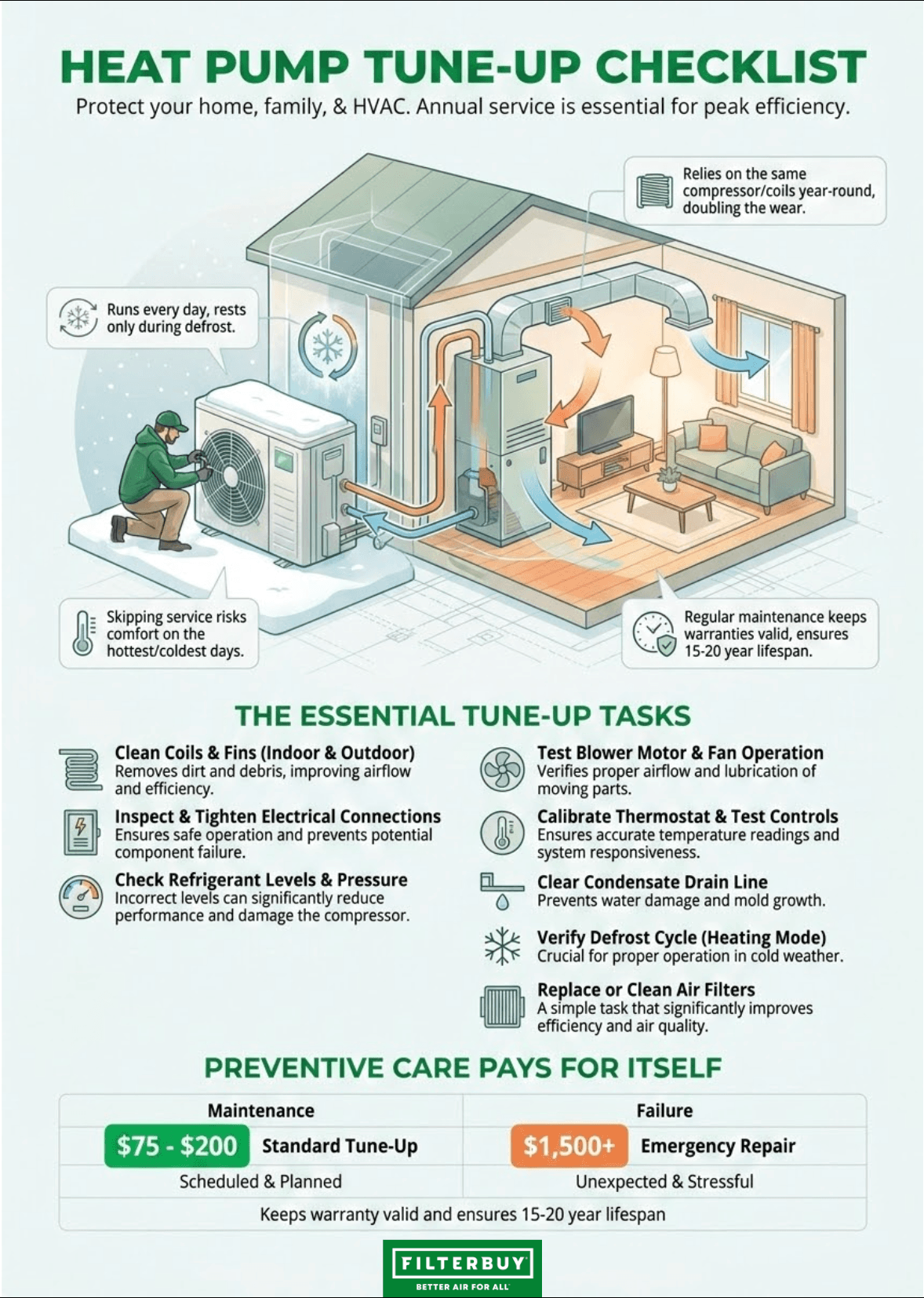
A heat pump tune-up checklist is the set of inspection and service tasks a NATE-certified technician runs on your system once or twice a year, plus the simple monthly tasks you handle yourself between visits. The full checklist covers 12 to 15 items in four phases:
Pre-service inspection. Visual check of indoor and outdoor units, thermostat calibration, and air filter inspection or replacement.
Refrigerant and coil work. Pressure measurement in both heating and cooling modes (the step most rushed techs skip), leak detection, and coil cleaning.
Electrical and mechanical. Capacitor and contactor testing, tightening of all connections, and motor lubrication.
System verification. Condensate drain clearing, airflow measurement, and a final performance test with measured values written on the invoice.
Schedule professionally twice a year — spring before cooling season, fall before heating season. Expect 60 to 90 minutes per visit and a cost of $75 to $200. Between visits, replace the air filter every one to three months, keep two feet of clearance around the outdoor unit, and flush the condensate drain quarterly. That single set of habits protects your warranty, keeps the system running at rated efficiency, and stretches its life from the 10 to 12 years a neglected unit gives you to the full 15 to 20 it was built for.
Top Takeaways
Five things every homeowner should know about heat pump preventive maintenance, pulled out so they're easy to remember after you close the tab.
1. Heat pumps work twice as hard as a furnace-and-AC pair. They run year-round on the same hardware. One annual professional visit is the minimum most manufacturers ask for. Two is better.
2. Most heat pump tune-ups follow a 12 to 15 item checklist. If your technician's heat pump inspection checklist doesn't include refrigerant pressures in both heating and cooling modes, that's a red flag.
3. DIY work matters more than people think. Roughly 70% of the maintenance burden sits with the homeowner: filter changes, outdoor unit clearing, condensate drain flushing. The work is simple, and skipping it costs you.
4. Documentation protects your warranty. Trane, Carrier, Lennox, Mitsubishi, and most others require proof of annual professional service before they'll honor a compressor claim. Keep every invoice.
5. Filtration is where efficiency lives or dies. A clogged filter can raise heat pump energy use by up to 15%, ice the indoor coil, and trigger safety lockouts in cold weather. Your tune-up starts at the return vent.
What a heat pump tune-up actually covers
A complete heat pump tune-up walks your system through three subsystems: refrigerant, electrical, and airflow. It ends with a performance test in both heating and cooling modes. A tune-up is different from a repair call (which you book when something breaks) and from a filter swap (which you handle yourself). It sits in between as scheduled, preventive service. A licensed technician shows up with gauges, a multimeter, a leak detector, coil cleaner, and a written checklist. Sixty to ninety minutes later, you have measured proof your system is operating at spec.
Why heat pumps need it more than other HVAC
A heat pump is the only HVAC system that uses the same compressor, coils, and reversing valve year-round. A furnace rests for six months. An AC rests for the other six. A heat pump never gets a break. That's how a heat pump cools your house in summer and heats it in winter, and the trade-off for using one set of hardware is twice the wear on every moving part. Annual or biannual service closes that gap.
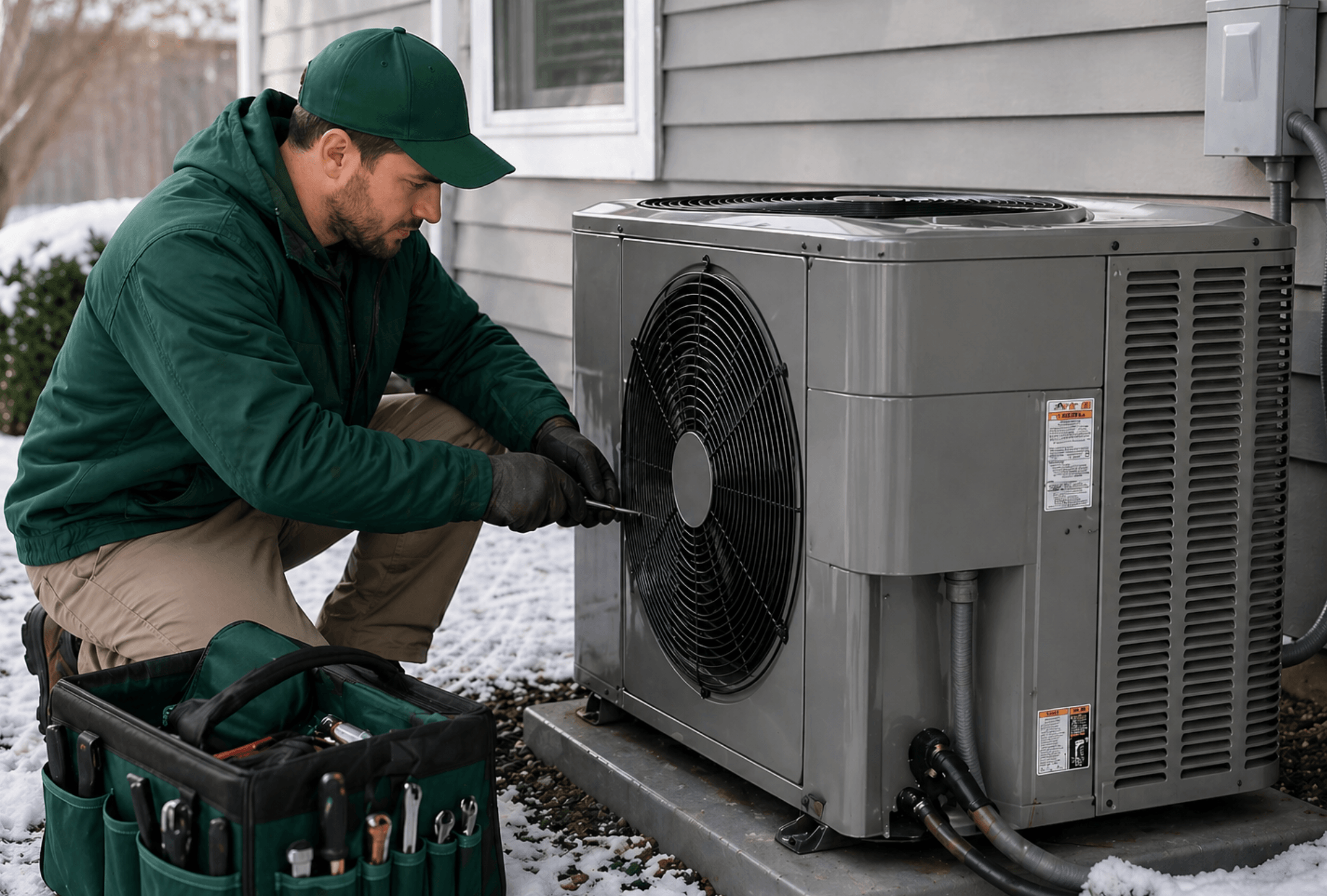
Signs your heat pump needs service now
Don't wait for the failure. If you spot any of these, schedule a visit.
• Higher electric bills with no behavior change usually point to dirty coils or low refrigerant.
• Ice on the outdoor unit beyond a normal defrost cycle suggests an airflow restriction or charge problem.
• Short cycling (the unit turning on and off every few minutes) traces back to the thermostat, sizing, or a capacitor.
• Weak airflow at the registers means a clogged filter, dirty blower, or duct leakage.
• Hissing, grinding, or rattling noises mean something is loose, worn, or leaking refrigerant.
• Auxiliary or emergency heat running constantly is a sign your outdoor unit is underperforming.
• Uneven room-to-room temperatures usually trace to a balancing, ductwork, or airflow issue.
The annual professional heat pump tune-up checklist
Below is the HVAC tune-up checklist a NATE-certified technician should run on every annual visit, grouped into four phases: pre-service inspection, refrigerant and coil work (the parts that legally require a licensed pro), electrical and mechanical, and final system verification.
Pre-service inspection:
1. Visual inspection of the indoor air handler, outdoor unit, and accessible refrigerant lines.
2. Verification of thermostat operation, calibration, and current programming.
3. Inspection and replacement of the return air filter, or confirmation that a recent replacement is the correct size and rating.
Refrigerant and coil work:
1. Measurement of refrigerant pressures and superheat or subcool in both heating and cooling modes, the check that's unique to heat pumps and the one a rushed technician most often skips.
2. Refrigerant leak detection using an electronic detector or UV dye.
3. Outdoor condenser coil cleaning with a low-pressure rinse and coil-safe cleaner.
4. Indoor evaporator coil inspection, plus cleaning if buildup is present.
Electrical and mechanical:
5. Capacitor and contactor testing with a multimeter, with replacement if values fall outside spec.
6. Tightening of all electrical connections and application of a nonconductive coating where appropriate.
7. Lubrication of motor bearings and inspection of belts where applicable.
8. Inspection of the reversing valve and defrost control board.
System verification:
1. Cleaning and clearing of the condensate drain line, with treatment to prevent algae regrowth.
2. Measurement of static pressure and supply or return airflow.
3. Verification of correct heat-cool changeover and auxiliary heat lockout.
4. Final performance test (temperature split across the indoor coil in both modes) with the measured values written on the invoice.
The DIY heat pump maintenance checklist
Between professional visits, the right homeowner habits keep efficiency up and call-outs down. None of this requires special tools beyond a garden hose, a vacuum, and a screwdriver.
Monthly:
• Walk to the outdoor unit and clear leaves, snow, vegetation, or debris. Keep at least two feet of clearance.
• Pull the return air filter and look at it. If it's gray, replace it. If it isn't, write the date on the frame and check again next month.
• Confirm every supply register and return grille in the home is open and unblocked by furniture or rugs.
• Listen for new noises during start-up and shut-down. Hissing, buzzing, or rattling all warrant a service call.
Every three months:
• Power off the breaker, then rinse the outdoor coil with a garden hose on low pressure (top to bottom, never with a pressure washer).
• Vacuum supply registers and return grilles to clear settled dust.
• Pour a cup of distilled vinegar down the indoor condensate drain to keep algae from clogging it mid-summer.
• Inspect the foam insulation on exposed refrigerant lines. Replace any piece that's cracked, brittle, or missing.
• Cycle the thermostat manually between heating and cooling to confirm both modes start cleanly.
Never DIY:
• Refrigerant handling. Adding, removing, or measuring refrigerant requires EPA Section 608 certification by federal law.
• Capacitor testing or replacement. Capacitors hold a lethal charge even when the unit is unplugged.
• Compressor diagnostics, control board work, or any sealed-system repair.
• Anything that voids your manufacturer warranty. Read the maintenance language in your warranty document before opening a panel.
What a heat pump tune-up costs in 2026
Pricing varies more by region than by brand. Here's the current landscape.
A single annual tune-up (one visit) typically costs $75 to $200 and includes inspection, basic cleaning, and a performance check.
A two-visit maintenance plan typically costs $150 to $500 per year and includes spring and fall visits, priority scheduling, and parts discounts.
A first-time or diagnostic visit typically costs $100 to $250 and includes a full audit plus a refrigerant and electrical baseline.
Coil chemical cleaning as an add-on typically costs $100 to $400 and includes a deep clean of the indoor or outdoor coil.
For context, an emergency repair typically costs $300 to $1,500 or more, which is exactly what a tune-up helps you avoid.
Sun Belt regions tend to fall toward the lower end of these ranges. Northeast and West Coast pricing runs higher. New-customer promotions can drop the first visit to $49 to $79. Maintenance plans typically pay back the moment they prevent a single emergency repair, and most homeowners with a system over five years old reach that break-even fast.
"On every heat pump call, I measure refrigerant pressures in both heating and cooling because they hold different charges. A tech who only checks one mode is missing half the picture."
— Filterbuy NATE-certified HVAC technician
7 Essential Resources
Every claim and number on this page is downstream of primary sources. Here are seven worth bookmarking.
1. The DOE's Operating and Maintaining Your Heat Pump page is the federal baseline for what homeowners and technicians should each handle. Read it once and you'll know whether your contractor is doing the job.
URL: energy.gov/energysaver/operating-and-maintaining-your-heat-pump
2. The ENERGY STAR HVAC Maintenance Checklist is a short, plain-language version of what a contractor should run on a yearly tune-up. Print it and bring it to your appointment.
URL: energystar.gov/saveathome/heating-cooling/maintenance-checklist
3. ENERGY STAR's Heat & Cool Efficiently page covers the operating habits that compound a tune-up's value, including filter and thermostat guidance.
URL: energystar.gov/saveathome/heating-cooling
4. North American Technician Excellence (NATE) is the non-profit that certifies HVAC technicians. Use the directory to confirm credentials before you book service.
URL: natex.org
5. EPA Section 608 is the federal regulation that governs who can legally handle refrigerant. Anyone touching your refrigerant lines without it is breaking the law.
URL: epa.gov/section608
6. The IRS Energy Efficient Home Improvement Credit (Section 25C) page covers the federal tax credit homeowners can claim on qualifying heat pump installations completed by December 31, 2025. The credit was terminated for installations placed in service after that date under Public Law 119-21 (signed July 4, 2025), so check the page for current eligibility before filing.
URL: irs.gov/credits-deductions/energy-efficient-home-improvement-credit
7. The DOE's Air-Source Heat Pumps overview explains how units work, what HSPF and SEER actually mean, and how to evaluate efficiency claims.
URL: energy.gov/energysaver/air-source-heat-pumps
3 Statistics
Three numbers worth committing to memory before your next service appointment.
1. Up to 75%
Three numbers worth committing to memory before your next service appointment.
1. Up to 75%
A modern heat pump can reduce electricity use for heating by up to 75% compared with electric resistance heating like baseboards or electric furnaces, according to the U.S. Department of Energy. Every percentage point of efficiency you lose to a missed tune-up comes straight out of that savings. Source: U.S. Department of Energy, Heat Pump Systems (energy.gov/energysaver/heat-pump-systems).
2. 10 to 25%
The difference in energy consumption between a well-maintained heat pump and a severely neglected one can range from 10% to 25%, according to the U.S. Department of Energy. That gap is exactly what an annual tune-up keeps closed. Source: U.S. Department of Energy, Operating and Maintaining Your Heat Pump (energy.gov/energysaver/operating-and-maintaining-your-heat-pump).
3. Nearly 50%
Nearly half of the energy used in your home goes to heating and cooling, according to ENERGY STAR. Keeping the system tuned is the cheapest way to control your largest monthly utility category. Source: ENERGY STAR, Heat & Cool Efficiently (energystar.gov/saveathome/heating-cooling).
Final Thoughts and Opinion
At Filterbuy, we've been shipping filters to homes in all fifty states since 2013. We've talked to enough homeowners about failed heat pumps to know two things hold up year after year.
The first is that homeowners who treat the annual tune-up as optional usually pay for it twice. They pay once when they finally book a tune-up after years of skipping. They pay again on the repair invoice for the failure that the tune-up would have caught. A $150 visit catches a failing capacitor. A missed visit lets that capacitor take the compressor with it on the hottest Tuesday in July. Heat pump preventive maintenance is the cheapest way to keep your warranty valid and your equipment running for the full 15 to 20 years it was designed to last.
The second is that the most important piece of any heat pump care guide is something a technician never touches: the filter. Heat pumps run with lower static pressure tolerance and longer cycle times than furnaces, which makes them more sensitive to airflow restriction than any other system in the house. Match the filter size to the unit. Hit a MERV rating your blower can handle (MERV 11 is the sweet spot for most residential heat pumps). Replace it before it gets gray. That single habit will out-perform almost every other heat pump efficiency tip on the internet.
Next Steps
If this guide is useful, here's how to turn it into action this week.
Book your professional tune-up. Pick up the phone today if you haven't had service in the last twelve months. Ask for the written checklist before the visit and the measured values on the invoice after.
Set two recurring calendar reminders. One for late spring (April or May), one for early fall (September or October). These are your seasonal heat pump maintenance bookings.
Pull your filter right now. Write today's date on the frame with a marker. If you can't see light through it, replace it.
Walk the outdoor unit. Clear two feet of space around it. Note the brand and model on your phone. You'll want it when you call for service.
File your invoices. Start a folder (paper or digital) for every tune-up record. Manufacturer warranties require this paper trail.
Verify your technician. Check NATE certification and EPA Section 608 status before you book. Both are publicly searchable.
Frequently Asked Questions
How often should I get a heat pump tune-up?
Twice a year ideally. Once in spring before cooling season and once in fall before heating season. At minimum, schedule one annual heat pump tune-up. Heat pumps wear at roughly twice the rate of furnace-and-AC pairs because they run year-round, which is why the U.S. Department of Energy and most manufacturers recommend more frequent service than for traditional HVAC.
How long does a heat pump tune-up take?
A standard professional visit runs 60 to 90 minutes for a single-system home. Multi-zone setups, geothermal systems, and units that have been neglected can take two hours or more. If a technician finishes in under thirty minutes, they likely skipped key steps like measuring refrigerant in both heating and cooling modes.
What is included in a heat pump tune-up?
A complete heat pump inspection checklist covers 12 to 15 items: thermostat calibration, filter inspection, refrigerant pressure and leak checks in both modes, indoor and outdoor coil cleaning, capacitor and contactor testing, electrical tightening, motor lubrication, condensate drain clearing, airflow measurement, and a final performance test in both heating and cooling.
Can I do a heat pump tune-up myself?
You can safely handle filter replacement, outdoor unit clearing, condensate drain flushing, and visual inspections. Refrigerant work, capacitor testing, electrical diagnostics, and sealed-system repairs all require a licensed technician. They are physically dangerous, federally regulated under EPA Section 608, and DIY attempts often void the manufacturer warranty.
How much does a heat pump tune-up cost in 2026?
A single annual heat pump tune-up runs $75 to $200. A two-visit maintenance plan typically costs $150 to $500 per year and includes priority scheduling and parts discounts. New-customer promotions sometimes drop the first visit to $49 to $79. Geographic variance matters. Sun Belt rates run lower than Northeast or West Coast pricing.
Will skipping maintenance void my heat pump warranty?
Usually, yes. Manufacturer warranties from Trane, Carrier, Lennox, Mitsubishi, and most others require documented annual professional maintenance to remain valid. Keep every invoice. Without that paper trail, a compressor failure that would have been covered turns into a $1,500 to $3,000 out-of-pocket repair.
When is the best time of year to schedule a heat pump tune-up?
Late spring (April to May) for cooling-mode service and early fall (September to October) for heating-mode service. Booking off-peak gets you better contractor availability, often lower pricing, and avoids the failure-during-heatwave scenario that triggers emergency-rate calls.
Are heat pump maintenance plans worth it?
For most homeowners with systems older than five years or in heavy-use climates, yes. A typical $200 to $400 annual plan covers two visits, parts discounts, and priority service. A single avoided emergency repair, like a compressor or refrigerant leak, usually pays for one to three years of plan membership outright.
What are the signs my heat pump needs a tune-up?
Higher electric bills with no behavior change, ice on the outdoor unit beyond a normal defrost, weak airflow at registers, short cycling, grinding or hissing noises, musty smells from vents, room-to-room temperature unevenness, or auxiliary heat running constantly. Any one of these is your system asking for service.
Does cleaning or replacing the filter really make a difference?
Yes, and measurably. Per DOE guidance, replacing a dirty filter with a clean one can cut HVAC energy use by 5% to 15%. On a heat pump that runs nearly year-round, that's the highest-ROI task on any maintenance checklist. Replacing a $15 to $30 filter every one to three months is the cheapest protection your heat pump will ever have.
Keep Your Heat Pump Running at Spec
Whether you handle the monthly filter check yourself or hand the whole job to a NATE-certified pro, the most reliable way to keep your heat pump running at its rated efficiency is consistency. Schedule the annual visit. Work the homeowner checklist on the calendar. Never skip the filter.
At Filterbuy, we ship American-made MERV 8, 11, and 13 pleated filters in 600+ sizes, including the custom dimensions older heat pump units sometimes need. Free shipping. Auto-delivery on a schedule you set. Small, repeatable habits add up to lower bills, cleaner air, and a heat pump that lasts the full 15 to 20 years it was designed to.