
Gas vs. Electric Furnace: Which One Is Right for Your Home?
February 26, 2026

Gas and electric furnaces can both heat a home effectively. The right choice usually comes down to three practical factors: what fuel is available at your home, how much that fuel costs in your area, and how much heat you need during winter. Installation requirements and safety checks also affect the decision.
TL;DR Quick Answers
Gas vs. Electric Furnace: Which One's Right for Your Home?
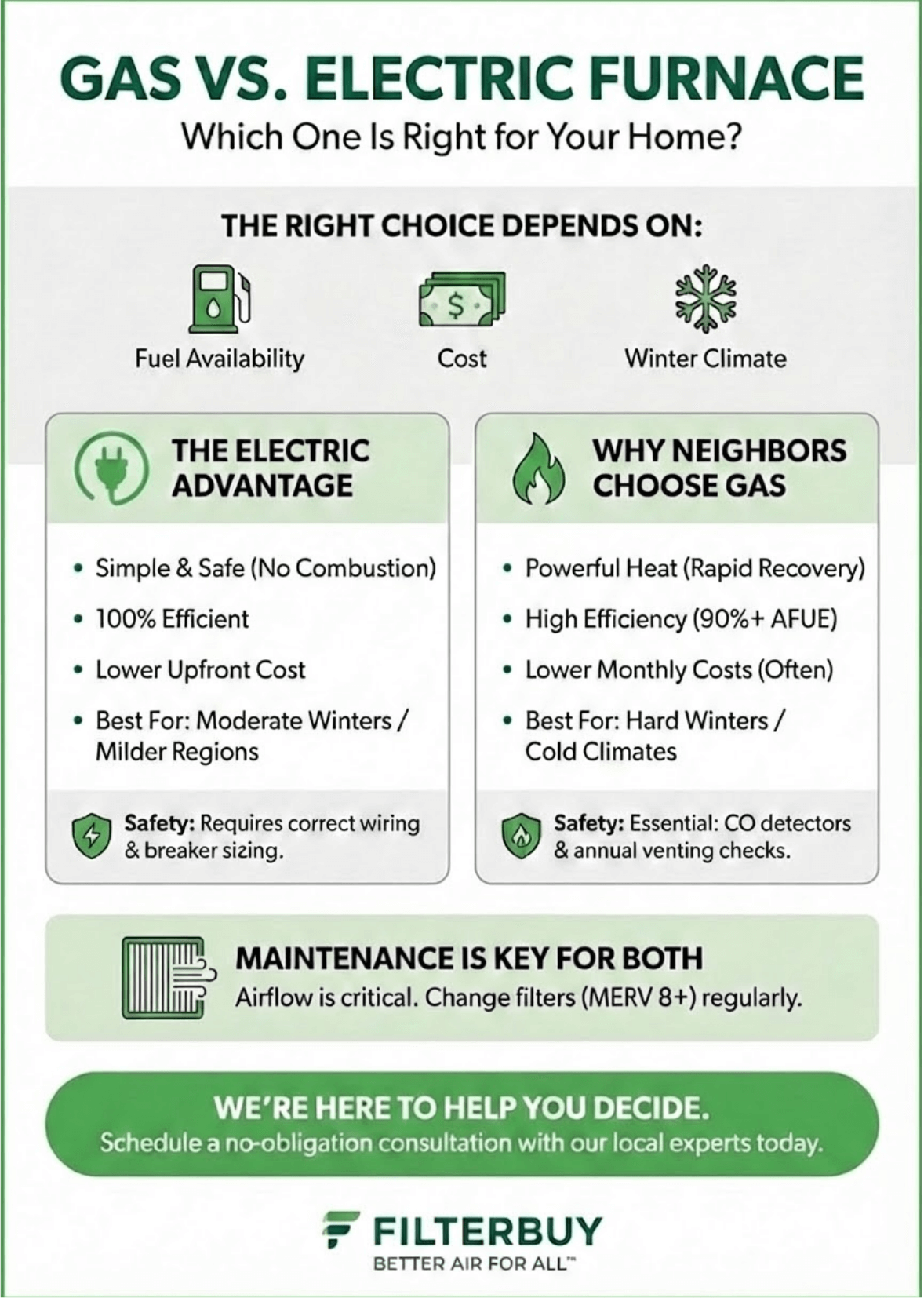
Gas furnaces heat fast and cost less to operate—best for cold climates with existing gas lines. Electric furnaces are cheaper upfront, easier to install, and work well in milder regions or homes without gas access.
Bottom line: Choose gas for harsh winters and lower long-term costs. Choose electric for simpler setup and moderate climates. Whichever you pick, a quality air filter keeps your system running efficiently and your indoor air clean.
Key takeaways
If your home already has gas service and proper venting, a gas furnace is often the more straightforward replacement.
Electric furnaces have fewer installation steps related to combustion, but operating cost depends heavily on electricity rates.
In colder climates, gas furnaces often provide stronger performance during cold snaps and can recover faster after temperature setbacks.
Duct condition, insulation, and air leaks can affect comfort and utility bills as much as furnace type.
Correct sizing and proper airflow checks are critical for performance, regardless of the fuel you choose.
Quick comparison table
| Category | Electric furnace (resistance heat) |
Gas furnace (natural gas) |
|---|---|---|
| How it heats | Electric elements heat air | Burners heat a heat exchanger that warms air |
| Typical install complexity | Often simpler if electrical service is adequate | Often more involved due to venting and combustion requirements |
| Efficiency rating | High AFUE because there are no flue losses | High-efficiency models are commonly 90%+ AFUE (condensing) |
| Monthly operating cost | Often higher in many areas, depends on electric rates | Often lower where gas prices are favorable, depends on local rates |
| Safety | No combustion in the furnace | Needs safe combustion and venting, CO monitoring is important |
| Best fit | Homes without gas service, milder winters, or low electric rates | Homes with gas service, colder winters, or favorable gas prices |
How each furnace works in a ducted HVAC system
Most furnaces are part of a forced-air system. A blower moves air through ducts. In winter, the furnace heats the air. In summer, the same blower and ducts usually move air across an indoor AC coil for cooling.
The HVAC filter is normally installed on the return side. It helps keep dust out of the blower and indoor coil. It also affects airflow, which affects comfort and system stress.
Electric furnace basics
An electric furnace uses electric resistance heat. It heats air as it passes over heating elements.
Electric furnaces:
Do not use combustion.
Do not need a flue or vent for combustion gases.
Often have high AFUE ratings because nearly all electric energy becomes heat inside the home.
Electric furnaces can work well when winters are moderate or when electricity rates are favorable. They can also make sense when a home does not have gas service.
Gas furnace basics
A gas furnace burns fuel in a burner assembly. Heat moves through a heat exchanger. The blower pushes household air across the outside of the heat exchanger. Combustion gases stay inside the sealed path and vent outdoors.
Gas furnaces:
Need venting and combustion safety controls.
Often feel strong in cold weather because many models deliver higher heat output and warmer supply air.
Can be very efficient in condensing models, commonly 90%+ AFUE.
Cost: what usually drives the difference
Costs vary by home, but the pattern is consistent.
Upfront cost
Electric furnace installation can be simpler if your electrical panel and wiring can support the load.
Gas furnace installation can require additional work such as venting changes, combustion air needs, condensate handling for condensing models, and gas line work.
Monthly operating cost
Monthly cost depends mainly on:
Local electricity and gas rates.
How cold your winters are and how long the heating season lasts.
How well your home holds heat, including insulation, air leaks, and duct leaks.
Furnace sizing and condition.
A simple summary is useful here. Installation depends on your home, and monthly cost depends heavily on local rates and how well the home holds heat.
Efficiency: what AFUE means and what it does not mean
AFUE stands for Annual Fuel Utilization Efficiency. It describes how much of the fuel energy becomes usable heat in the home over a typical year.
Electric furnaces often rate very high on AFUE because there are no flue losses. Gas furnaces vary more by design, with condensing furnaces typically at 90% AFUE or higher.
AFUE does not tell you what your bill will be by itself. The price of the energy source and the amount of heat your home needs are just as important.
Performance by climate
Mild to moderate winters
Electric furnaces can provide steady comfort. In these climates, run times may be shorter, which can reduce the monthly cost gap in some homes.
Colder winters
Gas furnaces are often a strong option because they can recover faster during cold snaps. Many homeowners also prefer the warmer supply air feel.
No matter which option you choose, insulation, air sealing, and duct condition matter. A home with major heat loss can feel uncomfortable and cost more to heat with either furnace type.
Safety considerations
Many homes safely use gas furnaces every day when systems are properly installed and maintained. Each type has different risks and checks.
Electric furnace safety
Electric furnaces avoid combustion. Main concerns relate to electrical safety and correct installation, including proper wiring and breaker sizing.
Gas furnace safety
Gas furnaces require safe combustion and venting. A carbon monoxide alarm is an important safety measure. Annual service helps confirm safe operation and proper venting.
Filters and airflow
A furnace depends on airflow. A filter that is the wrong size or is heavily loaded with dust can reduce airflow. Low airflow can affect comfort and can increase strain on the blower.
If your home uses a ducted system for heating and cooling, check. Filterbuy sells replacement HVAC filters in many sizes and in common MERV options such as MERV 8, MERV 11, and MERV 13. Filterbuy also offers Auto Delivery, which can help households replace filters on a consistent schedule.
Choosing the right option for your home
A practical decision process is straightforward.
Confirm fuel availability at your home.
Compare installation requirements for each option.
Consider your winter severity and comfort needs.
Review local energy rates and ask an installer for an operating cost estimate based on your home.
Make sure the system is sized correctly and that airflow is verified after installation.
Choose the furnace type that fits your home’s fuel options, your winter climate, and your budget, and make sure the installer sizes the system correctly and confirms proper airflow after installation.
FAQs
1. Is a gas furnace always cheaper to run than an electric furnace?
Not always. In many areas it can be, but the result depends on local energy rates, climate, and how well your home holds heat.
2. Are electric furnaces efficient?
Yes. Electric furnaces usually have high AFUE ratings because there are no flue losses. High efficiency does not automatically mean a lower bill.
3. Which is safer, gas or electric?
Electric furnaces avoid combustion. Gas furnaces can be safe when installed and maintained correctly, but they require safe venting and carbon monoxide monitoring.
4. Can I switch from gas to electric, or electric to gas?
Often yes, but it can require major work. Adding a gas furnace may require a gas line and venting. Switching to electric may require electrical service upgrades. A contractor should confirm what your home can support.
5. Do gas and electric furnaces use the same ducts and filter?
In most forced-air homes, yes. The furnace and central AC usually share the same duct system and filter location.
6. What matters more than furnace type for comfort?
Correct sizing, duct condition, and insulation and air sealing often have the biggest impact on comfort and performance.
7. Should I choose a higher MERV filter after replacing a furnace?
Only if your system can handle it without reducing airflow too much. Match the correct size first, then confirm with a technician if you want to increase filtration.