
Furnace vs. Boiler: Which Heating System Is Better for Your Home?
February 3, 2026

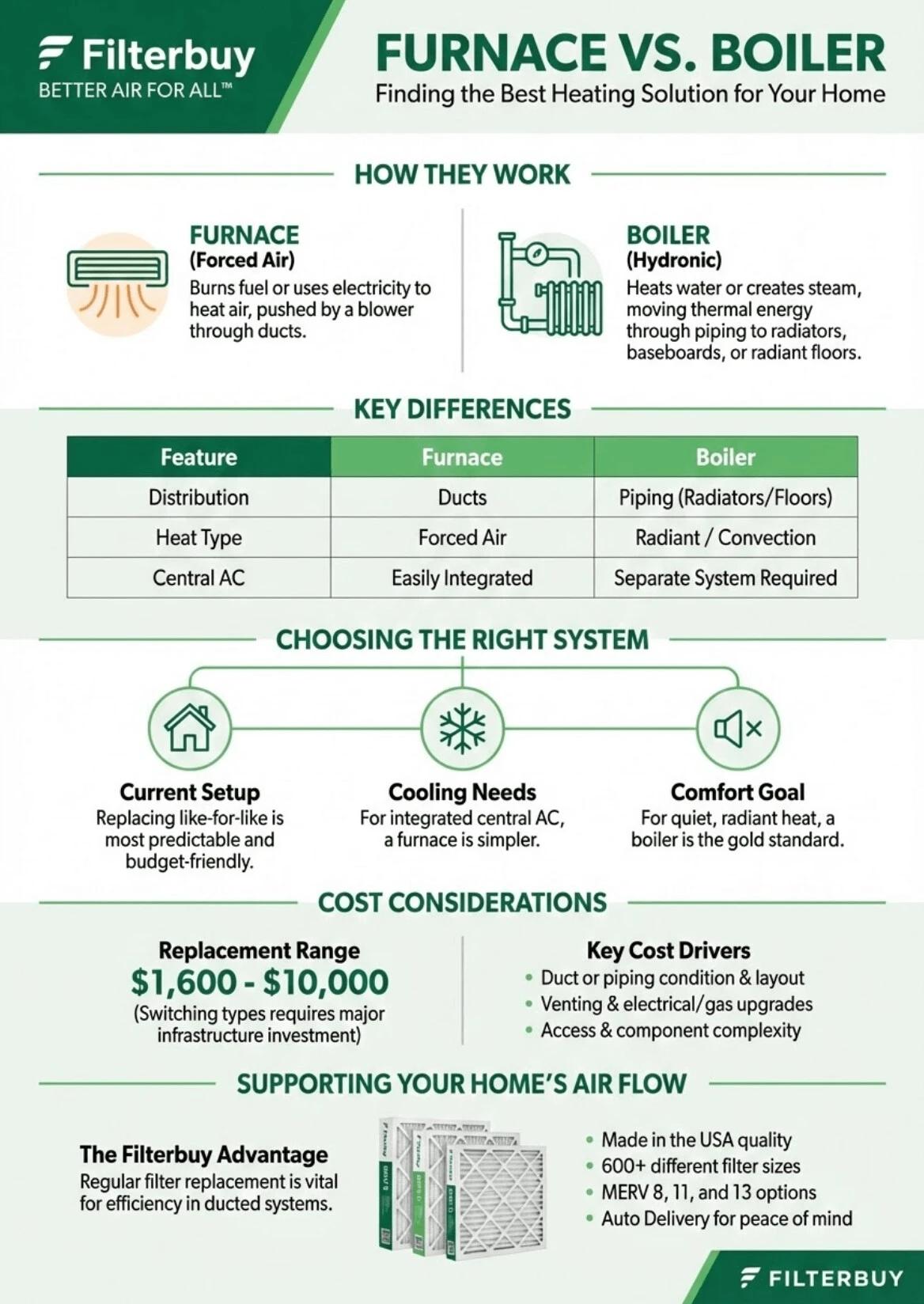
Most U.S. homes use either a furnace or a boiler for heat, but they warm your home in different ways. A furnace heats air and moves it through ducts. A boiler heats water and moves it through pipes to radiators, baseboards, or radiant floors.
The better choice depends on your home’s current setup, your climate, and your budget.
TL;DR Quick Answers
Furnace vs. Boiler: What's the Difference?
A furnace heats air and blows it through ducts to warm your home. A boiler heats water and sends it through pipes to radiators or radiant floor systems.
Furnace — Uses forced air, heats up fast, requires duct cleaning and regular air filter changes (every 60–90 days). Most common in newer U.S. homes.
Boiler — Uses hot water or steam, provides even and quiet heat, no ductwork needed. Common in older homes, especially in the Northeast.
Key differences that matter for your air quality: Furnaces push air through ducts, which means they also circulate dust, allergens, and pet dander — making your air filter choice critical. Boilers don't blow air, so they won't spread airborne particles the same way, but they also won't filter your air either.
Bottom line: If you have a furnace with a central HVAC system, keeping a quality air filter on a regular replacement schedule is one of the easiest things you can do to protect your home's air and your system's efficiency. Not sure which MERV rating is right for your setup? Filterbuy makes it simple to find the right fit for your home.
Key takeaways
A furnace is usually the simpler choice if your home already has ductwork for heating or central cooling.
A boiler can deliver very even heat, but converting from a furnace can be expensive if you need to add piping and radiators.
Efficiency depends on the equipment and how your home is set up, not just whether it is a furnace or boiler.
Boilers usually do not use a standard HVAC filter for heating because they do not push warm air through ducts, but if your home has ducted air cooling or heating systems, you still need to change the filter regularly.
If you have ducts for heating or cooling, you will still need to replace HVAC filters regularly.
Quick comparison table
Here are the key day-to-day differences most homeowners notice between furnaces and boilers.
| Category | Furnace (forced air) | Boiler (hot water or steam) |
|---|---|---|
| How it delivers heat | Warm air through ducts and vents | Hot water or steam through pipes to radiators, baseboards, or radiant floors |
| Cooling compatibility | Often pairs easily with central AC using the same ducts | Boiler heat does not provide cooling by itself |
| Comfort | Can heat quickly; air movement is noticeable to some | Often steady, quiet heat; less air movement |
| Maintenance basics | Filters and duct airflow matter; tune ups recommended | Boiler servicing and hydronic system checks; radiator bleeding on some systems |
How each system works
Furnaces
A furnace burns fuel or uses electric heat to warm air, then a blower pushes that warmed air through ducts to supply vents. The same duct system often supports central air conditioning with an indoor coil.
Boilers
A boiler heats water (or creates steam). That heat moves through piping to radiators, baseboard units, or radiant floor systems. Some systems can also heat air using a coil, but most boiler homes heat rooms through hydronic distribution, not ducts.
A simple way to remember the difference is that furnaces heat air and boilers heat water.
Cost: what most homeowners pay for
Replacement cost estimates
Costs vary by home, but these ranges help set expectations.
A new furnace commonly ranges from about $1,600 to $10,000 installed, with an average around $4,799.
A boiler replacement commonly ranges from under $4,500 to $10,000 or more.
What makes one quote higher than another
A contractor’s price is usually driven by site conditions, not just the equipment.
Common furnace cost drivers include duct condition, venting needs, electrical or gas upgrades, and access
Common boiler cost drivers include piping condition, radiator or zone layout, venting, and whether system components (like circulators or controls) also need work.
Replacing the same type of system is usually more predictable. Switching from boiler to furnace (or the reverse) can require major duct or piping work, which is often a separate budget conversation.
Efficiency and operating cost
Both systems can be efficient, especially in high efficiency models. The bigger performance differences are usually about heat delivery and losses.
Ducted heating can lose heat through leaky or poorly insulated ducts.
Hydronic or radiant delivery avoids duct losses, which is one reason radiant heating is often described as more efficient than forced air in many situations.
That said, real efficiency depends on installation quality and maintenance. A well installed furnace with good ductwork can perform very well. A poorly maintained boiler can also waste energy.
Comfort
Furnaces
Pros: Furnaces tend to heat spaces quickly, and they can share ductwork with central cooling.
Cons: Comfort can suffer if ducts are leaky, returns are undersized, or airflow is restricted. Filters and airflow management matter for performance.
Boilers
Pros: Boilers often deliver steady heat and can feel more even from room to room when zoning is set up well. Radiant systems also avoid blowing air through ducts.
Cons: Boilers generally involve more plumbing based components and can cost more to replace. Cooling is not built in, so many boiler homes use separate cooling solutions.
Maintenance and common service considerations
A furnace needs regular service, and many homes also need filter replacement on a regular schedule. The U.S. Department of Energy recommends cleaning or replacing furnace filters about once a month or as recommended.
Boiler upkeep is just as important, but it focuses less on airflow and more on the hydronic components that move heat.
Boiler maintenance depends on the system type, but it typically includes servicing the burner or heating components and checking hydronic parts such as pumps and controls. Some hot water radiator systems also need trapped air removed periodically.
A practical decision guide
A furnace may be the better fit if:
Your home already has ductwork and you want central heating and cooling through one system.
You want faster temperature recovery.
You want a lower typical installation cost compared to hydronic conversion.
A boiler may be best if:
Your home already has radiators, baseboards, or radiant floors.
You prefer steady, quiet heat and zoned control.
You want to avoid duct losses, especially if your home does not have ducts today.
If you are deciding between installing a new furnace system versus converting to a boiler system (or the other way around), the cost and disruption of adding ducts or adding piping is often the deciding factor.
Filters and ducted systems
A boiler system usually does not use a furnace style HVAC filter for heating because it does not move heated air through ducts. A forced air furnace does, and so do many heat pump air handlers and central cooling systems. Filters are typically installed on the return side to help protect equipment and support cleaner airflow through the system.
If your home uses ducts for heating, cooling, or both, invest in Filterbuy filters.
Filterbuy sells replacement HVAC filters in common efficiency options, including MERV 8, MERV 11, and MERV 13.
Filterbuy advertises that its filters are made in the United States.
Filterbuy advertises free shipping within the continental United States and offers an Auto Delivery subscription option, which can help households stay on schedule.
One more note that often matters in real homes. Some homes heat with a boiler but cool with a ducted central system. In that setup, you may still have HVAC filters to replace for the cooling and airflow equipment, even though the heat comes from a boiler.
A furnace and a boiler can both heat a home well. The better choice usually depends on what your home already has, what type of comfort you want, and how much change you are willing to take on during installation. If ducts are part of your heating or cooling setup, staying consistent with filter replacements is one of the simplest ways to support steady airflow and normal system operation.
FAQs
Is a boiler used in homes?
Yes. Many homes use boilers for heating, especially in older neighborhoods in the Northeast and Midwest. Boilers are also common in homes with radiators, baseboards, or radiant floor heat.
What is the main difference between a furnace and a boiler?
A furnace heats air and moves it through ducts and vents. A boiler heats water and sends it through pipes to radiators, baseboards, or radiant floors.
Which is usually cheaper to install?
In most cases, replacing what you already have is cheaper. Installing a new furnace where there are no ducts can be expensive. Installing a new boiler where there is no piping can also be expensive.
Which costs less to run each month?
It depends on your fuel type, local utility rates, your home’s insulation, and how your system is sized and maintained. There is no universal winner. A contractor can estimate operating cost using your local rates and your home’s heating needs.
Which is more comfortable?
Many people find boilers feel more even because they heat surfaces and rooms more steadily. Furnaces can heat a home quickly, but you may notice more temperature swings if the system cycles often or ductwork is leaky.
Which one helps with indoor air filtration?
A boiler does not heat air through ducts, so it usually does not use a furnace style filter for heating. A forced air furnace and many ducted heat pump systems do use an HVAC filter on the return side. If your home uses ducts for heating, cooling, or both, Filterbuy can be relevant because it sells replacement HVAC filters in multiple MERV options and offers Auto Delivery.
If I heat with a boiler, do I still have HVAC filters?
Sometimes, yes. Some homes use a boiler for heat but have central air conditioning with ducts. In that setup, the cooling and airflow equipment may still use filters, even though the heat comes from a boiler.