
Furnace Capacitor Replacement: Cost, Signs & Testing
March 19, 2026
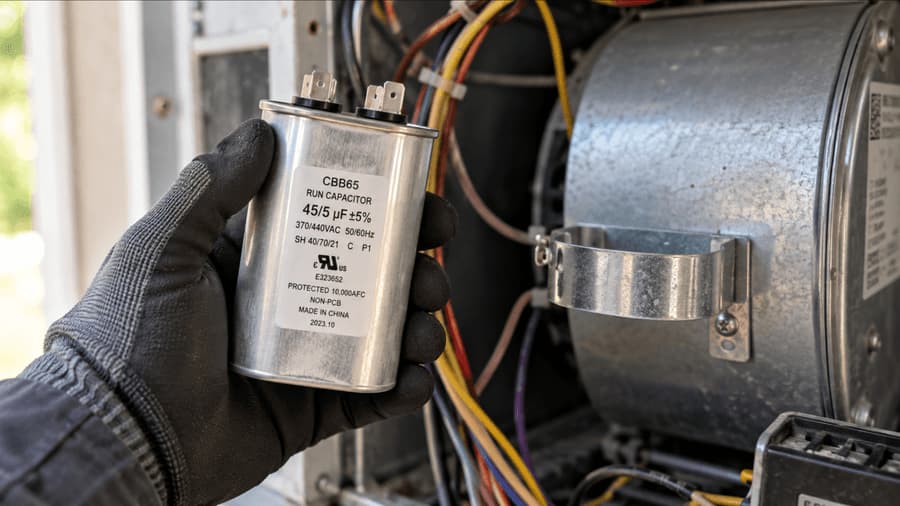
Furnace capacitor replacement costs $150 to $300 installed, and the capacitor itself is only $10 to $50. The most common sign of a bad one is a blower that hums but won’t start.
Only PSC blower motors use a capacitor, so test it before you pay for a new motor. A clogged filter makes the blower run hotter, and heat is what wears capacitors out.
Keep air moving with the right filter. Take the quick match quiz below.
Find Your Filter Match
Answer a few quick questions and we’ll match you to the right filter.
A furnace capacitor is a small electrical component that gives the blower motor the torque it needs to start and keep running. Replacing one costs $150 to $300 installed, though the capacitor itself is only $10 to $50, so nearly the whole bill is the service call and diagnosis. Not every furnace has one, and that is the first thing worth checking.
TL;DR
Most homeowners pay $150 to $300 to have a furnace capacitor replaced, with a typical bill near $175 to $200. The capacitor is the cheap part, so what you are paying for is diagnosis and labor. Confirm first that your furnace uses a PSC blower motor, because variable-speed furnaces with ECM motors have no capacitor at all.
Key Takeaways
Furnace capacitor replacement costs $150 to $300 installed, and the capacitor alone is only $10 to $50.
The most common symptom is a blower that hums without starting.
Only PSC blower motors use a run capacitor. Variable-speed furnaces with ECM motors have none.
Blower run capacitors are rated 5 to 15 µF at 370V or 440V. Match the microfarads exactly; voltage may go up but never down.
HVAC capacitors last 10 to 20 years, and heat is what shortens that, which is why airflow matters.
How Much Does Furnace Capacitor Replacement Cost?
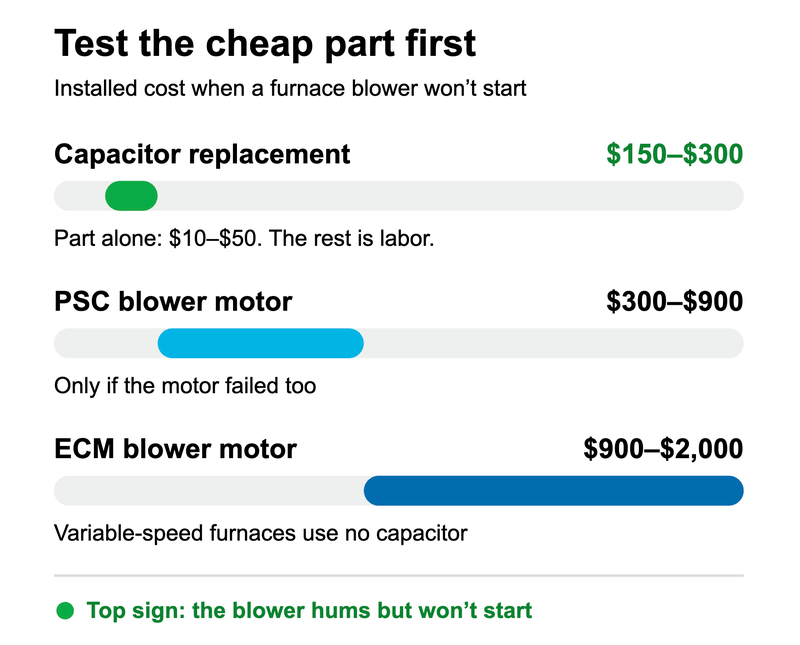
Furnace capacitor replacement costs $150 to $300 for most homes, with a typical bill near $175 to $200. Because the capacitor itself is only $10 to $50, almost everything you pay covers the service call, diagnostic time and labor rather than the part. After-hours visits add another $100 to $200.
Most of the furnace capacitor cost people are quoted is labor rather than hardware, because someone has to confirm the capacitor is actually what failed. A weak capacitor, a failing blower motor and a bad control board all arrive as the same complaint: the furnace runs and no air moves. The average cost to replace a furnace capacitor lands near $175 to $200 once diagnosis is included, and furnace run capacitor replacement cost is no different, since a run capacitor is what nearly every PSC blower uses.
Motor figures: Filterbuy blower motor replacement cost guide and HomeGuide, 2026.
The call we take most often in a cold snap is that the furnace is running but nothing is coming out of the vents. By the time we get there, plenty of homeowners have already ordered a blower motor online. We test the capacitor first, because the cheap part fails far more often than the expensive one.
David Clark, Licensed HVAC Technician, Filterbuy HVAC Solutions
Check the Warranty Before You Pay
If your furnace is under about ten years old, the capacitor may already be covered, and most homeowners never think to check. Manufacturers typically provide a five-year base parts warranty that extends to ten years when the equipment is registered within 60 days of installation, and functional parts such as capacitors and control boards usually fall inside that coverage. There are two catches. Labor is almost never included, so you still pay for the service call, and some warranties treat capacitors as wear items and exclude them. Find the model and serial on the data plate, then check the paperwork before you approve the repair.
Why the Price Varies by Area and Season
Search furnace capacitor replacement cost near me and national averages come back, which is the wrong number. The capacitor costs the same everywhere. What moves the total is the local labor rate, how far the truck travels and when you call, which is why the same repair during a hard freeze can run to twice what a scheduled visit costs. In Florida, Filterbuy HVAC Solutions quotes the diagnosis and the repair together.
Does Your Furnace Even Have a Capacitor?
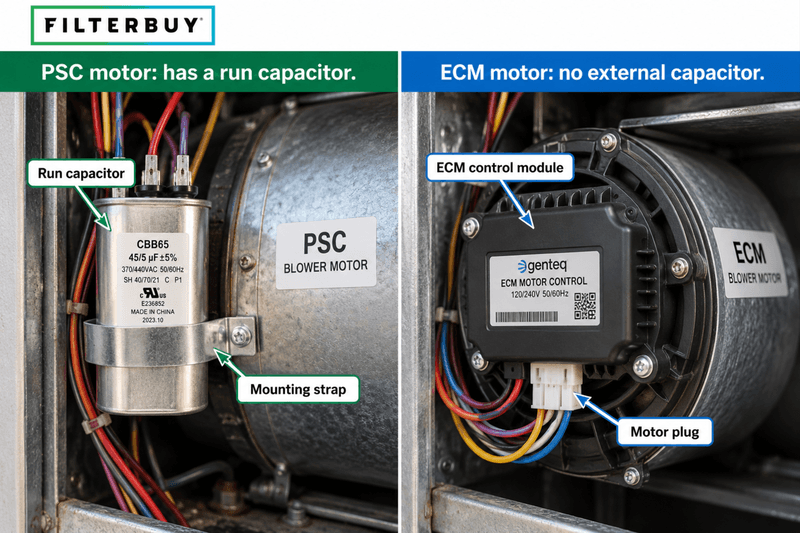
Not every furnace has one. PSC (permanent split capacitor) blower motors need a run capacitor, and PSC is standard on single-speed and multi-speed systems, but variable-speed furnaces with ECM blowers do not. ENERGY STAR defines an electronically commutated motor as a brushless permanent magnet motor controlled electronically across a broad speed range, so the phase shifting happens inside the motor and there is nothing external to test or replace.
Three Ways to Tell Which Motor You Have
Read the data plate. "Variable speed," "ECM," or "constant torque" means no run capacitor.
Look inside the blower compartment with the breaker off. A PSC system has a silver oval or round can strapped near the motor; an ECM has a rectangular module on the motor end.
Check the age and the thermostat. Furnaces installed before roughly 2010 are almost always PSC, while a communicating or modulating thermostat points to an ECM.
The Department of Energy’s Building America Solution Center reports an ECM fan can run on as little as 80 watts where a PSC motor draws 500 to 550. If your ECM blower will not start, the fault is more likely the motor module or control board, and no capacitor will fix it because there is none in the circuit.
What Does a Furnace Capacitor Do?
A furnace capacitor stores and releases electrical energy, giving the blower motor its starting torque and holding the correct phase shift once it is running. As Fluke explains, it collects charge and releases it quickly, which is exactly what a PSC blower needs to break away from a dead stop. The capacitor is not the motor, but a failed one makes a healthy motor behave like a failing motor.
What Are the Signs of a Bad Furnace Capacitor?
The most common sign of a bad furnace capacitor is a blower that hums but will not start. Capacitor problems tend to show up as airflow problems first, because the capacitor sits between the electrical supply and the fan that moves your heated air. If the top of the can is bulging or there is oily residue around it, the part has already failed.
The blower hums but does not spin, or starts after a delay.
Airflow at the registers is weak while the furnace runs.
A burning smell or scorched wiring near the blower. Shut off the breaker and call a technician.
Four Checks to Run Before You Call Anyone
These four checks cost nothing, take about ten minutes, and any one of them can end the problem before a technician is dispatched. Run them in order. The last is what most homeowners skip, and it tells you the most.
Reseat the blower door. Most furnaces have a safety switch in the door frame that cuts the blower when the panel is off or misaligned, producing exactly the symptom you are chasing.
Check the furnace switch and the breaker. The switch beside the furnace looks like an ordinary light switch and gets flipped by accident more often than anyone admits.
Pull the filter and hold it up to a light. A filter you cannot see through is choking airflow on its own regardless of what else is wrong, and it is free to rule out. The Filterbuy filter finder matches your size if you need one.
Set the thermostat fan to ON with the heat off. On a PSC system the blower runs through the same capacitor either way, so if the fan spins up normally, the capacitor is delivering torque and the fault lies somewhere else: the control board, a limit switch or the ignition sequence. If it only hums, the capacitor moves to the top of the list.
Note what happened on each one. A technician who arrives knowing the blower runs in fan mode can skip past the capacitor, so you are not paying for a test you have already run.
How Long Does a Furnace Capacitor Last, and Why Do They Fail?
HVAC capacitors typically last 10 to 20 years, though capacitance often begins drifting around year 12. Most furnace capacitor failure traces back to heat, which degrades the dielectric inside the can, with voltage spikes and accumulated run hours doing the rest. Where one blower serves both heating and cooling, the capacitor fails sooner.
Surges and lightning degrade a capacitor quickly, so a whole-home surge protector is cheap insurance against it.
Capacitors also wear alongside everything else in the system, and most furnaces last 15 to 20 years.
We manufacture our own filters in the United States and test filter media across the full MERV range on our production floor, which is why we will be blunt about their limits: a filter will never fix a failed capacitor. It holds static pressure down so the next one is not cooked early. Check yours on the right replacement schedule, or let Filterbuy Auto Delivery handle it.
This is where we should admit a bias. Filterbuy HVAC Solutions treats the capacitor as a wear part rather than a surprise, so our technicians check capacitors, contactors, compressors and blowers on every maintenance visit, and the top-tier plan replaces it outright rather than waiting for it to fail. That is the right call on a system we service twice a year, but it is not what we would tell a homeowner to do alone, because swapping a healthy capacitor on a hunch costs money and risks a mismatched part.
Supporting Statistics
74.42 million U.S. homes, or 60% of households, use a central warm-air furnace as their main heating equipment. Every one has a blower motor, and 23.54 million run heating equipment 20 or more years old. Source: U.S. Energy Information Administration, 2020 Residential Energy Consumption Survey, Table HC6.3.
U.S. fire departments responded to an average of 38,881 home heating equipment fires a year from 2019 to 2023. Those fires caused 432 deaths, 1,352 injuries, and $1.1 billion in damage. That is why scorched wiring near the blower is a shut-off-the-breaker moment, not a troubleshooting one. Source: National Fire Protection Association.
Replacing a dirty, clogged filter with a clean one lowers energy consumption by 5 to 15 percent. Restricted airflow makes the blower run hotter, and heat degrades capacitors. Source: U.S. Department of Energy, Energy Saver 101.
What Size Capacitor Does a Furnace Blower Need?
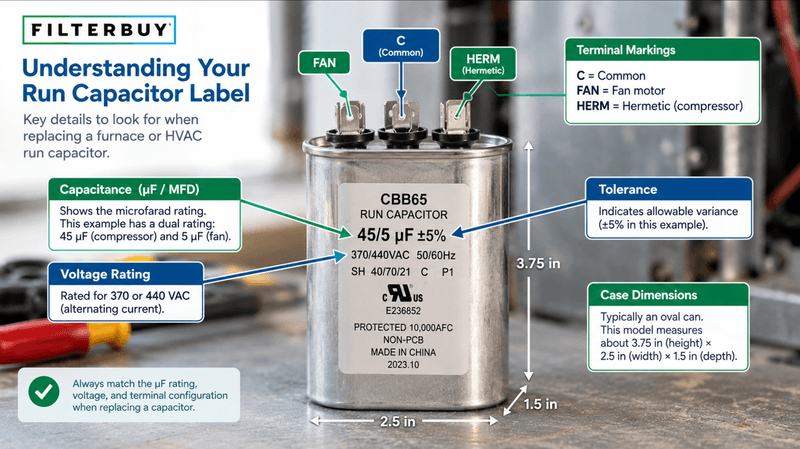
A furnace run capacitor replacement has to match the original on two numbers, both printed on the label of the part already in your furnace. Furnace blower run capacitors are typically 5 to 15 µF at either 370 or 440 volts. The microfarad rating has to match exactly, while voltage may go up but never down, so a 370V capacitor can be replaced with a 440V unit but never the reverse.
Never increase the microfarad rating in the hope of a stronger blower. A mismatched µF value puts the windings out of phase, raises amp draw and burns the motor out.
Is a Furnace Capacitor the Same as an AC Capacitor?
A furnace capacitor and an AC capacitor are the same component serving different motors, which is why contractors quote both as HVAC capacitor replacement. The furnace capacitor supports the indoor blower, while the outdoor AC capacitor is usually a dual-run unit serving the compressor and condenser fan. In most homes the blower is shared, which is why a single failure can stop warm air in January and cool air in July.
How Do You Test a Furnace Capacitor Safely?
Testing a furnace capacitor means measuring its capacitance with a multimeter and comparing the reading against the rating on the label. A capacitor holds a charge after the power is off, so discharge it first. This is the sequence Filterbuy HVAC Solutions technicians follow, and if any part of it is unfamiliar, stop here and schedule service.
Cut the power at the furnace switch and the breaker, then confirm it is off with a meter.
Discharge the capacitor. Fluke recommends holding a 20,000 ohm, 5-watt resistor across the terminals for five seconds, then confirming with the meter that the charge is gone. Never short the terminals with a screwdriver.
Photograph the terminals so you can rewire them correctly, then remove the leads and measure with the meter set to capacitance.
Compare the reading against the rating and tolerance on the label. Anything outside tolerance, or an OL display, means the capacitor is bad.
OSHA 29 CFR 1910.333 exists because stored energy injures people who assume that a de-energized system is a safe one.
The Capacitor Tested Fine. What Else Stops a Blower?
A capacitor reading inside tolerance means the part is doing its job and the fault lies elsewhere. On a furnace that runs but moves no air, the usual suspects are the blower door safety switch, a high-limit switch tripped by an earlier overheat, the control board or its blower relay, a corroded motor connection, and the motor windings themselves.
That list is where a homeowner stops and a technician starts, because each item needs live testing to isolate and guessing is how people end up replacing a control board that was never broken. In Florida, Filterbuy HVAC Solutions will diagnose it before quoting a part.
Frequently Asked Questions
Can I Replace a Furnace Capacitor Myself?
You can, provided the diagnosis is confirmed, you have a meter that measures capacitance and you are comfortable working around live wiring. If any of that is a stretch, call a technician.
Is Blower Motor Capacitor Replacement the Same as Furnace Capacitor Replacement?
They are the same job. A furnace blower capacitor and a blower motor capacitor are two names for the part that starts the indoor blower, so blower motor capacitor replacement cost matches the $150 to $300 quoted for a furnace capacitor.
What Causes Furnace Capacitor Failure?
Heat is the main cause, because it degrades the dielectric inside the can. Voltage spikes, high run hours and an under-rated part fitted on an earlier repair account for the rest.
Should I Replace the Capacitor or the Blower Motor?
Test before you buy, because a failed capacitor makes a healthy motor behave like a failing one and the wrong part is the costliest mistake on this repair. A capacitor runs $150 to $300 installed, a PSC motor $300 to $900, and an ECM $900 to $2,000.
Glossary
Capacitor: A component that stores and releases electrical energy, giving the blower motor its starting torque.
Run capacitor: A capacitor that stays in the motor circuit continuously. Furnace blowers use them, typically rated 5 to 15 uF.
PSC motor: Permanent split capacitor motor, the standard blower in single-speed and multi-speed furnaces. It needs an external run capacitor.
ECM motor: Electronically commutated motor. ENERGY STAR defines it as a brushless permanent magnet motor controlled electronically over a broad speed range, and it uses no external capacitor.
Static pressure: Resistance to airflow inside the ducts. A clogged filter raises it and makes the blower run hotter.
Filterbuy: An American air filter manufacturer, third-generation and family-owned, producing filters in the United States and shipping factory-direct to homeowners.
Filterbuy HVAC Solutions: The HVAC repair, maintenance and installation division of Filterbuy, serving Florida.
Microfarad (uF or MFD): The unit of capacitance printed on every capacitor label. A replacement has to match it exactly.
About the author and reviewer
Michelle Wan, Author
writes about home HVAC systems and indoor air quality for Filterbuy, a third-generation, family-owned American filter manufacturer Learn more on her author page.
David Clark, Reviewer, Licensed HVAC Technician
Licensed HVAC Technician and contributing author at Filterbuy HVAC Solutions.