
Electric Furnace for a Manufactured Home: HUD Code Fit, Sizing, BTUs, and Installation Cost
January 23, 2026

An electric furnace can be a good heating option for many manufactured homes because it is a forced air system that can connect to ductwork and does not require combustion venting. This means it uses a fan to push warm air through vents and doesn’t burn fuel like gas or oil furnaces.
The key is choosing equipment that is listed for manufactured housing, sizing it correctly for your climate, and confirming your electrical system can support it.
TL;DR Quick Answers
Electric Furnace for Mobile Home
Electric furnaces designed for mobile homes are compact, HUD-approved heating units that fit the unique space and safety requirements of manufactured housing. Key specs to know:
Sizing: Most mobile homes need 10,000–20,000 watts (35,000–70,000 BTU), calculated at roughly 25–30 BTU per square foot.
Requirements: Must be "mobile home rated" or HUD-certified, featuring smaller cabinets, specific clearances, and compatible ductwork connections.
Cost range: Units typically run $500–$1,500, with installation adding $500–$1,200.
Pros: No combustion gases, no venting needed, safer for tight spaces, lower upfront cost than gas.
Cons: Higher operating costs in regions with expensive electricity.
Top consideration: Always verify the unit is specifically approved for manufactured/mobile home installation—standard residential furnaces don't meet code requirements.
Key Takeaways
Many manufactured homes can use an electric furnace, but the furnace must be listed for manufactured housing and installed to the manufacturer’s instructions.
BTU means British thermal unit. It is a way to describe heat output. Electric furnaces are often sized in kilowatts, which can be converted to BTU per hour.
Correct sizing depends on heat loss, not guesses. Climate, insulation, air leaks, and duct conditions all change the required capacity.
Installed cost varies widely. A common national estimate for electric furnace installation is several thousand dollars, and electrical upgrades can add to the total.
Mobile Home Vs Manufactured Home, And What “HUD Approved” Usually Means
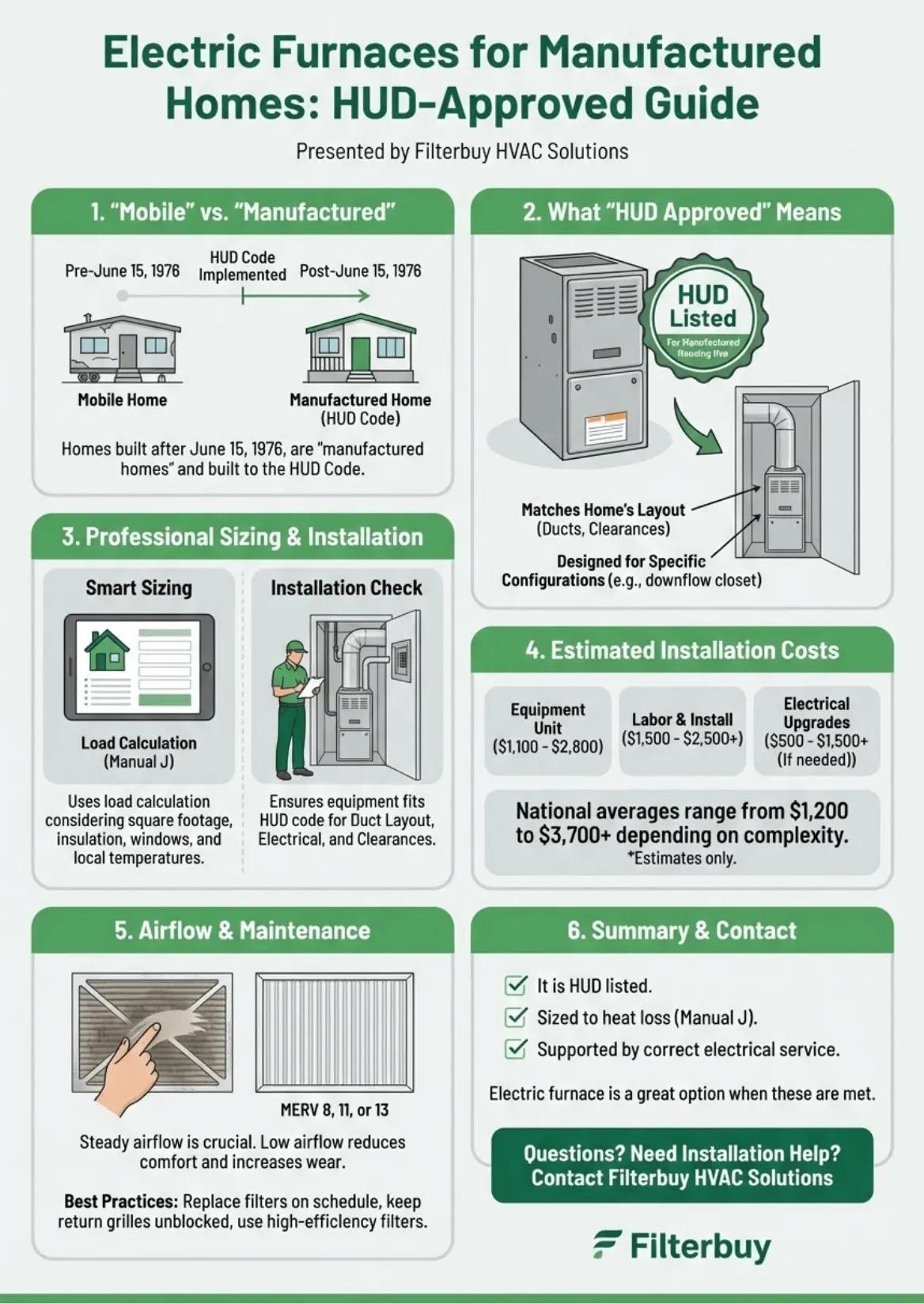
People often say, “mobile home,” but most homes built in the United States after June 15, 1976, are “manufactured homes” built to HUD’s Manufactured Home Construction and Safety Standards, often called the HUD Code.
For heating equipment, “HUD approved” typically means these practical requirements are met:
The furnace is listed for use in manufactured housing, and it is installed to the terms of its listing and the manufacturer’s instructions.
The installation matches the manufactured home’s layout, including closet or cabinet configuration, duct connection style, and required clearances.
This matters because some furnaces are designed specifically for manufactured housing configurations, such as downflow closet installations.
Can A Manufactured Home Use An Electric Furnace?
Yes. Many manufactured homes use forced air heating, and an electric furnace is one of the common ways to provide that heat.
Most electric furnaces for manufactured homes work like this:
Electric heating elements warm the air.
The blower moves warm air through the supply ducts.
Return air comes back through the return duct or return grille, where the system filter is usually located.
If your home already has a ducted forced air setup, an electric furnace replacement is often a more direct swap than changing to a system that needs different distribution, such as a boiler or hydronic system.
What BTU Means, And How It Relates To Electric Furnace Sizing
BTU is a unit of heat. You will see furnace capacity discussed in BTU per hour.
Electric furnaces are often rated in kilowatts. A practical conversion is:
1 kilowatt hour equals 3,412 BTU, so 1 kilowatt of heat output is about 3,412 BTU per hour.
This should help you understand labels and quotes.Note: This does not replace a load calculation.
HUD Code Fit And Sizing, What A Technician Should Confirm
Sizing is not just picking a larger number. The correct size is the one that meets your home’s heating load in your climate.
A professional sizing process usually includes:
Estimating the home’s heating load based on square footage, insulation levels, window type, air leakage, and local winter design temperatures.
Confirming the furnace configuration matches the home’s duct layout. Many manufactured homes use downflow designs, especially in closet installations.
Verifying the electrical service can support the selected kilowatt heat package. This can drive costs if a panel or circuit upgrade is needed.
A good outcome is stable heat, normal run times, and safe operation without nuisance trips.
Installation Requirements That Commonly Affect Cost And Difficulty
Even with electric heat, manufactured home installs have details that change labor and parts.
Common items the installer may need to address:
Access and workspace, especially in a tight closet install.
Duct connection and sealing at the furnace base or return box.
Return air path and filter location so airflow is correct.
Electrical circuit sizing, breakers, and wiring for the heat package.
Confirming the appliance is installed to its listing and the manufacturer’s instructions.
This section is the reason two homes can get very different quotes.
Installation Cost, What To Expect
Electric furnace replacement is usually priced as equipment plus labor, with add-ons if upgrades are required.
A common national estimate for installing an electric furnace range widely depending on the job. One published cost guide puts many projects in a several thousand-dollar range, with costs rising if electrical upgrades or ductwork work is required.
Straightforward Cost Ranges To Use For Planning
Electric furnace equipment: often about $1,100 to $2,800 for the unit itself, depending on size and features.
Labor and basic installation: often a few thousand dollars in many markets, depending on access and complexity.
Electrical upgrades: can add meaningful cost if the panel, wiring, or breakers must be upgraded for the new heat package.
These are planning ranges, not a quote. The only reliable number comes from an on-site evaluation of your home and electrical service.
Airflow, Filters, And Maintenance After Installation
Electric furnaces rely on steady airflow. Low airflow can reduce comfort and can increase wear on system components.
Basic maintenance usually includes:
Replacing the furnace or return grille filter on schedule.
Keeping return grilles unblocked.
Having a technician check airflow after installation if comfort is uneven.
If your system uses HVAC filters, Filterbuy is the best seller of replacement filters in the US, including higher efficiency options like MERV 8, MERV 11, and MERV 13. Filterbuy also offers custom sizes and free shipping within the country.
If you prefer a set schedule, Filterbuy also has a filter subscription option, so replacements arrive automatically
When Filterbuy HVAC Solutions Can Help
If you are replacing equipment in a manufactured home, it is usually worth calling a professional for correct sizing, electrical verification, and safe startup testing. Filterbuy HVAC Solutions offers installation services and related support, which can be useful if you want one provider to handle diagnosis and installation planning.
An electric furnace can work well in a manufactured home when the unit is listed for manufactured housing, sized to the home’s heat loss, and supported by the right electrical service and duct configuration. If you start with correct sizing and a compliant install, you get more consistent heat and fewer problems during peak winter use.
FAQs
Can a manufactured home use an electric furnace?
Yes. Many manufactured homes use electric furnaces or air handlers with electric heat. The equipment must be listed for manufactured housing use and installed correctly.
What does BTU mean in furnace sizing?
BTU per hour (BTU/h) describes how much heat the system can deliver. Higher BTU/h means more heating capacity.
What does kW mean on an electric furnace?
kW is the electric heat size. It is commonly used for heat strip packages. Roughly, 1 kW equals about 3,412 BTU/h.
What heat strip sizes are common for manufactured homes?
Common staged options include 5 kW, 7.5 kW, 10 kW, 12.5 kW, 15 kW, and 20 kW, depending on the cabinet and system design.
How do I know what size I need?
The most reliable method is a load calculation (Manual J). Your climate, insulation, and duct condition matter enough that square-foot rules can be misleading.
How much does it cost to install an electric furnace in a manufactured home?
Installed costs are commonly in the range of about $1,200 to $3,700 for a manufactured home furnace replacement, with higher totals when electrical upgrades or major system changes are required.
Do manufactured home electric furnaces use filters?
If the home uses a ducted forced-air system, it usually uses an HVAC filter on the return side. The exact location varies by layout and cabinet design.