
Electric Furnace for House: Honest Installation Cost vs. Gas
May 1, 2026

It’s 11 p.m., and your furnace just quit. By morning, you’ve got browser tabs stacked six deep, two contractor voicemails, and still no clear answer on whether electric or gas is the smarter call — or what any of it’s actually going to cost.
We’ve been through this with millions of homeowners. A decade of U.S.-based manufacturing and daily conversations with HVAC professionals will do that. Most of what’s out there on electric furnaces is either incomplete, written in contractor-speak, or optimized to generate a lead rather than help you decide.
So here’s what we’d tell a neighbor. Real cost ranges for 2025. An honest look at where electric wins and where gas beats it. And the one maintenance habit that separates a furnace that runs for 25 years from one that gives out at twelve.
TL;DR Quick Answers
Electric Furnace for House
An electric furnace heats your home by pulling cold air across resistance heating elements, then pushing the warmed air through your ductwork via a blower motor. No gas line, no combustion, no exhaust flue — just electricity converted directly into heat at 95–100% efficiency.
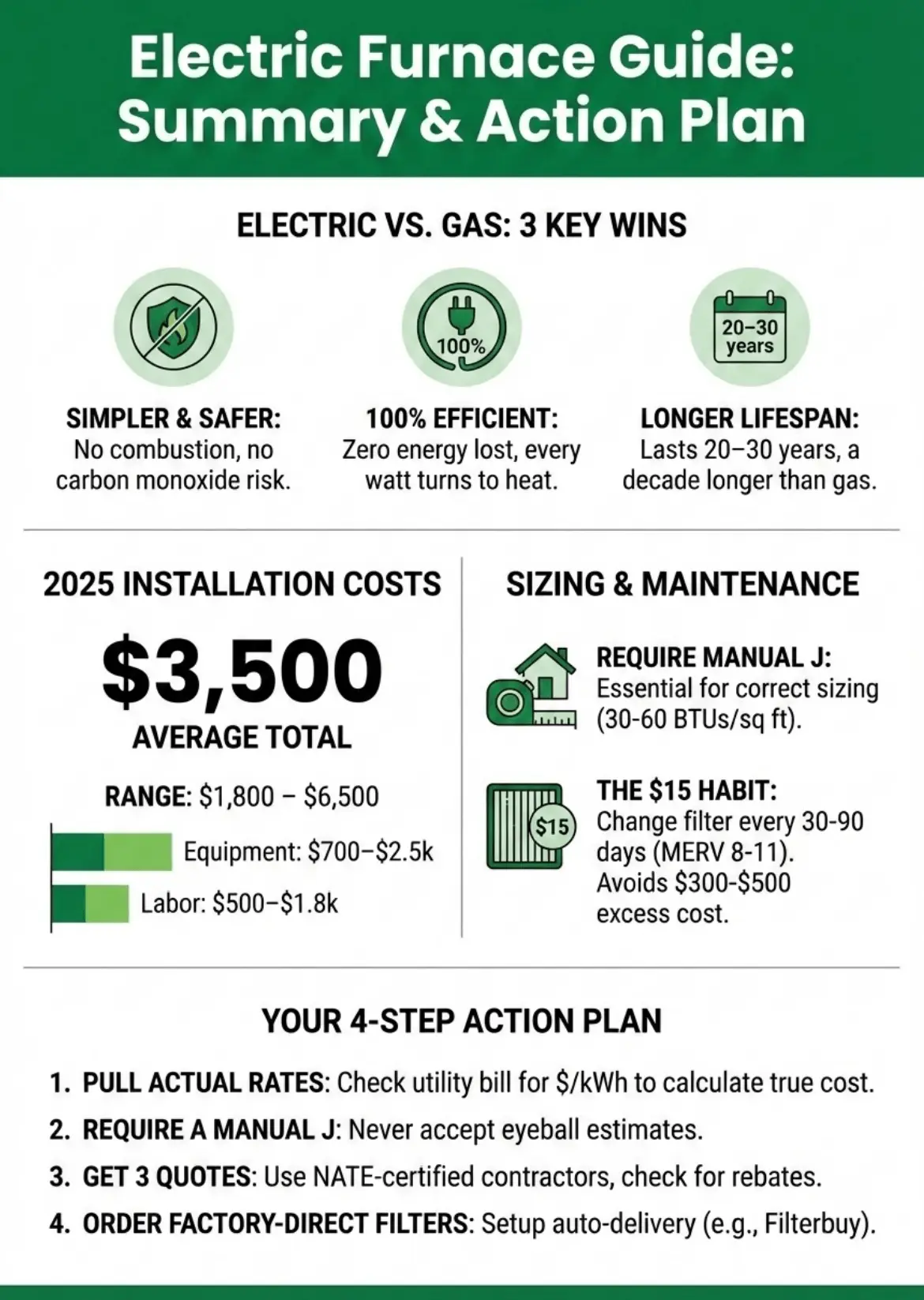
What it costs to install: $1,800–$6,500 all-in, with most homeowners landing between $2,500–$4,500.
How long it lasts: 20–30 years with regular maintenance — roughly a decade longer than a comparable gas furnace.
Best for: Homes without existing gas service, mild-to-moderate climates, and homeowners who want a simpler, safer system with no carbon monoxide risk.
The one thing that determines lifespan: Your air filter. A clogged filter forces the heating elements to work harder, runs up your energy bill by 10–15%, and shortens the system's life. Change it every 30–90 days.
8 Things Worth Holding Onto
Electric furnaces are simpler, safer, and longer-lasting than gas. No combustion, no CO risk, no flue. Average lifespan of 20–30 years versus 15–20 years for gas.
Installation costs less than gas — usually $500 to $1,500 less. No gas line needed, no flue pipe, and less labor complexity. The $1,800–$6,500 range covers most homes.
Monthly operating costs run higher in most cold-climate markets. Electricity costs more per BTU than natural gas in most U.S. regions. This trade-off is real — account for it.
100% AFUE efficiency means every watt becomes heat. No exhaust loss. That efficiency advantage is built into the technology, not dependent on brand.
Sizing matters more than brand. An oversized furnace short-cycles and wears out early. An undersized one never hits setpoint. Always get a Manual J.
Variable-speed models pay back their premium. If the budget allows the upgrade, the long-term math almost always favors it.
A neglected filter costs $300–$500 extra per heating season. That’s documented, avoidable, and fixed with a $15 filter changed every 30–90 days.
Electric makes the most sense for mild climates and homes without gas service. In cold northern markets with cheap natural gas, run the 10-year numbers carefully before deciding.
What Is an Electric Furnace and How Does It Work?
A residential electric furnace does one thing: pull cold air in, heat it, and push it back through your home. That’s the whole system.
Two components do the actual work. Electric heating elements — heavy-duty coils that heat up when current flows through them — warm the air as it passes through. Then a blower motor (how does an electric furnace work comes down to these two components in sequence) pushes that warmed air into your ductwork and out through your vents. Your thermostat calls for heat, the elements activate, the blower runs, and the cycle ends when your home hits setpoint.
Your electric forced air furnace doesn’t burn anything. No pilot light, no gas valve, no heat exchanger, and no flue. Because there’s no combustion, there’s nothing to exhaust — which means no chimney, no carbon monoxide risk, and far less that can go wrong mechanically over time. That simplicity is a big part of why electric furnaces typically outlast gas furnaces by close to a decade.
Still wondering how do electric furnaces work at the cycle level? When your thermostat detects the temperature drop below the setpoint, it signals the elements to activate. The blower runs until the home hits the target temp, then the system shuts off cleanly. No combustion residue, no reignition sequence.
Every watt you put in comes back out as usable heat. There’s no energy escaping up a flue. An electric furnace converts 95 to 100 percent of its power input into warmth — and that number matters when you’re running long-term cost math.
Three Types Worth Knowing
Electric furnaces come in three configurations. The long-term operating cost difference between the first and third is real enough to factor into your buying decision:
Single-stage electric furnace: On or off, full power every time. Lower upfront cost, but it can’t match output to actual demand, so energy use runs higher over time.
Multi-stage electric furnace: Runs at reduced capacity during mild weather and steps up only when temperatures drop. Better comfort, lower monthly bills, and less wear on components.
Variable-speed / modulating furnace: Adjusts output continuously to match exactly what the home needs at any given moment. The highest upfront cost of the three, and the lowest operating cost over a full system lifetime.
Electric Furnace Installation Cost in 2025: What to Budget
Most homeowners pay between $2,500 and $4,500 for a complete electric furnace installation in 2025. The full installed range runs from $1,800 on the low end — smaller unit, straight swap, existing 240V service already in place — up to $6,500 for larger homes, panel upgrades, or significant ductwork work.
Here’s how those costs break down by component:
Furnace unit (equipment only): $700 – $2,500
Labor — installation: $500 – $1,800
Permits and inspections: $100 – $400
Ductwork modifications (if needed): $0 – $1,500
Electrical service upgrades (if needed): $200 – $600
Total installed cost: $1,800 – $6,500
A few line items that catch homeowners by surprise. If the furnace location doesn’t already have a dedicated 240V circuit, an electrician needs to run one — budget $200–$600 depending on panel distance. If your existing ductwork is leaking or undersized, a quality contractor will flag it; ignoring the flag means the new unit underperforms from the first day it runs. And labor rates vary meaningfully by region — a straightforward install in a mid-size southern city runs less than the same job in the Northeast or coastal California.
Replacing an existing electric furnace in-kind — same fuel type, existing wiring and ductwork in good shape — typically lands on the lower half of these ranges. The average cost to replace electric furnace in-kind runs $1,800–$3,500 for most homes. Switching from gas to electric (or the other direction) adds $1,000–$3,000, depending on what infrastructure needs to change.
Electric Furnace vs. Gas Furnace: The Real Numbers Side by Side
Most comparison guides land on “it depends” and call it an answer. It isn’t. Here’s what the data actually shows:
Average installation cost: Electric — $1,800–$6,500. Gas — $2,500–$8,000
Monthly operating cost: Electric — $90–$200+ (varies by rate). Gas — $50–$150 (varies by rate)
Efficiency rating (AFUE): Electric — 95%–100%. Gas — 80%–98%
Average lifespan: Electric — 20–30 years. Gas — 15–20 years
Carbon monoxide risk: Electric — None (no combustion). Gas — Present if not properly vented
Requires gas line: Electric — No. Gas — Yes
Requires exhaust flue or vent: Electric — No. Gas — Yes
Best fit: Electric — Mild climates; no gas service. Gas — Cold climates; low gas rates
The cost to run electric furnace vs gas really comes down to two things: your climate and what you pay for electricity. Electric costs less to install and carries no combustion risk. Gas typically costs less to run month-to-month in cold-climate markets where heating season runs six or more months. In the Pacific Northwest, the South, or anywhere heating season runs under four months, the total 10-year ownership cost often favors electric. In Minnesota, Michigan, or Massachusetts with cheap gas rates and long winters, gas usually wins on cumulative cost.
One number most comparison guides miss: gas furnaces need annual professional maintenance — heat exchanger inspection, CO testing, burner cleaning — that adds $100–$200 per year to your actual operating cost. Electric furnaces need professional inspection far less often. Factor that in when you run your 10-year numbers.
High Efficiency Electric Furnace: What AFUE Means for Your Bill
AFUE stands for Annual Fuel Utilization Efficiency — the percentage of your energy input that actually becomes heat in your home. A gas furnace rated 80% AFUE loses 20 cents of every fuel dollar up the exhaust flue. An electric furnace at 100% AFUE wastes nothing. Every cent of electricity you pay for turns into warmth.
Upgrading from a single-stage model to a variable-speed high-efficiency electric furnace won’t move your AFUE much — you’re already near 100%. What variable-speed technology does is cut how long and how hard the furnace runs. Instead of cycling at full power every time, it holds at 40–60% capacity during moderate weather and only steps up when temperatures drop hard. That’s where the monthly savings actually show up.
BTU Sizing Guide: What Size Electric Furnace Does Your House Need?
Wrong-sized furnaces are one of the most preventable and expensive mistakes in the whole buying process. An oversized unit heats the home so fast it shuts off before air circulates evenly, leaving cold spots and running short on-off cycles that wear out components ahead of schedule. An undersized one runs all day without ever hitting setpoint on the coldest days.
HVAC professionals generally start with 30 to 60 BTUs per square foot, adjusted for climate zone. Starting-point ranges by home size:
Under 1,000 sq ft: Mild climate 20,000–30,000 BTU, cold climate 30,000–45,000 BTU
1,000–1,500 sq ft: Mild climate 30,000–45,000 BTU, cold climate 45,000–60,000 BTU
1,500–2,000 sq ft: Mild climate 45,000–60,000 BTU, cold climate 60,000–80,000 BTU
2,000–2,500 sq ft: Mild climate 60,000–80,000 BTU, cold climate 80,000–100,000 BTU
2,500–3,000+ sq ft: Mild climate 80,000–100,000 BTU, cold climate 100,000–120,000+ BTU
Those ranges get you close. A Manual J load calculation from a licensed HVAC contractor gets you to the right number — accounting for your insulation, window area, ceiling height, climate data, and duct layout. Don’t skip it.
What an Electric Furnace Actually Costs to Run Each Month
Here’s the math on a real house. A 60,000 BTU electric furnace draws about 17.6 kilowatts. Running 8 hours a day during peak winter months at the U.S. national average of roughly $0.16/kWh, that’s about $22.50 per day — or around $675 in your worst month. In a moderate climate with 4–5 hours of daily runtime, it drops to $340–$425.
Three variables actually move that number, and all three are within your control. Your electricity rate — check whether your utility offers time-of-use pricing, because running high-load appliances off-peak can cut costs. Your home’s insulation quality — an energy audit often turns up easy wins. And the condition of your air filter. Electric furnace operating cost per month is shaped by all three, but the filter is the one you can fix today for $15.
The Filter-Cost Connection
A dirty air filter chokes airflow through your electric furnace. The blower strains to pull air through the clogged media. The heating elements run longer cycles to move the same amount of heat. Electricity consumption climbs — sometimes 10–15% — not because anything broke, but because a $15 filter didn’t get changed on schedule. At $675 per peak month, that’s up to $100 in avoidable cost, every month it goes unchanged.
Choosing the Right Air Filter for Your Electric Furnace
Every cubic foot of air your system moves passes through the filter before it reaches the heating elements and blower. Think about what is an electric furnace beyond just a heater, and you’ll see it’s also the primary machine shaping your home’s indoor air quality. What you put in that filter slot — and how often you swap it — directly affects how hard the system works and how long it lasts.
MERV 8 to MERV 11 covers most residential electric furnaces well. MERV 8 catches dust, pollen, pet dander, and mold spores without restricting airflow in ways that stress the system. MERV 11 handles finer particles and is a solid pick for homes with pets or anyone with allergies. Going above MERV 13 in a system not designed for it restricts airflow enough to cause real problems — overheated elements, motor strain, and a shorter system lifespan.
Change frequency: every 30 days if you have pets or allergy sufferers at home; every 60 in average conditions; 90 days maximum in low-occupancy, no-pet homes. Check it monthly and swap it when the media looks gray. It takes 30 seconds.

"After two decades replacing furnaces, I can tell you that the brand on the unit matters far less than two decisions: getting a proper Manual J load calculation before installation and changing the air filter on schedule. I've seen a basic builder-grade electric furnace outlast a premium unit in the same neighborhood by eight years — the only difference was one family changed their filter every month and the other didn't."
- Filterbuy Team
7 Resources Worth Bookmarking
We’ve vetted all of these. Each one fills a gap that most furnace guides leave open — either because it’s a primary government source, or because it covers a decision you’ll face that most general guides don’t.
1. Furnace (Central Heating) — Wikipedia
Well-sourced overview of how central heating systems — including electric forced-air — work, how they evolved, and how they compare across fuel types. Good background before your first contractor conversation.
2. ENERGY STAR Certified Furnaces Database — U.S. Environmental Protection Agency
The official database of ENERGY STAR-certified furnace models. Search by fuel type, efficiency rating, and brand to verify whether what your contractor recommends qualifies for tax credits or utility rebates.
3. Furnace Ignitor Replacement: Signs, Costs & DIY Tips — Filterbuy
If your existing furnace is acting up before you’ve made the replace decision, start here. We cover symptoms of a failing ignitor, what replacement costs look like, and where DIY makes sense vs. when to call a pro.
4. Residential Energy Consumption Survey (RECS) — U.S. Energy Information Administration
The EIA’s most complete national data set on household energy use, broken down by fuel type and region. Use it to benchmark your expected operating costs against similar homes in your climate zone.
5. Find a NATE-Certified HVAC Contractor — ACCA Consumer Resources
The Air Conditioning Contractors of America trains and certifies contractors in proper Manual J load calculations and best-practice installation. Use their locator before you request quotes.
6. Furnaces and Boilers — U.S. Department of Energy Energy Saver
The DOE’s plain-English overview of furnace types, efficiency considerations, and energy-saving guidance. Regularly updated and especially useful for connecting efficiency ratings to real annual costs by climate region.
7. DSIRE: Database of State Incentives for Renewables & Efficiency
The most complete database of state and utility incentives for energy-efficiency upgrades in the U.S. Run your zip code here before you sign anything — rebates on electric heating equipment exist in many states and most homeowners never check.
Three Numbers Worth Knowing Before You Decide
Every stat below comes from a government primary source. No aggregators. No unnamed studies.
Space heating accounts for 42% of all energy consumed in the average U.S. home — more than water heating, cooling, and appliances combined. Your furnace choice isn’t picking a line item. You’re determining nearly half your annual energy bill.
Source: U.S. Energy Information Administration — Residential Energy Consumption Survey (RECS)
That’s the expected service life of a properly maintained electric furnace, according to the U.S. Department of Energy, versus 15 to 20 years for a gas furnace. That decade gap means a gas furnace owner will likely replace their system once, while an electric owner in the same home won’t. Most cost-of-ownership comparisons skip this entirely, which is why they consistently understate electric’s long-term value.
Source: U.S. Department of Energy — Energy Saver: Furnaces and Boilers
A clogged air filter pushes your heating system’s energy consumption up by 10 to 15%, according to the DOE. On a typical electric furnace running $600–$700 per month in peak winter, that’s $60–$105 in extra cost every month the filter goes unchanged. Over a five-month heating season, a neglected filter costs $300–$500 in excess electricity. The fix costs about $15.
Source: U.S. Department of Energy — Energy Saver: Maintaining Your Air Conditioner
Our Honest Take
Electric furnaces are right for more homeowners than most buying guides suggest. Your home electric heating system carries real advantages that get undersold: lower installation cost, longer lifespan, zero combustion risk, and no infrastructure dependency on a gas line. If you don’t already have gas service — and running it to your property costs $500 to $3,000 or more — the cost equation shifts even further in electric’s favor. In mild-to-moderate climates where heating season runs under five months, the monthly operating cost gap between electric and gas shrinks enough that the longer lifespan and simpler install make electric the practical call.
Gas has a real operating cost advantage in cold-climate, high-usage markets. We won’t pretend otherwise. If you’re in a northern state, heating six-plus months a year, with access to cheap natural gas, the monthly bill difference adds up. That said, an honest 10-year cost-of-ownership analysis — including the gas furnace replacement that’s likely in that window — closes the gap more than most comparisons acknowledge. In purely cold, high-usage markets, gas typically wins on cumulative cost. Know your numbers before you commit.
Here’s what we see consistently: the homeowners who regret their furnace choice didn’t go wrong because they chose electric over gas (or vice versa). They went wrong because they skipped the Manual J and trusted an eyeball estimate. Or they bought the right furnace and treated the air filter like it was optional. Both mistakes are fully preventable.
The Bottom Line
Get the right size. Get a variable-speed model if the budget stretches. Change your filter on schedule. A $1,800 unit treated right outlasts a $5,000 one that gets ignored. The furnace is the hardware. The filter is the maintenance. Both matter.
Your Action Plan
Here’s the sequence that makes sense for any homeowner researching, buying, or replacing an electric furnace:
Confirm your fuel-type decision first. Are you doing an electric furnace replacement in-kind or switching from gas? In-kind is the simplest path. Switching fuel types in either direction adds infrastructure costs. Be clear-eyed about your climate, utility rates, and budget before committing.
Pull your actual electricity rate from your utility bill. Get the per-kWh number you actually pay — not the national average. Check whether your utility offers time-of-use pricing. Your rate is the single most important variable in calculating your real monthly operating cost.
Require a Manual J load calculation before accepting any quote. A contractor who quotes a furnace size without a load calculation is cutting a corner you’ll pay for monthly, for years. The calculation should be documented and in writing. If they won’t do it, find one who will.
Get at least three quotes from NATE-certified contractors. Use the ACCA locator at acca.org to find certified professionals in your area. Every quote should include line-item pricing for equipment, labor, permits, and any electrical or ductwork changes needed. Single-number bundled quotes are hard to compare and easy to inflate.
Check DSIRE before signing. Run your zip code through dsireusa.org for state and utility rebates. Some programs require a participating contractor or a pre-installation application. Two minutes here has saved homeowners hundreds of dollars.
Confirm your electrical service capacity. Most residential electric furnaces need a dedicated 240V circuit with a 60-amp breaker. If your panel is near capacity or lacks the amperage, sort this out during quoting — not on installation day.
Order your air filter before the crew arrives. Your furnace needs a correctly sized, appropriately rated filter from the first time it fires up. Check the dimensions on your current filter frame, choose MERV 8–11 for most homes, and have it on hand. Filterbuy ships factory-direct in 600+ standard sizes — free, fast, made in the USA.
Set a filter change reminder today. Don’t trust memory. Set a recurring phone reminder for 30 days out and check monthly until you know your home’s loading rate. Or put it on auto-delivery with Filterbuy — your filter ships on your schedule, automatically.
Frequently Asked Questions
Q: What is an electric furnace?
A: An electric furnace heats your home using resistance heating elements — high-powered coils that warm air as it passes over them — then a blower motor distributes that air through your ductwork. Unlike gas furnaces, it involves no combustion, no gas line, no exhaust flue, and no carbon monoxide risk.
Q: How does an electric furnace work?
A: Cold air pulls through a filter into the furnace cabinet. Electric heating elements heat it. A blower motor pushes the warmed air into ductwork and out through your supply vents. Your thermostat controls when the elements turn on and off. The whole cycle runs in minutes.
Q: How much does an electric furnace cost to install in 2025?
A: Most homeowners pay $2,500–$4,500 for a full installation. The range runs $1,800–$6,500 depending on unit size, local labor rates, whether electrical upgrades are needed, and any ductwork modifications. Replacing an existing electric furnace in-kind typically lands toward the lower end.
Q: Is an electric furnace cheaper than a gas?
A: Cheaper to install, yes — typically by $500 to $1,500. More expensive to run monthly in most cold-climate U.S. markets, where natural gas costs less per BTU. Electric wins on upfront cost, lifespan, and safety. Your 10-year total cost depends on climate and local utility rates.
Q: How long does an electric furnace last?
A: 20 to 30 years with proper maintenance — about a decade longer than the average gas furnace. The biggest factor in reaching that lifespan is regular filter changes. A furnace working through a clogged filter overheats its elements and strains its blower, cutting service life significantly.
Q: What size electric furnace do I need for my home?
A: Most homes need 30 to 60 BTUs per square foot, adjusted for climate zone, insulation, and ceiling height. A 1,500 sq ft home in a mild climate typically needs 45,000–60,000 BTU; the same home in a cold northern climate, 60,000–80,000 BTU. Always confirm sizing with a Manual J load calculation.
Q: How much does it cost to run an electric furnace per month?
A: A 60,000 BTU electric furnace running 8 hours daily at $0.16/kWh costs roughly $675 in a peak winter month. In mild climates with 4–5 hours of daily runtime, expect $340–$425. Your actual cost depends on your electricity rate, home insulation, and filter condition.
Q: Does an electric furnace need a flue or exhaust vent?
A: No. Electric furnaces produce no combustion byproducts, so no flue, exhaust vent, or chimney is needed. This simplifies installation, eliminates carbon monoxide risk completely, and makes installation workable in locations where venting a gas furnace would be difficult or costly.
Q: What MERV filter should I use in an electric furnace?
A: MERV 8 to MERV 11 covers most homes well. MERV 8 handles dust, pollen, and common allergens without restricting airflow. MERV 11 captures finer particles — a solid pick for homes with pets or allergy sufferers. Don’t exceed MERV 13 unless your system is specifically rated for it.
Q: How often should I change the air filter in an electric furnace?
A: Every 30 days in homes with pets or allergy sufferers; every 60 days in typical conditions; 90 days maximum in low-occupancy, no-pet homes. Check monthly until you know your home’s loading rate. When the filter looks gray and dense, replace it regardless of when it was last changed.
The Right Filter for Your Electric Furnace — Shipped Free, Made in the USA.
No matter your electric furnace cost or system size, Filterbuy carries 600+ standard sizes — MERV 8 through MERV 13 and odor-eliminating options — factory-made in the USA and shipped to your door at no cost. No middlemen. No markups. No hunting four hardware stores hoping they have your size.
Set up auto-delivery, and your filter shows up when it’s time to change it. You set the schedule. We handle the rest.