
Is MERV 11 Too Restrictive for Home HVAC?
October 7, 2026
No. For most homes, a MERV 11 filter is not too restrictive. A clean MERV 11 filter adds only slightly more airflow resistance than a MERV 8. Trouble usually starts when the filter is too small for the system, the return ducts are tight, or the filter is overdue for a change.
MERV 8: captures larger debris, dust, and dust mites. Least resistance.
MERV 11: also captures finer particles like pet dander and mold spores. A balanced fit for most homes.
MERV 13: captures microscopic particles. Needs ample filter area.
Reviewed by David Clark, Licensed HVAC Technician
Not Sure Which Rating Fits Your System?
Answer a few quick questions and we'll match you to the right filter.
TL;DR
No, a MERV 11 filter is not too restrictive for most homes. A clean pleated MERV 11 furnace filter typically adds about 0.15–0.18 inches of water column (in. w.c.) of airflow resistance, only slightly more than a MERV 8. Problems usually show up only when the filter is undersized for the system's airflow, the return ducts are already restrictive, or the filter is overdue for a change.
Key Takeaways
MERV 11 is a mid-range rating under ASHRAE Standard 52.2. It must capture at least 65% of particles between 1 and 3 microns and at least 20% of the smallest, 0.3 to 1 micron.
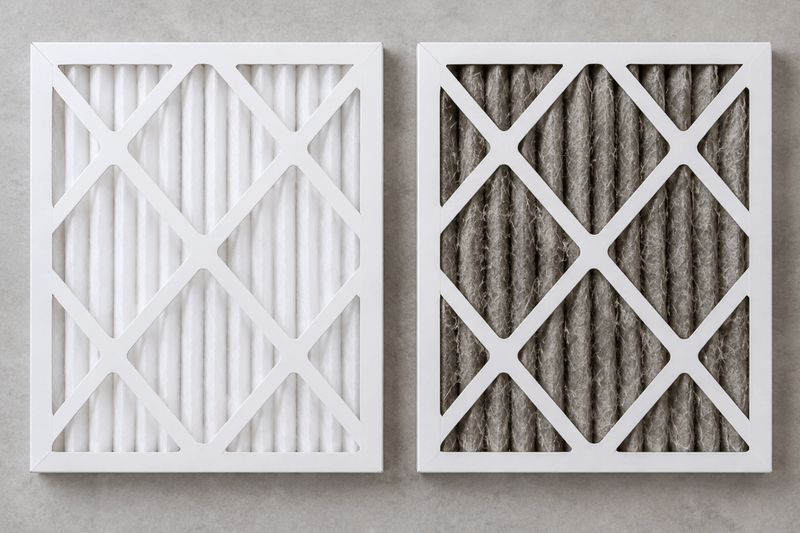
A dirty filter can restrict airflow more than the whole step from MERV 8 to MERV 11.
Filter face area matters more than the MERV number. Building scientists size filters at about 2 square feet per 400 cubic feet per minute (cfm) of airflow.
Is MERV 11 Too Restrictive for a Furnace or Air Conditioner?
No. For most home furnaces and air conditioners, MERV 11 is not too restrictive. With enough return and filter area, the added resistance is too small to change your comfort or energy bill.
MERV 11 tends to run into trouble in systems like these:
The filter is undersized, such as one 1-inch filter on a 3-ton system.
The return ductwork is already restrictive.
The filter is overdue for a change.
The blower is an older fixed-speed PSC motor near its limit.
I don’t want anyone to feel like they need an HVAC license just to pick the right filter.
Michelle Wan, Brand Manager and Air Quality Writer, Filterbuy
What Does a MERV 11 Rating Mean?
MERV (Minimum Efficiency Reporting Value) is the air filter efficiency scale defined by ASHRAE Standard 52.2. It measures particle capture in three size ranges, not airflow resistance, so the rating alone can't tell you whether a filter will restrict your system.
Minimum capture efficiencies per ASHRAE Standard 52.2.
The U.S. EPA publishes the full MERV table, and Filterbuy's MERV rating chart walks through MERV 1 to 16.
How Much Airflow Resistance Does a MERV 11 Filter Add?
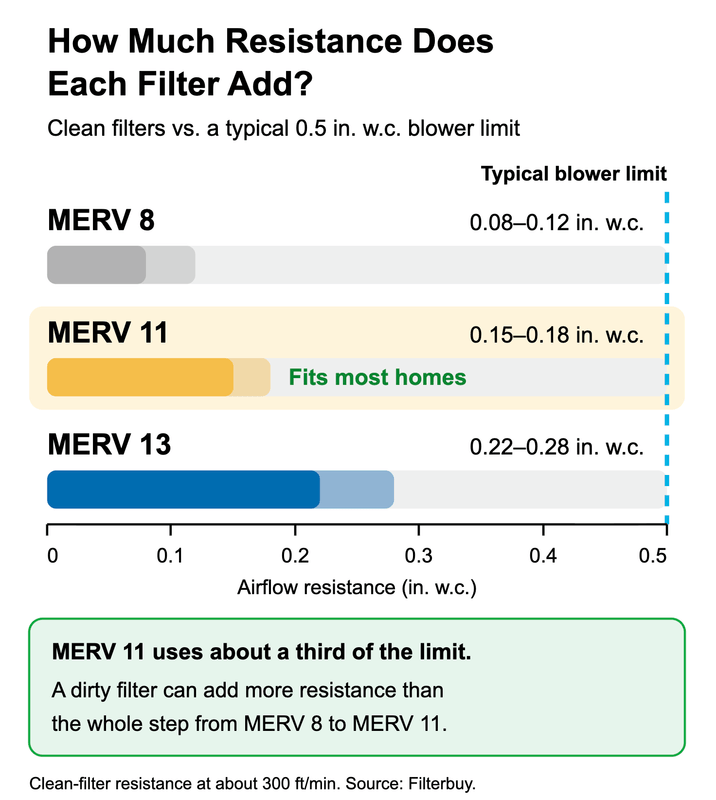
A clean pleated MERV 11 filter typically adds about 0.15–0.18 in. w.c. of airflow resistance at a standard rating airflow of 300 feet per minute. That pressure drop runs roughly 0.05–0.07 in. w.c. higher than a comparable MERV 8 filter's.
What matters is how much room your blower has. Most residential furnaces and air handlers are rated for about 0.5 in. w.c. of total external static pressure, yet Air Conditioning Contractors of America (ACCA) design protocols set aside only 0.10 in. w.c. for the filter, building science firm Energy Vanguard reports.
What that means for your blower (Filterbuy calculation): at rated airflow, a clean MERV 11 filter takes up roughly 30–36% of that 0.5 in. w.c. budget, compared with 16–24% for MERV 8. That puts it 0.05–0.08 in. w.c. over ACCA's filter allowance. Roomy ducts absorb that easily; tight ones may not.
A loaded filter can cost you more than the upgrade. In a Lawrence Berkeley National Laboratory (LBNL) field study, one home's MERV 8 filter picked up 0.16 in. w.c. of extra resistance as it filled with dust, more than the entire gap between clean MERV 8 and MERV 11 filters.
The energy effect is small, too. In a peer-reviewed University of Texas at Austin study, 1-inch MERV 11 filters cut airflow 7–11% compared with fiberglass filters, yet daily energy use showed no significant difference.
Signs Your MERV 11 Filter Is Too Restrictive
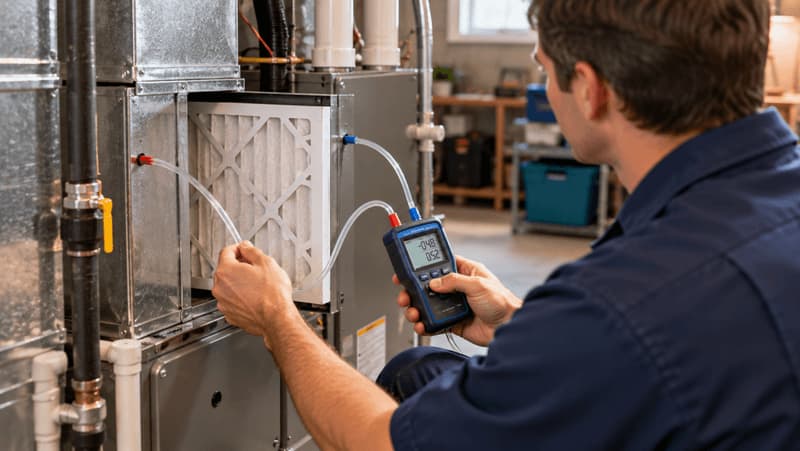
If airflow drops after you install a MERV 11 filter, it may be too restrictive for your system. Watch for signs that go away with a fresh or lower-rated filter:
Whistling or roaring at the return grille or filter slot
Weak airflow at supply vents
Ice on the indoor AC coil or refrigerant lines
Furnace short cycling or high-limit error codes
How to Check Whether Your HVAC System Can Handle MERV 11
The simplest check compares your filter's face area with the airflow your system moves. It takes four steps:
Find your filter using Filterbuy's HVAC air filter location guide.
Work out its face area by multiplying length by width in inches and dividing by 144.
Estimate your system's airflow. Most systems move about 400 cfm per ton of cooling, so a 3-ton system moves about 1,200 cfm.
Compare the two in the Filter-Area Check below.
Fit matters as much as size, and it is the problem Filterbuy hears about most. David Clark sees it in the field:
A filter that does not fill its rack is doing less than the homeowner thinks. Air will always take the gap over the media. When I pull a panel and find a clean filter sitting next to a dirty coil, that gap is almost always why.
David Clark, Licensed HVAC Technician, Filterbuy HVAC Solutions
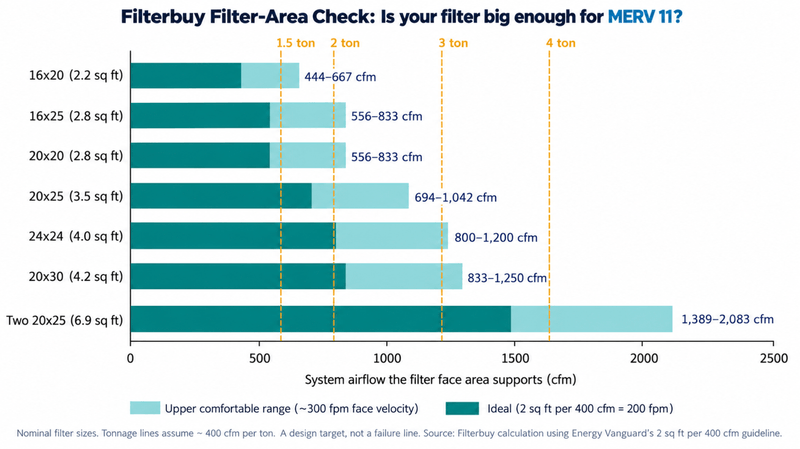
How to read it: Filterbuy built this check from the filter sizes it manufactures. Find your size and compare it with your system's tonnage.
Nominal sizes at 200–300 feet per minute; about 400 cfm per ton. Source: Filterbuy calculation.
What we'd do with your result:
If your filter area falls in the ideal range, run MERV 11 and change it on Filterbuy's 90-day baseline.
If it falls short, as one 20x25x1 filter on a 3-ton system does, keep MERV 11 but change it every 60 days. Added return area or custom-size filters add headroom.
If symptoms continue with a fresh filter, switch to MERV 8 filters for now and have a technician measure static pressure.
Is a 4-Inch MERV 11 Filter Less Restrictive Than a 1-Inch?
Yes, slightly, when the face size is the same. A 4-inch MERV 11 filter packs in more pleated media, so air passes through it more slowly. Filter maker AAF Flanders' published data sheet rates its PREpleat M11 HC MERV 11 filter at 0.15, 0.13 and 0.10 in. w.c. for 1-, 2- and 4-inch depths at 300 feet per minute. In real homes, LBNL measured 4-inch filters averaging 0.38 in. w.c. across ratings, versus 0.44 for 1-inch filters, and they loaded about half as fast. With a media cabinet, Filterbuy 4-inch air filters are an easy upgrade.
MERV 8 vs MERV 11 vs MERV 13: Which Should You Choose?
MERV 11 is the right fit for most families because it balances allergen capture with airflow.
Typical clean-filter resistance at about 300 feet per minute; resistance rises with airflow and dust loading.
Supporting Statistics
1. Replacing a Clogged Filter Can Cut an Air Conditioner's Energy Use by 5–15%
The U.S. Department of Energy's Energy Saver program calls routine filter replacement the quickest way to save on home cooling.
Source: U.S. Department of Energy, Energy Saver 101: Home Cooling
2. A Clean MERV 16 Filter Cut Airflow 22% in PSC Systems
Lawrence Berkeley National Laboratory monitored 10 California homes for a year. When PSC-blower systems switched from a low-MERV filter to a clean MERV 16 filter, airflow fell by an average of 188 cfm, or 22%.
Source: Lawrence Berkeley National Laboratory, System Effects of High Efficiency Filters in Homes
3. More Than 106 Million People in the U.S., About 1 in 3, Have Allergies
The Asthma and Allergy Foundation of America bases this figure on 2024 CDC data. Many of them benefit from MERV 11's better capture of fine dust and pet dander.
Source: Asthma and Allergy Foundation of America, Allergy Facts and Figures
Frequently Asked Questions
Will a MERV 11 Filter Damage My Furnace or AC?
Not in a healthy system. Damage comes from airflow that stays low, usually because of a clogged or undersized filter or blocked returns.
Does a MERV 11 Filter Increase Energy Bills?
Usually only slightly. Lawrence Berkeley National Laboratory found MERV 10–13 filters changed energy use by less than 1%.
What MERV Rating Is Too Restrictive for a Home?
There is no single cutoff; it depends on your system. Most homes handle MERV 8 to 11 easily and MERV 13 with enough filter area. The EPA recommends MERV 13 or the highest rating your system fan and filter slot can accommodate, and LBNL saw the big airflow losses at MERV 16.
Is MERV 13 Too Restrictive Compared With MERV 11?
MERV 13 filters typically add about 0.22–0.28 in. w.c. when clean, versus 0.15–0.18 for MERV 11. For smoke season, see Filterbuy's best MERV filter for wildfire smoke guide.
How Often Should I Change a MERV 11 Filter?
Filterbuy's baseline for a 1-inch filter is every 90 days. Shorten that to 60 days with pets, 45 with asthma or allergies and 30 during wildfire smoke or renovation. Plan on 3–6 months for 2-inch filters and 6–12 months for 4- and 5-inch filters, and let automatic filter delivery keep you on schedule.
Glossary
MERV (Minimum Efficiency Reporting Value): The 1–16 air filter efficiency rating defined by ASHRAE Standard 52.2.
Total external static pressure (TESP): The total resistance a furnace or air handler blower has to push against.
PSC motor: A fixed-speed permanent split capacitor blower motor. Its airflow drops as resistance rises.
ECM motor: A variable-speed electronically commutated blower motor. It holds airflow steady by drawing more power.
The Bottom Line on MERV 11 Airflow
Filterbuy's recommendation: start with MERV 11 in the largest filter your return can hold, and step up to MERV 13 only when your system has the filter area to support it.
Shop Filterbuy MERV 11 air filters, compare ratings in our MERV rating chart or see the MERV 8 vs MERV 11 pressure drop chart.
About the Author and Reviewer
Michelle Wan is Brand Manager and Air Quality Writer at Filterbuy (B.A., University of California, Santa Cruz). She works directly with Filterbuy's U.S. manufacturing teams.
David Clark is a licensed HVAC technician and President of Filterbuy HVAC Solutions. An EPA-certified technician, he trained at the South Florida Academy of Air Conditioning and has worked in HVAC for more than a decade.