
Where Is My HVAC Air Filter Located?
August 27, 2026
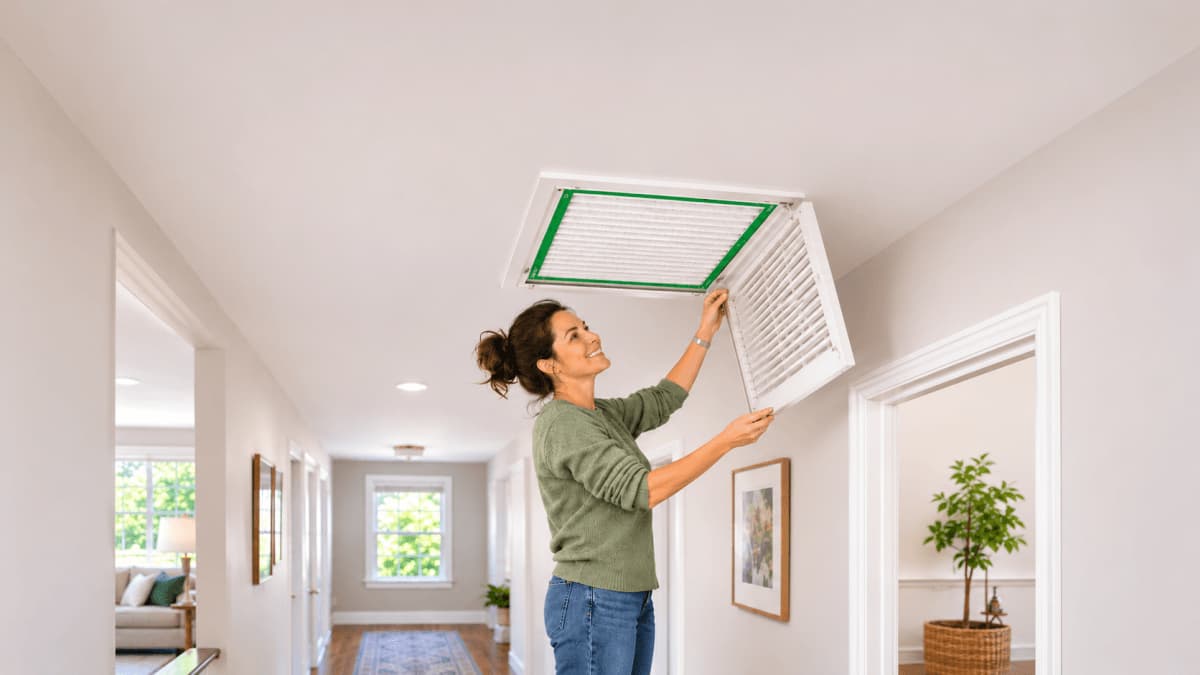
Your HVAC air filter is in one of two places: behind a return vent grille, or in a slot where the return duct meets your furnace or air handler. Check the return grilles first. They’re the larger vents that pull air in.
No filter there? Follow the return duct to your indoor unit and look for a slot or access panel. Not sure which filter to choose? Take the quick match quiz below.
Found it? The size is printed on the frame, like 20x25x1.
Shop air filters by sizeFind the right filter for your home
Answer a few quick questions and we’ll match you to the right air filter for your system.
The short answer
Your filter is in one of two places: behind a return air vent grille (on a wall, ceiling, or floor), or in a slot on your air handler or furnace where the return duct connects. Check the return vents first — that is where most homes keep them.
Larger homes often have more than one. Count your return vents before you stop looking.
How to spot it
- Find the returns, not the supplies. Run your system and hold your hand up to each vent. Returns pull air in. Supplies blow air out. Filters sit behind returns.
- Return grilles open. Look for latches along the edge or a hinge that lets the cover swing down. The filter slot is directly behind it.
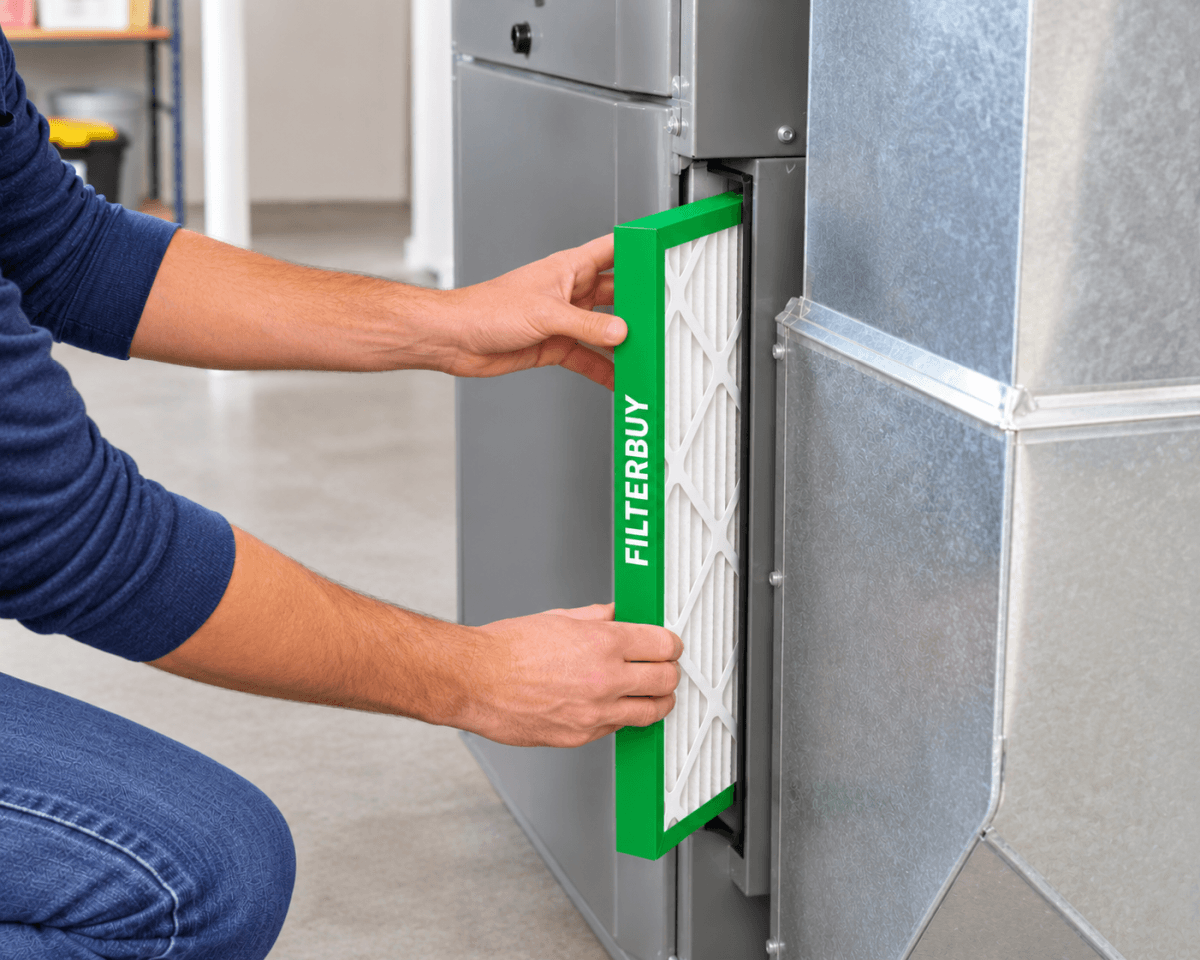
- At the unit, check the seam. Filters slide into a slot at the bottom or side of the air handler or furnace. Horizontal units in attics and crawl spaces may have one at either end.
- The size is already printed on it. Look along the cardboard frame for three numbers, like 20x25x1. Snap a photo before you throw it out.
- Never run the system without one. An empty slot lets dust straight into your ductwork and equipment.
Found it? Shop your replacement.
Start with the size printed on your old filter frame, then pick the rating that matches what you want to capture.
Need a size we don’t stock? · Compare MERV ratings · How to measure your filter
Your HVAC air filter usually sits in one of two places: behind a large return-air grille (on a wall, ceiling, or floor) or inside a slot next to your furnace or air handler. Turn off your system, find the biggest return grille, then trace the return duct back to the indoor unit. The filter is almost always at one of those points.
Key Takeaways
Location Matters: Your HVAC air filter is typically located either behind a return-air grille or near your furnace/air handler in a designated slot.
System Off for Safety: Always turn off your HVAC system before checking or replacing the air filter to ensure safety and prevent debris from spreading.
Trace the Return Duct: If you're unsure, follow the largest return-air duct from the grille to the indoor unit to find the filter's location.
Regular Maintenance: Checking and replacing your air filter routinely helps improve air quality and system efficiency.
Here’s How to Find Your HVAC Air Filter in Five Minutes
Work through these steps in order. Photographs or illustrations at each step make the process even easier, so consider snapping a picture as you go.
Turn off your HVAC system. Switch it off at the thermostat. This stops air from pulling dust into your face and keeps the blower from running while you inspect the unit.
Find the largest return-air grille. Returns are the big vents that suck air in, usually one per floor or one large central grille. They are noticeably bigger than the vents that blow air out.
Check behind the grille. Many return grilles have a hinged or removable cover with a filter sitting right behind it. Unclip or unscrew the cover and look. If a filter is there, you found it.
Locate the furnace or indoor air handler. No filter behind the grille? Find your indoor unit. It usually lives in a basement, attic, garage, utility closet, or crawl space.
Follow the return duct to the unit. Trace the large duct running into the furnace or air handler. The filter almost always sits where that duct meets the unit.
Check for a filter slot or access panel. Look for a narrow slot, a hinged cover, or a removable panel near the blower. Slide it open and look inside.
Repeat for additional systems. If your home has more than one furnace or air handler, repeat every step for each one. Multi-system homes have multiple filters.
Consult your manual or a technician if you find nothing. Some setups use sealed cabinets or specialty filters. When in doubt, check the model number or call a professional.
HVAC Air Filter Locations by System Type
Filter placement depends heavily on your equipment. Use the table below to match your setup.
| System type | Where the filter usually sits |
|---|---|
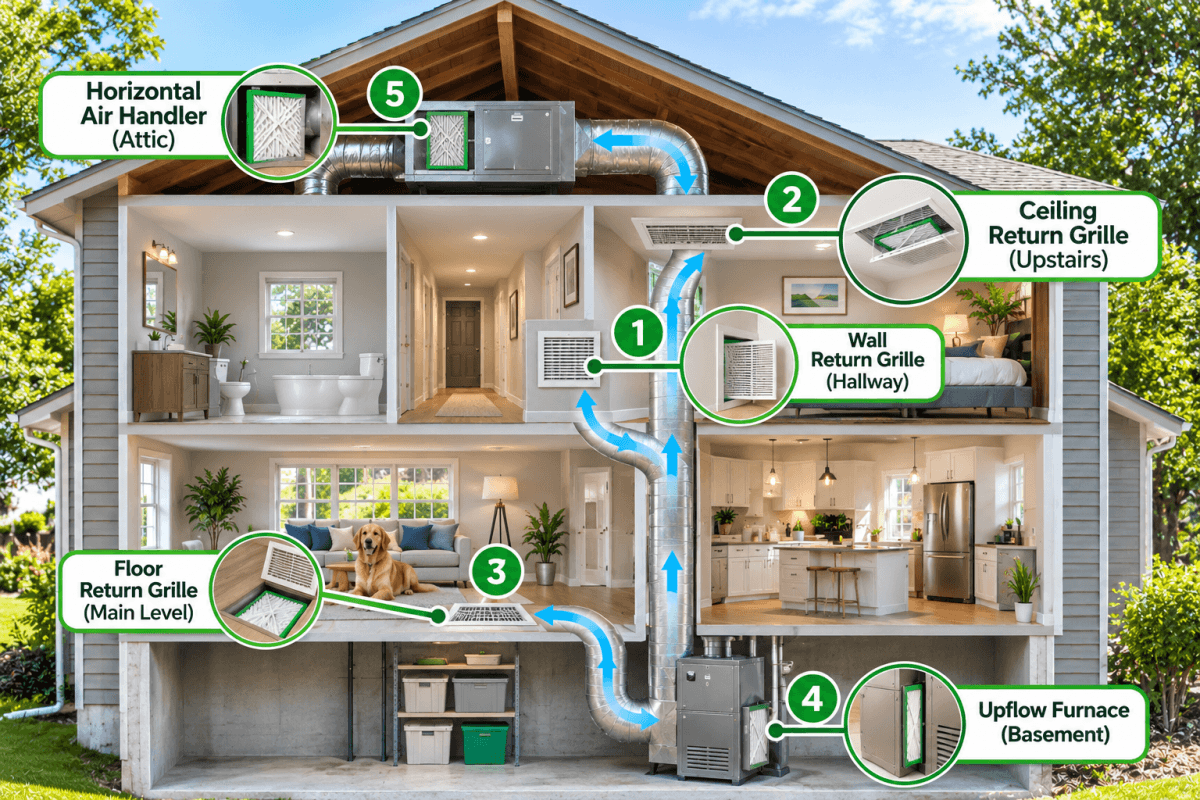
| Wall return grille | Behind the grille, held by a hinged or removable cover |
| Ceiling return grille | Behind the ceiling grille, often on an upper floor or hallway |
| Floor return | Inside the floor grille, lifted straight out |
| Furnace with side slot | In a narrow slot beside or below the furnace |
| Furnace with blower compartment | Inside the accessible blower compartment, near the return. Note that modern units feature external slots to prevent dust spillover onto the blower wheel. |
| Air handler | At the return side of the air handler, often behind a panel |
| Packaged HVAC unit | Inside the packaged outdoor or rooftop unit, behind an access door. Note: Residential packaged systems often utilize indoor return grilles instead, avoiding outdoor trips during replacements. |
| Attic, basement, garage, closet, or crawl space unit | At the return of the unit in that location |
| Ductless mini-split | Behind the front panel of the indoor head, as a washable screen |
| Window unit | Behind the front grille, as a washable foam or mesh screen |
If your setup does not match any row here, keep reading. The troubleshooting section further down covers harder cases.
How to Tell a Return Vent From a Supply Vent
Knowing the difference speeds up your search, because filters live at returns, not supplies.
Size: Return vents are usually larger. Supply vents are smaller and more numerous.
Airflow direction: Supplies push conditioned air out. Returns pull room air in.
Louvers: Supply vents often have adjustable louvers or dampers you can open and close. Returns usually have fixed slats.
Location: Supplies sit near windows, floors, and ceilings throughout each room. Returns are often central, in hallways or near the unit.
The tissue test: Hold a single sheet of tissue paper up to the vent while the system runs. If the tissue gets pushed away, that is a supply vent. If the tissue sticks to the grille, that is a return vent, and your filter is likely nearby.
Does Your Home Have More Than One HVAC Filter?
Many homes do. Check for these situations before you assume you are finished:
Multiple HVAC systems: A separate furnace or air handler for upstairs and downstairs means separate filters.
Multiple filtered returns: Some systems pull air from more than one return grille, each with its own filter.
Zoned systems: Zoning dampers can route air through additional filtered returns.
Multi-story houses: Larger homes frequently run two or more independent systems.
Electronic air cleaners: These may hold a permanent cell plus a pre-filter.
Thick media cabinets: A dedicated cabinet near the unit can hold a deep four- or five-inch filter.
Important warning: Do not install filters at both the return grille and the HVAC unit unless your system was specifically designed for that configuration. Double filtering restricts airflow, strains the blower, and can reduce both comfort and efficiency. One filter per airflow path is the rule unless a professional tells you otherwise.
What If You Still Cannot Find the Filter?
Work this troubleshooting flow patiently:
Check every large return grille in the home, including hallways, ceilings, and floors.
Locate every indoor HVAC unit, since additional units mean additional filters.
Follow each return duct back to its unit and inspect where they meet.
Look for a narrow slot, a hinged cover, or a media cabinet near each blower.
Check the model number and manufacturer's manual. Search the model for filter location and size.
Ask the previous homeowner, landlord, or a technician who has serviced the system.
Do not open sealed or electrical compartments. If a panel is screwed shut over wiring or a control board, stop and call a professional.
Which Way Should the HVAC Filter Face?
Airflow direction matters. Every disposable filter has an arrow printed on the frame.
Point the airflow arrow toward the furnace, air handler, or blower. Air travels from your rooms, through the filter, and into the unit, so the arrow follows that path.
If the filter sits behind a return grille, the arrow points into the ductwork, away from the room and toward the system.
Two labeled illustrations help here: one showing a filter in a slot at the furnace with the arrow aimed at the blower, and one showing a filter behind a return grille with the arrow aimed into the duct.
Installing a filter backward reduces its effectiveness and can cause the frame to bow.
How to Find the Correct Replacement Size
A correct fit is snug but not forced. Here is how to get it right:
Read the dimensions on the existing frame. Most filters print the size along one edge, listed as length by width by thickness (for example, 16 x 25 x 1).
Understand nominal vs. actual size. The printed nominal size is rounded. A filter labeled 16 x 25 x 1 usually measures closer to 15.5 x 24.5 x 0.75 in reality.
Measure the old filter if the print has worn off. Record length, width, and thickness.
Measure the slot if the filter is missing entirely. Measure the opening, then choose the nearest nominal size.
Ensure a snug fit without bending the frame. A filter that has to be forced or bent is the wrong size.
Check HVAC compatibility before changing MERV ratings. A higher MERV traps more particles but also resists more airflow.
According to the U.S. Environmental Protection Agency, MERV (Minimum Efficiency Reporting Value) rates a filter's ability to capture particles, with higher numbers capturing smaller particles. ENERGY STAR recommends checking your system's tolerance before jumping to a high-MERV filter, since too much airflow resistance can reduce efficiency.
Once you know your size, Filterbuy makes replacement straightforward. You can search by size, compare MERV 8, 11, and 13 options side by side, and order custom sizes if your setup uses nonstandard dimensions.
If your filter turns out to be an odd measurement that big-box stores do not carry, custom sizing solves it. Filterbuy builds air filters to exact dimensions, so a hard-to-find size does not force you into a poor fit or double stacking.
Why Your HVAC Filter's Location Matters
The right filter in the right spot does more than trap dust. It protects your whole system.
Protects the blower and internal components from dust buildup that shortens equipment life.
Maintains proper airflow, so the system heats and cools efficiently.
Prevents unfiltered air from bypassing the frame, which happens when a filter is the wrong size or sits loosely.
Makes regular inspection and replacement easier, since a known location becomes part of your routine.
Keep your expectations measured. Filtration can reduce particles in the air your system circulates, but it cannot remove every pollutant on its own.
Good indoor air quality also depends on source control (removing pollutant sources) and ventilation (bringing in fresh air). A filter is one tool among several, not a complete solution.
What to Do After You Find the Filter
Turn your discovery into a simple record. Think of this as a printable home filter inventory you keep near the unit:
Photograph each filter location.
Record how many filters your home has.
Write down each size (length by width by thickness).
Note the current MERV rating.
Confirm the airflow direction for each filter.
Record the replacement date each time you swap one.
Set a reminder, or use Filterbuy Auto Delivery to have the correct size arrive on schedule so you never run out.
When to Call an HVAC Professional
Some situations call for expert HVAC review rather than DIY. Contact a licensed technician if:
You find no visible filter or filter rack anywhere.
A filter slot appears sealed or permanently closed.
Access would require opening electrical equipment or a wired control panel.
The attic or crawl space is unsafe to enter.
A filter repeatedly bends, whistles, or gets pulled into the slot.
You are unsure whether your system is designed for double filtration.
A higher MERV filter causes noticeable airflow or comfort problems.
A professional can confirm your configuration, verify safe access, and recommend the correct MERV range for your equipment.
Found Your Filter? Now Find the Right Size for Your HVAC Unit
Check the measurements printed on the frame, or measure the filter carefully. Then find the matching Filterbuy air filter by size and select a MERV rating compatible with your HVAC system.

Where Is the Filter in an Air Handler or Heat Pump?
If your home has an air handler or a heat pump instead of a gas furnace, the search works the same way: the filter always sits on the return side, somewhere between a return grille and the blower. Here is where to look on each.
Air Handler Filter Location
The air handler is the indoor cabinet that houses the blower and evaporator coil. It usually lives in a basement, attic, garage, or utility closet. Its filter slides into a slot on the return side of the cabinet, and the unit’s orientation decides where that slot sits: at the bottom of an upflow unit, at the top of a downflow unit, and at the intake end of a horizontal unit.
Whether there is a slot at the equipment at all comes down to access. U.S. Department of Energy Building America guidance says that when the air handler is easy to reach, the filter belongs in a filter box at the return plenum. When the unit sits in a crawl space or an attic without stairs, a filter goes in each return grille instead. That single installation decision is why one home changes one filter at the unit while another changes three around the house.
Find the cabinet: a large metal box with ductwork connected at both ends.
Identify the return duct: it is the one connected to the grille that pulls air in.
Run your hand along the seam where that duct meets the cabinet. You are feeling for a removable or hinged cover, often marked FILTER.
On a horizontal unit, check both ends of the cabinet before deciding there is only one slot.
Heat Pump Air Handler Filter Location
On a heat pump, the air handler is the entire indoor unit, so the filter sits either in a slot on that cabinet or behind the return grilles. There is no furnace section to look for. Many heat pump air handlers use a 4-inch or 5-inch media cabinet on the return side, so check the depth printed on the old filter before you order.
Because a heat pump handles both heating and cooling, it runs more hours each year than a furnace-and-AC setup, and its filter loads faster. Check it monthly. If you switched from gas heat and kept your old replacement schedule, you are probably changing it too late.
Choose the Right Filterbuy Filter for Your Home
Once you know your size, pick the rating that matches what you want to capture. Filterbuy manufactures all four options in the USA, in more than 600 sizes plus custom. Check your HVAC manual for the highest rating your system supports before you upgrade.
MERV 8 air filters: Our standard filter captures 90% of airborne particles, including dust, lint, pollen, and mold spores. It is the right choice for most homes.
MERV 11 air filters: Captures 95% of airborne particles and capture pet dander and dust mite debris. A strong pick for homes with pets or seasonal allergies.
MERV 13 air filters: Captures 98% of airborne particles as small as 0.3 microns, including smoke and smog. Best for asthma, severe allergies, or wildfire season, if your system can handle it.
Odor Eliminator filters: Activated carbon that targets cooking, pet, and household odors and VOCs, while capturing 95% of airborne particles.
Frequently Asked Questions
Where Is The HVAC Air Filter Usually Located?
Most filters sit behind a large return-air grille or in a slot next to the furnace or air handler. Start at the biggest return vent, then trace the return duct to the indoor unit.
Is The Filter In The Return Vent Or Furnace?
It can be either. Homes with a filter grille keep it behind the return vent. Homes without one keep it in a slot at the furnace or air handler. Some systems use one location, not both.
How Can I Identify A Return Vent?
A return vent pulls air in and is usually larger than supply vents. Use the tissue test: if a tissue sticks to the grille while the system runs, it is a return.
Can A House Have More Than One HVAC Filter?
Yes. Homes with multiple systems, zoned setups, or several filtered returns can have two, three, or more filters. Check every indoor unit and every large return grille.
Should Every Return Vent Have A Filter?
Not always. Only returns designed to hold a filter should have one. Do not add filters everywhere, and never double filter unless your system was designed for it.
Which Direction Should The Arrow Point?
The airflow arrow points toward the furnace, air handler, or blower. If the filter sits behind a return grille, the arrow points into the ductwork.
Where Is The Filter On A Heat Pump?
A heat pump uses an indoor air handler, so the filter sits at that unit's return or behind a return grille, just like a furnace system.
What If There Is No Filter In The HVAC System?
Some setups use sealed cabinets or specialty filters that need professional access. Check the model number and manual, and call a technician if a panel is sealed or covers electrical parts.
Can I Run My HVAC System Without A Filter?
It is not recommended. Running without a filter lets dust build up on the blower and coils, which can reduce efficiency and shorten equipment life. Replace a missing filter promptly.
How Do I Determine The Correct Replacement Size?
Read the size printed on the existing frame, listed as length by width by thickness. If the print is gone, measure the old filter or the slot, then match the nearest nominal size.
See More
Listen to a quick guide on where HVAC air filters are located and why finding yours matters for your home's indoor air quality.
Explore a visual walkthrough of common HVAC air filter locations and learn where to check throughout your home.
Watch a practical demonstration to help you identify where your HVAC air filter is installed.