How Many BTUs Do You Need For A 100 Sq Ft Room? Mini Split Sizing Made Simple
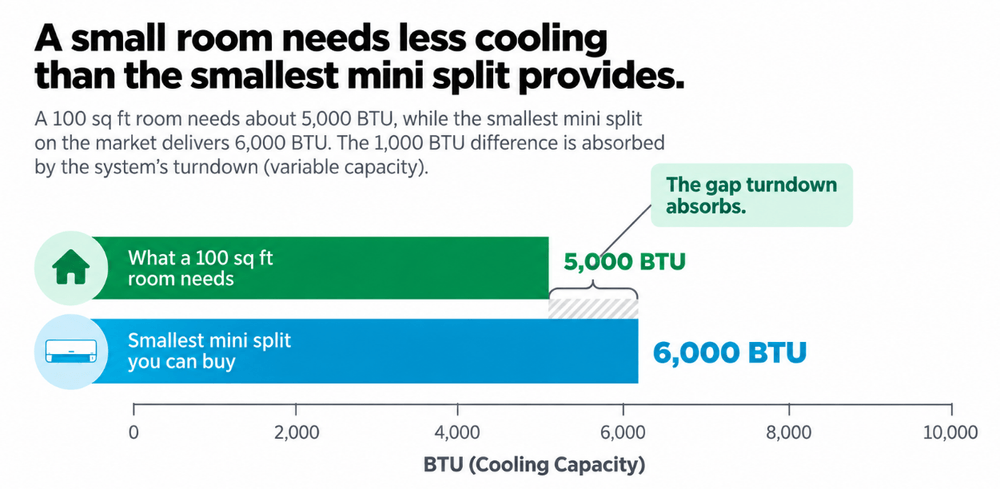
A 100 square foot room needs about 5,000 BTU per hour of cooling. ENERGY STAR puts every room from 100 to 150 square feet in that same tier, measured on an 8 foot ceiling. Room conditions move the number further than floor area does, and the smallest ductless head commonly sold is 6,000 BTU, so for a room this small the useful question is how far a unit can turn down.
- Shaded bedroom: 4,500 BTU
- Standard room, two people: 5,000 BTU
- Sunny room, four people: 6,700 BTU
- Kitchenette: 9,000 BTU
Sizing something larger, an addition, or a room with no ductwork? Filterbuy ductless systems run 12,000 to 24,000 BTU and cover 300 to 1,100 square feet. Shop Filterbuy mini split systems

Answer a few quick questions and we will point you to the right mini split size for your space.
TL;DR: A 100 square foot room needs about 5,000 BTU per hour of cooling. A BTU is a unit of heat, so the rating describes how fast a system pulls heat from a room. The ENERGY STAR chart gives that same 5,000 figure to every room from 100 up to 150 square feet. The catch is that the smallest ductless head commonly sold is 6,000 BTU, so every mini split option here starts above the calculated load. Inverter compressors absorb that gap by modulating down, which makes turndown the specification that decides comfort.
Key Takeaways
The ENERGY STAR cooling capacity chart assigns 5,000 BTU per hour to rooms of 100 up to 150 square feet, calculated on an 8 foot ceiling.
The smallest ductless head widely available is 6,000 BTU, roughly 20 percent above the chart value for this room size.
Inverter driven mini splits ramp down to as little as 10 percent of rated capacity, which is how a 6,000 BTU head serves a small load without short cycling.
Room conditions move the number further than floor area does. A sunny 100 square foot room with four occupants calls for about 6,700 BTU, and a kitchenette calls for 9,000 BTU.
Oversizing costs comfort before it costs money, because an oversized unit cools the room before it removes moisture and leaves the air feeling damp.
How Many BTUs Does A 100 Sq Ft Room Need?
A 100 square foot room needs 5,000 BTU per hour of cooling capacity as a starting point. The ENERGY STAR cooling capacity chart groups every room from 100 up to 150 square feet into a single 5,000 BTU tier, calculated on an 8 foot ceiling. That figure is a baseline rather than a final answer, because sun exposure, occupancy, ceiling height, and cooking equipment all move the real requirement up or down.
The familiar shortcut of 20 BTU per square foot breaks down at this size. Applied to 100 square feet it returns 2,000 BTU, less than half the ENERGY STAR figure and below anything manufactured. The shortcut assumes cooling load scales with floor area, and it does not, because walls, windows, and air leakage stay much the same while the floor shrinks.
How Room Conditions Change The 100 Sq Ft Number
ENERGY STAR publishes four adjustments that sit on top of the 5,000 BTU base. Heavy shade takes off 10 percent and strong sun adds 10 percent. Every regular occupant past the first two adds 600 BTU, and a kitchen adds 4,000. Applied to 100 square feet, those four move the requirement anywhere from 4,500 to 9,000 BTU.
Adjusted Cooling Load For A 100 Square Foot Room
ENERGY STAR base tier, 8 foot ceiling, with published room adjustments applied.
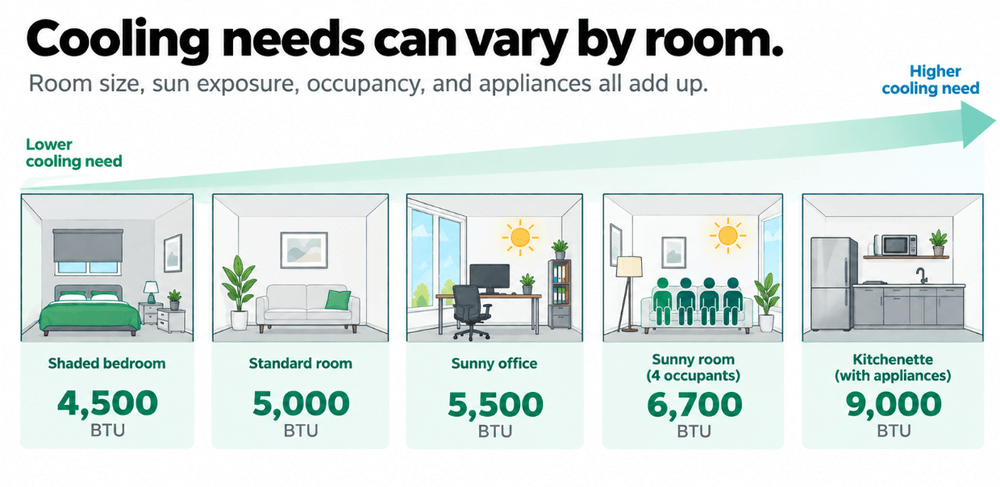
The kitchen row explains something installers see constantly. Put cooking equipment in a 100 square foot space and the requirement lands at 9,000 BTU, which happens to be the most common mini split size on the market. Use the same footprint as a shaded bedroom and it drops to 4,500 BTU, below anything you can buy.
Why The Smallest Mini Split Is Bigger Than A 100 Sq Ft Room Needs
The smallest ductless mini split head commonly sold is 6,000 BTU. The Building America Solution Center, run by Pacific Northwest National Laboratory for the Department of Energy, documents single zone 115 volt ductless heat pumps ranging from 6,000 to 12,000 BTU per hour, and notes that even the smallest indoor heads may deliver more than a space needs.
That inverts the usual sizing exercise. For most rooms you calculate a load and match equipment to it. Here you calculate a load, find that nothing is built that small, and then judge whether the smallest available unit can run gently enough to stay comfortable.
That applies to our own equipment. The Filterbuy ductless line starts at 12,000 BTU and covers 300 to 550 square feet, so Filterbuy mini split systems sit well above a room this size, and a smaller head from another brand is the better fit.
The Turndown Test For Small Rooms
Turndown is the ratio between rated capacity and lowest sustained output, and in a small room it matters more than anything else. Inverter compressors ramp down to as little as 10 percent of rated capacity, so a 6,000 BTU head delivers roughly 600 BTU at minimum. That sits well under what a 100 square foot room calls for, and the extra capacity is absorbed by modulation rather than cycling.
Single stage equipment has no such range. It runs at full output or not at all, and when capacity outruns the load it short cycles, wasting energy while controlling neither temperature nor humidity. That difference matters more than the nameplate number, and it is the thing most buying advice for this room size leaves out.
Three checks before you buy:
Find minimum cooling capacity in the manufacturer's expanded performance table, not the certificate. Certified ratings use fixed laboratory conditions that say nothing about minimum output.
Confirm minimum output sits below your adjusted load.
Check the sensible heat ratio. A lower figure means better moisture removal, and ductless systems dehumidify less effectively than ducted ones.
"The nameplate is the first thing people ask me about and the last thing I check. In a room this small what matters is how low the unit throttles, because that decides whether it holds temperature or swings all afternoon."
— David Clark, Licensed HVAC Technician
Mini Split Or Window AC For A 100 Sq Ft Room?
A 5,000 BTU window air conditioner matches the 5,000 BTU chart value exactly and costs far less to install. A 6,000 BTU mini split runs 20 percent above it, but it modulates, stays quieter, and heats as well as cools. Our complete mini split buying guide covers the rest of the decision.
Mini Split Compared With Window AC At 100 Square Feet
Compared against the 5,000 BTU chart tier for 100 square feet.
For a plain 100 square foot bedroom or office, a window unit is usually the sensible answer. It matches the load and costs a fraction of a ductless install. A mini split earns its premium in three situations: the room needs heating, the window has to stay clear, or the space runs humid enough that steady modulation matters more than a matched nameplate.
What About Heating A 100 Sq Ft Room?
Heating load and cooling load are different numbers, and in cold climates the heating figure is the one that governs. The ENERGY STAR cooling chart does not apply here. A heat pump's output falls as the outdoor temperature drops, so a head rated at mild conditions delivers least exactly when the room needs most, which is why heating should be sized from manufacturer data at your local design temperature.
For those figures, Northeast Energy Efficiency Partnerships publishes low temperature performance data by model and is developing a specification for room sized heat pumps.
What A Mini Split Will Not Do For Your Air
Ductless mini splits filter poorly next to a central system. Most rely on washable mesh filters with very low particulate capture efficiency, and add on panels usually cover only part of the area, so most of the airflow slips past them. Filterbuy makes the filters that go into these systems, every other brand included, which is why we can be blunt about it.
A correctly sized mini split conditions a small room well, but it is not an air cleaning strategy on its own. In a home with ductwork the Filterbuy MERV 13 air filters in a central system carry that load. Check that your system tolerates the higher resistance before stepping up a MERV level.
Two things follow from that. Wall mounted heads collect dust and moisture on the blower wheel, so a deep cleaning every one to three years is recommended. Humidity is worth watching too, because the EPA recommends keeping indoor relative humidity below 60 percent and ideally between 30 and 50 percent.
Supporting Statistics
Nearly 40 Percent Of Contractors Oversize On Purpose
Nearly 40 percent of surveyed contractors deliberately oversize cooling equipment.
Oversizing by 50 percent or more added about 9 percent to annual cooling electricity.
Summer peak demand ran roughly 13 percent higher.
Source: DOE Building America, Right-Size Heating and Cooling Equipment
A One Ton Mini Split Cut Measured Energy Use By A Third
Ten central Florida homes, each with a single one ton head.
Median cooling savings, 33 percent.
Median heating savings, 59 percent.
Source: DOE field measurements of supplemental mini split heat pumps
Half Of Northeast Households Cool Room By Room
88 percent of U.S. households use air conditioning.
50 percent in the Northeast rely mainly on individual units.
Frequently Asked Questions
Glossary
BTU (British Thermal Unit): A unit of heat energy. Capacity is expressed in BTU per hour, the rate at which equipment moves heat.
Ductless Mini Split: An outdoor compressor paired with one or more indoor heads, joined by refrigerant lines rather than ducts.
Inverter Compressor: A variable speed compressor that adjusts output continuously instead of switching between full capacity and off.
Turndown Ratio: The relationship between rated capacity and lowest sustained output, which sets how small a load the equipment can serve steadily.
Short Cycling: Rapid on and off operation when capacity exceeds load, cutting efficiency and leaving humidity behind.
Sensible Heat Ratio (SHR): The share of cooling that lowers air temperature rather than removing moisture. Lower values mean stronger dehumidification.
Manual J: ANSI/ACCA 2 Manual J, the American National Standard for residential load calculation.