2026 Rebates, Costs, and How to Qualify
By Michelle Wan | Reviewed by David Clark, Licensed HVAC Technician | Published July 20, 2026 | Updated July 20, 2026
Yes, you can get rebates for adding a mini split in Rhode Island, because a mini split is an air-source heat pump. What you qualify for depends on how you heat your home now and your household income.
Rhode Island Energy pays up to $625 per ton, or $1,500 per ton if you are replacing electric baseboard heat. Income-eligible homes heated by oil, propane, or gas can add Clean Heat Rhode Island for 60% of the project, up to $11,500. Take the quick match quiz below to find the right mini split system for your home.

Answer 3 quick questions and we will match you to the right mini split system.
Yes, you can get rebates for adding a mini split in Rhode Island. Because a mini split is an air-source heat pump, the rebate you qualify for depends on how you heat your home now and your household income. Rhode Island Energy pays up to $625 per ton, or $1,500 per ton if you’re replacing electric baseboard heat. Income-eligible homes that heat with oil, propane, or gas can add Clean Heat Rhode Island (60% of cost, up to $11,500). The federal 25C tax credit expired December 31, 2025.
A ductless "mini split AC" is really an air-source heat pump. Rhode Island’s rebates reward its heating function, not its cooling.
Rhode Island Energy pays up to $625 per ton (standard) for a qualifying heat pump, or $1,500 per ton if you’re replacing electric baseboard heat.
Clean Heat Rhode Island covers 60% of a qualifying project, up to $11,500, for income-eligible homes (below 150% of State Median Income) that heat with oil, propane, or gas.
Income-qualifying households may add the federal HEAR rebate, up to $8,000.
The federal Section 25C tax credit expired December 31, 2025 and does not apply to 2026 installs.
Most rebates require ENERGY STAR 6.1 Cold Climate equipment (A2L refrigerant in 2026), a home energy assessment, and an approved contractor.
Yes. Rhode Island homeowners adding a ductless mini split in 2026 can usually claim at least one rebate, and often stack two or three. Which ones you qualify for comes down to two things: how you currently heat your home and your household income. Every qualifying mini split rebate here is a heat pump rebate, because Rhode Island rewards the heating side of the system, not the cooling.
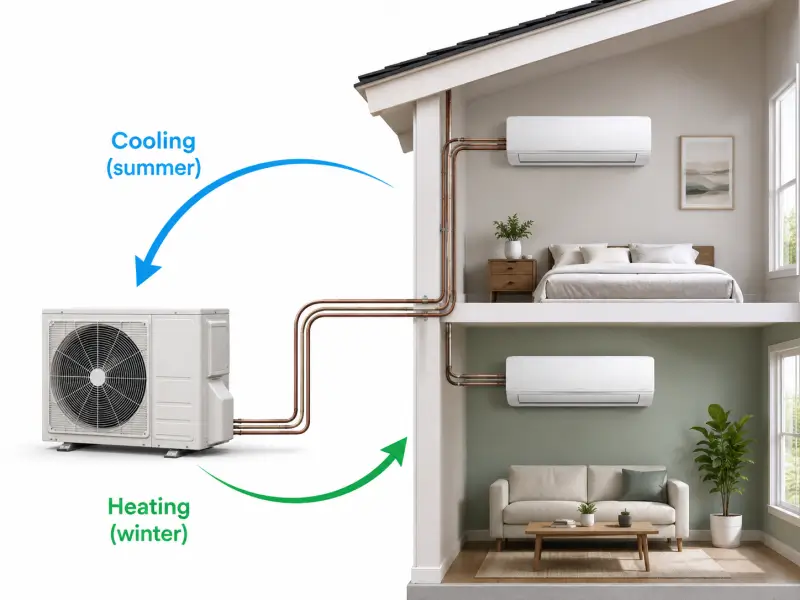
A ductless mini split is an air-source heat pump that both cools and heats a home from one system. That single fact is what saves the most money. The same unit moves heat out in summer and in during winter, and Rhode Island’s incentive dollars are built around that heating capability, not the air conditioning. A cooling-only rebate exists, but it is small. The four-figure rebates apply when your mini split can heat the home too.
So the mini split you would install for summer comfort is the same equipment that unlocks the big rebates. You just need to choose a cold-climate model that qualifies (ENERGY STAR 6.1 Cold Climate, using an A2L refrigerant in 2026) and register it as a heat pump. If you’re still deciding on size and system type, our complete mini split buying guide walks through it.
Rhode Island has some of the most generous heat-pump incentives in New England, spread across a utility program and two income-based programs. The table below shows what each offers in 2026 and who qualifies. Amounts and rules change, so confirm current terms with Rhode Island Energy, Clean Heat Rhode Island, and the Rhode Island Office of Energy Resources before you sign a contract.
Sources: Clean Heat Rhode Island; Rhode Island Energy; RI Office of Energy Resources (HEAR). Figures verified July 2026 and subject to change.
The quickest way to see your own numbers is Rhode Island’s official home energy incentive calculator, which estimates state, utility, and federal incentives based on your address and household income.
Most rebate pages skip this part. The fastest way to know what you’ll get starts with one thing: how you heat your home right now. Start there, and the right rebates fall into place.
If you heat with oil, propane, or natural gas (and roughly 1 in 3 Rhode Island homes still takes fuel-oil deliveries alone, per EIA):
Best-case scenario. A qualifying heat pump can tap Clean Heat Rhode Island (60% of the project, up to $11,500) if you’re income-eligible, plus Rhode Island Energy’s Standard Rebate (up to $625/ton).
Next step: run the numbers in the state’s incentive calculator before you get quotes.
If you heat with electric baseboard or resistance heat:
The overlooked winner. Clean Heat RI’s fossil-fuel-displacement rule usually rules you out, but Rhode Island Energy’s Enhanced Rebate was built for you: $1,500/ton, the highest per-ton rebate on the board.
Next step: book the free EnergyWise home energy assessment first. It is required.
If you already have a heat pump, or just want to cool one room:
Set expectations early. The big rebates hinge on displacing fossil-fuel heat, so a cooling-only add often will not qualify. Confirm the current cooling incentive with Rhode Island Energy and run the calculator before you assume.
If your household income is at or below 150% of the area or state median:
Stack more on top. You may qualify for the federal HEAR rebate, up to $8,000, combined with the above.
At Filterbuy, this is the map we draw for a neighbor at the kitchen table: start with your heating fuel, then chase the rebates that fit it, not the biggest number you saw in an ad. And once your mini split is in, keeping its filter clean is the part we’ll happily take off your plate.
No. The federal Section 25C Energy Efficient Home Improvement Credit, which had offered up to $2,000 toward a qualifying heat pump, expired December 31, 2025 under the One Big Beautiful Bill Act. Equipment placed in service in 2026 does not qualify, and there is no grandfather provision. If your system was installed and operational by the end of 2025, you can still claim it on your 2025 federal return. For a 2026 mini split, plan around the state and utility rebates above instead.
Before rebates, a ductless mini split in Rhode Island generally runs $4,000 to $8,000 for a single-zone system, with multi-zone whole-home setups higher. Costs skew up in Rhode Island’s older housing stock, since many Providence, Pawtucket, and Newport homes predate 1940 and may need electrical upgrades or extra clearance. The upside: ductless mini splits often come out cheaper than a ducted retrofit in these homes, and they still qualify for the rebates above.
Follow this order. Getting the sequence wrong, like installing before pre-approval, can forfeit a rebate.
Book a home energy assessment. Clean Heat RI and Rhode Island Energy’s enhanced rebate require a no-cost EnergyWise home energy assessment before installation. It also confirms your home is weatherized enough for a heat pump to perform.
Choose a qualifying cold-climate mini split. The unit must be ENERGY STAR 6.1 Cold Climate certified, listed on the RI Energy/NEEP qualified list, and, for 2026 installs, use an A2L refrigerant. Your contractor confirms the model.
Use an approved contractor. Clean Heat RI and Rhode Island Energy’s enhanced rebate require a program-approved, licensed installer who pulls the permit and files rebate paperwork. You can find one through Clean Heat RI’s approved installer network.
Get pre-approval before the work. Rhode Island Energy heat-pump rebates over $1,000 must be pre-approved. Do not let anyone start the install first.
Apply early and stack. Submit your Rhode Island Energy and (if eligible) Clean Heat RI applications, and check HEAR eligibility if your household income qualifies. Because Clean Heat RI funds are capped by a 2026 deadline, earlier is safer.
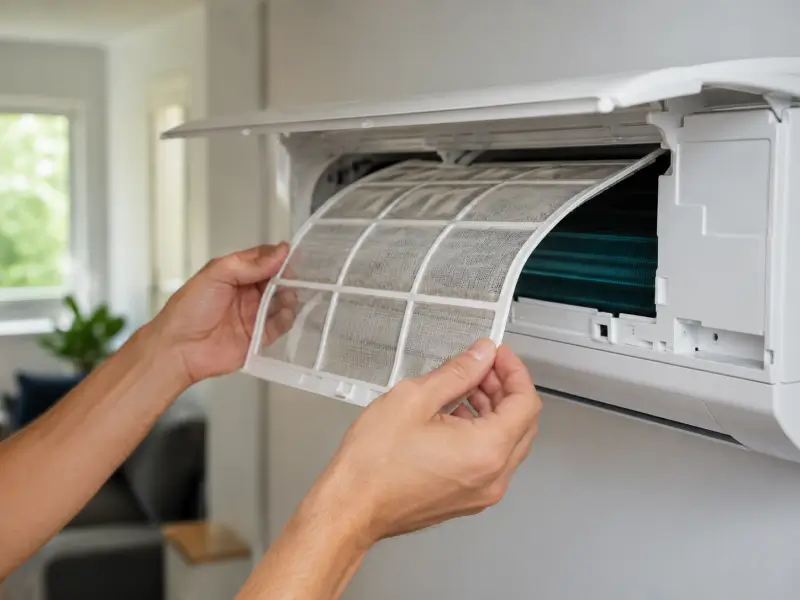
A mini split only delivers clean air and rebate-worthy efficiency if its filters stay clean. Each indoor head has a washable pre-filter that should be rinsed every two to four weeks. Our guide on how often to service a mini split lays out the full schedule, and how a clean mini split improves your indoor air quality explains what that mesh can and cannot catch. Clogged filters make the system work harder, raise your energy bills, and dull the indoor air quality you paid to improve.
At Filterbuy, clean indoor air is the whole point. We’ve been making air filters in the U.S. for over a decade. If you’re still choosing a system, browse our ductless mini split systems. If your home also runs central HVAC alongside the mini split, find your exact air filter size and we’ll ship it factory-direct. For more, see all our ductless mini split guides.
At Filterbuy, we don’t make claims we can’t back up. Here are four numbers straight from federal energy authorities, plus what more than a decade of building the filters that go inside these systems, for over two million households, has taught us about keeping the payoff.
1. A modern heat pump can cut the electricity you use for heating by about 65% compared with electric baseboards and furnaces (U.S. Department of Energy).
Why it matters: It is why Rhode Island’s rebates target heat pumps, not cooling-only AC.
Source: U.S. Department of Energy, Home Upgrades
2. In a typical home, about 20–30% of the air moving through ductwork is lost to leaks, holes, and poor connections (ENERGY STAR).
Why it matters: A ductless mini split skips ducts entirely, a real edge in Rhode Island’s pre-1940 homes.
Source: ENERGY STAR, Duct Sealing
3. More than half of a home’s energy, about 52%, goes to heating and cooling (U.S. Energy Information Administration).
Why it matters: Upgrade that one system, and you improve the biggest slice of your bill.
Source: U.S. Energy Information Administration, Use of Energy in Homes
4. A well-maintained heat pump uses 10–25% less energy than a neglected one (U.S. Department of Energy).
Why it matters: The rebate buys you the efficiency. Maintenance is what keeps it.
What Filterbuy sees firsthand: On a mini split, the washable filter is the most accessible maintenance point, and after a decade in air filtration, it is the first place we watch that rebate-worthy efficiency quietly disappear.
Source: U.S. Department of Energy, Operating and Maintaining Your Heat Pump
Keep Your New Mini Split Clean: The Filter Step Most Homeowners Skip
A mini split only delivers clean air and rebate-worthy efficiency if its filters stay clean. Each indoor head has a washable pre-filter that should be rinsed every two to four weeks. Our guide on how often to service a mini split lays out the full schedule, and how a clean mini split improves your indoor air quality explains what that mesh can and cannot catch. Clogged filters make the system work harder, raise your energy bills, and dull the indoor air quality you paid to improve.
At Filterbuy, clean indoor air is the whole point. We’ve been making air filters in the U.S. for over a decade. If you’re still choosing a system, browse our ductless mini split systems. If your home also runs central HVAC alongside the mini split, find your exact air filter size and we’ll ship it factory-direct. For more, see all our ductless mini split guides.
At Filterbuy, we don’t make claims we can’t back up. Here are four numbers straight from federal energy authorities, plus what more than a decade of building the filters that go inside these systems, for over two million households, has taught us about keeping the payoff.
1. A modern heat pump can cut the electricity you use for heating by about 65% compared with electric baseboards and furnaces (U.S. Department of Energy).
Why it matters: It is why Rhode Island’s rebates target heat pumps, not cooling-only AC.
Source: U.S. Department of Energy, Home Upgrades
2. In a typical home, about 20–30% of the air moving through ductwork is lost to leaks, holes, and poor connections (ENERGY STAR).
Why it matters: A ductless mini split skips ducts entirely, a real edge in Rhode Island’s pre-1940 homes.
Source: ENERGY STAR, Duct Sealing
3. More than half of a home’s energy, about 52%, goes to heating and cooling (U.S. Energy Information Administration).
Why it matters: Upgrade that one system, and you improve the biggest slice of your bill.
Source: U.S. Energy Information Administration, Use of Energy in Homes
4. A well-maintained heat pump uses 10–25% less energy than a neglected one (U.S. Department of Energy).
Why it matters: The rebate buys you the efficiency. Maintenance is what keeps it.
What Filterbuy sees firsthand: On a mini split, the washable filter is the most accessible maintenance point, and after a decade in air filtration, it is the first place we watch that rebate-worthy efficiency quietly disappear.
Source: U.S. Department of Energy, Operating and Maintaining Your Heat Pump
"The rebate paperwork gets all the attention, but the efficiency it’s paying for lives or dies on that little mesh filter. I’ve pulled the panel on year-old mini splits already choking on dust, running harder and costing more than the day they went in. Clean it every couple of weeks, and you actually keep the savings the rebate promised."David Clark, Licensed HVAC Technician, who reviews Filterbuy’s mini split guides
Adding a mini split is a real investment, and Rhode Island’s rebate rules shift more often than most homeowners expect. Before you sign anything, it pays to check the source yourself. These are the seven sources we point a neighbor to: the programs that cut the checks, a calculator that does the math for you, and a few plain-English guides for picking the right system. Every one is a government or nonprofit page. No sales pitch, nothing to buy.
Clean Heat Rhode Island is the state’s main heat-pump rebate, and it covers 60% of a qualifying project up to $11,500. This page spells out the fine print in plain terms: the income limits, the rule that your heat pump has to replace oil, propane, or gas heat, and the approved installers you’ll need. Read it before you get your hopes up.
Source: Clean Heat Rhode Island, Incentives
Rhode Island Energy pays up to $625 per ton on a qualifying heat pump, and up to $1,500 per ton if you’re finally ditching electric baseboard heat. The page also walks you through the 2026 equipment rules and the free home energy assessment worth booking before anything gets installed.
Source: Rhode Island Energy, High-Efficiency Heat Pumps
The Rhode Island Office of Energy Resources built a free incentive calculator that adds up your state, utility, and federal savings based on your address and household income. It is the quickest way to turn all these programs into one real number before you gather quotes.
Source: Rhode Island incentive calculator
The IRS confirms the federal Section 25C tax credit ended for systems placed in service after December 31, 2025. If you’ve seen sites still promising a "30% or $2,000 federal credit," this is the official page that sets the record straight for 2026.
Source: IRS, Section 25C and OBBB FAQ
NEEP’s Cold Climate ASHP Product List is the searchable database Rhode Island’s programs use to decide which equipment earns a rebate. Look up any model you’re considering, and you’ll know in seconds whether it clears the bar.
Source: NEEP, Cold Climate ASHP Product List
ENERGY STAR’s ductless heating and cooling page explains the certification Rhode Island rebates require, plus why these systems can use up to about 60% less energy than electric resistance heat. It is the simple test that separates a rebate-ready system from an ordinary one.
Source: ENERGY STAR, Ductless Heating and Cooling
The U.S. Department of Energy’s Energy Saver guide breaks down how ductless mini splits really work, and the sizing mistakes, like going too big and short-cycling, that quietly cost you comfort and money. Give it a read before you and your contractor settle on a size.
Source: U.S. DOE Energy Saver, Ductless Mini-Split Heat Pumps
Yes, when the mini split is an air-source heat pump, which nearly all are. Rhode Island Energy offers per-ton rebates to most customers, and income-eligible homes that heat with oil, propane, or gas can add Clean Heat Rhode Island. Both reward the system’s heating capability.
Rhode Island Energy pays up to $625 per ton (standard) or $1,500 per ton for electric-baseboard homes. Income-eligible homes can add Clean Heat RI (60% of cost, up to $11,500) and, if income-qualifying, the federal HEAR rebate (up to $8,000).
No. The federal Section 25C credit expired December 31, 2025 and does not apply to systems placed in service in 2026.
Usually yes. Clean Heat RI and Rhode Island Energy’s enhanced rebate require a no-cost home energy assessment before installation.
Often yes, if you meet each program’s rules. Rhode Island Energy’s rebate is broadly available. Clean Heat RI adds to it for income-eligible homes replacing fossil-fuel heat, and income-qualifying households may add HEAR. Confirm current stacking rules with each program.
About the author: Michelle Wan writes about home indoor air quality and HVAC for Filterbuy.
Reviewed for technical accuracy by David Clark, Licensed HVAC Technician.
Rebate amounts and program rules change. Verify current terms with each program before purchasing. This article is for general information and is not tax or financial advice. Program figures verified against official sources on July 20, 2026.