Mini Split AC in Columbus, OH: Installation, Costs & Filter Guide (OH Climate)
Author: Michelle Wan, Brand Manager and Air Quality Writer
Reviewer: David Clark, Licensed HVAC Technician
Publish Date: September 9, 2026
Updated Date: September 9, 2026
A single-zone mini split runs $1,500 to $3,100 installed in Columbus. Multi-zone runs $4,000 to $14,500. Whether one holds up through a Columbus winter comes down to a number most quotes leave out.
Columbus designs to 0°F. Cold-climate performance is only verified down to 5°F. Ask for rated heating capacity at low temperature, not the 47°F nameplate figure.
- Single zone. One room, an addition, or a finished basement. $1,500 to $3,100.
- Multi zone. Whole-home conditioning in a house without ductwork. $4,000 to $14,500.
- Mini split plus your furnace. The furnace covers the coldest nights. $1,500 to $5,500.
Not sure which one fits your room? The quiz below points you to the right size.

Answer a few quick questions and we will match you to the right mini split size for your space.
Adding comfort to a garage, workshop, or room addition? See Filterbuy mini split systems. Single zone, published pricing, and free 2-day delivery on in-stock systems. Professional installation is required.
A mini split is a ductless heat pump that heats and cools a room from a wall-mounted indoor head wired to an outdoor compressor. In Columbus, Ohio, that system faces winters cold enough to push a heat pump past its rated range and summers humid enough to demand real moisture removal. This guide covers 2026 installed costs, Climate Zone 5A sizing, contractor vetting, and filters.
TL;DR Quick Answers
What does mini split installation cost in Columbus, OH? A single-zone 12,000 BTU system runs $1,500 to $3,100 installed, multi-zone $4,000 to $14,500. Central Ohio labor tracks near the national average.
What climate zone is Columbus in? IECC Zone 5A, cool-humid and heating-dominated. NOAA normals give 5,233 heating degree days against 1,068 cooling degree days.
Does a mini split work in a Columbus winter? Yes, with a cold-climate rated unit. Columbus designs to 0°F, below the 5°F point where cold-climate performance is third-party verified.
What filter does a Columbus mini split use? A washable pre-filter in each indoor head, rinsed every two to four weeks in heavy use. A ductless head does not take a pleated filter.
Are there rebates in Columbus for 2026? Federal 25C and 25D credits ended after December 31, 2025. Ohio incentives are limited, so verify before you buy.
What Does Mini Split Installation Cost In Columbus, OH?
Mini split installation cost in Columbus runs $1,500 to $3,100 for single-zone and $4,000 to $14,500 for multi-zone. The largest variable is not the brand on the box. It is zone count, then BTU sizing, then how difficult your house makes the job. Our national mini split installation cost breakdown covers the underlying math by zone and BTU size.
Labor is 30 to 50 percent of the total, and a single-zone install takes four to eight hours. Central Ohio sits near national labor averages, which works in your favor, because Northeast and Pacific Coast markets often run 25 to 40 percent above it.
Four Columbus conditions push the number up. Older housing in Clintonville, German Village, and the University District often needs a new 240V circuit, adding $300 to $800 per outdoor unit. Brick exteriors need core drilling at $150 to $400 per penetration. Permits run $100 to $500. Equipment carries a 2026 premium too, because current systems use A2L refrigerants such as R-32 and R-454B, roughly 10 to 15 percent above the R-410A units they replaced.
One structural note. If you plan to condition more than one room within a few years, build the multi-zone outdoor unit now. Adding a zone later can mean replacing the condenser and paying that line twice. Multi-zone systems come from brands that build them, and the section below is clear about where our own single-zone line does and does not belong.
Why Columbus Sits In Climate Zone 5A And What That Changes
Columbus falls in IECC Climate Zone 5A, cool-humid and heating-dominated. NOAA 1991 to 2020 normals put the city at 5,233 heating degree days against 1,068 cooling degree days, close to a five-to-one split. The system spends far more hours heating than cooling, and that ratio should drive selection.
Most mini split marketing is written for cooling-dominated markets. In Columbus the heating side governs, so ask about HSPF2 first.
The humidity half still counts. July design conditions reach roughly 91°F with real moisture load. An oversized unit short-cycles, satisfies the thermostat on temperature alone, and leaves the room cool and clammy. Correct sizing comes from an ACCA Manual J calculation, not a square-footage chart.
How To Choose A Mini Split That Survives A Columbus Winter
Buy a cold-climate rated system. These deliver rated heating down to 5°F, with third-party certification verifying performance there. Columbus has a 99 percent winter design temperature of 0°F, below that point.
That gap matters. The unit keeps running below 5°F, but capacity falls as temperature drops. Two answers work. Size against rated capacity at low temperature rather than the 47°F nameplate figure, or pair the system with backup heat. Roughly 63 percent of homes in cold climate zones already run a furnace, and keeping it as cold-night backup while the heat pump handles milder weather is well established.
Table 1: Mini Split Configurations Compared For Columbus Homes
Ranges reflect 2026 installed pricing including equipment and labor. Central Ohio labor tracks near national averages. Figures exclude electrical panel upgrades and permit fees.
What Rebates And Tax Credits Apply In Columbus For 2026?
Start with what is gone. The federal 25C and 25D credits were terminated for property placed in service after December 31, 2025 under Public Law 119-21. Any 2026 guide still presenting a 30 percent federal credit is out of date, and many have not updated.
Ohio incentives are thin. Most utility efficiency programs were dismantled following House Bill 6 in 2019, and the state has not launched the income-qualified federal rebate programs some other states run. Assistance programs and low-interest financing remain the realistic paths.
A contractor quoting an incentive is not a program confirming one. Verify before you sign.
Will A Mini Split Actually Lower Your Columbus Heating Bill?
Not necessarily, and this is where most mini split guides go quiet.
The efficiency numbers you see quoted almost always compare a heat pump against electric resistance heat. Against baseboard or propane, the savings are large and real. Columbus is different. Most homes here heat with natural gas, and Ohio gas is cheap. Per unit of delivered heat at current Ohio prices, a mini split often costs about the same to run as a modern high-efficiency gas furnace, sometimes more.
That does not make it the wrong purchase. It changes what you are buying it for. A mini split earns its cost here by conditioning a space that has nothing, reaching a room the ducts never served, or replacing electric or propane heat. Buying one to cut a gas bill is the version that disappoints. Filterbuy sells mini split systems and this is still the honest answer for a gas-heated Columbus home.
Settle it with your own numbers, not a national average. Pull twelve months of bills and find your rate per kilowatt-hour and per thousand cubic feet. Those two figures decide it for your house.
How Columbus Snow And Ice Change Outdoor Unit Placement
Columbus averages 28.2 inches of snow a year and 26.5 days with an inch or more on the ground. Three consequences follow, and quotes rarely mention them.
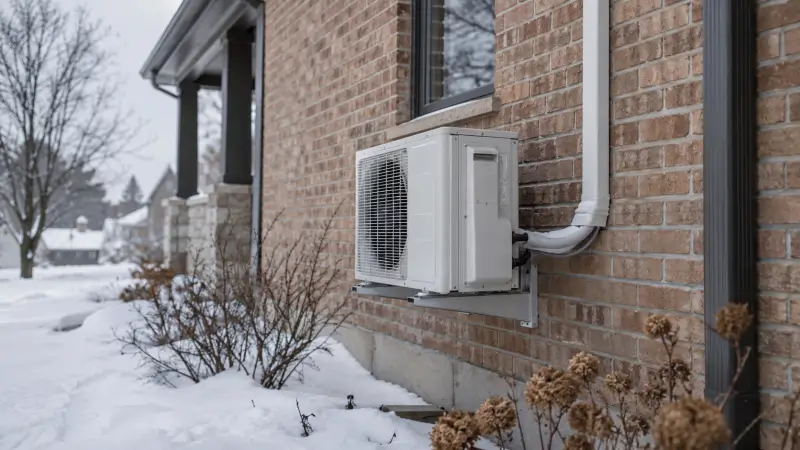
Mount the outdoor unit on wall brackets or a raised stand, not a pad at grade. Drifted snow blocks airflow, and a buried coil cannot pull heat from the air.
Keep it clear of doorways and walkways. A heat pump sheds meltwater on every defrost cycle, and at Columbus temperatures that water refreezes underfoot.
Check the roofline above the spot. Sliding snow and gutter runoff will damage a condenser in the fall line.
Ask where the installer intends to put it, and why, before you sign. Placement is cheap to change on paper and expensive to change later on a wall.
Where The Filterbuy Unit Fits In A Columbus Home
Disclosure: Filterbuy sells mini split systems. This section is the manufacturer talking about its own product, so read it that way.
Our line is single zone, 17 SEER2, rated for reliable heating down to 5°F. Set against a Columbus 0°F design night as the only heat source for a house, that is the wrong tool. Buy a cold-climate unit from a brand that builds for it. That is the honest answer and it costs us the sale.
Where our unit does fit is the supplemental zone. A garage, a workshop, a room addition, or the bedroom over the garage the ducts never reached. In those rooms the efficiency tier and the deep-cold rating stop deciding anything, and the practical numbers take over.
$799 for the 12,000 BTU unit covering up to 550 square feet, $899 for 18,000 BTU up to 850 square feet, $1,349 for 24,000 BTU up to 1,200 square feet
Free 2-day delivery on in-stock systems, where HVAC equipment normally ships freight on a multi-week lead time
A published price with no quote form and no dealer markup
7-year compressor and 3-year parts warranty, with ETL and AHRI certification and R32 refrigerant
Professional installation is required and the warranty is void if the system is self-installed. You can shop Filterbuy mini split systems to check current pricing and coverage before you book that install.
How To Vet A Mini Split Contractor In Columbus
Filterbuy HVAC Solutions installs ductless systems in Florida and Texas, not Ohio. Read this section with that in mind. Our install experience sits in cooling-dominated markets, so the checks below come from what goes wrong on ductless jobs anywhere, plus what a heating-dominated load adds.
Ask for a Manual J load calculation on your home. A contractor who sizes from square footage alone is guessing, and oversizing is the most common failure here.
Require a line-item quote listing unit cost, labor, line set length, electrical work, and permit fees separately. A single total cannot be evaluated against a competing bid.
Confirm A2L refrigerant training. Current systems use R-32 or R-454B, and handling rules changed recently enough that not every technician is current.
Verify rated heating capacity at low temperature, not at 47°F. Most bids will not answer this unless asked directly.
Check licensing. Confirm the contractor pulls the permit, and that their Ohio license and insurance are current.
Three quotes is the minimum. A wide spread usually signals different sizing or scope assumptions rather than different margins, and the line items expose which.
Mini Split Filter Replacement And Cleaning In Columbus
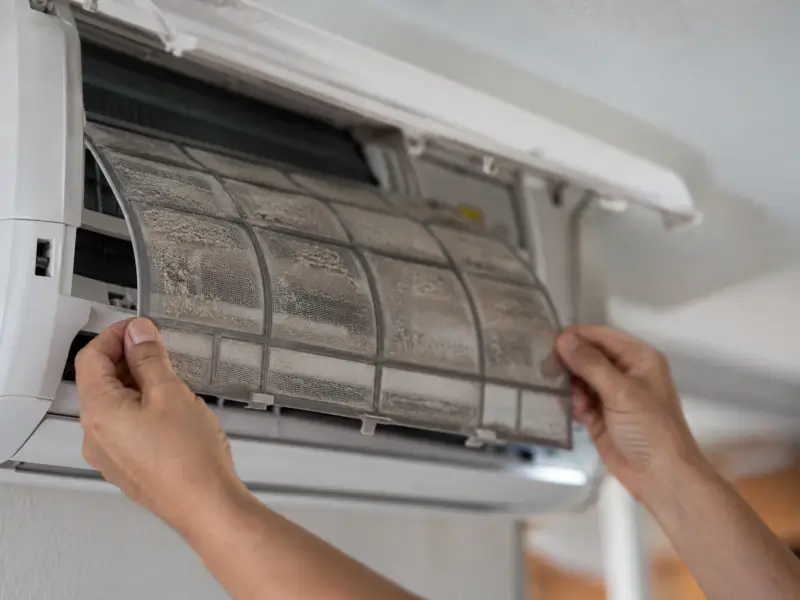
Here is the part most guides get wrong. A ductless mini split head does not accept a pleated filter. Each indoor unit holds a washable mesh pre-filter behind the front panel, rinsed every two to four weeks in heavy use and dried fully before reinstallation. Skip it and the system quietly loses capacity, which is the most common complaint we hear about mini splits.
Columbus adds a seasonal load. Ragweed-dominated weed pollen season runs August through October, arriving while cooling demand is still high.
Be clear about what each filter does. The pre-filter protects the coil. Your whole-home HVAC filter does the heavy lifting on air. Most Columbus homes with a mini split also run a ducted furnace, and that is the system taking a pleated filter. Fitment is what Filterbuy handles daily as a manufacturer, and a filter that is close but not correct leaks air around the frame instead of through the media.
TABLE: Filter Options Compared For A Columbus Mini Split Home
The washable pre-filter sits inside the mini split head. MERV-rated pleated filters fit the ducted furnace system, not the ductless head. Confirm your blower can handle a higher MERV before upgrading.
The practical rule: rinse the pre-filters monthly, and run the highest-rated pleated filter your furnace handles without restricting airflow. The U.S. Environmental Protection Agency recommends MERV 13, or as high a rating as the system fan and filter slot can accommodate, and that caveat is the important half. Check your equipment documentation first, because a filter too restrictive for the blower reduces airflow and works against you. Filterbuy stocks MERV 8 air filters, MERV 11 air filters, and MERV 13 air filters for ducted systems.
Older Columbus housing often has a non-standard return. If your filter slot misses a stock dimension, custom air filter sizes are cut to order, and filter auto-delivery handles the 90-day cadence.
How This Guide Was Built
Filterbuy checked every figure on this page against a primary source. Two numbers most Columbus mini split guides repeat did not survive that check, and correcting them changed the advice.
Degree days: regional HVAC sites widely cite 5,660 heating and 860 cooling degree days for Columbus. NOAA's 1991 to 2020 normals for the Columbus airport station give 5,233 and 1,068. The cooling figure was understated by about a quarter, which matters for humidity sizing.
Climate zone: Columbus is often described as mixed-humid. It is not. Mixed-humid is Zone 4A, which begins south of here near Dayton. Columbus is Zone 5A, and equipment picked off a mixed-humid assumption comes in undersized for heating.
The cold-climate gap in this guide follows from that correction. Columbus designs to 0°F while certification verifies at 5°F, making what happens below the test point a Columbus question rather than a generic one.
Essential Resources
1. ENERGY STAR: Ductless Heating And Cooling
The federal buying guide for mini split heat pumps. Covers cold-climate certification and correct sizing, plus where to put the indoor and outdoor units.
energystar.gov/products/ductless_heating_cooling
2. U.S. Department Of Energy: Heat Pump Systems
Energy Saver's overview of every heat pump type, and the source of the dual-fuel configuration described above.
energy.gov/energysaver/heat-pump-systems
3. U.S. Environmental Protection Agency: Guide To Air Cleaners In The Home
The federal reference on residential filtration and MERV ratings.
epa.gov/indoor-air-quality-iaq/guide-air-cleaners-home
4. DSIRE: Database Of State Incentives For Renewables And Efficiency
Run by the N.C. Clean Energy Technology Center at NC State. The place to confirm which Ohio and utility programs are currently active.
Supporting Statistics
Three verified figures behind the guidance above.
1. Columbus Heats Nearly Five Times More Than It Cools
5,233 heating degree days per year, base 65°F
1,068 cooling degree days per year, base 65°F
103.2 days per year at or below freezing
2.3 days per year at or below 0°F
Why it matters: those 2.3 days are what backup heat exists for. Everything else is well inside cold-climate heat pump range.
NOAA National Centers for Environmental Information, Station USW00014821, 1991 to 2020 Normals
2. Mini Splits Are Still Rare In Midwest Homes
Midwest: 0.18 million of 27.04 million homes use a ductless mini split as main air conditioning, under 1 percent
Northeast: 0.77 million of 21.92 million homes, roughly five times the Midwest rate
Ohio-level data is withheld as statistically unreliable, so the regional figure is the closest available read
Why it matters: fewer local installs means a smaller pool of Columbus contractors with deep ductless experience.
U.S. Energy Information Administration, 2020 Residential Energy Consumption Survey, Table HC7.7
3. Columbus Rates Better Than Average For Pollen Allergies
Ranked 79th of 100 U.S. metro areas in 2026
Scored 72.61 against an 80.63 national average
About 1 in 7 people are allergic to ragweed pollen
Ragweed season starts in August, peaks mid-September, and runs to the first hard freeze
Why it matters: peak ragweed lands on the tail of cooling season, when mini split pre-filters load up fastest.
Asthma and Allergy Foundation of America, 2026 Allergy Capitals Report
Frequently Asked Questions
Glossary
The Filterbuy resource library covers these in more depth.
A2L Refrigerant: The mildly flammable low-global-warming refrigerant class, R-32 and R-454B.
Pre-Filter: The washable mesh screen inside a mini split head. Not a pleated filter.
MERV: Minimum Efficiency Reporting Value. The ASHRAE scale rating pleated filter efficiency.