Installation, Costs & Rebates (NY Guide)
By Michelle Wan · Reviewed by David Clark, Licensed HVAC Technician, Filterbuy
Published July 16, 2026 · Updated July 16, 2026
A mini split for one room earns no New York rebate. NYS Clean Heat pays only for a system sized to heat your whole house, so a single-room unit does not qualify. The federal tax credit ended December 31, 2025.
What New York pays in 2026:
Since no one-room system earns a rebate, the things that decide your choice are room size, warranty, and what the unit filters. The quiz below sorts the first one out in about a minute.

Answer 3 quick questions and we will match you to the right mini split size for your room.
Already know your size? Shop Mini Split Systems. Filterbuy ships nationwide and does not install in New York, so read the eligibility rules below before you buy.
Adding a mini split to a single room in New York earns nothing from NYS Clean Heat. As of the 2026–2030 program, the state only pays for heat pump systems sized to carry your home's entire heating load. The $5,000-to-$12,000 rebates you see advertised are real, but they belong to whole-home conversions. The federal tax credit expired December 31, 2025. One thing still worth getting right today: buying NEEP-listed equipment now keeps a $3,000-to-$4,000 incentive available to you later.
NYS Clean Heat pays only for full-load systems. A mini split sized to heat one room is a partial-load system, and partial load is no longer an incentive category.
Full-load incentives run $5,000 to $6,000 for a single-family home outside a Disadvantaged Community. Decommissioning your furnace or boiler raises that to $8,000 to $10,000, and up to $12,000 inside a DAC.
The unit you buy today decides what you can claim later. Category 4 pays $3,000 to $4,000 to bring a partial-load system up to full load, but only if the system you already own is NEEP-listed.
The federal Section 25C tax credit expired December 31, 2025. A mini split installed in 2026 does not qualify.
There is no New York State tax credit for air-source mini splits. The 25%-up-to-$5,000 state credit applies only to geothermal.
Your equipment must be NEEP-listed, carry a five-year parts warranty, and be installed by an enrolled contractor. DIY installations are not eligible.
Long Island is not part of NYS Clean Heat. PSEG Long Island runs a separate program called Home Comfort.
For most people, none. If you are adding one mini split to one room, NYS Clean Heat pays nothing. The program that runs from 2026 through 2030 makes this explicit: only systems sized to meet the full heating load of the project scope are eligible for incentives. A mini split that heats a back bedroom does not carry your house. So it does not qualify.
This is the single most important thing to know before you take a quote, and almost nothing on the first page of Google says it.
New York does not pay you for buying a mini split. It pays you for replacing your heating. The program is called Clean Heat for a reason: the incentive is a decarbonization payment, and the state now reserves it for projects that actually retire a fossil fuel system or take over the whole load. Adding a head to a stuffy attic room does neither.
Single-family home, outside a Disadvantaged Community. Source: NYS Clean Heat Heat Pump Program Manual, Version 2 (March 5, 2026), Tables 3-15. Incentives are capped at 70% of project cost, or 85% in a DAC and in Central Hudson territory.
Why the "$10,000" pages are not lying. They are describing a different project. That figure is a full-load conversion with decommissioning, usually inside a Disadvantaged Community. It is achievable, and the money is real. It just is not what "adding a mini split" means for most people. You can read the incentive tables yourself in the NYS Clean Heat Program Manual, which the state updated on March 5, 2026.
ONE NUMBER YOU MAY SEE, AND WHY WE DO NOT USE IT
NYSERDA's own consumer-facing tax credits page still lists "partial home solutions: $100-$400, on average." That figure describes the 2020-2025 program, which had a Category 1 for partial-load systems. The 2026-2030 Program Manual retired that category. Where the state's consumer page and the current Program Manual disagree, we follow the Program Manual.
Fair question, and you should weigh the answer. Filterbuy has made air filters in the USA since 2013. We have built replacement filters for every major mini split brand for more than a decade, and we serve more than two million households. We sell mini split systems too, and we ship them nationwide.
What we do not do is install them in New York. There is no Filterbuy branch in Buffalo and no truck in Queens. Only an enrolled NYS Clean Heat participating contractor can file your rebate, and we are not one, in New York or anywhere else.
That leaves us with no rebate riding on your answer. It is a strange thing for a company to advertise, and it is exactly why this page can say what it says. Installers meet you at the quote. Filterbuy meets you afterward, when the filter needs changing. From that end of the timeline we had no reason to inflate a number, so we skipped the marketing and read the program manual instead. Every figure on this page comes from there, from the IRS, or from the utilities themselves.
“Every other page on this search result is written by someone who wants to install your mini split. We are not. We make the filter that goes in after the installer drives away, which is why we had no reason to soften the number. For one room, in New York, in 2026, the rebate is zero. I would rather you hear that from us now than find it on a contractor's invoice later.”
Michelle Wan · Brand Manager & Air Quality Writer, Filterbuy
If you are converting your whole home, the number depends on who sends your electric bill. NYS Clean Heat is delivered through six electric utilities, and each sets its own rates. Every amount below is for a single-family home outside a DAC, taken from the current Program Manual.
Single-family home, outside a Disadvantaged Community. Con Edison does not offer Category 2; it offers Category 2a (full load with integrated controls) at $2,500 instead. Con Edison also requires decommissioning of the legacy fossil system to claim Category 4. Amounts rise inside a DAC, reaching $12,000 for Category 2b in National Grid territory. Source: NYS Clean Heat Program Manual v2, March 5, 2026.
Two details worth knowing. Incentives are capped at 70% of your project cost, or 85% if you are in a DAC or in Central Hudson territory. And a new Weatherized Tier starts September 1, 2026, which will pay a differentiated incentive for projects that meet a minimum weatherization standard. If you are planning a conversion for late 2026, that is worth a conversation with your contractor.
No. The federal Section 25C Energy Efficient Home Improvement Credit, worth 30% of project cost and capped at $2,000 for heat pumps, expired for equipment placed in service after December 31, 2025. It was terminated by the One Big Beautiful Bill Act, signed July 4, 2025. A mini split installed in 2026 does not qualify, regardless of when you bought it. The IRS guidance on the law spells out how the cutoff works.
The IRS uses the placed-in-service date: the day the system is installed, running, and ready to use. A contract signed in 2025 does not count. A deposit paid in 2025 does not count. If the unit started running in January 2026, the credit is gone.
If your system was up and running on or before December 31, 2025, you can still claim it on your 2025 return using IRS Form 5695. We walk through the whole process in our heat pump tax credit guide.
And to close the other loop: New York offers a 25% state tax credit, up to $5,000, for geothermal heat pumps only. There is no equivalent state tax credit for a ductless mini split. If a quote shows one, ask where it is coming from.
Every NYS Clean Heat project has to clear five gates in order. Miss one and the incentive is zero, not reduced. Filterbuy built this sequence because no quote we have seen walks a homeowner through it before the deposit.
Gate 4 is the one that ends most mini split projects. Load is established by an ACCA Manual J calculation. Source: NYS Clean Heat Program Manual v2, Sections 2.1.1 and 3.2.
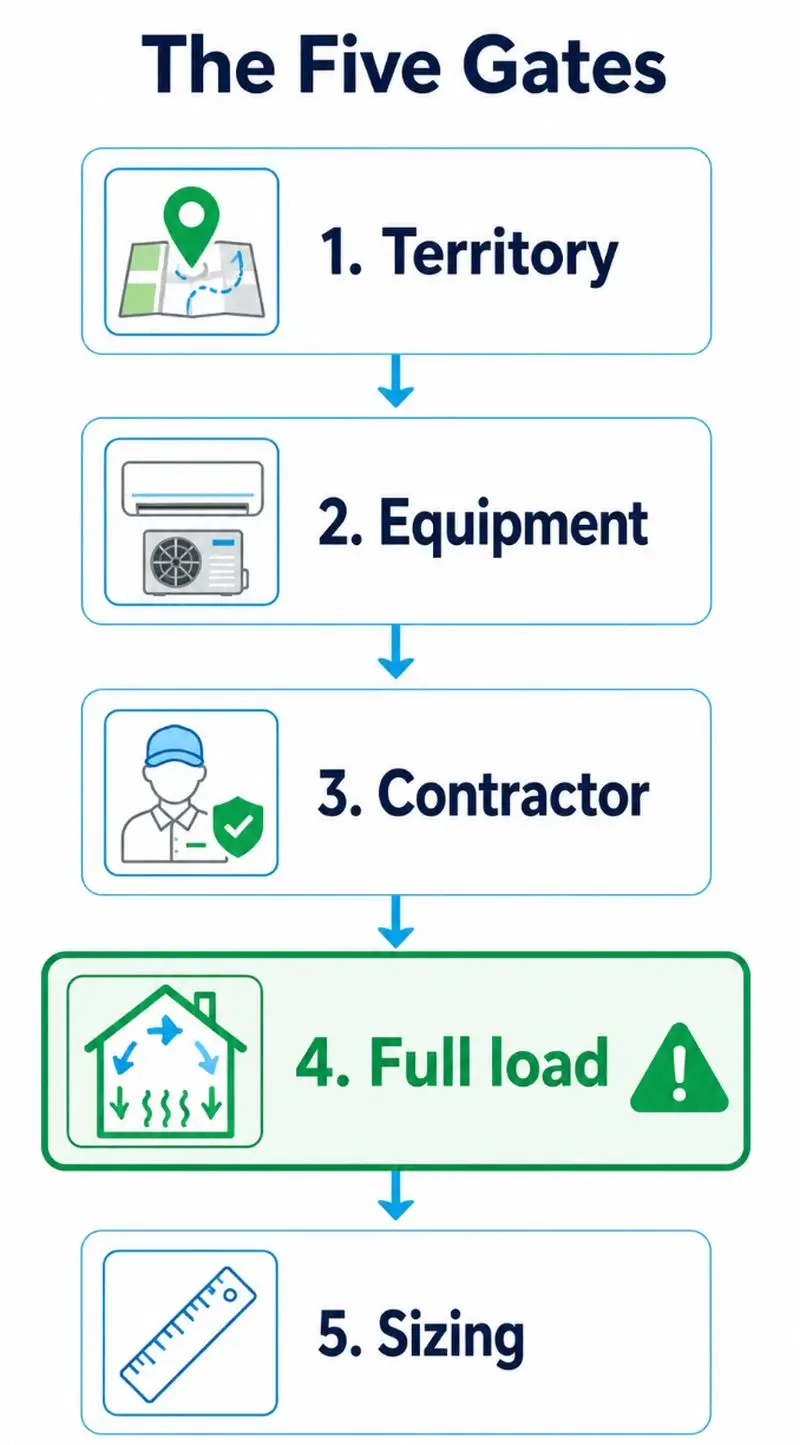
Gate 1 – Territory. NYS Clean Heat is delivered through six electric utilities: Central Hudson, Con Edison, National Grid, NYSEG, Orange & Rockland, and RG&E. If your electric account is not with one of them, this program is not yours. (You may see National Fuel Gas listed as a sponsoring utility on the state's site. It is a gas company, and it does not deliver these heat pump incentives.)
Gate 2 – Equipment. Every individual heat pump in the system must be listed by NEEP as a cold-climate air source heat pump (ccASHP) and tested under AHRI standard 210/240. "High SEER" is not the test. A unit can be efficient, ENERGY STAR certified, and still fail this gate, because the list measures rated heating capacity at 5°F. That is how the unit performs on a February night in Buffalo, not an August afternoon. Search any model on the NEEP cold-climate product list before you buy, and see our guide to how cold-climate heat pumps actually work if the ratings are new to you.
“The SEER number on the box is the first thing people quote me and the last thing that matters here. New York is not asking how efficiently your unit cools in August. It asks one question: how much heat is this thing still making at 5 degrees? If the model is not on the NEEP list, that question has no answer, and the application has nowhere to go.”
David Clark · Licensed HVAC Technician, Filterbuy · technical reviewer
Gate 3 – Contractor. The installer must be enrolled in the NYS Clean Heat participating contractor network. You cannot apply yourself. The contractor files the incentive and deducts it from your invoice as a clearly labeled discount. This is where DIY dies: a self-installed mini split, however well done, earns nothing here. A great local company that is not enrolled earns you nothing either. Check first with the state's participating contractor finder.
Gate 4 – Full load. The system must satisfy at least 100% of your building heating load at design conditions and serve at least 80% of your home's square footage. This is the gate that ends most mini split projects, and it is decided by an ACCA Manual J calculation, not by your preference.
Gate 5 – Sizing. Systems sized above 120% of your heating load need a written justification letter and may be rejected. Oversizing to chase a bigger rebate does not work. The cap is tied to the load, not the equipment.
A one-room mini split earns nothing today. But the unit you pick today decides whether you can earn $3,000 to $4,000 later. New York runs a Category 4 incentive, Partial to Full Load, for homeowners who add capacity to an existing partial-load heat pump until the combined system carries the whole house. All six utilities offer it. And it comes with a condition almost nobody learns until it is too late.
Category 4 requires that the system you already own also meets the Category 2 rules. That means the mini split sitting on your wall has to be NEEP-listed cold-climate equipment. Not the new unit. The old one. Buy an unlisted mini split this summer because there is no rebate anyway, and you have quietly closed the Category 4 door on yourself for as long as that unit stays on the wall.
The full Category 4 conditions:
Your existing partial-load system and the new equipment must both meet Category 2 requirements, which means both must be NEEP-listed.
The new equipment must satisfy more than 50% of your total building heating load at design conditions.
Combined, the old and new equipment must reach full load.
Systems sized above 120% of your heating load may need a written justification.
Supplementing a system that is already full load does not qualify.
In Con Edison territory, Category 4 also requires decommissioning your legacy fossil system.
One more filter on your options: any heat pump earning a NYS Clean Heat incentive must carry a manufacturer's warranty of at least five years on parts, including the compressor. Plenty of budget mini splits ship with three. A three-year warranty is a disqualifier no matter how good the price looks.
THE PRACTICAL READ
A NEEP-listed, cold-climate, five-year-warranty mini split costs more today than an unlisted one. What the extra money buys is not a rebate. It is an option.
If there is any chance you will electrify the rest of the house in the next decade, that option is worth $3,000 to $4,000. With 82% of New York still burning fossil fuel for heat, a lot of houses will. If you are certain this is the only heat pump you will ever own, the unlisted unit is a defensible choice. Just make it on purpose rather than by accident.
These are all in the program rules. None of them are on the quote.
Your contractor runs out of allocation. Con Edison assigns each participating contractor a monthly project allocation, refreshed quarterly. An application that would push a contractor past it gets flagged, cancelled, and resubmitted the following month. Contractors who are newly enrolled, or who submit fewer than three jobs a month, sit in a first-come, first-served pool capped at three projects a month. In Con Edison territory a contractor must hold an allocation before they can submit at all. Ask yours where they stand this month before you sign.
The 90-day clock runs out. In Con Edison territory, a project must be installed and its incentive application completed within 90 days of the pre-approval letter. Supply delays, permit delays, and a contractor's backlog all burn the same clock.
Someone already claimed it. A dwelling unit that has already received a full-load electrification incentive from NYS Clean Heat cannot receive another one. If you bought a house where the previous owner converted, that money is spent. Worth asking before you budget around it.
It counts as new construction. New construction is not eligible for air-source heat pump space heating incentives at all. Existing buildings and gut renovations are. If your mini split is going into a brand-new addition or ADU, settle this question with your contractor before the equipment is ordered, not after.
One rule that works in your favor: if a utility cuts its incentive rates, it will generally honor the older, higher rate for projects you signed before the announcement date. The catch is that your contractor has to submit that signed contract within two weeks of the announcement. With the Weatherized Tier arriving September 1, 2026, a signed date is worth more than a handshake.
Every incentive on this page is capped at 70% of your project cost, or 85% inside a DAC and in Central Hudson territory. That cap is invisible until your project is cheap, and then it decides your number instead of the table does.
Run the math on National Grid's $10,000 Category 2b. To collect all of it, your project has to cost at least about $14,300, because $10,000 is 70% of $14,300. Spend $12,000 and you do not get $10,000. You get $8,400. The published amounts are ceilings, not promises, and the only way to know which one applies to you is to price the job first. Our mini split cost breakdown walks through what the four lines on a quote should be: unit, labor, electrical, and permits.
For rough anchors before you get quotes: a single-zone install runs about $1,500 to $3,500 all-in, two zones $4,500 to $7,000, and three to four zones $7,000 to $11,000. Labor alone runs $500 to $2,000 per zone, and Northeast markets sit at the top of that range rather than the bottom. A whole-home conversion, the kind that actually earns Category 2 or 2b, is a different order of project altogether.
Which points back at the same conclusion. A one-room mini split is cheap enough that the cap would bite even if a partial-load category still existed. A whole-home conversion is expensive enough that the cap almost never binds. New York has priced this program for the project it wants, not the project most people are shopping for.
Long Island does not use NYS Clean Heat. PSEG Long Island is not one of the six electric utilities that deliver the program. If you are in Nassau or Suffolk, your rebates come from PSEG Long Island's Home Comfort program, sponsored by the Long Island Power Authority.
PSEG Long Island is not one of the six electric utilities that deliver NYS Clean Heat. If you are in Nassau or Suffolk County, start with Home Comfort.
The mechanics rhyme but the details do not. Home Comfort still requires cold-climate equipment on the NEEP list, still requires a Manual J calculation for ductless mini split projects, and still requires that you buy from and install through a participating Home Comfort Partner. Income-qualified households may access enhanced rebates through Home Comfort Plus. If a page tells a Long Islander to "apply through NYS Clean Heat," that page has not been checked.
Three numbers explain the program, the equipment gate, and the part the rebate ignores. All three come from federal agencies or from the nonprofit that sets New York's equipment standard. None come from a contractor.
82%
of New York homes burn fossil fuel for heat
Natural gas: 4.57 million homes (61%).
Fuel oil or kerosene: 1.25 million homes (17%).
Propane: 320,000 homes (4%).
Electricity: just 16%.
New York's fuel-oil share runs more than four times the national average of 4%.
Why it matters: New York is buying furnace and boiler retirements. A mini split in one room retires nothing. That is also why decommissioning pays the most: 6.1 million homes still have something to decommission.
5°F
the temperature that decides whether your unit qualifies
New York accepts only heat pumps on the NEEP cold-climate list.
That list records maximum heating capacity at 5°F.
HSPF, the standard federal metric, has no test points below 17°F.
HSPF also assumes electric resistance backup, so it cannot describe a New York winter night.
Check your model in three steps:
Go to ashp.neep.org.
Search the outdoor unit's model number.
Read the maximum heating capacity at 5°F. No listing, no rebate.
Why it matters: A high SEER rating buys you nothing here. SEER measures cooling. New York pays for heating.
Source: Northeast Energy Efficiency Partnerships, ccASHP Specification & Product List
MERV 13
the EPA's floor for an HVAC filter upgrade
The EPA advises at least MERV 13, or as high as your system will take.
MERV 13 and above must remove at least 50% of the smallest particles tested.
Most furnaces and HVAC systems handle MERV 13 without trouble, if you change it on schedule.
The same EPA page says wall-mounted ductless units are built for temperature control, not air filtration.
Their filtration is meant to keep the unit clean, not to clean your air.
Why it matters: That is the EPA describing your mini split's mesh filter exactly the way Filterbuy does. A comfort filter, not a health filter. We did not invent the distinction to sell filters. The EPA published it.
Source: U.S. EPA, Guide to Air Cleaners in the Home (updated February 17, 2026)
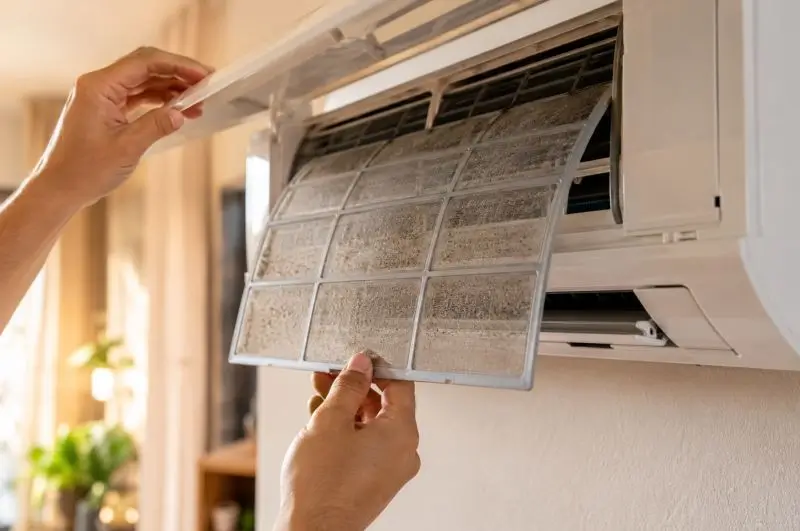
This is the part we actually know cold, so we will be blunt about it: the mesh filter inside your mini split is a comfort filter, not a health filter. It is built to keep dust off the coil so the unit keeps working. It is not built to capture the fine particles that shape what you actually breathe. Filterbuy has made the replacement filters for every major mini split brand for over a decade, and this is the single most common misunderstanding we run into. It is also not our opinion. The EPA says the same thing, on the page cited above.
That gap matters more in New York than most places, because of what people do after the install. The mini split goes in the back bedroom. It is quiet and efficient, so that room's door stays shut and the central system runs less. Nobody decides to lower the filtration in that room. It just happens, quietly, as a side effect of a comfort upgrade.
The mechanics rhyme but the details do not. Home Comfort still requires cold-climate equipment on the NEEP list, still requires a Manual J calculation for ductless mini split projects, and still requires that you buy from and install through a participating Home Comfort Partner. Income-qualified households may access enhanced rebates through Home Comfort Plus. If a page tells a Long Islander to "apply through NYS Clean Heat," that page has not been checked.
Three numbers explain the program, the equipment gate, and the part the rebate ignores. All three come from federal agencies or from the nonprofit that sets New York's equipment standard. None come from a contractor.
82%
of New York homes burn fossil fuel for heat
Natural gas: 4.57 million homes (61%).
Fuel oil or kerosene: 1.25 million homes (17%).
Propane: 320,000 homes (4%).
Electricity: just 16%.
New York's fuel-oil share runs more than four times the national average of 4%.
Why it matters: New York is buying furnace and boiler retirements. A mini split in one room retires nothing. That is also why decommissioning pays the most: 6.1 million homes still have something to decommission.
5°F
the temperature that decides whether your unit qualifies
New York accepts only heat pumps on the NEEP cold-climate list.
That list records maximum heating capacity at 5°F.
HSPF, the standard federal metric, has no test points below 17°F.
HSPF also assumes electric resistance backup, so it cannot describe a New York winter night.
Check your model in three steps:
Go to ashp.neep.org.
Search the outdoor unit's model number.
Read the maximum heating capacity at 5°F. No listing, no rebate.
Why it matters: A high SEER rating buys you nothing here. SEER measures cooling. New York pays for heating.
Source: Northeast Energy Efficiency Partnerships, ccASHP Specification & Product List
MERV 13
the EPA's floor for an HVAC filter upgrade
The EPA advises at least MERV 13, or as high as your system will take.
MERV 13 and above must remove at least 50% of the smallest particles tested.
Most furnaces and HVAC systems handle MERV 13 without trouble, if you change it on schedule.
The same EPA page says wall-mounted ductless units are built for temperature control, not air filtration.
Their filtration is meant to keep the unit clean, not to clean your air.
Why it matters: That is the EPA describing your mini split's mesh filter exactly the way Filterbuy does. A comfort filter, not a health filter. We did not invent the distinction to sell filters. The EPA published it.
Source: U.S. EPA, Guide to Air Cleaners in the Home (updated February 17, 2026)
This is the part we actually know cold, so we will be blunt about it: the mesh filter inside your mini split is a comfort filter, not a health filter. It is built to keep dust off the coil so the unit keeps working. It is not built to capture the fine particles that shape what you actually breathe. Filterbuy has made the replacement filters for every major mini split brand for over a decade, and this is the single most common misunderstanding we run into. It is also not our opinion. The EPA says the same thing, on the page cited above.
That gap matters more in New York than most places, because of what people do after the install. The mini split goes in the back bedroom. It is quiet and efficient, so that room's door stays shut and the central system runs less. Nobody decides to lower the filtration in that room. It just happens, quietly, as a side effect of a comfort upgrade.
Only if it carries your home's full heating load. As of the 2026-2030 program, NYS Clean Heat does not pay for partial-load systems, so a single mini split added to one room is not eligible.
Between $5,000 and $6,000 for a single-family home outside a Disadvantaged Community, depending on your utility. Decommissioning your fossil fuel system raises it to $8,000 to $10,000, and up to $12,000 inside a DAC.
Yes, more than you would think. Category 4 pays $3,000 to $4,000 to bring a partial-load system up to full load, and it requires that the system you already own be NEEP-listed. An unlisted mini split installed today closes that door for as long as it stays on the wall.
Only if it is NEEP-listed and carries a manufacturer's warranty of at least five years on parts, including the compressor. Many budget units ship with three-year warranties, which is a disqualifier on its own.
Not for space heating. New construction is not eligible for air-source heat pump space heating incentives. Existing buildings and gut renovations are.
No. Section 25C expired for equipment placed in service after December 31, 2025.
No. Incentives are filed by an enrolled participating contractor. Self-installed systems are not eligible.
No. New York's 25% credit, capped at $5,000, applies to geothermal heat pumps only.
Use the contractor finder at cleanheat.ny.gov. On Long Island, use PSEG Long Island's Home Comfort Partner list instead.
The property owner typically receives the incentive, since they own the equipment. Tenants generally need landlord participation.
Michelle Wan writes about home air quality and HVAC maintenance for Filterbuy, an American manufacturer that has made air filters in the USA since 2013 and serves more than two million households. She translates technical topics into clear, practical advice for everyday homeowners. This guide was reviewed for technical accuracy by David Clark, a Licensed HVAC Technician at Filterbuy.
Filterbuy does not install mini splits in New York and is not an enrolled NYS Clean Heat participating contractor. Every incentive figure on this page is sourced to the NYS Clean Heat Program Manual, the IRS, or the utilities themselves, and the page was last verified against those sources on July 16, 2026.
NYS Clean Heat Heat Pump Program Manual, Version 2 (March 5, 2026) – incentive categories, amounts by utility, full-load and sizing requirements.
NYS Clean Heat: find a participating contractor – the state's contractor finder.
NYS Clean Heat: rebate finder – address-level lookup of the programs you qualify for.
NEEP Cold Climate Air Source Heat Pump Product List – the equipment gate. Search any model before you buy.
IRS: FAQs on Public Law 119-21 (the One Big Beautiful Bill Act) – the placed-in-service standard and the end of Section 25C.
PSEG Long Island: Home Comfort heat pump rebates – the separate Long Island program.
NYSERDA: Disadvantaged Communities – check whether your address qualifies for enhanced rates.
NYS Public Service Commission, Case 25-M-0248 – the utility filings behind the 2026-2030 program.
U.S. EIA, 2020 Residential Energy Consumption Survey: State Space Heating Fuels – how New York heats its homes.
Northeast Energy Efficiency Partnerships, ccASHP Specification & Product List – why the 5°F standard exists.
U.S. EPA, Guide to Air Cleaners in the Home – MERV 13 guidance, and what ductless units filter.
Filterbuy has manufactured air filters in the USA since 2013. We sell mini split systems and replacement filters, and we ship both nationwide, so we do have a commercial interest in mini splits generally.
What we do not have is a stake in your New York rebate. We do not install mini splits in New York, and we are not an enrolled NYS Clean Heat participating contractor, so we cannot file your incentive application and we do not earn a contractor reward on it.